What do you buy a learner bike for? Well, firstly it must
be to pass your test on - or so one would assume. Second might come the need
to taste what the big, bad world of motorbikes is really like -what it means
to ride a faster bike and have some fun.
The three 125 trailies we tested last month would answer all
these criteria except for a couple of details. For a start, they're damn tall
(due deference here to Caroline Eccles in Write Lines) and so short arses
might have some problems. Their off-road pedigree is good, excellent in fact,
but they're still dirt bikes and can't cut it in looks or performance on the tarmac. In the end, not everyone wants to
look like the after shock of an acid house party.
Honda's much-hyped NSR125R and the cheaper, but similar,
NS125R have attempted to take all the honours in this sector with big bike
looks and some excellent detailing. But sluggish engine feel and performance
has meant that they promise more than they deliver. But all the manufacturers'
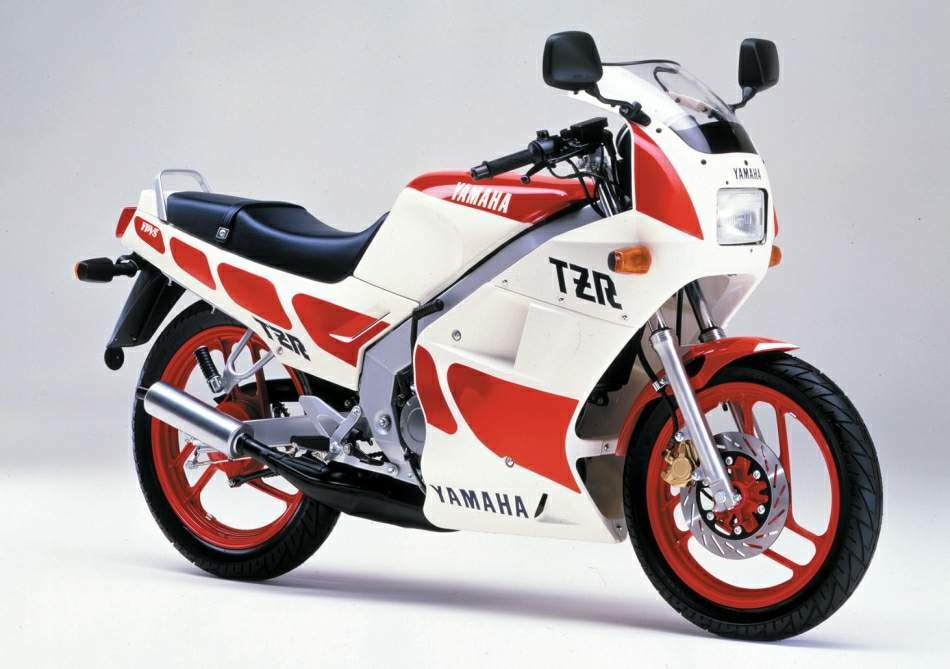
learner sales are down except for one company this year - Yamaha. The TZR125
shows why.
There's nothing very special about this bike compared to its
competitors. They are all limited to the paltry 12hp, they all ape big bike
styling in some way, and it's because of this uniformity that subtle
differences become great ones. In short the TZR125 is more exciting to ride
than its competitors and this must be why it's selling well.
The rider's view is standard - twin clocks, clear but cheap
switchgear, and none too sporting handlebars. The fairing not only looks like
a diminutive FZR from the outside but from above too it shares the big bike's spare, weight saving look
which Yamaha get away with. It'll start nine times out of ten without the
choke which is just as well as this little item is severely hidden away under
the tank on the left. A few minutes warming up and the bike starts to show
signs of things to come.
Unlike Honda's supposed built for only 12hp', the TZR manages to rev through to the red line at 10,500rpm. Power is
maintained all the way through above peak at 7500rpm; below this not much
happens and the TZR is as guilty as the rest of gutlessness below five grand.
Ally this to the less than slick clutch action around the same engine speed
and you have the recipe for a few false starts with a true novice on board.
Still, once you're under way you soon feel at home on the TZR,
the front single 267mm disc doing all asked of it, with some sensitivity too,
and the back 210mm item working well without being too sharp. The steering is light but neutral, although
the skinny bar grips (rather than the riding position) can induce some aches and pains in town. Adding further to the discomfort is
the vibration that the TZR inflicts on you at high revs - in other words at
the 65-70mph cruising speed.
Such a cruising speed is not bad though. The TZR will show
75mph on the clock in the right conditions reflecting its willingness to rev
through rather than cough and splutter like others of the ilk. The suspension
is up to it too. It's all standard stuff with the only the front forks letting
things down over seriously bumpy terrain, the rear monoshock proving very
adept. Indeed, on a smooth surface the only indication that you're on a
learner bike is the limited power which would be useful in picking the TZR out
of a corner. Without careful swapping of cogs the power isn't always there
when needed, leading to oversteer occasionally purely for lack of rear wheel
propulsion.
Finish is good on the diminutive Yamaha. The exhaust system
looks the least hard wearing, which is unfortunate, for anything louder - like
your average after-market jobbie - would be stepping beyond that fine
line of good taste and community care. As it is any wheelie type antics
threaten your place on the Neighbourhood Watch 'Fun-Weekend' Planning
Committee. The TZR is a loud bike - probably another reason why it's selling
well.
But if that's what the boys and girls want, Yamaha are going
to give it to them at the reasonable cost of £1759. The only cheaper race
replica 125 is Kawasaki's ageing AR model, while Honda's and Suzuki's (the
capable RG125 from the latter stable is still popular) offerings are £200 and
£40 more, respectively. The Honda especially seems overpriced at this stage.
The skinny proportions of the TZR make you feel like a racer a
little more than its wider competitors. The tank, seat and bodywork all flow
along without the hint of an unwanted lump or blemish. Indeed the TZR makes
fewer pretensions to being a big bike than some: it's quite happy being a
fast, noisy small bike. Comfort is reasonable, though, and although the bars
skimp on rubber the footrests are veritably obscene in the amount they use to shelter young legs from
vibration. They are largely successful.
Other notable bits on the TZR are the grabrail which works; a
seat that hurts when the weather gets hot; a clunk-ridden gearbox that you get
used to; and lastly, a terrific sense of achievement when some toad pulls
alongside at the lights, sneers, and you manage to lose him on the next bend.
It may not happen, but when it does you get the sense that this is what the
TZR was made for. Kid's stuff really.