|
|
|
|
Classic Bikes
Custom Bikes
Individual
Racing Bikes AJP
AJS
Aprilia
Ariel
Avinton / Wakan
Bajaj
Benelli
Beta
Bimota
BMW
Brough Superior
BRP Cam-Am
BSA
Buell / EBR
Bullit
Bultaco
Cagiva
Campagna
CCM
CF Moto
Combat Motors
Derbi
Deus
Ducati
Excelsior
Fantic
GASGAS
Ghezzi Brian
Gilera
GIMA
Harley Davidson
Hero
Highland
Honda
Horex
Husaberg
Husqvarna
Hyosung
Indian
Jawa
Kawasaki
KTM
KYMCO
Laverda
Lazareth
Magni
Maico
Mash
Matchless
Mondial
Moto Guzzi
Moto Morini
MV Agusta
MZ / MuZ
NCR
Norton
NSU
Paton
Peugeot
Piaggio
Revival Cycles
Roland Sands
Royal Enfield
Sachs
Sherco
Sunbeam
Suzuki
SWM
SYM
Triumph
TVS
Ural
Velocette
Vespa
Victory
Vincent
VOR
Voxan
Vyrus
Walt Siegl
Walz
Wrenchmonkees
Wunderlich
XTR / Radical
Yamaha
Zero
Video
Technical
Manufacturer List Contact
|
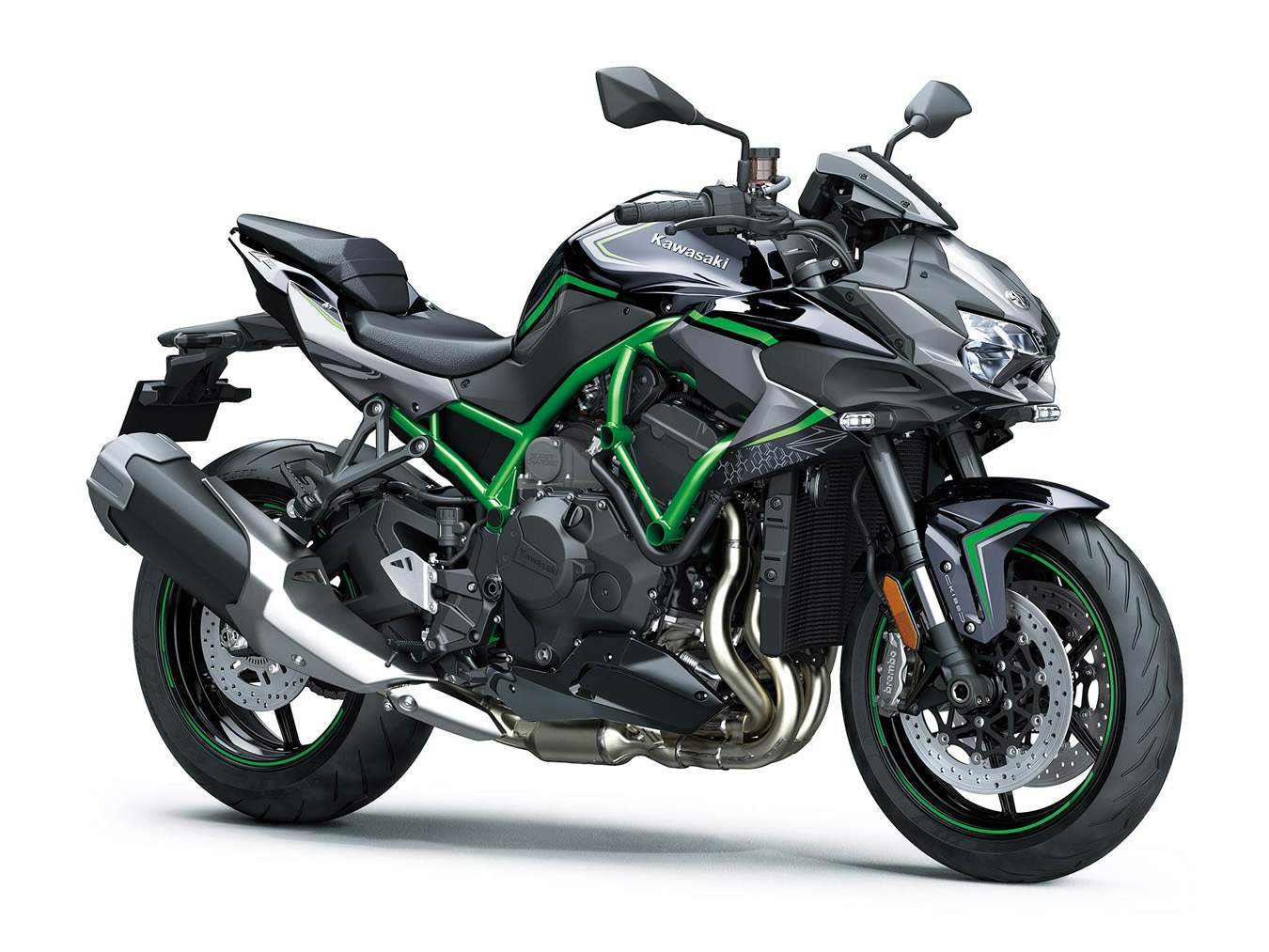
Kawasaki Z H2 |
|
Make Model |
Kawasaki Z H2 |
|
Year |
2020 |
|
Engine |
Four Stroke, transverse four cylinder, DOHC, 16 valve, Supercharger Centrifugal, scroll-type |
|
Capacity |
998 cc / 60.9 cub in |
|
Bore x Stroke |
76 x 55 mm |
|
Cooling System |
Liquid cooled |
|
Compression Ratio |
11.2:1 |
|
Lubrication |
Forced, wet sump with oil cooler |
|
Exhaust |
4-1-2 |
|
Induction |
Fuel-injected with supercharger |
|
Ignition |
Digital |
|
Starting |
Electric |
|
Max Power |
197 hp / 147 kW @ 11000rpm |
|
Max Torque |
137 Nm / 101 lb-ft @ 8500 rpm |
|
Transmission |
6-speed, return, dog-ring |
|
Final Drive |
Chain |
|
Primary Reduction Ratio |
1.480 (74/50) |
|
Gear Ratios |
1st 3.077 2nd 2.471 3rd 2.045 4th 1.727 5th 1.524 6th 1.348 |
|
Final Drive Ratio |
46/18 |
|
Frame |
Trellis, high-tensile steel |
|
Front Suspension |
Showa SSF BP forks |
|
Front Wheel Travel |
120 mm / 4.7 in |
|
Rear Suspension |
Showa shock - Uni Trak |
|
Rear Wheel Travel |
134 mm / 5.2 in |
|
Front Brakes |
2x 290mm discs, Brembo M4 monobloc calipers |
|
Rear Brakes |
Single 226mm disc, 2-piston caliper |
|
Front Tyre |
120/70ZR17 M/C 58W |
|
Rear Tyre |
190/55ZR17 M/C 75W |
|
Rake |
24.9° |
|
Trail |
104 mm / 4.1 in |
|
Dimensions |
Length 2085 mm / 82 in |
|
Wheelbase |
1455 mm / 57.3 in |
|
Ground Clearance |
140 mm / 5.5 in |
|
Seat Height |
830 mm / 32.6 in |
|
Wet Weight |
239 kg / 527 lbs |
|
Fuel Capacity |
19 Litres / 5 US gal |
Here is the U.S.
press release from Kawasaki:
Kawasaki’s legacy of creating motorcycles that have unrivaled performance,
excitement, and Sugomi™ styling continues with an all-new flagship model of the
Kawasaki Z line of naked motorcycles, the 2020 Z H2. With the arrival of the
hypernaked Z H2 and its powerful, balanced supercharged engine, the second
chapter of Kawasaki’s Z history is about to begin and marks the beginning of a
new era.
Featuring a powerful and balanced supercharged engine, performance can be
enjoyed across its entire rev range while still offering superb fuel efficiency.
The innovative new Z H2 offers refined naked styling, a high level of handling
and comfort, plus the latest technology worthy of the new Z series flagship
model.
The Z H2 was developed to deliver the power you desire on-demand, a chassis that
delivers superb maneuverability while harnessing the engine’s incredible power,
comfort that enables you to ride for long distances, and a host of advanced
features designed for maximum functionality. The Kawasaki Z H2 is a truly unique
motorcycle and offers a glimpse of the future.
Engine
The Z H2’s Balanced Supercharged Engine is the product of Kawasaki Group
technology, designed in-house not only by the Motorcycle and Engine Company, but
also with collaboration from the Aerospace Systems Company, Energy System and
Plant Engineering Company, and Corporate Technology Division. Kawasaki created a
supercharged engine with high output, yet manageable power delivery.
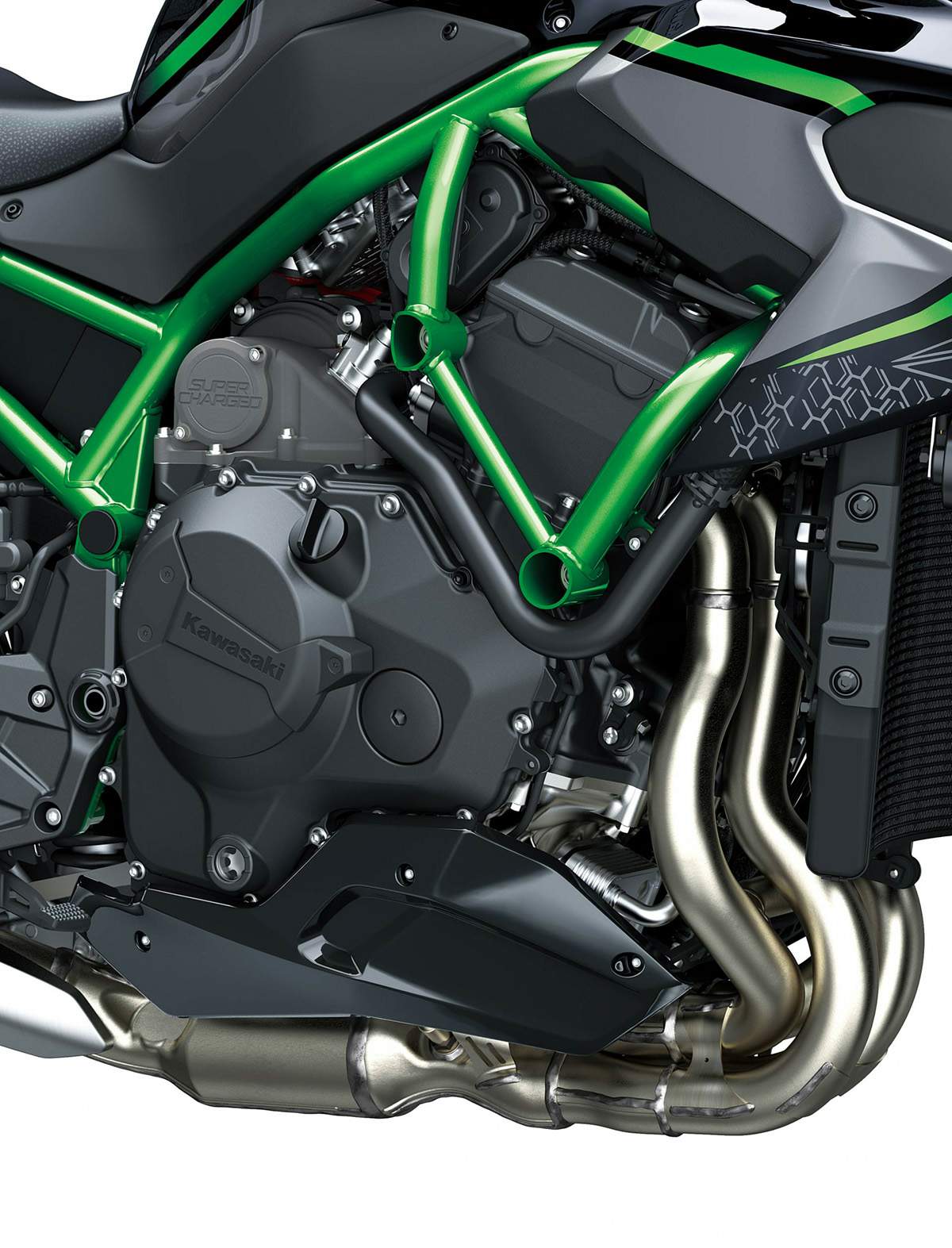
The water-cooled DOHC 4-valve parallel 4-cylinder 998cc supercharged engine of the Z H2 has been tuned to showcase high-performance throughout the rpm range. Its wide powerband creates optimal low-mid range torque for light handling and all out supercharged performance on the top end. Smooth acceleration in the low to mid rpm range was achieved by shortening the second reduction ratio and optimizing the valve timing. In the chamberless exhaust system, an increase in the tube length of the manifold assembly further improves the output in the low to mid rpm range.
Where torque is
more apparent, in the low to mid rpm range, the supercharged engine emphasizes
easy-to-handle throttle response and smooth acceleration, while in the high-rpm
range as the speed increases, the power from the supercharged engine is brought
to the forefront. The Z H2 also features a ram air intake. The air duct provides
a clean path for air flowing linearly from the ram air intake to the
supercharged engine, contributing to higher performance.
The street specific Z H2 supercharger design and tuning were developed by
Kawasaki Heavy Industries, Ltd. (KHI) showcasing the in-house knowledge of
forced induction engine performance. The supercharger’s high efficiency and
minimal heat gain meant an intercooler was unnecessary, allowing savings in both
weight and space. The supercharger is located centrally in the best position to
evenly distribute the compressed air to all four cylinders.
The supercharger is driven by a planetary gear train, which runs off the
crankshaft. The gear train increases the impeller speed up to 9.2x the crank
speed (1.15x step gear with an 8x planetary gear).
Transmission
The Z H2 uses a dog-ring transmission that has been developed through feedback
from the Kawasaki Racing Team and utilizes optimal gear ratios for street
performance. Rather than shifting the gears into place, the gears in this
configuration stay in place, with the lightweight dog-rings moving to engage the
gears. This design allows the shifting effort to be lighter and shorter for
quicker acceleration.
Assist & Slipper Clutch
Complementing the transmission is an Assist & Slipper clutch, race-inspired
technology that offers both a back-torque limiting function as well as a light
feel at the lever.
The Assist function is noticed by the lighter pull at the clutch lever, helping
to reduce rider fatigue especially in stop and go traffic situations.
The Slipper function is noticed when excessive engine braking occurs as a result
of quick or accidental downshifts. The slipper cam comes into play, forcing the
clutch hub and operating plate apart, which relieves pressure on the clutch
plates to reduce back-torque and help prevent the rear tire from hopping and
skidding.
Chassis
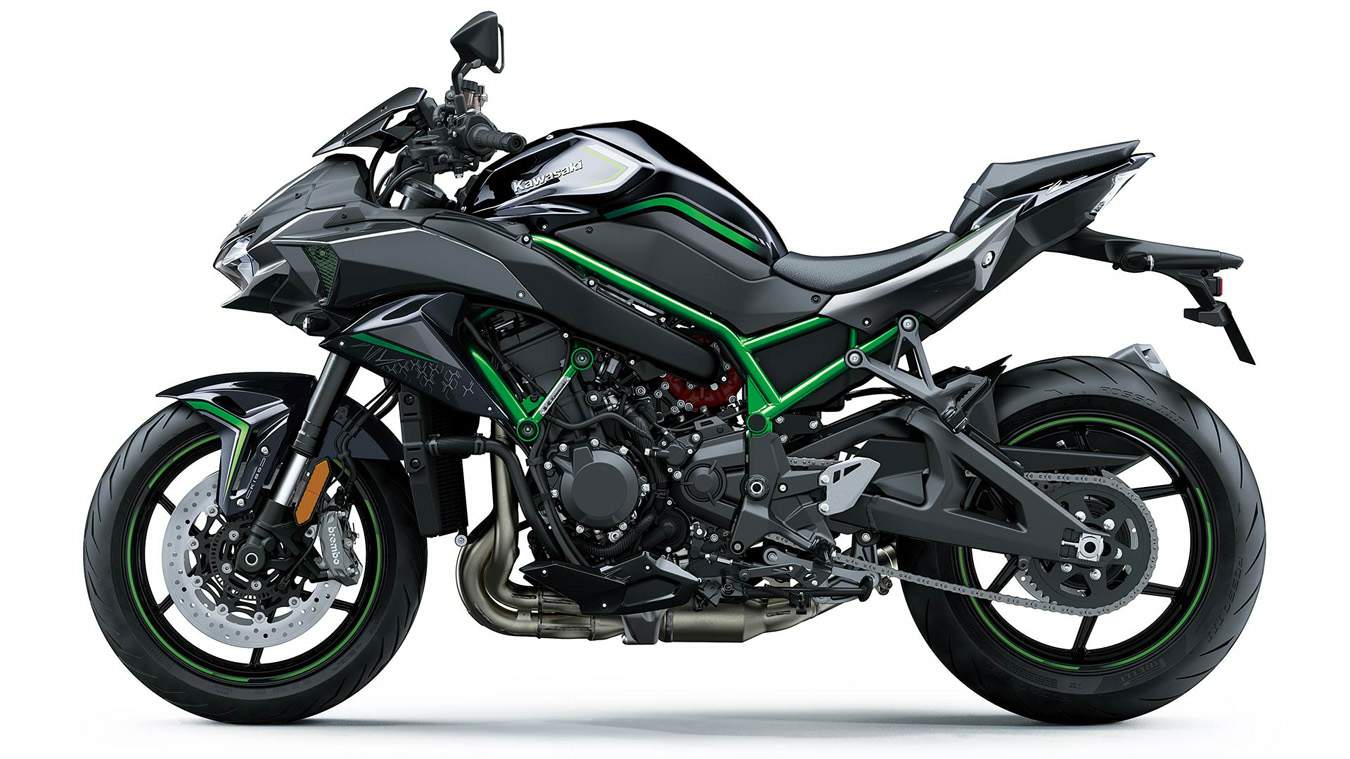
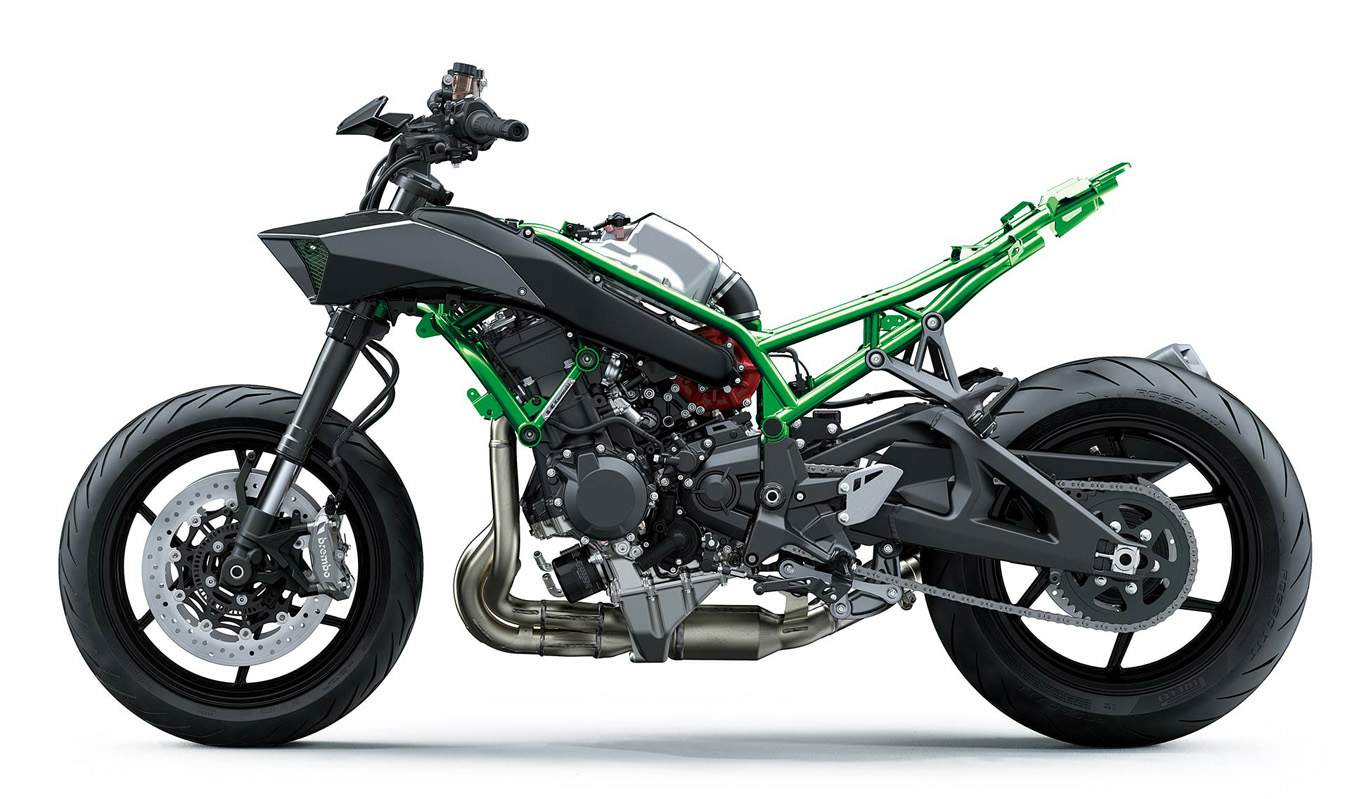
A specially designed, lightweight trellis frame delivers both light handling and
excellent straight-line stability. The chassis offers excellent maneuverability
while harnessing the massive supercharged power of the Z H2 engine. The compact
naked model frame has a high-level of balance between flexibility and toughness
so that you can ride on a variety of roads.
The new high-tensile steel frame utilizes wheelbase and caster angle dimensions
that showcase the light, sporty handling unique to the Z H2. By achieving the
desired riding position and center of gravity, the frame and suspension of the Z
H2 performs well across a range of speeds.
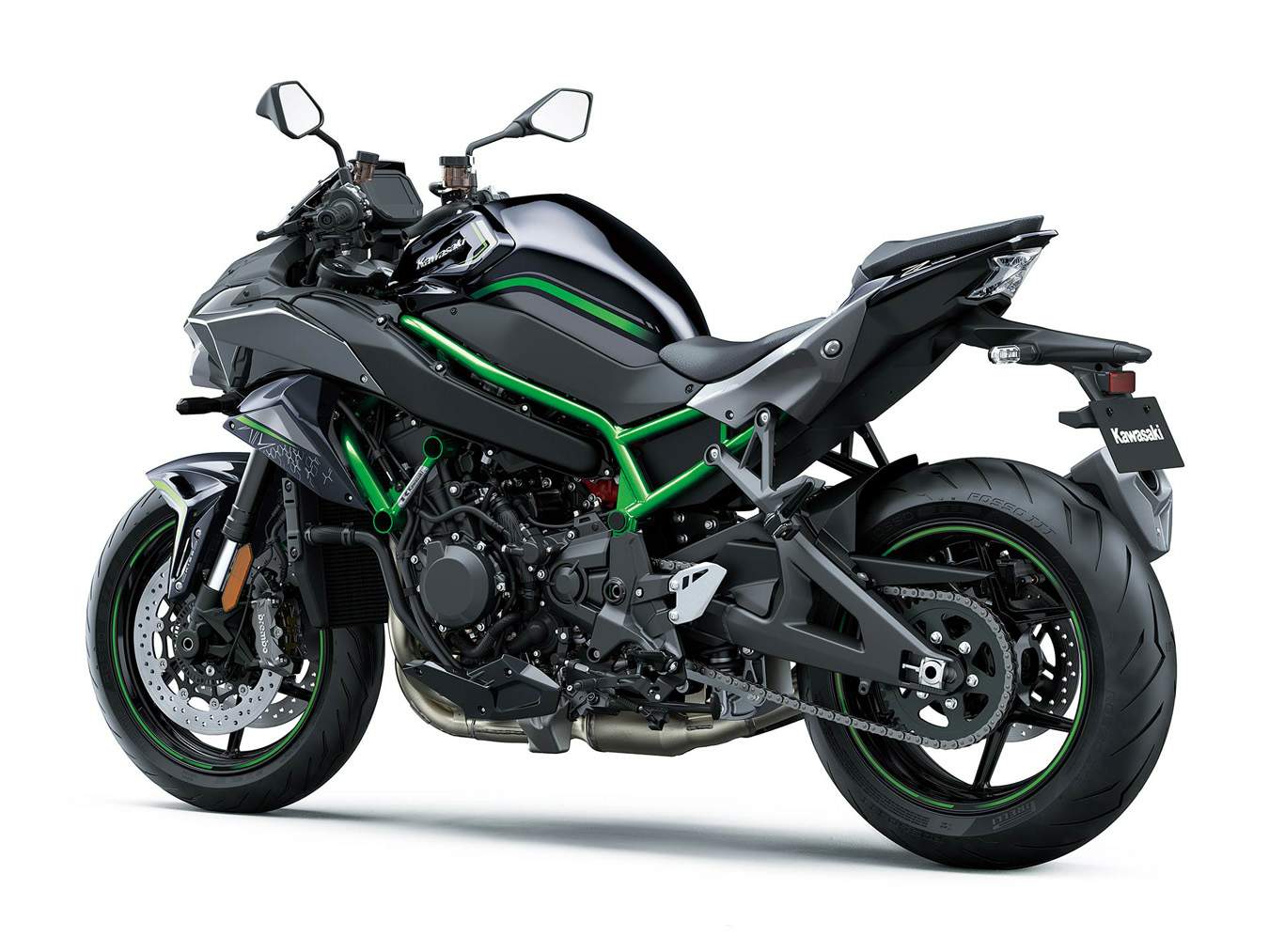
A double-supported style of swingarm was chosen for the Z H2, similar to those
found on Kawasaki supersport models. It offers the high rigidity and lightweight
construction necessary for high performance. The swingarm mounting plate is
located on the back of the engine, enabling it to play the role of a cross
member in the frame, contributing to rigidity and weight reduction.
Suspension
Complementing the chassis design, the Z H2 motorcycle is equipped with the Showa
SFF-BP (Separate Function Fork – Big Piston) fork. Combining the concepts of
Showa SFF and BPF, this advanced fork offers both racetrack performance and
everyday usability.
The Showa SFF-BP offers smooth action at the beginning of the stroke that
contributes to excellent composure under braking. The large-diameter damping
piston is much larger than what is found in a cartridge-type fork of the same
size. The result is greater control as the fork begins to compress and a very
calm attitude change as vehicle weight shifts forward when reducing speed,
offering greater chassis stability on corner entry. The settings can be adjusted
according to the rider’s size and the riding conditions.
The rear is held up by a Uni-Trak® swingarm system and Showa shock. This
combination ensures performance in all speed ranges and achieves a strong
withstanding force by maintaining hold in the suspension stroke even under
high-adrenaline riding.
Brakes & Wheels
The Z H2 pursues ease of handling from low and medium speeds up to high speeds,
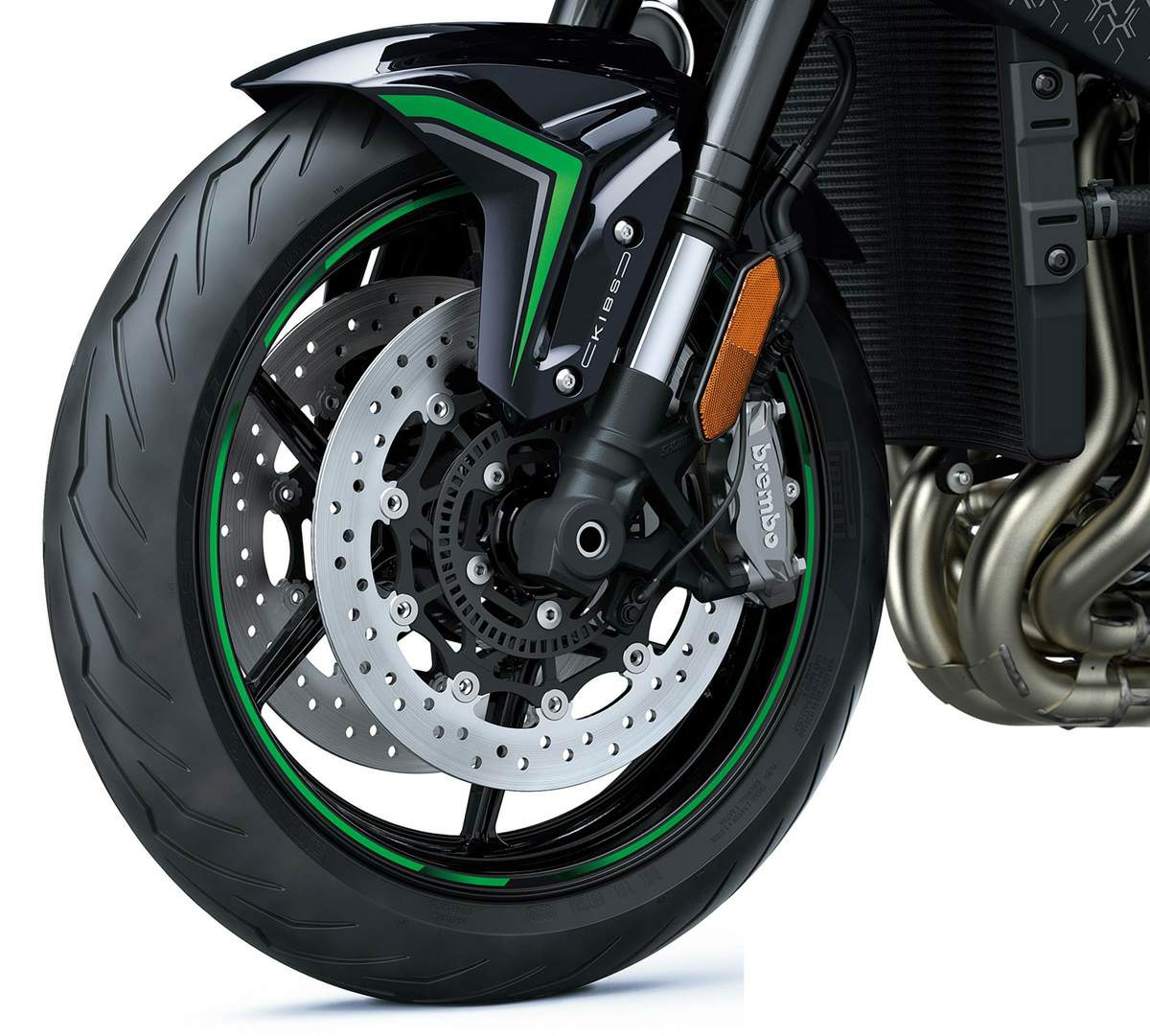
and for that reason, a high performance brake system is required. On the front,
Brembo monobloc calipers are used and consist of a highly rigid one-piece
structure that is machined from a cast aluminum block, boasting a strong braking
force. Radially mounting the caliper provides even higher levels of performance.
Nissin master cylinders provide excellent functionality suitable to the
characteristics of the Z H2 by applying Kawasaki’s unique settings. Deceleration
can be controlled from various speed ranges as well as controlling the starting
point for changing body posture when needed.
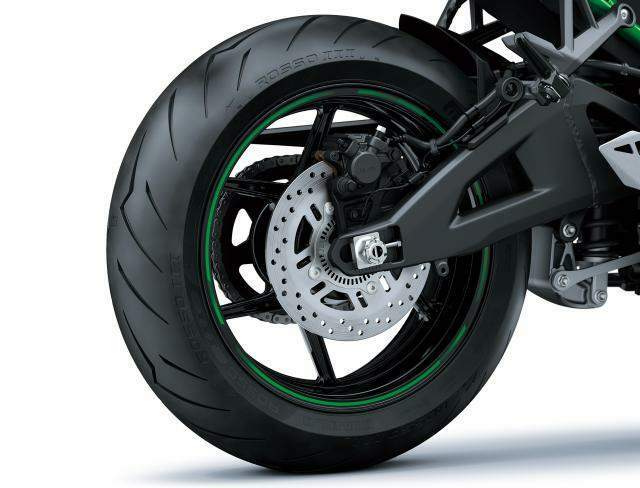
The lightweight 17” wheels are equipped with Pirelli Diablo Rosso III tires,
front and rear. The front tire is a 120/70ZR17 M/C 58W; the rear tire is a
190/55ZR17 M/C 75W.
Ergonomics
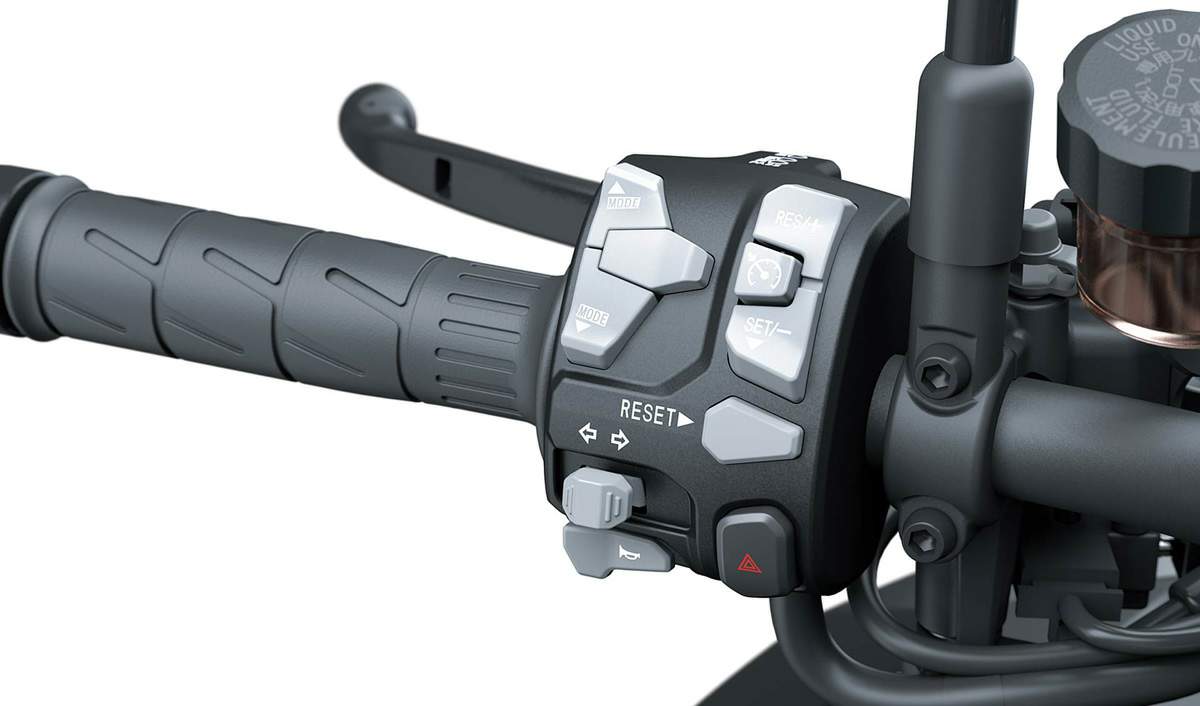
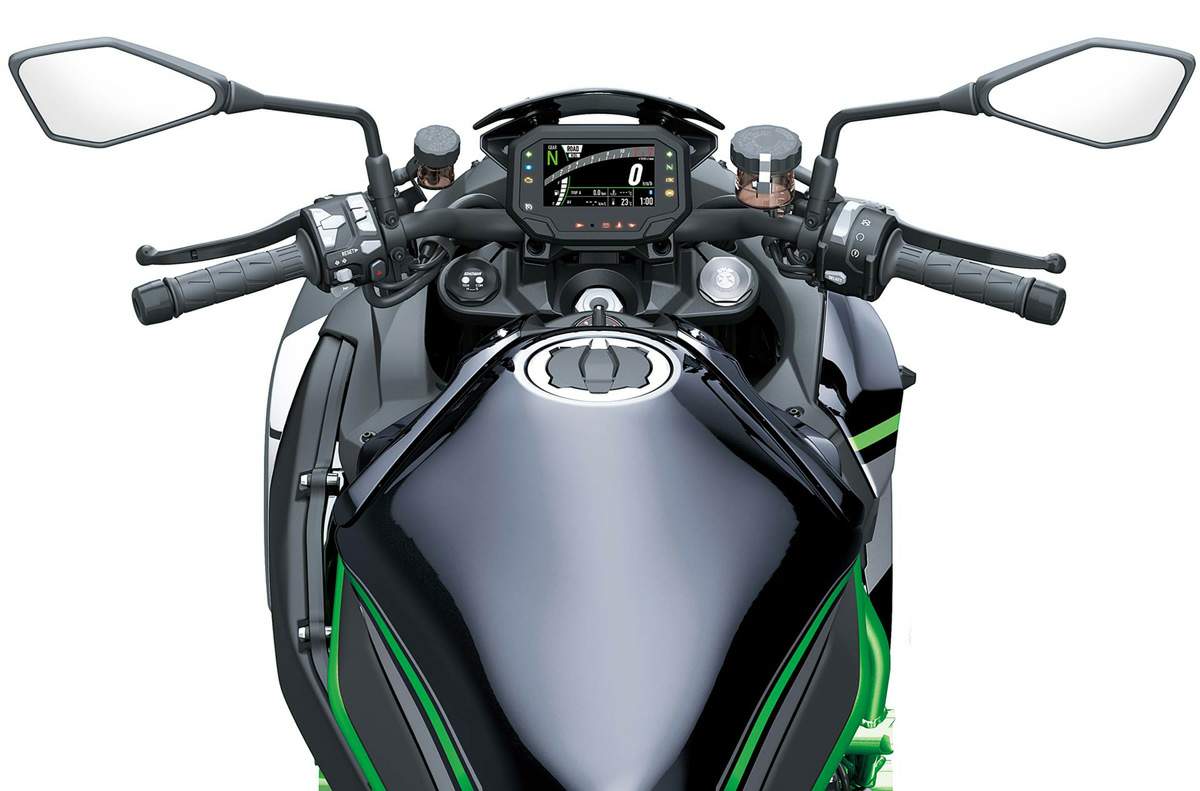
A relaxed riding position has been created by a combination of an upright
handlebar shape and a seat with an optimized base plate and cushion thickness.
This design provides a high degree of freedom for riding posture and low
vibration, allowing for a pleasant and comfortable ride. Adding to the Z H2
motorcycle’s comfort and strength is a fat-type handlebar and handle switches.
Electronics & Rider Aids
The strength of Kawasaki’s cutting-edge electronics has always been the highly
sophisticated programming that uses minimal hardware to give the ECU an accurate
real-time picture of what the chassis is doing and what the rider wants, to best
support the rider’s inputs with a natural feel. Using the latest evolution of
Kawasaki’s advanced modeling software including input from a compact Bosch IMU
(Inertial Measurement Unit), Kawasaki Cornering Management Function (KCMF)
monitors engine and chassis parameters throughout the corner to assist riders in
holding their intended line through the corner. The Z H2 utilizes the input from
multiple sensors to optimize ride quality via the Kawasaki TRaction Control (KTRC),
Kawasaki Launch Control Mode (KLCM) and the Kawasaki Intelligent Anti-Lock
Braking System (KIBS).
Electronic Cruise Control
The Z H2 is equipped with electronic cruise control, which improves the overall
comfort for those long days on the road. The cruise control system enables
riders to set and maintain their desired speed with the simple press of a
button. Once activated, the rider does not have to constantly apply the throttle
to maintain speed. The cruise control helps to reduce ride fatigue when
traveling long distances, allowing the rider to relax and enjoy cruising,
contributing to a high level of riding comfort.
KQS (Kawasaki Quick Shifter)
The Z H2 features a highly reliable contactless-type quick shifter that allows
for ultra quick, full power upshifts and seamless acceleration. The system
detects that the shift lever has been actuated, and sends a signal to the ECU to
cut ignition so that the next gear can be engaged for clutchless shifting.
Power Mode Selection
Riders can set power delivery to suit conditions and/or preference, choosing
from Full, Middle and Low. Middle Power is 75% of Full Power, while Low Power is
50% of Full Power.
Styling
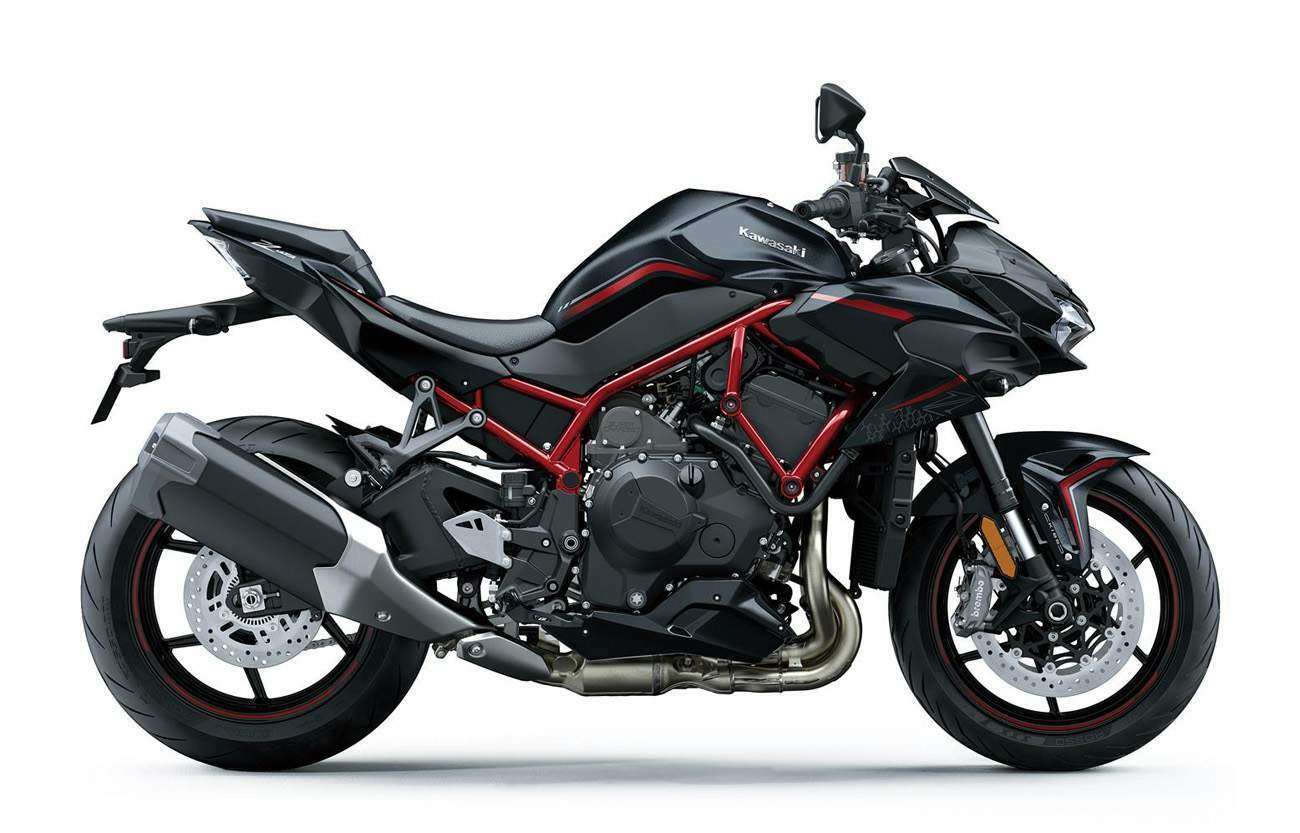
The styling of the Z series flagship Z H2 has been shaped according to Sugomi
design concept and the minimalist bodywork that Kawasaki’s Z series lineup of
motorcycles is known for. Sugomi describes the unique aura that radiates from
beings possessing compelling presence and unrivalled power. Featuring a low
crouching stance and the asymmetry of the air intake duct installed on the left
side of the vehicle body, the Z H2 intensely and aggressively emphasizes the
identity of Sugomi design. Only the air intake duct and the under cowl are
asymmetrical, all other design work represents accurate symmetry, giving the Z
H2 a well-balanced and highly harmonious design.
The supercharger housing is visible from the outside thanks to the naked model
concept that does not have a cowl covering the motorcycle’s body. Providing a
glimpse of the supercharger between the frame makes for a more impressive
appearance.
The Z H2 is equipped with an LED headlight and taillight. The bulbs low power
consumption and high durability improve maintainability while providing
high-light intensity and high illumination. A clean headlight beam spread
contributes to visibility of the rider’s surroundings. The frame-mounted
headlamps also influence the styling around the front and create an innovative
look that is different from previous naked models.
TFT Color
Instrumentation
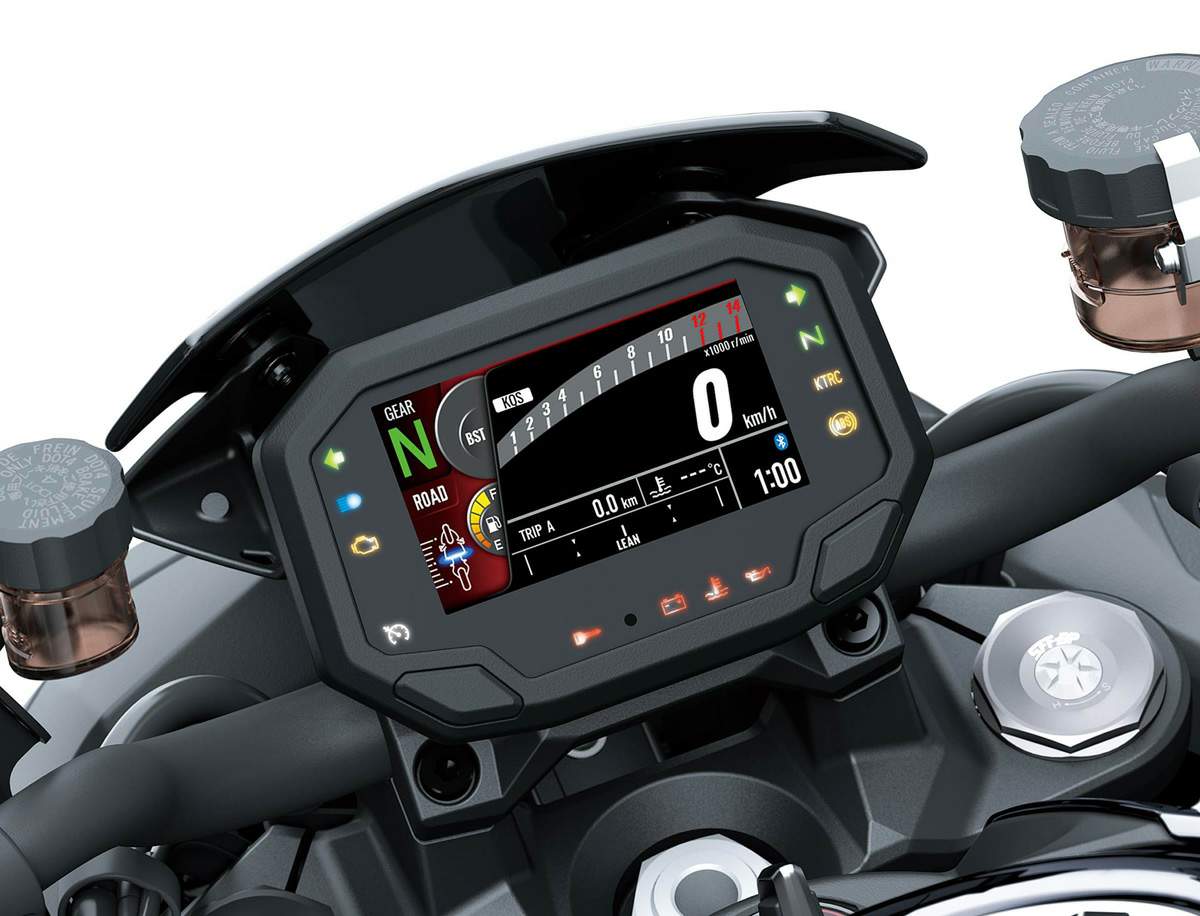
The 4.3” all-digital TFT color instrumentation gives the cockpit of the Z H2
motorcycle a high-tech, high-grade appearance. The full-color display features
TFT (thin-film transistor) technology and delivers a high level of visibility.
Display functions include: digital speedometer, gear position indicator, shift
indicator, odometer, dual trip meter, fuel gauge, remaining range,
current/average fuel consumption, outside temperature, coolant temperature,
clock, Economical Riding Indicator, IMU indicator, KIBS indicator, boost
pressure and boost temperature.
Smartphone Connectivity
Kawasaki continues to offer its Z lineup the addition of Smartphone
Connectivity. A chip built into the instrument panel enables riders to connect
to their motorcycle wirelessly. Using RIDEOLOGY THE APP*, a number of instrument
functions can be accessed, logged, and reviewed contributing to an enhanced
motorcycling experience. The following information can be viewed:
Vehicle Info
- Check
latest status update
Riding Log
- Can be
logged in detail, and played back for review
- Route, Distance & Time traveled can be logged for review
- Riding conditions can be recorded in detail
Telephone Notifications
- Provides a notification on dash when a call or mail is received by smartphone
Tuning
- General instrument display setting changes can be made on your smartphone
- Kawasaki Riding Management modes can be set
The app can also be used when away from the motorcycle. When riding (with the
app ON), the bike and smartphone are always connected and riding log data is
being recorded by the app. After ride is complete, the latest riding information
is stored by the app and may be viewed on the smartphone. Any changes made via
the app while the engine is off, or while out of range, will be implemented as
soon as the ignition is turned on and the smartphone is in range with the app
ON.
* RIDEOLOGY THE APP is not intended for use during vehicle operation. Only use
RIDEOLOGY THE APP when the vehicle is not being operated and it is safe to do
so.
Highlights of the 2020 Z H2
Powerful 998cc Balanced Supercharged Engine
Effortless Dog-Ring Transmission
Specially Designed, Lightweight Trellis Frame
High-Performance Showa Suspension Components
Brembo® Monobloc Brake Calipers
Aggressive Sugomi™ Styling and Minimalist Bodywork
LED Lighting
All-Digital TFT Color Instrumentation
Smartphone Connectivity via RIDEOLOGY THE APP
State-of-the-Art Electronics (IMU Electronics Package, Integrated Riding Modes,
Power Mode, KTRC, KCMF, KIBS, KLCM, KQS, Electronic Cruise Control, Assist &
Slipper Clutch)
The 2020 Kawasaki Z H2 will be available in Metallic Spark Black/ Metallic
Graphite Gray/ Mirror Coated Spark Black
|
Any corrections or more information on these motorcycles will be kindly appreciated. |