|
|
|
|
Classic Bikes
Custom Bikes
Individual
Racing Bikes AJP
AJS
Aprilia
Ariel
Avinton / Wakan
Bajaj
Benelli
Beta
Bimota
BMW
Brough Superior
BRP Cam-Am
BSA
Buell / EBR
Bullit
Bultaco
Cagiva
Campagna
CCM
CF Moto
Combat Motors
Derbi
Deus
Ducati
Excelsior
Fantic
GASGAS
Ghezzi Brian
Gilera
GIMA
Harley Davidson
Hero
Highland
Honda
Horex
Husaberg
Husqvarna
Hyosung
Indian
Jawa
Kawasaki
KTM
KYMCO
Laverda
Lazareth
Magni
Maico
Mash
Matchless
Mondial
Moto Guzzi
Moto Morini
MV Agusta
MZ / MuZ
NCR
Norton
NSU
Paton
Peugeot
Piaggio
Revival Cycles
Roland Sands
Royal Enfield
Sachs
Sherco
Sunbeam
Suzuki
SWM
SYM
Triumph
TVS
Ural
Velocette
Vespa
Victory
Vincent
VOR
Voxan
Vyrus
Walt Siegl
Walz
Wrenchmonkees
Wunderlich
XTR / Radical
Yamaha
Zero
Video
Technical
Manufacturer List Contact
|
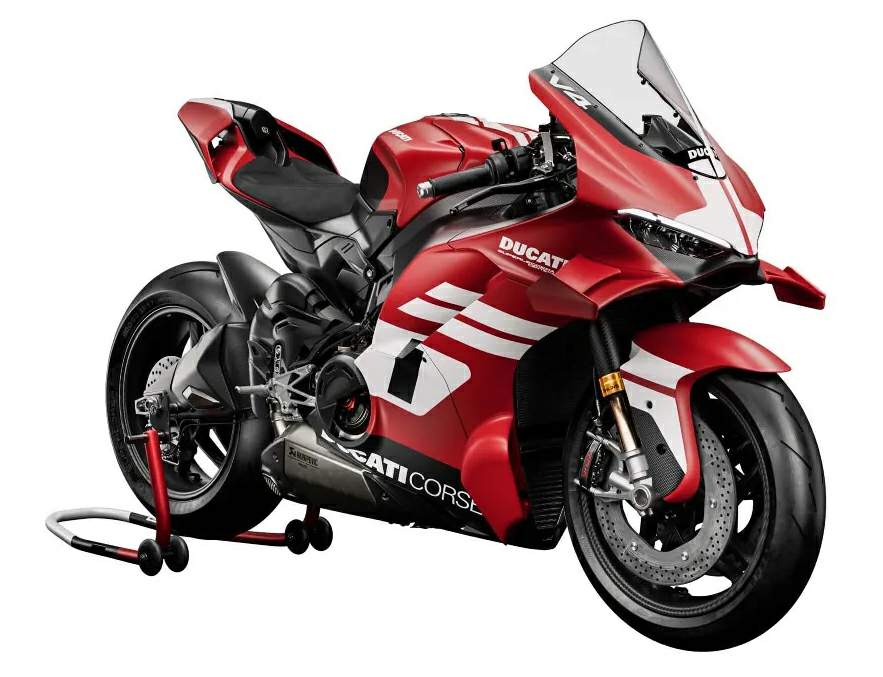
Ducati Superleggera V4 Centenario
From a press release issued by Ducati: Since its inception, Ducati has been working with one conviction: limits are not an obstacle, but a starting point. In this century of history, the Borgo Panigale-based manufacturer has created motorcycles that surpass and redefine expectations, the result of passion, vision, engineering rigor, and determination. And when the motorcycle is a Superleggera, the mission is always the same: to create the motorcycle of dreams, without limits and without compromise. Not a mere exercise in style, nor a prototype, but the desire to transform freedom into engineering. In its centenary year, which brings together a century of moments that have marked the history of the Borgo Panigale manufacturer, Ducati presents the most extreme road bike ever developed: the new Superleggera V4 Centenario.
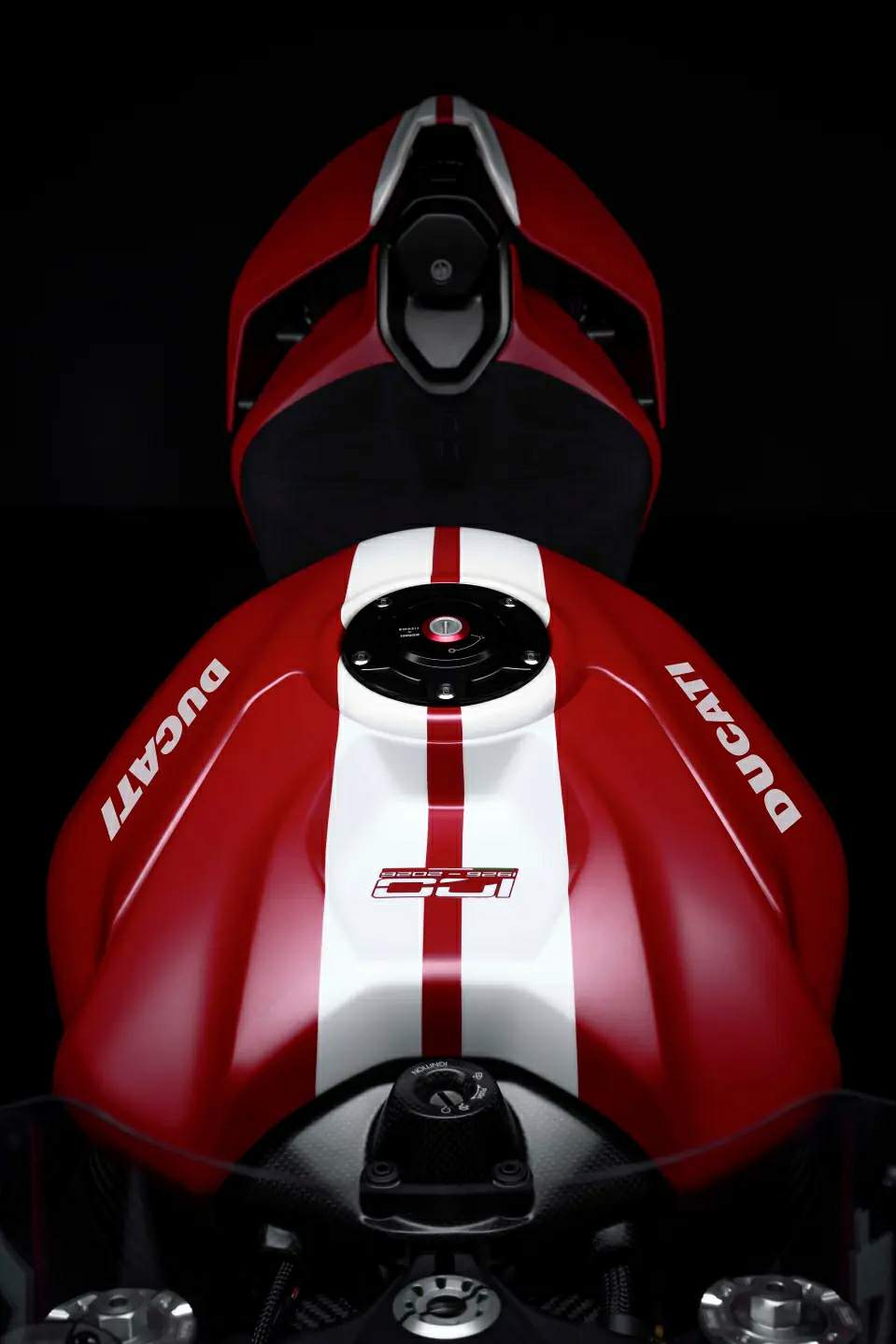
Superleggera bikes are created when Ducati engineers are given total freedom. No constraints. No compromises. Just the goal of creating the road-legal super sportbike that all enthusiasts dream of. Every Superleggera pushes the technological boundaries of the motorcycle world. It brings solutions never seen on a production bike. It opens up new avenues. It changes the rules. The Superleggera V4 Centenario is based on the seventh generation of Ducati's Superbike, features a fully carbon-fibre chassis, and marks the debut of the first carbon-ceramic braking system and a fork with carbon-fibre stanchions ever fitted to a road-legal motorcycle. It is the first to use a fork with carbon-fibre sleeves and is also the first to produce 228 horsepower (Euro %+ configuration), which increases to 247 horsepower with the racing exhaust. The wet weight without fuel is just 381 lb, dropping to 368 lb when fitted with the standard racing kit. Every fibre of its carbon, every screw, every tiny choice is aimed at the pursuit of perfection. The closest thing to the impossible we have ever dared to create. To date, Ducati is the only company in the world that has produced motorcycles like this. Limited-edition collector's items are highly sought after by collectors worldwide. True unicorns of motorcycling, created for those who understand that owning a Superleggera means much more than owning a motorcycle. This happened in 2013 with the first 1199 Superleggera, the first motorcycle to feature a magnesium-alloy frame, swingarm, and wheels. The limits were pushed again with the 2016 1299 Superleggera, the world's first motorcycle to feature a carbon-fibre chassis. The bar was raised even further with the 2020 Panigale V4 Superleggera, the motorcycle that took aerodynamics to the extreme, and now, with the Superleggera V4 Centenario, Ducati is rewriting the rules of what is possible on a production motorcycle. In addition to the 500 Superleggera V4 Centenario bikes, there are 100 Superleggera V4 Centenario Tricolore bikes to further mark this historic milestone for the Borgo Panigale-based manufacturer. The livery creates a link between tradition, the present, and the future, combining the vision of new technologies with the colours of tradition. The livery celebrates the legacy of the 750 F1 Endurance Racing, the last “classic” two-valve racing model and one of the most iconic and rare Ducati's of the 1980s. The Tricolore colours that once dominated the racetracks are revisited in a revamped design that combines retro charm and modernity. The result is a highly evocative livery, created for those who love the authentic spirit of past glories without sacrificing today's style and technology.
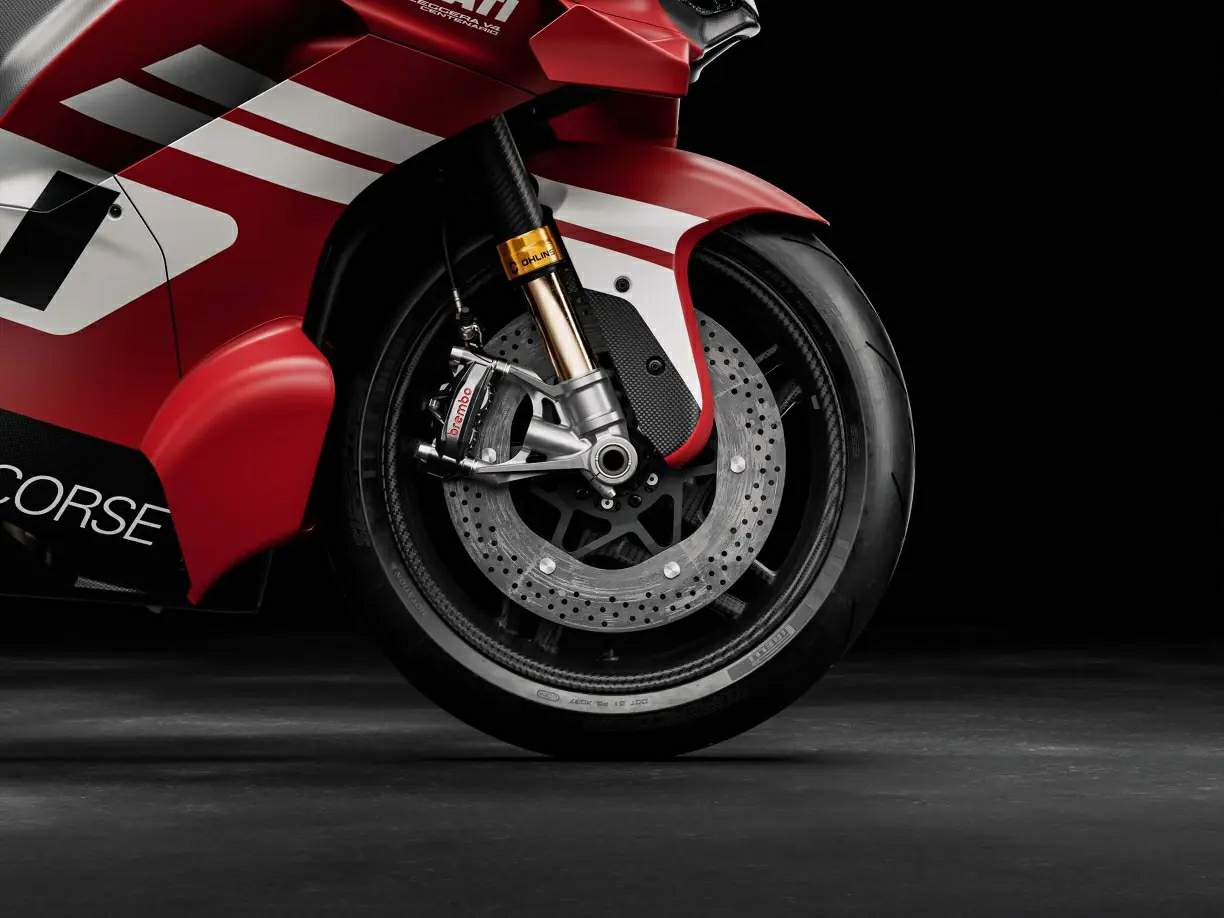
MotoGP Experience MotoGP-derived brakes and suspension The system also includes new Brembo GP4-HY monoblock boosted callipers machined from solid aluminium, with integrated cooling fins and differentiated 30 and 34 mm pistons. The callipers use an anti-drag system that completely releases the disc when the rider releases the lever, eliminating residual torque and thus improving smoothness when entering corners. The pads are specifically designed to work with the carbon-ceramic surface, ensuring precision and modulation under all conditions. The suspension also sets a new world first: the Superleggera V4 Centenario is the first road bike to feature the pressurized Öhlins NPX 25/30 Carbon fork with carbon fiber sleeves made from unidirectional layers to achieve maximum weight savings compared to conventional production. The weight saving compared to the Panigale V4 R is 8%, rising to 10% compared to the standard Panigale V4, with a tangible improvement in direction changes and front-end sensitivity. The mechanical fork, designed to minimize weight, keeps the cartridge pressurized, reducing cavitation and providing more consistent support during braking and corner entry. At the rear, the Öhlins TTX36 GP LW shock absorber features a special steel spring for maximum lightness and MotoGP-derived valves that enhance the rear wheel's ability to trace small road imperfections and improve small-bump control, with easy, tool-free hydraulic adjustment. The suspension linkages are made of titanium, again for maximum lightness. A combination that brings MotoGP suspension to enthusiasts.
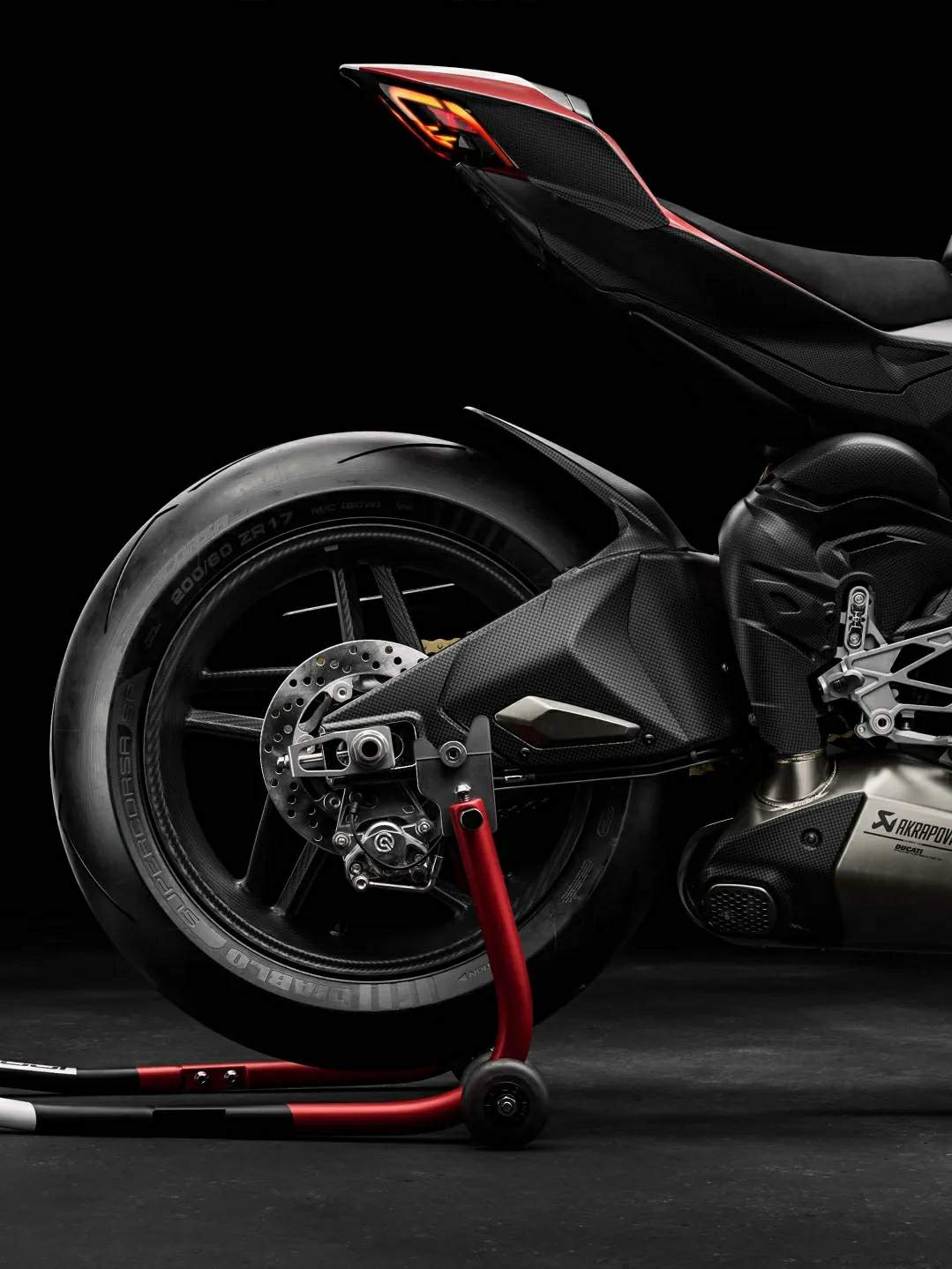
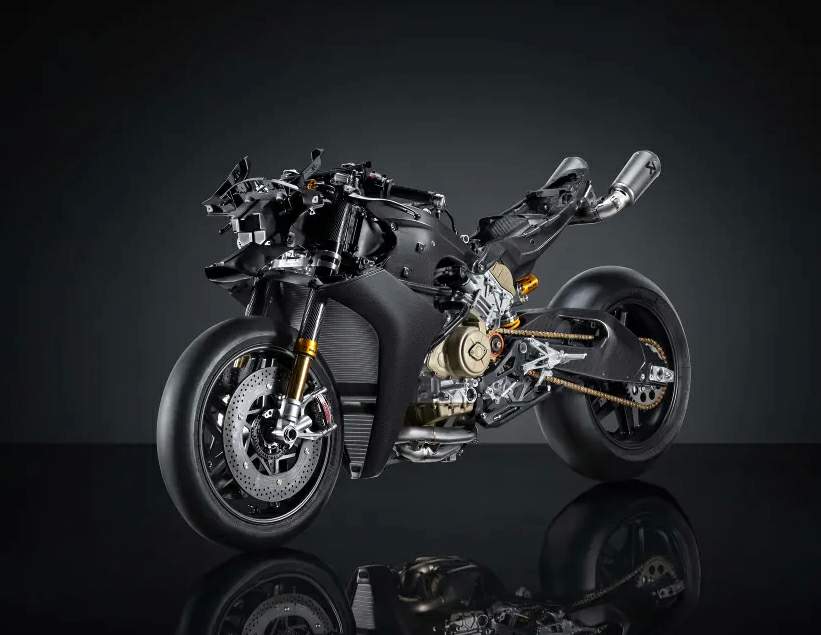
Carbon fibre chassis The carbon front frame weighs 17% less than the aluminum one on the Panigale V4, offering calibrated stiffness to improve cornering grip and the natural tendency to close the line. The swingarm is manufactured using a sacrificial mandrel process, which enables a very light monolithic structure. Compared to the aluminium component, it is 21% lighter while maintaining equivalent lateral and torsional stiffness, ensuring maximum grip out of corners. Every single element of the chassis has been designed for maximum lightness, with absolute determination. The five-spoke wheels are almost 300 grams lighter than those of the Panigale V4 S Carbon, the front subframe weighs 200 grams less, and the rear monocoque reduces weight by 3 lb. The result is a weight of only 381 lb in road configuration, which drops to 368 lb when fitted with the standard-supplied racing kit. To ensure the highest structural quality, every single carbon fibre component in each Superleggera is inspected using three different non-destructive testing methods: Transient Active Thermography, Phased Array Ultrasonics, and Computed Axial Tomography. This is the same process used in the aerospace industry, and one that Ducati has employed on all Superleggera models since the 1299.
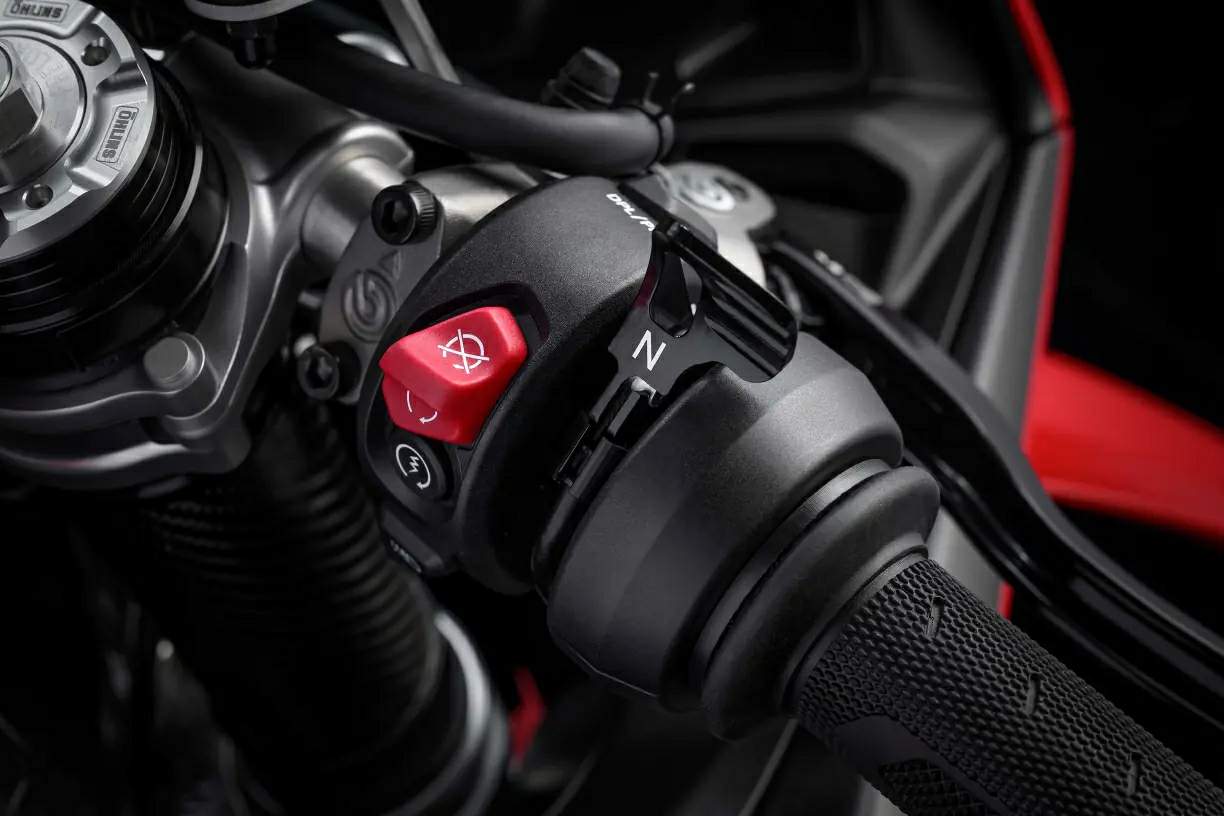
The engine is 8 lb lighter than the 1,103-cc unit of the Panigale V4 with dry clutch. The reduction is due to the use of titanium, lighter screws and redesigned internal components to reduce rotating masses. The two-ring pistons (one ring and one scraper) use “box-in-box” technology and feature an oversized piston pin to handle the increase in power. The cylinder heads retain the same configuration as the 998 cc Desmosedici Stradale R engine, with 34 mm titanium intake valves and 27.5 mm steel exhaust valves. All sixteen valves use titanium semi-cones, a solution typical of competition engines. The timing of the Desmodromic system is manually set and certified by a plate signed by the technician who performs the check. Craftsmanship excellence is applied to cutting-edge technology. The crankshaft has been lightened by replacing the steel counterweights with tungsten inserts. Tungsten is much denser than steel, which allows the same balancing effect to be achieved using smaller, more compact inserts, particularly when positioned in the outermost areas, i.e. at high radius, where their effect is greatest. The result is faster revving and more immediate throttle response, while reducing stress on the bearings and other mechanical components and maintaining the strength needed to withstand the power level achieved. The engine breathes through oval throttle bodies measuring 56 mm, larger than the 52 mm of the Desmosedici Stradale. The trumpets are fixed to reduce weight and optimized with different lengths (20 mm on the left, 10 mm on the right) to improve flow. The upper injectors have improved atomization thanks to the tip that brings the spray closer to the duct. The exhaust system uses titanium manifolds with an increased diameter of 41.7 mm and an approved Akrapovič silencer. The transmission relies on the Ducati Racing Gearbox, with neutral positioned under first gear instead of between first and second. This solution, thanks to the Ducati Neutral Lock (DNL) system, eliminates the possibility of accidentally engaging neutral and finding yourself without engine braking in the final, most delicate phase of braking when entering corners in first gear. Furthermore, the absence of a neutral between first and second gear makes shifting between these two gears faster, smoother, and more repeatable than with a traditional gearbox configuration. The chain is a DID ERV7, the same used by Superbike Factory teams, which on the Superleggera V4 Centenario works on an Ergal sprocket. This choice allows for a reduction of 1.5 lb compared to the Panigale V4 S components.
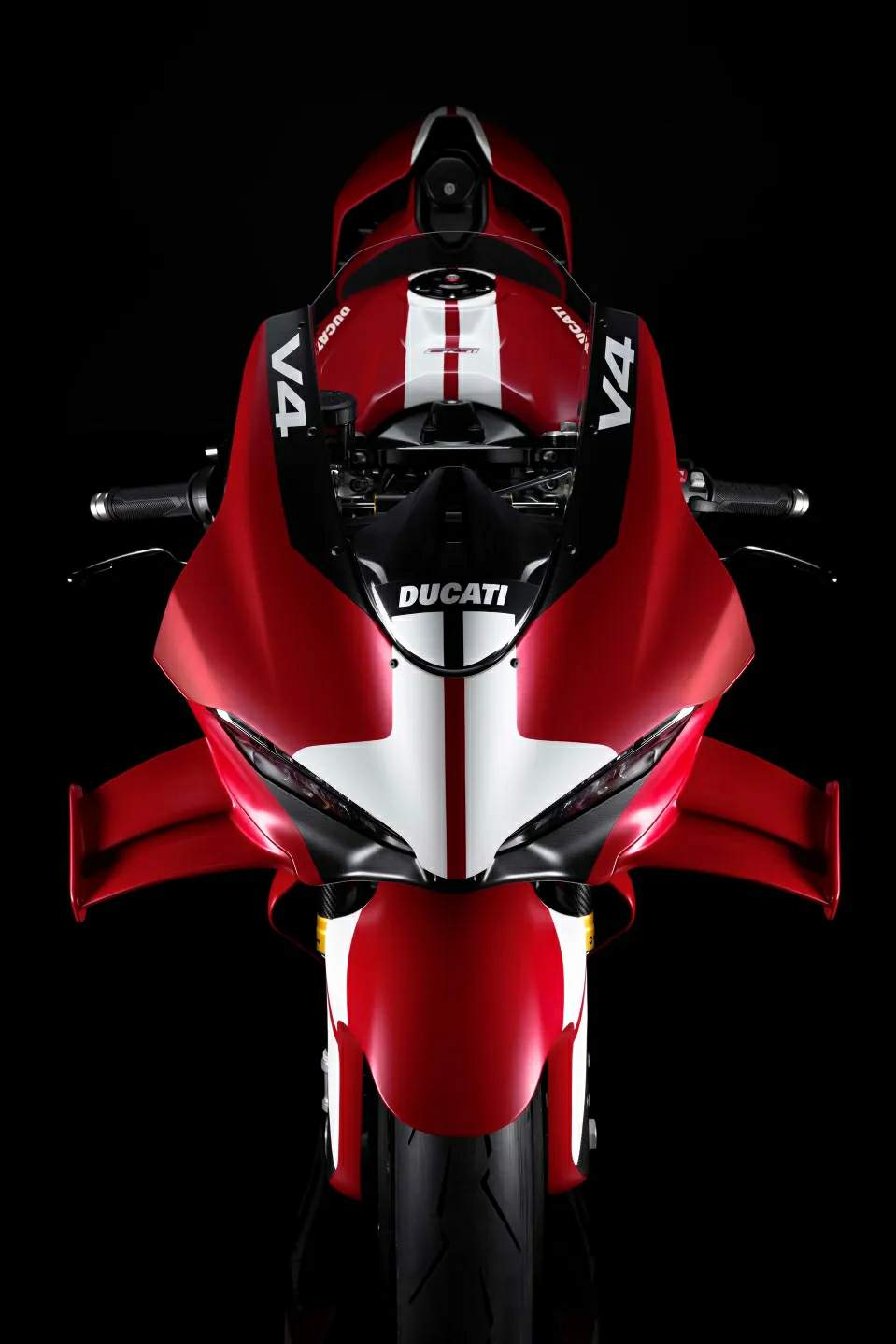
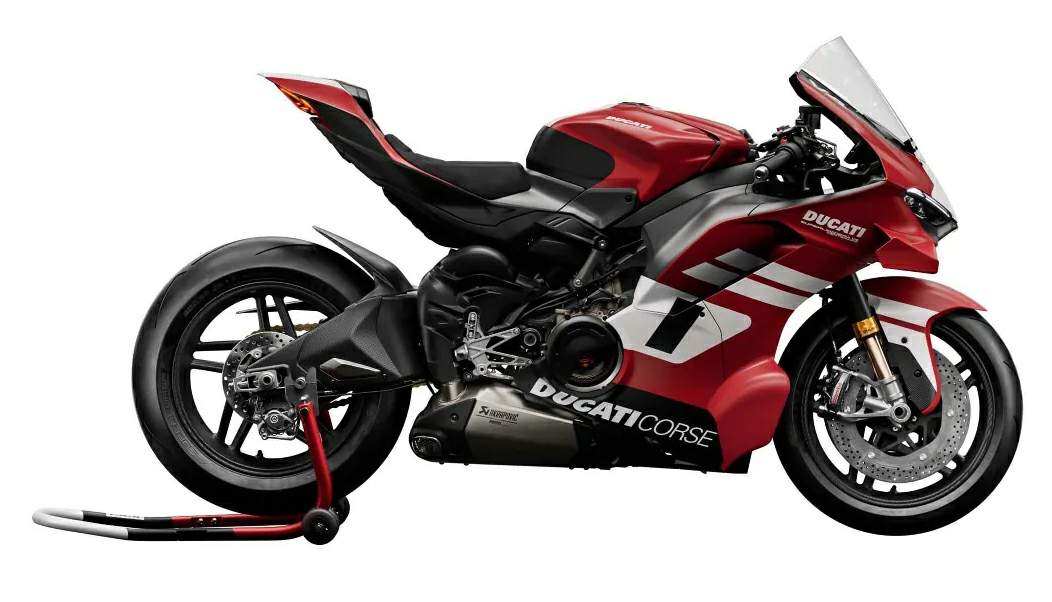
Beauty designed by the wind The fairing of the Superleggera V4 Centenario is made entirely of carbon fibre and left partially exposed to highlight the material's purity. Of course, to minimize weight, the Superleggera is equipped with many other carbon-fibre components: mudguards, tank cover, rad-duct, sprocket cover, heel guards, steering splash guards, seat base, intake duct, license plate holder, and rear bank cover. The radiator cap, footrest plates, accessory fuel tank cap, and, of course, the upper and lower steering plates are made of billet aluminium. The former is further highlighted by the lasered model number (XXX/500), in the dedicated dashboard animation and on the titanium insert of the ignition key, reminding you of the exclusivity of a limited series every time you look at it. The GP26 livery combines Ducati's iconic white stripes with
the new matt Rosso Centenario red. A dark red, like that of its origins: from
the red of the 1949 Ducati 60, the first complete motorcycle that marked
Ducati's entry among motorcycle manufacturers, to that of the 1955 Gran Sport
'Marianna', the first Ducati designed for racing, signed by engineer Fabio
Taglioni. It was the GP26 livery of the Superleggera V4 Centenario that inspired
that of the official Desmosedici bikes of the Lenovo team. Ducati Traction Control (DTC) DVO, Wheelie Control (DWC) DVO, Slide Control (DSC) and Ducati Power Launch (DPL) DVO offer more precise management thanks to new algorithms. Cornering ABS now includes, in addition to RaceBrake Control and Road eCBS strategies, the new Engine Brake Control DVO, which introduces the Dynamic Engine Brake (DEB) function. The latter automatically adjusts engine braking forces by also using the rear brake, optimizing available grip under braking based on the rear-wheel load. In addition, DEB improves braking performance during corner entry by using the rear brake even when the front brake is released, as professional riders use this method manually. This allows even less-experienced riders to focus only on the front brake during corner entry. By applying rear during corner entry, this allows riders to tighten the line, improving their confidence during this critical phase. The collectors' specials of the Superleggera V4 Centenario The special equipment, which includes the racetrack racing kit, further enhances the Superleggera V4 Centenario's uniqueness. Each model features the Akrapovič racing exhaust, DAVC Race Pro software, and a dedicated lower fairing, open clutch cover, swingarm, and alternator cover protectors, all crafted from carbon fibre. The case also contains a kit for removing the headlights, side stand, license plate holder, and direction indicators to complete the track configuration, a racing aluminium fuel cap machined from solid, a brake lever guard, a charge maintainer, and a neoprene racing seat. The exclusivity of the Superleggera V4 Centenario is heightened by the chance, available only to its owners, to complete their look with a limited-edition helmet, leather jacket, and suit, all featuring a colour scheme that echoes the GP26 Rosso Centenario livery.
Main Standard Equipment ** Components not approved for road use
|
|
|
Any corrections or more information on these motorcycles will be kindly appreciated. |

 Desmosedici
Stradale R 1100 Engine
Desmosedici
Stradale R 1100 Engine