.

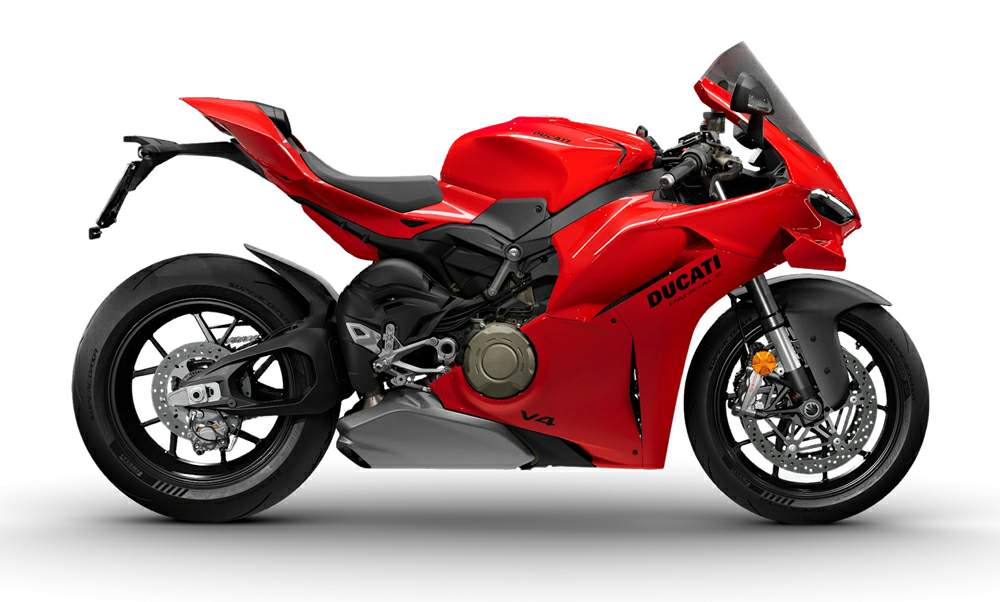
Ducati Panigale V4 / V4S

Make Model

Ducati Panigale V4 / V4S

Year

2027

Engine

Four stroke, Desmosedici Stradale 90° V4, counter-rotating crankshaft, 4 Desmodromically actuated valves per cylinder

Capacity

1103 cc / 67.3 cu in

Bore x Stroke

81 x 53.5 mm

Compression Ratio

14.0:1

Cooling System

Liquid cooled

Induction

Electronic fuel injection system. Twin injectors per cylinder. Full ride-by-wire elliptical throttle bodies. Variable length intake system

Emission Euro 5+

Exhaust

4-2-1-2 system, with 2 catalytic converters and 6 lambda probes

Starting

Electric

Max Power

160.4 kW / 218 hp @ 13500 rpm

Max Torque

120.6 Nm / 89.0 lb-ft @ 11000 rpm

Clutch

Hydraulically controlled slipper and self-servo wet multiplate clutch, self bleeding master cylinder

Transmission 

6 Speed with Ducati Quick Shift (DQS) up/down EVO

Primary Drive

Straight cut gears, Ratio 1.80:1

Final drive

Chain 520, Front sprocket 17, Rear sprocket 42

Gear Ratio

1st 36/15, 2nd 34/17, 3rd 33/19, 4th 32/21, 5th 30/22, 6th 27/22

Frame

Aluminum alloy "Front Frame" with optimized stiffnesses

Front Suspension

V4: Fully adjustable Showa BPF fork. 43 mm chromed inner tubes

V4S: Öhlins NPX 25/30 (SV) S-EC 3.0 pressurized  43 mm fully adjustable fork with TiN treatment. Electronic compression and rebound damping adjustment with Öhlins Smart EC 3.0 event-based mode

Front Wheel Travel

125 mm / 4.9 in

Rear Suspension

V4: Fully adjustable Sachs unit. Aluminum hollow symmetrical swingarm

V4S: Fully adjustable Öhlins TTX36 (SV) S-EC 3.0 unit. Electronic compression
and rebound damping adjustment with Öhlins Smart EC 3.0 event-based
mode. Aluminium Hollow Symmetrical Swingarm

Rear Wheel travel

130 mm / 5.1 in

Front Brakes

2 x 330 mm semi-floating discs, radially mounted Brembo Monobloc Hypure 4-piston callipers with race eCBS. Self bleeding master cylinder

Rear Brakes

Single 245 mm disc, 2-piston calliper with race eCBS

Front Wheel

V4: 5-spokes light alloy 3.50" x 17"

V4S:V5-spokesforged aluminium alloy 3.50" x 17"

Rear Wheel

V4: 5-spokes light alloy 6.00” x 17”

V4S:  5-spokes forged aluminium alloy 6.00” x 17”

Front Tyre

120/70 ZR17 Pirelli Diablo Supercorsa SP-V4

Rear Tyre

200/60 ZR17 Pirelli Diablo Supercorsa SP-V4

Rake

24°

Trail

98 mm / 3.86 in

Wheelbase

1477 mm /  58.1 in

Seat Height

850 mm / 33.5 in

Wet Weight ( no fuel) V4: 191 kg / 421 lbs

V4S: 187 kg / 412 lbs

Fuel Capacity 

17 Litres / 4.5 US gal

Safety equipment V4: Ducati Slide Control (DSC), Engine Brake Control (EBC), Ducati Brake Light (DBL), Chain Guard (DBL), Chain Guard Ducati Power Launch (DPL) DVO, Ducati Quick Shift (DQS) Up/Down 2.0, Full LED Headlights With Daytime Running Light (DRL), Sachs Steering Damper, Quick Adjustment Buttons, Pit Limiter, Auto-Off Indicators

V4S: Ducati Power Launch (DPL) DVO, Ducati Quick Shift (DQS) up/down 2.0, Full LED headlights with Daytime Running Light (DRL), Ducati Electronic
Suspension (DES) 3.0 with Öhlins Smart EC 3.0, Lithium-ion battery, Quick adjustment buttons, Pit Limiter, Auto-off indicators, Forged aluminium wheels

Standard equipment V4: Riding Modes, Power Modes, Race eCBS, Ducati Vehicle Observer (DVO),Ducati Traction Control (DTC) DVO, Ducati Wheelie Control (DWC) DVO, Ducati Slide Control (DSC), Engine Brake Control (EBC), Ducati Brake Light (DBL), Chain guard

V4S: Riding Modes, Power Modes, Race eCBS, Ducati Vehicle Observer (DVO), Ducati Traction Control (DTC) DVO, Ducati Wheelie Control (DWC) DVO, Ducati Slide Control (DSC), Engine Brake Control (EBC), Ducati Brake Light (DBL), Chain guard

From Ducati web-site:

The Panigale V4 further raises the level of performance, with an average lap time improvement of 4 tenths. The Desmosedici Stradale evolves to become even more efficient, achieving 218 hp, while refinements to the frame, electronics and aerodynamics improve the precision, control and riding feeling when seeking the limit.

Thanks to the Ducati Factory Made program, the Panigale V4 can be customised more than ever before. With eleven exclusive colours, two dedicated liveries and a selection of components installed directly at the factory.


Faster with each lap.
As on the racetrack, the Panigale V4 never stops evolving. Every improvement is the result of continuous work on the details to offer a riding experience that is increasingly similar to that of a Ducati race bike.


The engine, chassis, electronics and aerodynamics work in unison to heighten feeling and control, delivering thrills that bring every rider closer to the sensations experienced by professional racers. A continual evolution that translates into even greater performance on track.
More power at high revs.


The Panigale V4 develops the Desmosedici Stradale with refinements to the intake, exhaust and lubrication system, increasing maximum power to 218 hp. A raised rev limit and longer final drive ratio allow the engine’s thrust at high revs to be fully exploited, helping to lower lap times by an average of 4 tenths.

1103 cc Desmosedici Stradale
The 1103 cc Desmosedici Stradale brings solutions deriving directly from Ducati’s experience in MotoGP to the Panigale V4. The 90° V4 architecture, Desmodromic valve system, counter-rotating crankshaft and Twin Pulse firing order all contribute to defining the engine’s unique character.


For this evolution, the intake and exhaust systems are optimised to increase the power by 2 hp at high revs. The limiter, raised to 15,000 rpm from second to fifth gear, allows the rider to make use of the power curve for longer. In combination with the longer final drive, the Desmosedici Stradale reduces the number of gear changes through more technical sections of the circuit, turning the performance gain into a tangible advantage on track.


Desmodromic system as on the MotoGP
The Desmodromic system is one of the distinctive elements of the Desmosedici Stradale. Unlike a traditional spring-valve system, it directly controls valve opening and closing, guaranteeing maximum precision also at high engine speeds.


A solution that allows the Ducati V4 to exploit high-performance cam profiles, contributing to the performance of the engine and its ability to express all the available power beyond 14,000 rpm.


Counter-rotating crankshaft
As on the MotoGP prototypes, the crankshaft is counter rotating or rather rotated in the opposite direction to the wheels to counteract the gyroscopic effect and ensure handling and agility in the changes of direction, as well as reduce the tendency to wheelie under acceleration and braking.


Twin Pulse firing order
The 70° offset between the crankpins combined with the 90° V-layout of the engine generates a firing order that Ducati calls “Twin Pulse”, because it is as if the engine were reproducing the firing sequence of a twin. The distinctiveness lies in the fact that the two left-hand cylinders fire closely together, as do the two right-hand ones. On the timing chart, the ignition points are at 0°, 90°, 290° and 380°. This particular firing order makes the V4 sound very similar to the MotoGP Desmosedici.


Greater performance at high revs
The Desmosedici Stradale’s intake and exhaust systems and lubrication circuit are developed to increase engine performance at high revs. The new high-flow air filter, the reduction in exhaust back pressure and the recalibration of the oil circuit all contribute to increasing the maximum power to 218 hp.


The power increase of 2 hp is constantly available between 12,000 and 14,000 rpm, with a peak of +3.5 hp at 13,000 rpm.


The rev limit raised to 15,000 rpm together with the longer final drive ratio allow the Desmosedici Stradale’s torque curve to be fully exploited, improving efficiency on track and reducing the number of gear changes through more technical sections.


Akrapovič PRO full racing exhaust system
Directly derived from the Panigale V4 R, the new Akrapovič PRO full racing exhaust is now available for the Panigale V4. With this Akrapovič racing system, maximum power is increased by 11 hp and torque by 7 Nm with respect to homologated values, while the weight drops by 6.6 kg. The Akrapovič PRO exhaust comes complete with the DAVC Race Pro software to optimise performance with the racing exhaust and slick/rain tyres.


Ducati Hollow Symmetrical Swingarm
Lightweight, sophisticated and functional, the Ducati Hollow Symmetrical Swingarm contributes to the dynamic behaviour of the Panigale V4 by improving grip, precision and stability under acceleration. A solution designed to offer the rider a more direct connection with the bike and greater control during more demanding riding phases on track.


MotoGP-derived Front Frame
The Front Frame of the 2027 Panigale V4 evolves to offer greater grip and feeling and an even more precise response when riding at the limit.


The Front Frame has lower lateral stiffness, designed to generate more grip and offer the rider even more precise feeling.


The lower fastenings of the Front Frame have been machined to remove material and obtain the desired reduction in lateral stiffness. With respect to the previous frame, lateral stiffness is reduced by 12%.
The greater flexibility increases the bike’s ability to absorb bumps when leaning at high angles, maximising tyre grip and maximising the potential in terms of corner speed.


The frame modification also increases the bike’s tendency to hold its line, allowing the rider to take corners more tightly and open the throttle earlier.


For the rider, this translates into greater cornering speed, thanks to the possibility to achieve greater lean angles and, consequently, quicker lap times.

Forged wheels with a MotoGP-inspired design
The Panigale V4 S is equipped with aluminium alloy forged wheels developed according to a Ducati design and project. With a tangential five-spoke design inspired by that of the DesmosediciGP, they reduce overall weight (-2.17 kg) and the moment of inertia (-22% at the front and -23.5% at the rear) with respect to the cast aluminium five-spoke Y-design wheels of the Panigale V4.


Racing riding position
Developed for the track, the ergonomics of the Panigale V4 ensure the right balance of control, freedom of movement and aerodynamic efficiency. A configuration that helps the rider to maintain precision and confidence under hard braking, when moving in the seat, and at maximum acceleration.


Tank designed around the rider
Incredibly narrow, the tank is designed to improve the bike’s ergonomics and control, particularly under braking and when hanging off through the turn. The shape of the 17-litre aluminium tank, with a section that extends beneath the seat like on the race bike, allows the rider to assume the correct aerodynamic position along the straight. Thanks to deep grooves and side buffers, it also allows the rider to be more efficient under braking, taking the load off the arms and reducing physical effort. The specially shaped upper side surfaces also help the rider maintain the hanging-off position through the corner. In the front section, the space not occupied by fuel is used to house part of the electronics, for better weight distribution.


Adjustable semi-handlebars
On the Panigale V4 S, the semi-handlebars can be positioned 10 mm higher with respect to the standard configuration, a solution inspired by today’s MotoGP bikes. This configuration increases the steering leverage, improves bike control during more demanding riding phases and reduces physical effort during hard braking. As it not possible to move the steering lock to the higher position, the adjustment is not homologated and is reserved for track use.


A seat designed around the rider
The seat of the Panigale V4 is designed to improve comfort and freedom of movement during sports riding. 35 mm longer and 50 mm wider than the previous generation, it offers the rider greater support during intense braking and facilitates the body’s movements when hanging off.


Via the Ducati Factory Made programme, it is also possible to configure the Panigale V4 with different seat solutions directly at the factory, adapting the ergonomics and style to your needs already at the production stage.


Advanced electronics for maximum control
The electronics package on the Panigale V4 reaches new levels with the application of the Superleggera V4 Centenario’s riding controls. Controls that exploit the Ducati Vehicle Observer, an algorithm developed by Ducati Corse to ensure more effective handling.


Thanks to the DVO, Ducati Traction Control (DTC) heightens control of rear wheel slip, working more precisely and continuously during the manoeuvre to limit any loss of grip and subsequent recovery.
Ducati Wheelie Control (DWC) also benefits from the introduction of the DVO, allowing for more accurate identification of wheelies and more precise intervention that is almost predictive.


Ducati Slide Control (DSC) supports the rider, controlling the amount of torque delivered depending on the slide angle. It operates thanks to the inertial platform and improves corner exit performance by preventing slide angles that would otherwise be difficult to manage. Ducati Power Launch (DPL) can guarantee lightning starts, allowing the rider to focus only on releasing the clutch. DPL also benefits from the introduction of DVO, helping to increase repeatability and boost rider confidence in the system.
The Ducati Quick Shift (DQS) 2.0 represents a significant evolution with respect to traditional systems, swapping the traditional lever with microswitch for a direct mechanical lever.


The electronic strategy of the DQS is entrusted to the positioning sensor on the gear drum that identifies the gear engaged, fiving the rider a more direct, consistent feel, with less of a ‘rubbery’ sensation and reduced lever travel, for a better overall riding experience. The DQS MY27 leverages the calibrations developed for the Panigale V4 R.


Cornering ABS with combined braking strategies for track and road
The Panigale V4 is equipped with Cornering ABS with combined braking strategies designed for both road and track. The road strategies, developed by Bosch, are the same as the previous generation and ensure greater safety and stability with respect to a traditional system. The track braking strategies, on the other hand, called Race Brake Control (RBC), were conceived by Ducati as it developed the Panigale V4R. These strategies allow a rider to emulate the riding techniques of professional riders. The Race Brake Control (RBC) strategies also exploit the contribution of the rear brake much more than on the Panigale V4 thanks to a precision method of calculation and greater pressure that can be applied at different lean angles. This, in turn, allows the rider to brake later, thanks to the system’s ability to decelerate the bike to the point just before rear-wheel lock-up in the final phase of corner entry, as only a professional rider can.


The available modes are Track PRO and Track Expert. Both use the Post Run function that automatically maintains residual pressure on the rear brake after the front brake is released, simulating the technique of professional riders who use the rear brake to tighten the line. The two modes differ in the level of pressure they apply to the rear.


Dynamic Engine Brake Control (DEB)

The DEB (Dynamic Engine Brake) is the advanced new engine brake control system, the result of in-house Ducati development. It replaces the previous Engine Brake Control (EBC) and offers five levels of intervention (compared to the previous three) and even better performance thanks to the application of the DVO algorithm and a new strategy that combines management of the engine brake with that of the rear braking system.


The DVO allows the level of engine braking to be precisely calibrated, taking into account the estimated vertical load on the rear axle. The result is even more precise management of the forces acting on the tyre, making engine braking more progressive and predictable.


At two of the five levels, the DEB automatically activates the rear brake, increasing the overall effect of the engine brake. The system continuously adapts the contribution of the rear brake and engine brake to the track conditions and to the load acting on the rear wheel.


From a dynamic standpoint, the DEB improves braking performance when leaned over as the front brake is released, while allowing the rider to tighten their line further on corner entry. It also ensures more consistent motorcycle behaviour, enhancing rider confidence.


6.9” TFT
The Panigale V4 dashboard, with 6.9” colour screen and 1280 x 480 resolution, sets new standards in terms of its readability, ease of use, and the amount of data it provides. The 8:3 aspect ratio increases the available data and insights and ensures excellent visibility even when tucked in behind the fairing. Thanks to the use of Optical Bonding technology, with graphics on a black background and glass protection, the aesthetic is impeccable and offers excellent visibility also during the day. The dash is controlled by an HMI that users two rocker controllers positioned on the left handlebar block.


RaceGP Info Mode
The Race GP Info mode, included in the DAVC Race Pro software (not homologated for road use) is specifically designed for track riding sessions. It is available by installing the DAVC Race Pro software, an autonomous accessory, which allows the rider to fully exploit the bike’s potential with the race exhaust and slick/rain tyres.


The Race GP mode presents a race layout (information relating to road homologation is removed); only information relevant to track use is displayed. Two quick-access menus can be activated via switches for the immediate management of various controls, while the white background maximises visibility.


Grip Level Meter

The Grip Level Meter, available by installing the DAVC Race Pro software (for track use only) helps the rider to understand the grip level at any precise moment by providing a tyre grip estimate of low, medium or high.


Advanced Riding Modes
“Race: A” Riding Mode – Race A Riding Mode offers the rider the full power of the engine (218 hp) with direct Ride by Wire response when opening the throttle (High Power Mode) and, in the S version, a very firm suspension setup (Active Track 1) for optimum performance. Race A mode provides a default low-intrusive electronics setting, designed for track riding, with Race eCBS at level 1.


“Race: B” Riding Mode – Race B Riding Mode retains the full power of the engine with High Power Mode and, in the S version, a different suspension setup (Active Track 2). The default electronics setting is low-intrusive and designed for track riding, but with a less permissive DSC setting (2 instead of 1) and Race eCBS set at level 3.


“Sport” Riding Mode - The Sport Riding Mode is associated by default with the Medium Power Mode (maximum power of 218 hp and a more progressive Ride By Wire response) and, in the S version, with a sports suspension setup (Active Dynamic 1). The electronic controls are set to support the rider during sports riding on the road.


“Road” Riding Mode - The Road Riding Mode is recommended for road riding, especially where surfaces are in less-than-optimal conditions. The RM provides the rider with 218 hp of power with a progressive response when opening the throttle (Medium Power Mode) and, in the S version, an Active Comfort 1 suspension setup, particularly suited to absorbing the bumps.


“Wet” Riding Mode – Wet Riding Mode is designed for riding on low grip surfaces or in the wet. This mode reduces maximum power to 160 hp with a particularly smooth throttle response (Low Power Mode) and, in the V4 S version, a softer suspension setup (Active Low Grip 1) to heighten grip and safety.

(It should be noted that some of the functions highlighted in this article is not for road use, intended exclusively for track use.)