|
|
|
|
Classic Bikes
Custom Bikes
Individual
Racing Bikes AJP
AJS
Aprilia
Ariel
Avinton / Wakan
Bajaj
Benelli
Beta
Bimota
BMW
Brough Superior
BRP Cam-Am
BSA
Buell / EBR
Bullit
Bultaco
Cagiva
Campagna
CCM
CF Moto
Combat Motors
Derbi
Deus
Ducati
Excelsior
Fantic
GASGAS
Ghezzi Brian
Gilera
GIMA
Harley Davidson
Hero
Highland
Honda
Horex
Husaberg
Husqvarna
Hyosung
Indian
Jawa
Kawasaki
KTM
KYMCO
Laverda
Lazareth
Magni
Maico
Mash
Matchless
Mondial
Moto Guzzi
Moto Morini
MV Agusta
MZ / MuZ
NCR
Norton
NSU
Paton
Peugeot
Piaggio
Revival Cycles
Roland Sands
Royal Enfield
Sachs
Sherco
Sunbeam
Suzuki
SWM
SYM
Triumph
TVS
Ural
Velocette
Vespa
Victory
Vincent
VOR
Voxan
Vyrus
Walt Siegl
Walz
Wrenchmonkees
Wunderlich
XTR / Radical
Yamaha
Zero
Video
Technical
Manufacturer List Contact
|
Bimota KB1
The 138mphKB1. Massimo Tamburini decided to revamp his MV Agusta 600 back in 1970. This enthusiast from Rimini scrapped the bike's original frame and substituted one of his own manufacture. He uprated the engine and then made his own chain final Final Drive to replace the MV's shaft system. So enthusiastic were press reports when the bike was unveiled that Massimo soon had people begging him to manufacture rolling chassis for their engines. Thirty lucky Honda 750 owners were the first to benefit from the engineer's skills and. when they announced that they were more than happy with their bikes, Massimo decided to close down his plumbing business and set up a bike factory. His factory not only produced rolling chassis, but racing models too, and the Bimota company's frames sheathed the works machines of Yamaha and Harley-Davidson, which Cecotto and Villa took to a total of four World Championships between them. The first series production bike built by the three directors of the company, Blanchi, Morri and Tamburini,
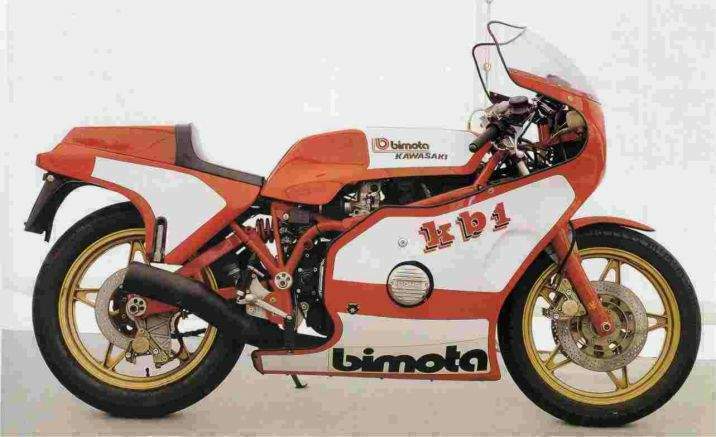
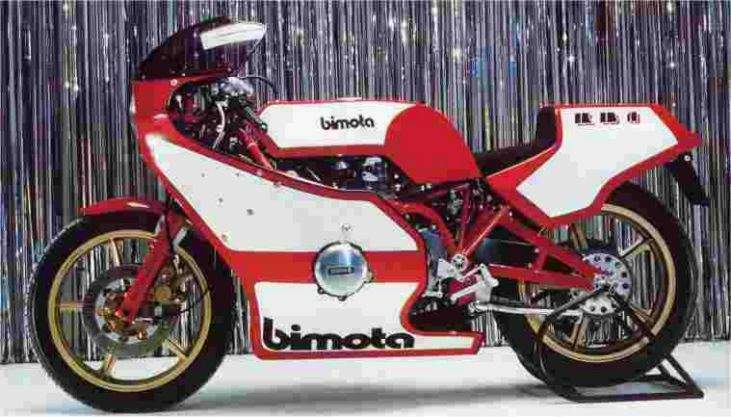
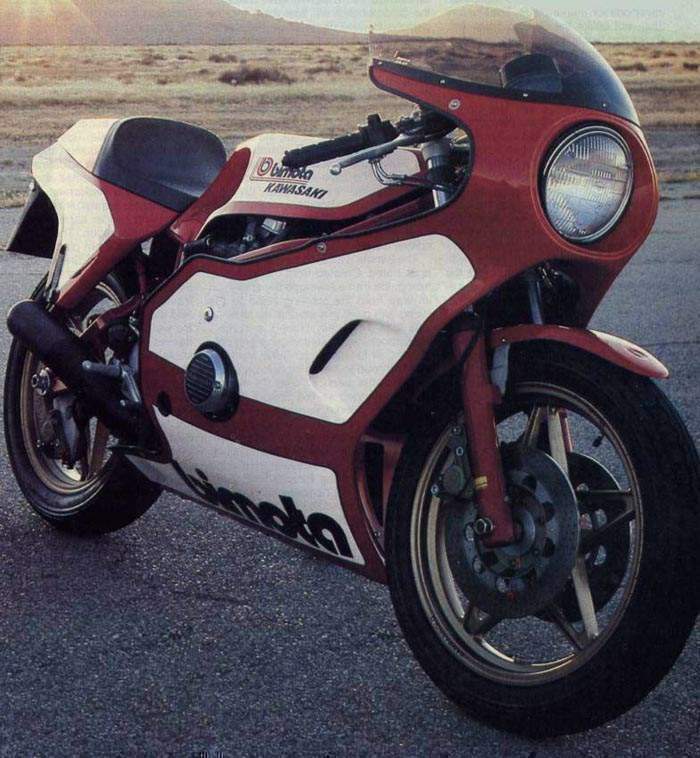
Although quite straightforward in design compared to the advanced SB2 and SB3 models, the Kawasaki based Bimota is still streets ahead of most other Café-racers and of even racing bikes in its layout. Chrome molybdenum tubing is used for the frame from which the engine hangs, with much bracing around critical areas like the steering head for extra rigidity. With the frame finished in bright red, it stands out as one of the most purposeful and neatly constructed chassis in motor cycling. A cantilever rear end is used, featuring a single horizontal Corte and Cosso spring/ damper unit, while cross-drilled cast iron discs are fitted on the bike's Campagnolo wheels. Standard Kawasaki instruments and switchgear are used on the KB1, while the machine is finished off with tank and bodywork almost identical to that of the 1977 works Yamahas, themselves noted for being particularly attractive and aerodynamically efficient. Obviously, with a low set riding position and the aid of a fairing not to mention the weight saving of almost 100 lb, the KB1 is a lot quicker than the standard Kawasaki. The bike rockets away from the start right up to its maximum speed of 138mph in almost no time at all. Top speed is governed by the gearing, for the engine soon pulls its red line in top gear, but with a high top end anyway, longer-legged gearing would blunt the bike's :celebration, and this is one of its main attractions. Of course, the Bimota's other obvious attraction is s road manners, which are simply of the highest order. The KB1 is a bike which would be quite at home on a race track and this is brought home when the first road bend is encountered.
The bike it begs to be banked hard into corners at seemingly impossible speeds, and it rewards the rider with fuss-free handling and as secure a feel as :an be expected on two wheels. The ride is firm without being hard and the suspension is very well damped with road ripples being soaked up nicely, and any other irregularities making their presence felt without upsetting the plot. Scraping any part of the bike in turns without actually falling off is nearly impossible on public roads, and only for the very capable on a race track. But simply, the KB1's abilities are above and beyond those of most of its potential riders, so there should be no problems on that score. Braking, too, is of the highest order in all conditions, just as you would expect. The first KB1 bikes were a little unwieldy about town due to their lack of steering lock, but later models have large indentations in the upper frame tubes for a little more movement. It looks crude to the eye and it may be a grotesque compromise to an engineer who has lovingly scanned the bike's specification in the first place. It must be remembered however, that the Bimota is a road bike and not a racer, and about-town riding is a necessity. Something else which is a compromise on the bike but which is appreciated by many is the seating. The latest KB1's tail fairings can be unclipped to be removed, along with the small saddle. A twin seat unit can then be clipped onto place, with rear seat pegs then unfolding from the rear bodywork. Of course, the lucky pillion may be uncomfortable but the pleasures of Bimota travel are worth suffering a little for.
|
|
|
Any corrections or more information on these motorcycles will be kindly appreciated. |