Four stroke, longitudinal 800 V-twin cylinder,
camshaft nestles at the base of the V between the cylinders. ,OHV, 4 valves
per cylinder operated by pushrods
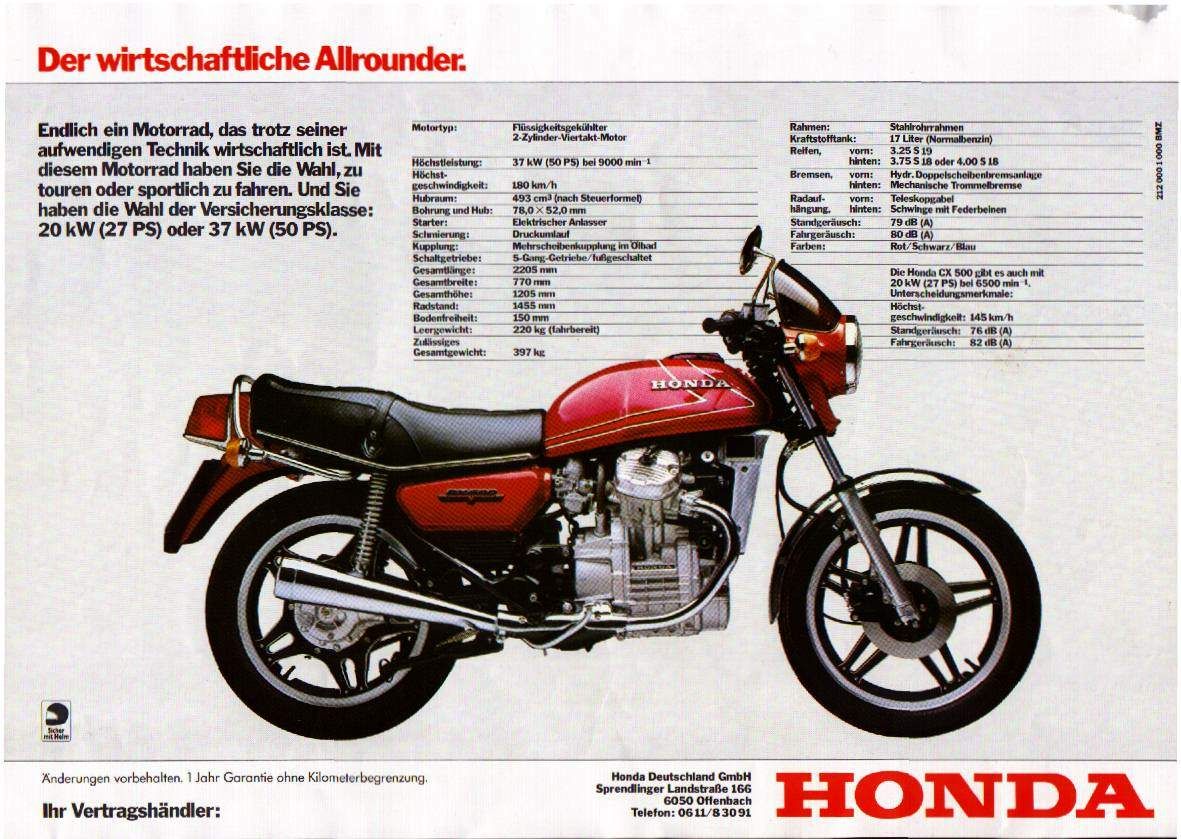
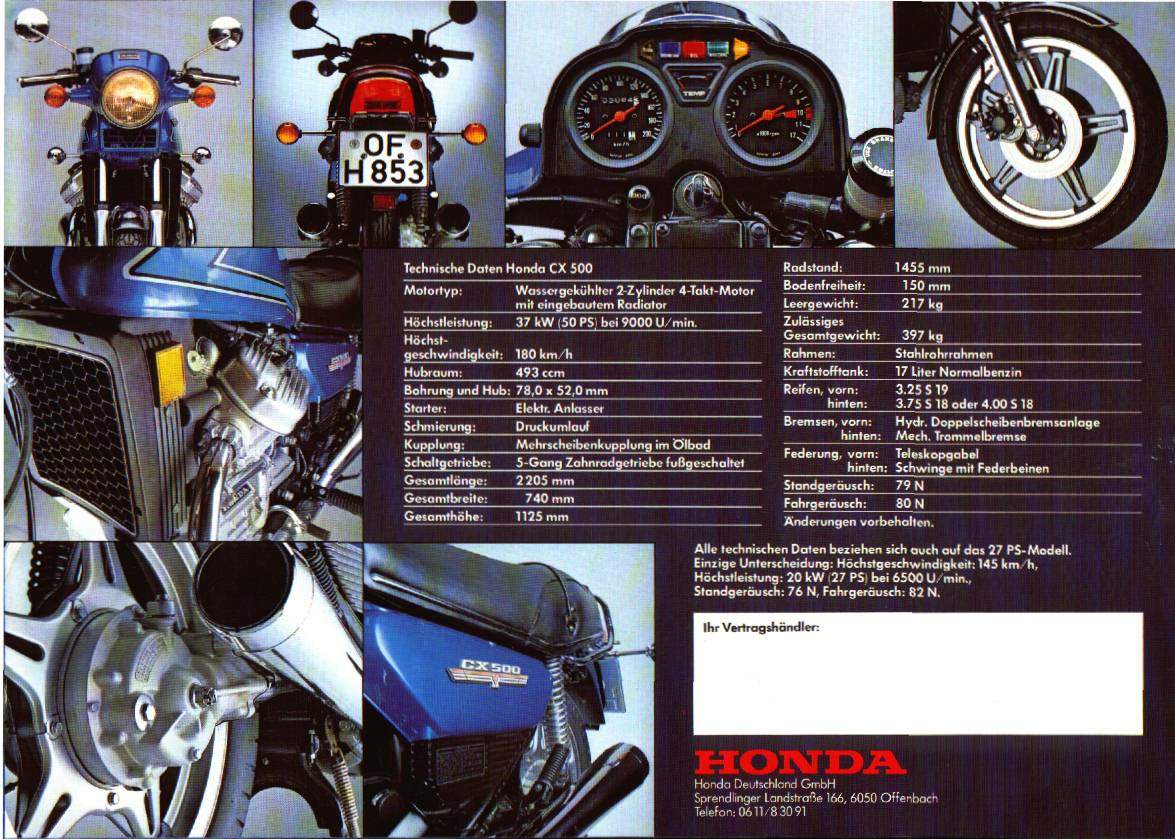
Capacity
497 cc / 30.3 cu-in
Bore x Stroke
78 x 52 mm
Compression Ratio
10.0:1
Induction
2x 34mm Keihin carbs.
Ignition
CDI
Starting
Electric
Max Power
50 hp / 37.2 kW @ 9000 rpm
Max Torque
46 Nm / 33.9 lb-ft @ 7000 rpm
Clutch
Wet, multi-plate, 5-speed
Transmission
5 Speed
Final Drive
Shaft
Front Suspension
33mm Showa telehydraulic fork
Front Wheel Travel
132 mm / 5.1 in
Rear Suspension
Swinging arm fork with adjustable shocks absorbers
Rear Wheel Travel
84 mm / 3.3 in
Front Brakes
2x 275mm discs
Rear Brakes
160mm Drum
Front Tyre
3.25-19
Rear Tyre
3.75-18
Dry Weight
205 kg / 452 lbs
Fuel Capacity
17 Litres / 4.4 US gal
Consumption Average
43 mpg
Standing
¼ Mile
14.0 sec / 93 mph
Top Speed
112 mph
.
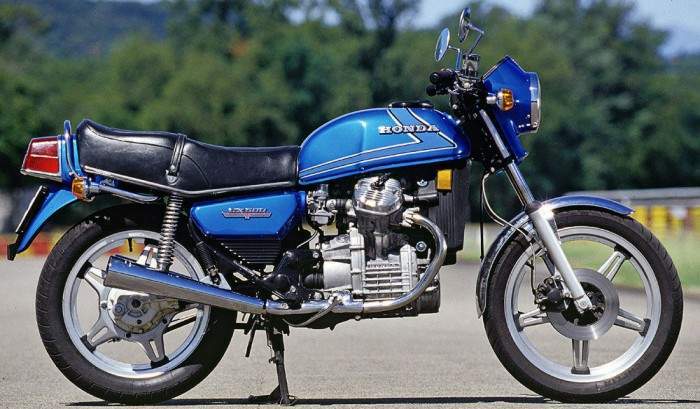
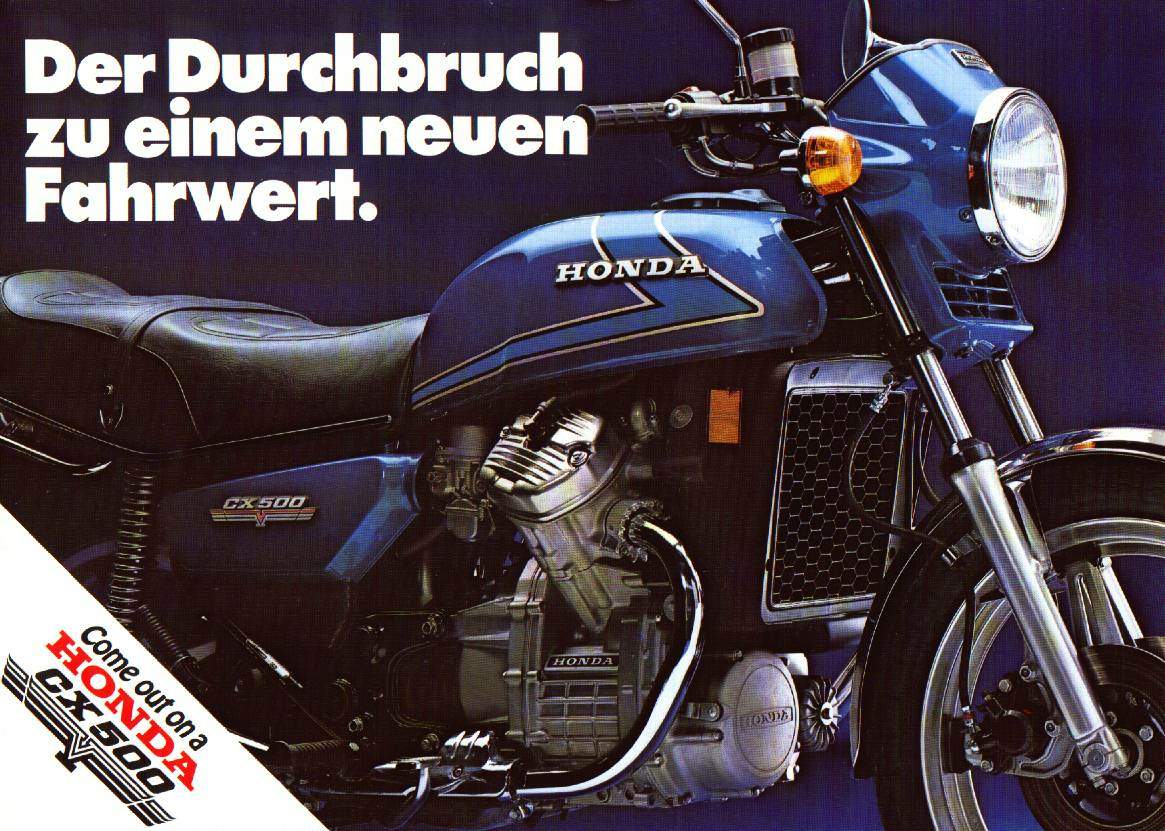
When introduced, the Honda CX500 was a novelty. It was the
first mass produced motorcycle to feature tubeless wheels along with the
CBX, it had a very peculiar design that didn’t appeal to journalists, it was
unusually large and heavy for a 500 – and it still managed to work very
well, thank you very much. It wasn’t perfect, but it was a better compromise
for many than anything else offered for the 1978 model year in its class.
The engine on which the CX 500 was based was originally developed for a
small car. Strangely, the first model run produced noticeably more power
than the later ones. Top speed prone has been recorded up to 187 kph / 116
mphand 0-100 kph / 0-62 mphcould be over in just 5.4 seconds along with a
standing start quarter-mile in 13.4 seconds. These early engines produced a
true 50 hp at the crank, as Honda promised in their pamphlets. For whatever
reason, power soon dropped into the 42-43 hp brackets, although Honda
retained the original specifications. This resulted in typical top speed
figures of just over 170 kph/ 105 mph and accordingly slower acceleration.
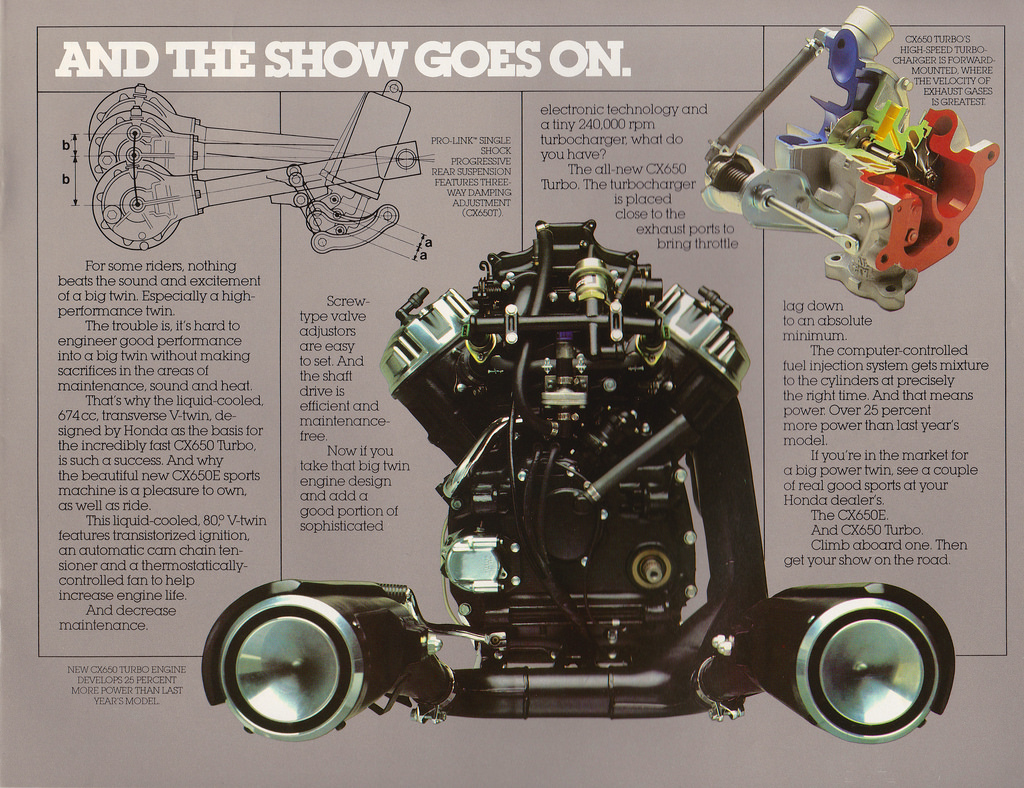
The CX engine was highly unconventional, and to this day its design has
never been replicated. To keep the engine narrow, it was made into an
80-degree V. This resulted in less than perfect primary balance, which
require 90 degrees, but through good balancing there was very little penalty
paid in the form of vibrations. In fact, the CX ran smoother than a Moto
Guzziwith its theoretically perfect 90-degree splay between the cylinders.
Liquid cooling was still considered somewhat exotic for motorcycles back in
the end of 1977, when the CX was introduced to the press, but helped to
controlboth noise emission as well as engine temperature. The cooling fan
was directly driven from the camshaft and often led to overcooling. With the
GL500 in 1981, the engine was revised slightly and received an automatic cam
chain adjuster, TCI ignition (previously CDI) and an electric cooling fan.
Despite the novel design and effective cooling system, the CX wasn’t
entirely trouble free. The cam chain tensioner in particular gave lots of
trouble as it was too weak and broke. Unlike most engines, this didn’t cause
any immediate and complete engine destruction, although the noise from the
flapping cam chain was alarming enough. It took Honda several attempts and a
couple of years to fully sort the cam chain tensioner malady.
Overall, the Honda was very easy to maintain. Valve access couldn’t be
easier, and adjustment took only a few minutes. The clutch was in front of
the engine beside the oil filter cartridge, and the gearbox could be removed
as a cassette. However, in order to gain access to the gearbox, cam chain
and ignition, the engine had to be removed from the frame. Although this may
sound bad, it was a rather simple process what with the engine being part of
the frame. Hence there were no down-tubes to deal with and the frame could
more or less be lifted off the engine in a couple of hours, leaving the
engine free. Not quite as simple as that of a Guzzi small block, but easier
than that of a BMW airhead.
Honda decided to splay the cylinder heads 22 degrees in order to move the
carbs out of the way from the rider’s feet, and hence had to move away from
their normal OHC design and over to OHV with pushrods. Although considered
obsolete and agricultural by many, the little Honda could still rev to
11,000 rpm before valve float set in. Honda even claimed they could make
their engine rev reliably to 12,500 rpm. For the production model, redline
was set to 9700 rpm, but the owner’s manual also stated that the engine
could be revved to 10500 for short bursts during hard acceleration.
Honda promoted the CX500 as both a sports- and a touringbike, although it
was much more of the latter than the former. The suspension was overly soft
in order to give a compliant ride; too soft for hard cornering as well as
for touring with a heavy load. The aftermarket soon offered air kits for the
fork and heavy duty shock absorbers for the rear. Still, stiffening the
front springing couldn’t help the spindly 33 mm stanchions in their quest to
guide the bike accurately. With the later GL series, the stanchion diameter
grew to 35 mm, whereas the Turbo received 37 mm jobbies. Still, despite its
many small issues, the bike worked splendidly for the sort of riding most
riders actually do.
Shaft final drive was a great convenience for the touring rider or the
commuter riding in inclement weather, but again not ideal for the sporting
rider with high demands for precise handling. Although far from as distinct
as that of the period BMWs, the little Honda still showed very noticeable
shaft drive reactions. Under acceleration the swing arm would be pushed
down, raising the rear end in the process and stiffening the suspension.
Trailing throttle would have the opposite effect, robbing the bike of
precious cornering clearance as well as upsetting the suspension. Again,
this mattered little for the majority.
In Europe, the CX family all had twin front discs, contrary to USA where
most only had a single front disc brake. Apparently, the addition of a
second disc did wonders for the bike’s stopping ability, as there were few
complaints about braking power in Europe, contrary to USA where the single
disc was generally found lacking.The later EuroSport versionin addition
featured a rear disc brake in place of the previous drum item.
Over the years, the CX500 engine propelled seven different variants;
CX500A/B, CX500C, CX500D, CX500E, CX500TC, GL500 and GL500I. The A/B, D and
E were what today is considered standards or nakeds, whereas the C and GL
were more cruiser oriented. The TC had a turbo and a full sports-touring
fairing, while the GL500I, for Interstate, featured full luggage and the
same fairing fond on the Gold Wing 1100. For 1983, the CX grew to 673 cc and
was named CX650. Unfortunately, Honda decided to drop the whole CX line at
the end of 1983 for most markets.Although production remained for another
two years, sales had dropped off markedly. With nearly 400,000 CX’s sold
over the years, though, it was one of Honda’s biggest successes after the
CB350 twin had totally dominated the market a decade earlier. - Eirik
Skjaveland