|
|
|
|
Classic Bikes
Custom Bikes
Individual
Racing Bikes AJP
AJS
Aprilia
Ariel
Avinton / Wakan
Bajaj
Benelli
Beta
Bimota
BMW
Brough Superior
BRP Cam-Am
BSA
Buell / EBR
Bullit
Bultaco
Cagiva
Campagna
CCM
CF Moto
Combat Motors
Derbi
Deus
Ducati
Excelsior
Fantic
GASGAS
Ghezzi Brian
Gilera
GIMA
Harley Davidson
Hero
Highland
Honda
Horex
Husaberg
Husqvarna
Hyosung
Indian
Jawa
Kawasaki
KTM
KYMCO
Laverda
Lazareth
Magni
Maico
Mash
Matchless
Mondial
Moto Guzzi
Moto Morini
MV Agusta
MZ / MuZ
NCR
Norton
NSU
Paton
Peugeot
Piaggio
Revival Cycles
Roland Sands
Royal Enfield
Sachs
Sherco
Sunbeam
Suzuki
SWM
SYM
Triumph
TVS
Ural
Velocette
Vespa
Victory
Vincent
VOR
Voxan
Vyrus
Walt Siegl
Walz
Wrenchmonkees
Wunderlich
XTR / Radical
Yamaha
Zero
Video
Technical
Manufacturer List Contact
|
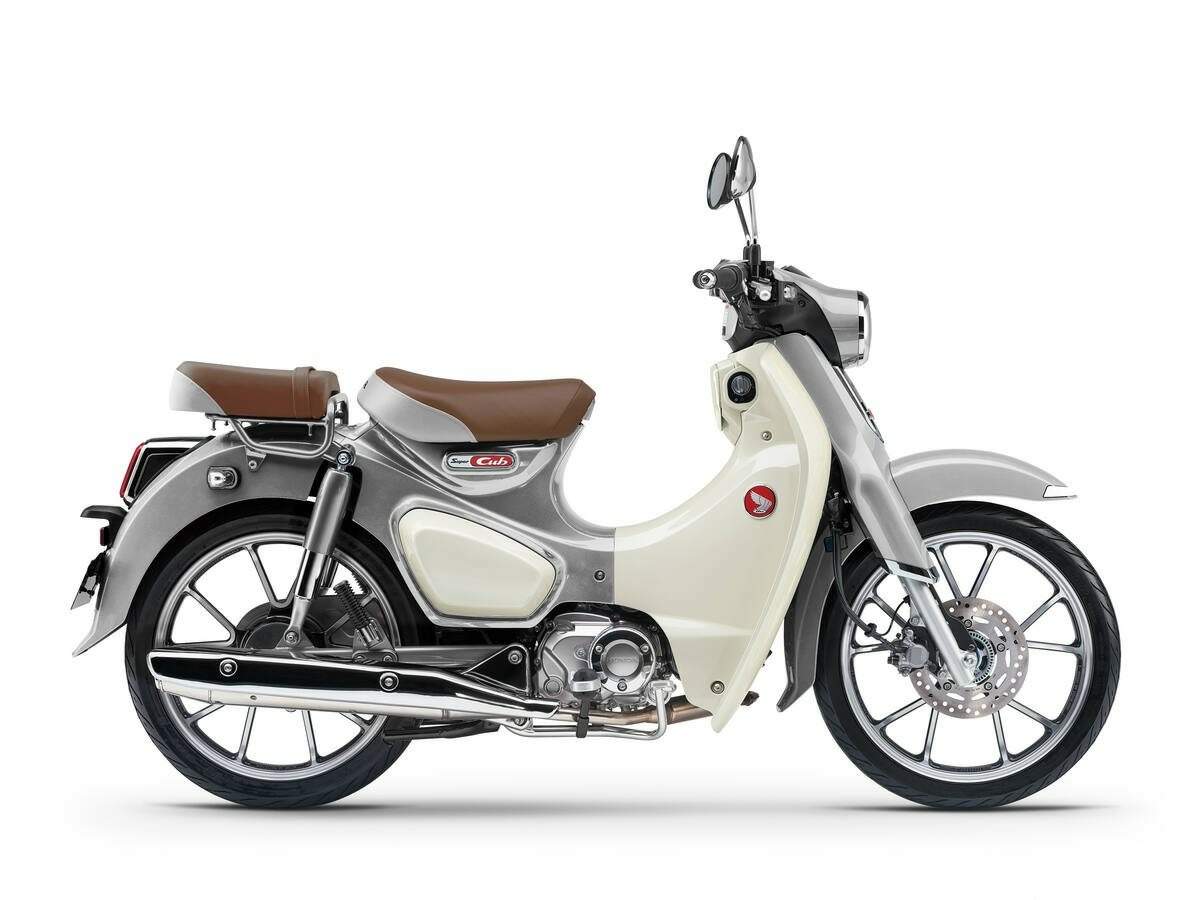
Honda C 125 Super Cub
From a press release issued By Honda: The very first Super Cub C100 was introduced in 1958, Honda’s 10th year of existence. Created by Soichiro Honda and his long-time business partner Takeo Fujisawa, its stated aim was straightforward: ‘to provide the joy of playing a useful part in people’s lives’. Nearly 60 years later, in 2017, the 100 millionth Super Cub was built, cementing its status as the most popular motor vehicle the world has ever seen. Along the way the Super Cub’s simple attributes of unique styling, reliability, frugality and sheer usability have never gone out of fashion. And it has quietly achieved exactly what Soichiro and Takeo wanted: to get people mobile and keep them mobile. The Super Cub series has long been popular in Japan - where it has long been popular with business users including the Japanese Post Office, and in South East Asia - where it retains an important role in people’s lives as private transport. Well aware of the number of urban European riders - across a wide range of age demographics - who look for credible retro-inspired machinery and head-turning style, Honda brought the latest version of the iconic machine to Europe in 2018, marking a new chapter in its long history. In 22YM the Super Cub C125 received further advances for its European audience. The timeless look was unchanged, but a brand-new EURO5-compliant engine and host of improvements drove it forward, just as Soichiro and Takeo would have wanted. 25YM saw the Super Cub C125 gain EURO5+ compliance – thanks to minor revisions to the fuel-efficient, air-cooled engine. Nothing changes mechanically for 26YM, but a new colour combination brings the iconic silhouette right up to date. The air-cooled SOHC engine is EURO5+ compliant and designed to produce smooth, usable power, returning impressive fuel economy of 1.5L/100km (WMTC mode). A 4-speed gearbox drives through a centrifugal clutch. Classic Cub styling – practical and easy to live with – is unchanged and includes standard-fit pillion seat and footpegs. Spring rates for front and rear suspension are set to smooth the ride on rougher city streets. New accessories available include a USB socket and heated grips. The 26YM Super Cub C125 will be available in a sole,
exclusive, paint finish: Key features Peak power of 7.2kW (a 0.1kW increase) arrives @ 7,500rpm,
with peak torque of 10.4Nm @ 6,250rpm. The gearbox is a 4-speed unit (with neutral at the bottom) and – in true Super Cub tradition – is operated via ‘automatic’ centrifugal clutch, without the need for a clutch lever. At standstill the rider simply selects the gear required with the left-hand foot lever and, as the throttle is opened, the clutch operates automatically and does so through each ratio change, up or down via heel or toe, toe for up through the gears, heel for down. Final drive ratio is 2.50 with 14T drive and 35T driven sprockets. A helical primary gear reduces ‘mechanical’ noise while the Alternating Current Generator (ACG) delivers healthy electrical output. Amazing fuel economy is on offer – 1.5 litres/100km (67.3km/l) (WMTC mode) – giving a range of approx. 250km from the 3.7 litre fuel tank. Styling & Equipment The Super Cub C125’s time-tested, evocative styling – defined instantly by the leg-guards and fully enclosed mechanical parts – is a design with one word in mind: ‘universality’. In other words, it must be easy for a wide range of people to use. A key part of this ethos is the laid-forward ‘S-shaped silhouette’ which runs from the step-through space to rear mudguard, making access on and off easy. The 2022 pillion seat and footpegs are standard equipment. Also, instantly recognisable as Super Cub is the ‘unit’ steering, which unifies the separate elements – forks, handlebars and leg shields – into one cohesive whole. On the original machine the handlebars, shaped to be like the wings of a bird, were a tactile and welcoming sales point and the modern-day Super Cub C125 with its forged, tapered handlebar wrapped in curvaceous moulded resin incorporating the switchgear and instruments, pays loyal homage to the original. The grips are placed in a natural, easy-to-hold position and complement the straight-backed riding position, which gives excellent all-round visibility. Aiding comfort, the seat uses thick, high-density urethane foam. It is also cut back on both sides up front, helping ground reach. All lighting is contemporary LED while the instruments highlight the depth of the overall design with two lenses separated by dual chrome rings. The outer ring houses the sweep of the analogue speedometer’s needle plus warning lights; the inner an understated digital display. A modern finishing touch is the Honda Smart Key which also controls the immobiliser as an extra theft deterrent and is equipped with an ‘answer back’ function whereby the indicators will ‘blink’ at the push of a button to make finding the vehicle easy in busy parking areas. And, with a nod to its forebears (and underlining its place in Honda’s history) a historical 3D ‘Classic Wing’ logo crowns the Smart Key fob. Chassis Fun, easy handling has always been another Super Cub strength.
To this end, the tubular steel ‘backbone’ frame has a rigidity balance carefully
tuned around the headstock and between the engine mounting points, to optimise
performance for the 124cc engine; the engine crankcases have specific hangers.
Both handlebars and seat are rubber mounted and the footpegs also feature rubber
inserts. Tubeless tyres are fitted, sized 70/90-17 front and 80/90-17 rear. A 220mm front disc brake and single-piston caliper are matched by a 110mm rear drum. Accessories
|
|
|
Any corrections or more information on these motorcycles will be kindly appreciated. |