|
Harley Davidson
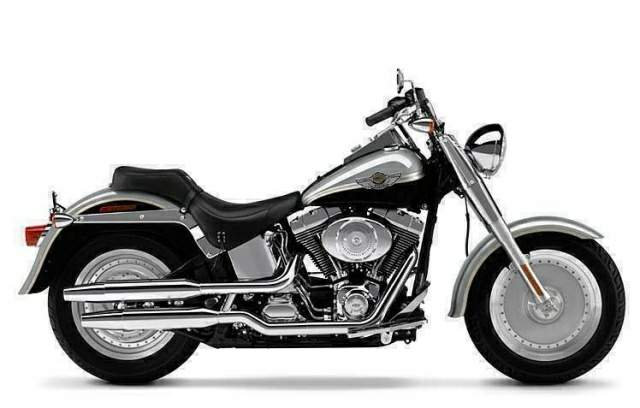
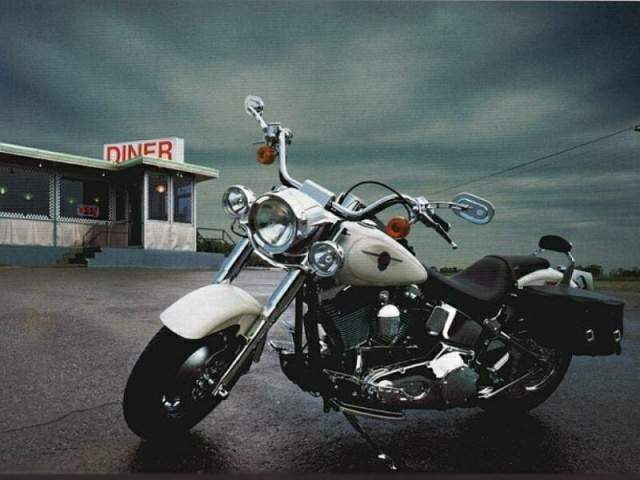
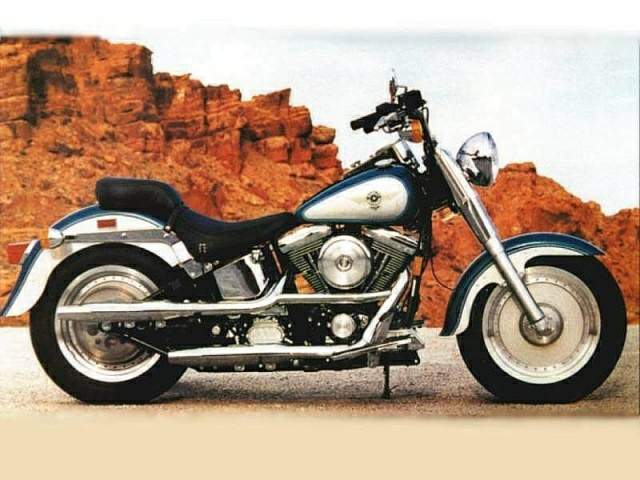
FLSTF Fat Boy

|
Make Model |
Harley Davidson FLSTF
Fat Boy |
|
Year |
1997-99 |
|
Engine |
Air cooled, four stroke, 45° V-Twin, OHV,
|
|
Capacity |
1338 |
|
Bore x Stroke |
88.8 x 108 mm |
|
Compression Ratio |
8.5:1 |
|
Induction |
|
|
Ignition /
Starting |
- / electric |
|
Max Power |
56 hp @ 5000 rpm |
|
Max Torque |
97 Nm @ 2350 rpm |
|
Transmission /
Drive |
5 Speed / Belt |
|
Front Suspension |
39mm Telescopic forks |
|
Rear Suspension |
Dual remote shocks adjustable preload, |
|
Front Brakes |
Single 292mm discs 4 piston caliper |
|
Rear Brakes |
Single 292mm disc 4 piston caliper |
|
Front Tyre |
130/90-16 |
|
Rear Tyre |
130/90-16 |
|
Dry-Weight |
320 kg |
|
Fuel Capacity |
19 Litres |
|
Review |
Motorcycle.com |

The FLSTF, or "Fat Boy" continued its run of popularity
in 1997. The wide "beach bars" were still used, as were the solid wheels at
both ends of the low-slung FL. Cosmetic changes were the only revisions to
the 1997 editions. But with a runaway success, why mess with the formula?
The original all-silver motif had been replaced in 1991, and every year saw
different hues being applied to the sheet metal of the Fat Boy. The winged
tank trim remained the same.

Star vs. Fat Boy Comparo
Los Angeles, May 17, 2000 -- For many years, if you wanted to ride a big-bore,
nasty-boy cruiser to play the part of neighborhood hoodlum, you had only one
choice: Harley-Davidson. But now a number of Japanese manufacturers have stepped
to the plate and are firing right and left at Milwaukee, trying to knock the
Motor Company off the pedestal it has grown so comfortable resting upon. One of
the most prolific bikes to come out of Milwaukee in some time, the Fat Boy, was
immortalized in James Cameron's film, Terminator II, under the muscle-bound
hind-quarters of Aah-nold. The sight of this large displacement muscle cruiser
on the silver screen instilled terror in old ladies and made the younger
generation weak in the knees as it turned heads and ruled the hangouts on the
back roads and boulevards of America.
The latest and most serious threats to the Fat Boy's boulevard-king status come
from Kawasaki's 1500 Vulcan Classic FI(which we sampled earlier this year in
Daytona), and Yamaha's Road Star. We had a chance to swing a leg over the new
Road Star at the Star line Intro in San Diego, California a few months ago and
came away impressed with what lead engineer, "Wacky" Macky Makino and his crew
of engineers came up with. We knew that these big bruisers from Japan would be
serious competition for Harley and had to see how they stacked up.
This Softail FLSTF Fat Boy is classic Harley from the ground up. Its minimalist
boulevard bruiser looks and ergos sit you upright so you can control the bike as
easily as you can swivel 'round to scope out the passing hotties.
A new Twin Cam 88B engine spices up an already well thought-out package with
with more power and twin counterbalancers to smooth out the vibes, allowing more
hours on the road before numb-butt sets in and forces you into the closest
watering hole.
Yamaha's new Road Star is based on the company's more touring-oriented Silverado
and, in this stripped-down form, appears to be aimed directly at the Harley Fat
Boy. From the 98 cubic inch (1,602 cubic centimeters) displacement (the largest
in the industry) down to the ergos and styling cues, it seems obvious what bike
Yamaha's sights were trained on. Riding the bikes back-to-back, you notice the
first surprising contrast; the Yamaha's motor actually vibrates ("pulses," as
Yamaha likes to say) more than the Harley.
"While Harley has been trying for years to smooth out the vibes on their motors,
Yamaha has engineered some "pulse" into their motors so they don't feel so
homogenized and the bike has the sort of character that is uncommon for a
Japanese cruiser."
At low revs, the Yamaha's motor throbs nicely with a muted "puff, puff" sound
emanating from the pipes beneath you. But as the revs rise, the motor's pulses
smooth as the motor pulls into a rev-limiter that seems at least 1,000 rpm too
low. By contrast, the Harley feels more like a Kawasaki W650 rumbling beneath
you at idle. It's pretty smooth with only a trace of the shake that has caused
so many nuts and bolts to come lose in days gone by. Then as you pull away from
the stop and keep twisting the throttle, you notice that the Harley starts to
vibrate more at high revs than the Yamaha.
Whether or not this is due to the Harleys smaller displacement or 1,700 rpm
higher rev ceiling, we can't say for sure. It's probably due to both, but you
notice the difference either way. The Fattie's 88B engine makes its 61.6 hp at
5,200 rpm and 77.0 ft/lbs at 3,300 rpm via 3.75 x 4.00 inch bore and stroke
figures for a total displacement of 88 cubic inches (1450 cubic centimeters).
The compression ratio is 8.9:1 and the cylinders are fed through a good ol' 40mm
carburetor. Burned gasses exit out of over/under shotgun-style dual exhausts
that do a decent job of keeping rumbling potatoes (say aloud, "potato, potato,
potato") down to acceptable levels. Bone stock, the Harley sounds better due to
both the pipes as well as the symphony of mechanical noises emanating from the
shiny chrome cases that Japan's latest just cannot compete with on a visceral
level.
The Road Star's 48-degree OHV v-twin is air-cooled and uses pushrods just like
Milwaukee's finest, but employs four valves per cylinder (as opposed to Harleys
use of only two per cylinder). The Japanese mill produces slightly less
horsepower at 55.4 hp at 3,800 rpm through a 113mm x 95mm bore and stroke, but
it trades upper-rpm poke for a whopping 86.8 ft/lbs down at 2,700 rpm. In the
cruiser game, torque is where it's at, and the Road Star has the upper hand
here.
The Yamaha's motor does this all via a similar 8.3:1 compression ratio and is
fed by a 40mm carburetor that gets its power out via a five-speed transmission.
Belt final drive is also employed by Yamaha as are the gargantuan looking front
forks and the dual over-under exhausts that follow all the Fat-Boy styling cues.
The claimed dry weight for the Fat Boy is 665.6 lbs and that heft is spread out
over its 94.3-inch stem-to-stern length. The frame sports rake and trail figures
of 32 degrees and 5.8 inches, bringing the wheelbase up to 64.5 inches. The seat
height on this bike checks in at a stumpy 25.5 inches just aft of the
five-gallon fuel tank and provides a wide berth to perch upon that's relatively
flat and allows more fore/aft movement than does the Yamaha's saddle.
Comparatively, the Road Star tips the scales at a claimed dry weight of 677 lbs
which puts it just on the porky side of the Hog. With the Yamaha you get a 5.3
gallon tank, but the added displacement negates any sort of mileage advantage
the increased fuel capacity should give the Yamaha.
The wheelbase on the Road Star is a Fat-Boy-esque 66.3 inches, but the seat
height is a bit taller at 27.9 inches. Also, just like on the Fat Boy which is a
Softail (which means the rear shock is hidden), the Yamaha hides its rear shock
as well.
"Coincidence? We think not. If imitation is the sincerest form of flattery... "
The Fat Boy's front and rear wheels are solid disks that contribute to the
overall perception of Fat-ness which, on this bike, is a good thing. Bolted to
the front wheel is a single 292mm disk which is part of the new-for-2000 brake
system that includes a new four-piston caliper with a new brake pad material and
a patented, fixed-rotor design that reportedly requires no periodic maintenance.
The Yamaha uses dual 298 mm front discs and a single 320mm rear disk. The rims
aren't the solid discs found on the Harley but are more traditional spoke rims
that some people preferred over the Fat Boy's items - especially in heavy
side-winds.
The brakes were the other area where we encountered something contrary to our
expectations. Harley brakes have always been on the weak side of things but,
compared to our Yamaha test unit, the Fat Boy's brakes were deemed most
impressive. The Yamaha's rear brake worked just fine, but the front lever
required a firm tug and needed to be pulled almost into the grip before any
significant sort of braking power was transferred to the front end. Bleeding the
brakes a few times brought them up to par with the Harley's binder, but we
expect better things from Yamaha -- especially when compared to a single
disk-equipped bike.
As far as little things go, the Fat Boy also comes equipped with a new,
maintenance-free sealed battery. Harley claims that the new battery has a
significantly longer life and makes starting easier than the old one, especially
in cold weather climates. Also new-for-2000 are sealed wheel bearings that
extend the service interval to 100,000 miles which may be cause for corporate
Harley's chest to swell, but we doubt many Fat Boys will see the better side of
50,000, let alone 100,000 miles. We'd prefer Yamaha's warranty for one year with
unlimited mileage.
So what's our choice for the best of these two cruisers in stock condition? Well
that all depends on whose money we're spending.
"If we had to spend our own cash, for $10,699 we'll take the Yamaha, thank you.
It's a torque monster that makes for a great all-day cruiser as well as a bit of
a hooligan bike with the appropriate lose nut sitting in the saddle."
If we weren't concerned about being debt-laden for a few years, we'd opt for the
Harley. At a suggested retail price of $15,280 for the base Fat Boy (for
two-tone paint add an additional $585, please), the price is a bit steep. But
there is still a feeling you get when sitting atop the Harley that no other
manufacturer has been able to duplicate yet. If that's worth the extra $4,581 it
will cost to park a Harley at your local hangout instead of the Yamaha, then go
ahead and spend it if you got it, we say.
But if we had to spend our own cash, for $10,699 we'll take the Yamaha, thank
you. It's a torque monster that makes for a great all-day cruiser as well as a
bit of a hooligan bike with the appropriate lose nut sitting in the saddle. And
for all the money we'd save compared to the Harley, just think of what that
$4,581 will buy us out of Yamaha's accessories catalog.
Hmm, sounds like an idea for a follow-up story right
there, doesn't it? Stay tuned.
Source
Motorcycle.com
|