|
|
|
|
Classic Bikes
Custom Bikes
Individual
Racing Bikes AJP
AJS
Aprilia
Ariel
Avinton / Wakan
Bajaj
Benelli
Beta
Bimota
BMW
Brough Superior
BRP Cam-Am
BSA
Buell / EBR
Bullit
Bultaco
Cagiva
Campagna
CCM
CF Moto
Combat Motors
Derbi
Deus
Ducati
Excelsior
Fantic
GASGAS
Ghezzi Brian
Gilera
GIMA
Harley Davidson
Hero
Highland
Honda
Horex
Husaberg
Husqvarna
Hyosung
Indian
Jawa
Kawasaki
KTM
KYMCO
Laverda
Lazareth
Magni
Maico
Mash
Matchless
Mondial
Moto Guzzi
Moto Morini
MV Agusta
MZ / MuZ
NCR
Norton
NSU
Paton
Peugeot
Piaggio
Revival Cycles
Roland Sands
Royal Enfield
Sachs
Sherco
Sunbeam
Suzuki
SWM
SYM
Triumph
TVS
Ural
Velocette
Vespa
Victory
Vincent
VOR
Voxan
Vyrus
Walt Siegl
Walz
Wrenchmonkees
Wunderlich
XTR / Radical
Yamaha
Zero
Video
Technical
Manufacturer List Contact
|
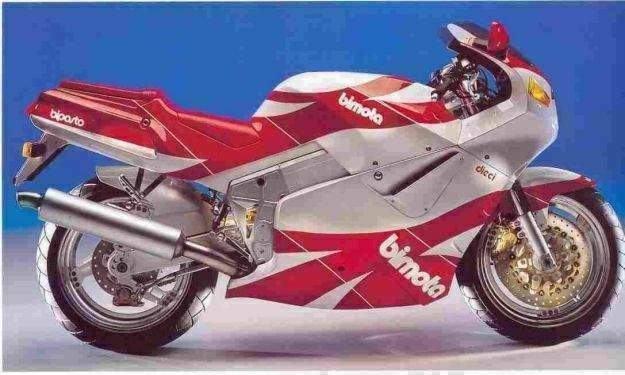
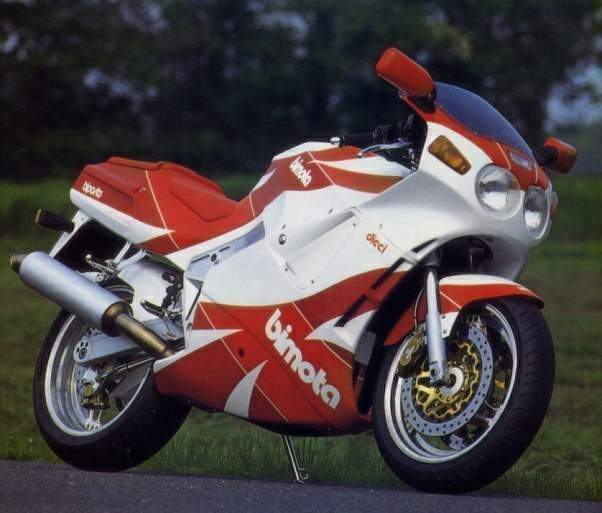
Bimota YB10 Dieci Biposto
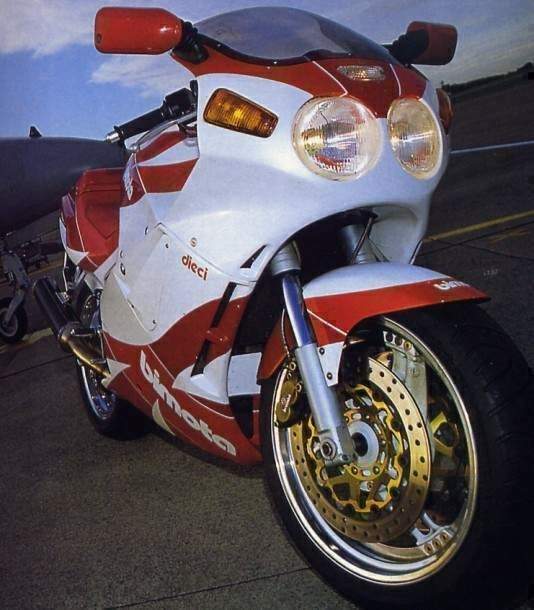
FOR YEARS it's been the ultimate Catch 22 for owners of the world's most exotic brand of sports bike. You park your shimmering Italian rocketship outside some classy watering-hole, spot a gorgeous creature alone at the bar and slide into the seat alongside,nonchalantly waving a £50 note at the barman while placing your monogrammed Bimota keyring in full view. Ten minutes' small-talk normally does the trick with the help of a two-wheeled Lamborghini — plus, if necessary, a few casual comments about falling Monaco penthouse and Argentinian polo-ponies. Your suitably impressed target is only too keen to accept the offer of a romantic dinner a deux, but then you remember - even if you could rustle-up a spare lid, the bloody bike has no room for a pillion. In reality, of course, it never happens quite like that. For one thing, owners of Bimotas and other single-seat superbikes are attracted only by the performance of their machines, and have no desire to boost their sex-appeal by dropping crass hints about personal wealth or testicular development. Oh no. All the same, the inability to carry a pillion has long been an occasional annoyance for some Bimota riders, even those who only want to drop the missus off at bingo every so often. The dual-seat Bellaria went some way to solving the problem, but for many Bimota enthusiasts a mere 600 is simply not a vehicle that one would contemplate owning. Enter the Biposto, Rimini's first big-bore bike designed for two. If the shape looks familiar that's because the Biposto is basically last year's Dieci model with a revised rear subframe, a spare set of footpegs and a thin piece of foam placed the top of a truncated tailpiece. Beneath the red and white skin is Bimota's traditional rigid chassis, consisting of tv frame spars, a swing arm made from a similarly high-spec aviation aluminium and a collection of expensive eye parts. Like the Dieci, the Biposto is fitted with upside-down Marzoc forks and the same firm's rear she unit. Front brakes are a blend of 320mm fully-floating front discs and four pot Brembo calipers. Tyres remain Michelin's Hi-Sport radials in ultra broad size the rear a 180-section cover it almost makes the bike's silly, spring-loaded sidestand redundant. They're fitted to new composite three-spoke mags to Bimota's own specifications. Holding the whole plot together is the familiar angled-forward layout of Yamaha's FZR1000 engine. A 20 valve unit is internally standard and fed by a stock bank of 40mm slide Mikuni carbs. Its output modified by Bimota's revised airb and four-into-one exhaust systi which retains Yamaha's EXl exhaust power valve system. The Italian factory claims a pov peak of 149bhp at 10,000rp slightly up on Yamaha's figure : a stock FZR, but whatever the re tive outputs it's the Bimota's adva: age in weight and chassis rigid that is likely to make most differer to performance. The Biposto's c weight figure of 187kg is far clo to that of the 179kg FZR600 than its 30kg heavier big brother. If we're talking compariso there's one new sportster that con so close you'd think its design must have used the Bimota - whi design dates back to the YB4 of 1^ - as a benchmark. Hond CBR900RR is 2kg lighter, 15n shorter in the wheelbase and hal degree steeper in its steering. 1 Fireblade is also 27bhp down claimed horsepower output of Biiposta, but you can see why iimota takes great pains to empha-ise how every piece of its chassis is natched, welded and assembled by land to ensure the best possible fit nd maximum rigidity.
Mere details, true, but important f for no other reason than to explain vhy the Biposto costs over twice as nuch as the Fireblade. Bimota's :raftsmanship is obvious in the pre-:ise welds and the immaculate finish, ind that quality makes itself felt on he road, where the tough chassis »ives the Biposto a gloriously go-jvhere-it's-pointed feel. And where i sharp twist of the right wrist sends :he bike leaping forward with a «ciousness that has you hanging snto the bars for dear life. In fact, the Bim feels fairly res-:rained under no-combat condi-:ions, thanks to a not-too-radical riding position dictated by clip-ons placed above the milled top yoke, rather than below as on the single seat Furano. The cockpit features refaced FZR dials, standard switch- gear, a steering damper forward of the headstock, and a pair of wide-set mirrors that would have been useful had one not been annoyingly limp-wristed. There's nothing remotely weak about Yamaha's FZR mill, which churns out serious stomp all the way from idle to the ll,500rpm redline. A brief blast through the countryside near Rome gave little chance to test Bimota's claims of additional power. But the Biposto did its best, leaping out of turns with as little as 3000rpm on the clock, and screaming to an indicated 160mph on the shortest of straights. The model on which this bike is based, the Dieci, recently came in for a fair bit of stick from an American mag, which after a comprehensive test reckoned its suspension was so stiff that handling was worse than that of a standard FZR. The Biposto's Marzocchi units were certainly not set-up for comfort, giving a firm ride that became harsh on a few particularly bumpy bits of Roman road. It's true, too, that there's not much scope for adjustment of the forks, which have a simple three-way knob for compression damping atop the left leg, plus a similar knob to select rebound on the right. But the upside-down legs felt immensely rigid, giving masses of stability when the big Brembos were used to their full. And the shock kept its cool despite the forces being fed into it by my 14-stone carcass and the tenacious rear Hi-Sport radial. The Biposto was much less happy when I put its two-up ability to the test with the help of a brave Italian journalist. Bimota insists that the Biposto is very much a sports bike, and that numerous rival sportsters are no better equipped. Even so, a decent grab-rail would be useful on a model that is, after all, specifically intended for use with a pillion. Those who wish to go two-up touring will still have to look elsewhere, but if you can afford £ 17,995 for the Biposto you can probably find a few grand more to back it up with something more suitable than this thinly-disguised racebike could ever be. For riders with shorter trips in mind, Bimota now produces a big-bore motorcycle that is more practical than its predecessors. And no less brilliant at all the things they have always done so well. O Source Bike Magazine of 1992
|
|
|
Any corrections or more information on these motorcycles will be kindly appreciated. |