|
|

|
|
|
|
Classic Bikes
Custom Bikes
Individual
Racing Bikes AJP
AJS
Aprilia
Ariel
Avinton / Wakan
Bajaj
Benelli
Beta
Bimota
BMW
Brough Superior
BRP Cam-Am
BSA
Buell / EBR
Bultaco
Cagiva
Campagna
CCM
CF Moto
Combat Motors
Derbi
Deus
Ducati
Excelsior
GASGAS
Ghezzi Brian
Gilera
GIMA
Harley Davidson
Hero
Highland
Honda
Horex
Husaberg
Husqvarna
Hyosung
Indian
Jawa
Kawasaki
KTM
KYMCO
Laverda
Lazareth
Magni
Maico
Mash
Matchless
Mondial
Moto Guzzi
Moto Morini
MV Agusta
MZ / MuZ
NCR
Norton
NSU
Paton
Peugeot
Piaggio
Revival Cycles
Roland Sands
Royal Enfield
Sachs
Sherco
Sunbeam
Suzuki
SWM
SYM
Triumph
TVS
Ural
Velocette
Vespa
Victory
Vincent
VOR
Voxan
Vyrus
Walt Siegl
Walz
Wrenchmonkees
Wunderlich
XTR / Radical
Yamaha
Zero
Video
Technical
Complete Manufacturer List
|
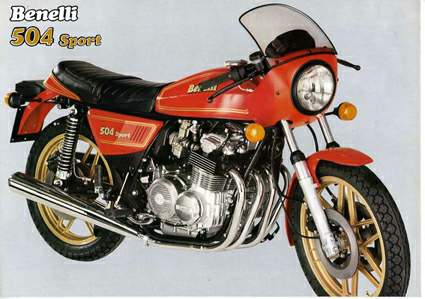
Benelli 504 Sport
Rumour holds that the old Honda CB500 four engine will fit straight into the Benelli 504's chassis. I don't know how true this is despite having owned a CB500 a long time ago. The engines do look similar and their power output is equally bland. The 500cc OHC across the frame four claims 50 horses but its delivery is so linear that it seems a lot less, there's never the feel of a motor coming on cam. Just like the old Honda, it'll put 80 to 85mph on the clock without any undue abuse, but going any faster is such hard work it's really not worth the bother. The engine responded to juvenile tacho excess by needing valve adjustments every 500 to 750 miles and putting out a flurry of secondary vibes through not just the pegs and bars but also the seat and tank. The carbs kept their balance for about 500 miles and every now and again one of the slides stuck, which made the engine hunt between 1000 and 5000 revs! Carburation always seemed slightly hesitant, a distinct delay between whacking open the throttle and the back wheel doing something. Its relatively primitive nature showed up in fuel that was never better than 40mpg. The dynamics of carburation, exhaust and combustion chamber shape were shown up when riding the 504 into a strong headwind; speed was down to 70mph and fuel up to 35mpg! The motor always felt revvy as well, I was often trying to change up another gear when I was already in top. I could never persuade the Benelli to adopt a relaxed pace to match the parameters of its performance and chassis. The gearbox, with more than 15000 miles done, was neither slick nor precise; it mirrored, in fact, some old sixties Honda hack in its application. It was not impossible to adapt to, but even then would serve up a false neutral, which buzzed the motor like its poor old heart was going to explode into a million pieces. The double cradle loop frame could have been produced by any factory anywhere in the world, but was well enough thought out to save the bike even when it was slung into desperate conditions by a sudden false neutral. The whole beast was held in check by famously stiff Italian suspension at both ends. The forks, despite their mileage still suffered from some seizing and responded to slow speed holes by sending concentrated jolts straight up my arms. The shocks did the same trick to my spine. Smooth roads held no terrors for the Benelli, it could be slung over on to the stand prongs without the Pirelli tyres giving a moment's worry. The 504 had 425lbs of mass and slow steering geometry against it in the curves, but its stability and neutrality allowed me to take outrageous risks when I was in the mood.
This stability held it in good stead on bumpy roads. The rider took a battering but the wheels held on to their line in a way that the old Honda four could never hope to emulate - it used to waddle about on soft suspension, zig-zaging from bump to bump. As the Benelli never accelerated hard nor went very fast, any test of the chassis was limited but, apart from the lack of bump absorption, I was at ease with the 504. Which is more than can be said for the drive chain. It always wanted to dissociate itself from the chassis, wore at an astonishing rate and broke three times when I tried to run them after removing links. They barely lasted 4000 miles. One time the broken chain busted into the back of the crankcases but I repaired that in-situ with good old Plastic Metal. The only other chassis horror was the way corrosion would suddenly appear from nowhere, spread like wildfire until the whole component was covered in gunge. The frame, wheels and exhaust were particularly susceptible. The front disc calipers followed the trend set by the Japanese of seizing up over the winter, but they were easily rebuilt. Pads lasted 8 to 10,000 miles a set. After a year's riding, various electrical components decided they couldn't take extended exposure to the English weather. Switches that filled with water, corroding contacts, made for amusing incidents such as the indicators flicking on and off in a psychedelic manner whilst the horn, normally nothing more than a croak, blared harshly enough to have pedestrians waving their fists in anger. The fuses either rusted to death, fell out or exploded. By the time I was able to find the energy to rewire the bike, the generator was burnt out, the rectifier had melted, the battery was devoid of acid and just about every other electrical component had to be replaced. The breakers provided a viable source of electrical components, although I stayed clear of Suzuki bits. The most difficult part was persuading someone to rewind the generator but fifty notes in the right hands solved that one. As the bike had to be stripped of all its cycle parts to access the electrical bits I took the time to rust proof and then Hammerite the frame. Some Scientific Coating's clear liquid was put on polished wheels, which meant that rather than a two hour cleaning session a week a quick wipe with a rag was all that was needed to keep them neat. A Honda CB500/4 four into one exhaust (thirty notes secondhand) was persuaded on to the Benelli engine but needed a bit of a pounding to clear the lower frame rails. It sounds lovely, but didn't increase performance.
Other complaints that could be levelled at the Benelli included a pathetic seat that went hard after 50 miles, wheels bearings that needed replacing every 6000 miles and a petrol tank that even when newish loved to rust rapidly - I'm on my third, one of them actually dropped a load of fuel over the engine. The bike sizzled for a while but resisted the urge to explode. The Benelli was quite resistant to crash damage, as long as engine bars protected the ends of the crankshaft, the demise of either extremely expensive. I've slid off on diesel a couple of times, did no more damage than batter the pegs and bars. More serious was smacking into the side of a car that shot out of a road so fast it could only have done so with the sole intention of trying to kill me. The front end hit the car, the sudden loss of momentum causing me to somersault over the cage, roll down the road a few yards and then pick myself up. I was full of craziness by then and would've torn the driver limb from limb, but the impact of the crash had warped the car's body so that none of the doors would open. There was a strong smell of petrol, so I tried to pull the Benelli out of the car with the intention of throwing a lighted match on the cage once we were at a safe distance. Fortunately for the cager, there was no way I could pull the bike out. Someone had phoned the police so there was no hope of physical retribution. When the bike was finally pulled free, damage consisted of bent forks and dented exhaust, along with a bit of cosmetic damage. The cast front wheel was still intact. His car looked a write-off so I decided not to inform my insurance company which would stop his claim dead. I had the forks straightened for £30 and cut and welded the pipes - they look a bit naff but matt black paint hides most of the damage. The smashed clock was glued back together with Superglue, as was one of the indicator lenses. This may sound dodgy but I've found it works fine from past experience. This crash occurred about three years and 12000 miles into my ownership (the clock read 19,650 miles). The only result of the damage was fork seals that didn't last for more than 5000 miles (I hadn't had to replace them before). There was so little suspension movement that the lack of damping that resulted wasn't too noticeable. Handling became more alarming when the rear shocks lost all their damping (at about 23000 miles). The back wheel would try to career off the road whenever I leant the bike over more than a few degrees on bumpy roads. It'll also jerk around after hitting a pot-hole. That was easily sorted with a pair of rather more compliant Konis. My spine was thankful for the diminution in violence of the bumps that got through the chassis. A slight weave occurred at 90mph, but this speed was never sustained for more than a few seconds so the weave had no chance of developing into a wobble. A cheap rack and massive top-box were added for a while, but that did upset the handling whenever any kind of mass was put in the box. It didn't feel safe above 60mph. One blustery day, the wind shook the back end so much I thought the swinging arm bearings were shot, but it was just the gale catching the plastic. In the end I dumped the top-box. That didn't help the touring ability. The shape of the tank meant that tank-bags slithered around all over the place, usually ending held in place by nothing more than its own weight and my knees. The only safe place to carry luggage was on the pillion perch. Once I had a bungee cord snap, wrap around the rear wheel whilst my clothes were scattered half a mile down the road. I never knew that bungee cords could be stretched so thin. Touring the bike could manage, but only 150 to 200 miles a day. Any more then it became very uncomfortable and somewhat enervating (from the vibes and revvy nature of the engine). Fuel, engine maintenance and chain wear were other variables that didn't inspire during long distance usage but the basic reliability of the engine meant I had every confidence in reaching my destination. Some Benelli motors don't last very long (I've just brought a dead 504 with only 14000 on the clock) but mine has now done 33000 miles without any major problems except for frequent doses of tender loving care. I suspect that is the determining factor in durability, neglected bikes both rusting and seizing quicker than most. Spares are so rare that it pays to track down one of the non-runners. Rarity of the 504 makes that hard work. Prices are hard to work out. There's always the odd jerk who thinks because it's rare and Italian it must be a classic worth thousands, but I bought my nice one for £450 and the non-runner for £95. That sounds about right for a machine that's slow, quick corrode and heavy on consumables. I like its looks but can't claim it approaches beauty. It runs well in town, for short blasts in the country and for moderate touring. As a cheap and cheerful all-rounder it makes the grade, as a future classic my money's on the CB500/4! Source .umgweb.com
KAWASAKI Z500 BENELU504SPORT
LAVERDA 500MONTJUIC No longer are the middleweight bikes the low-life alternatives to the last decade's expansion into the litre-plus arena of high-performance machinery. John Nutting tests three five-hundreds which for reasons of price, performance or appearance (or all three together) offer the discerning motorcyclist everything that could possibly be wanted in a machine. Photography by John Perkins and Ian Dobbie. It's not so long ago that Kawasaki
owners were the constant butt of every joke under the sun about poor handling.
But that's all changed with the introduction of the company's smallest
multi-cylinder four-stroke, the Z500. But if you think that the littlest four is just the six-fifty with all the major dimensions reduced then take a closer look. And find out the subtle details in the development of a sporting roadster for the eighties. True, the concept of the Z500 follows the theme found in most of the top-selling Japanese motorcycles of the last few years — an across-the-frame in-line four-cylinder engine mounted in a duplex-cradle chassis. In fact, on paper you'd be hard pushed to detect the major differences between the 497cc Kawasaki and the first of the smaller fours, Honda's CB500, introduced in late 1971. Both have similar power outputs, compression ratios, carburettor sizes, overall dimensions and dry weights. But the closer look reveals the ways in which the motorcycle buyer has become more demanding in the intervening eight years. And a brisk ride down a twisty lane is even more eye-opening. The Z500 is an extremely compact machine with a wheelbase of just under 55 inches and a dry weight of 4231b. It feels small, thanks mainly to a narrow 3.3 gallon fuel tank and tidy proportions around the side panels and footrests that allow the rider to place both feet flat on the ground at traffic stops. The frame itself appears conventional in that it has a large diameter backbone supporting the steering head. But it is substantially supported above the engine with massive gusset plates which effectively stiffen the front end of the structure. The front fork, a smaller version of the unit found on the shaft drive Z1000, appears also to be overly strong with leading-axle sliders with big clamps for the front-wheel spindle. At the rear, the swinging arm pivots on four needle roller bearings. The torsional stiffness of the front
fork is a real necessity when over seven inches of travel have been opted for
along with a steep Steering Head Angle of 64 degrees. Some riders might argue that the
suspension is harsh, and that's certainly true although it's not because of the
spring rates. Kawasaki have opted for an average 50 lb/in fork spring rate with
minimal preload along with ideal 901b/in rear springs. Fortunately, nothing is lost in the overall handling. The steering is excellent, being neutral and light to control whether the bike is being weaved through dense traffic or carved through tight bends. The tyres used impart confidence, being a ribbed Dunlop Gold Seal front matched with a Japanese-made TT100 at the rear, though we'd doubt if these would be much good when raced, in which role the Kawasaki most certainly will find itself. Moreover, the Z500 feels much more stable when cranked over than the CB500 ever did. And when matched to the sintered-pad disc brakes now found on all the top Kawasaki's, you have a chassis package that marks a new high for Japan. Two thin 10.8 inch diameter discs are used at the front with floating calipers while the rear unit uses the same disc but with a double piston caliper. Only criticism is of the excessive reach to the front brake handlebar lever. In performance, the Z500's engine matches the chassis perfectly. Peaking at a claimed 52bhp at 9,000 rpm with the red line marked at 9,500 rpm, it easily urges the bike to almost 110 mph flat out and puts indicated cruising speeds of around 90 mph comfortably in the grasp of the rider even when there's only small sections of open road to play with. Much of the engine's excellent power is derived from the use of double overhead camshafts and the four free-breathing 22mm-choke Tekei carburettors. Like the Z650 and the old CB500, the four-throw crank runs in plain bearings and drive is through a Morse-type chain and gears to the wet clutch. Bore and stroke are the same as the Z250; 55 x 52.4 mm. But new is the use of another Morse-type chain with an automatic adjuster for driving the camshafts. Some of the surprising snap throttle response and startling acceleration is derived from the six-speed gearbox and wide ratios. Gear change action is slick and noiseless and the 'box retains the useful neutral-finding dodge that stops you selecting second from bottom at a standstill. Kawasaki appear to have selected the gear ratios with drag racing in mind for the reve drops between gears are as similar all the way through the range instead of having a large gap between bottom and second and closing up the other ratios. In normal use though the engine is so flexible, pulling cleanly and usefully from as low as 1,000 rpm in top, that the lower ratios hardly ever get used. At the test strip though the effect
is obvious. The Z500 fires like a cannon from the gate to be easily the
quickest-accelerating 500cc machine on the market getting to 60 mph in 6.5
seconds. With no kickstart lever, it's just
as well the self starter was reliable. The engine fires up cleanly and is helped
on cold mornings by the throttle-valve lifter incorporated into the choke
mechanism. The clutch was annoying though. Like an old Triumph, it would stick
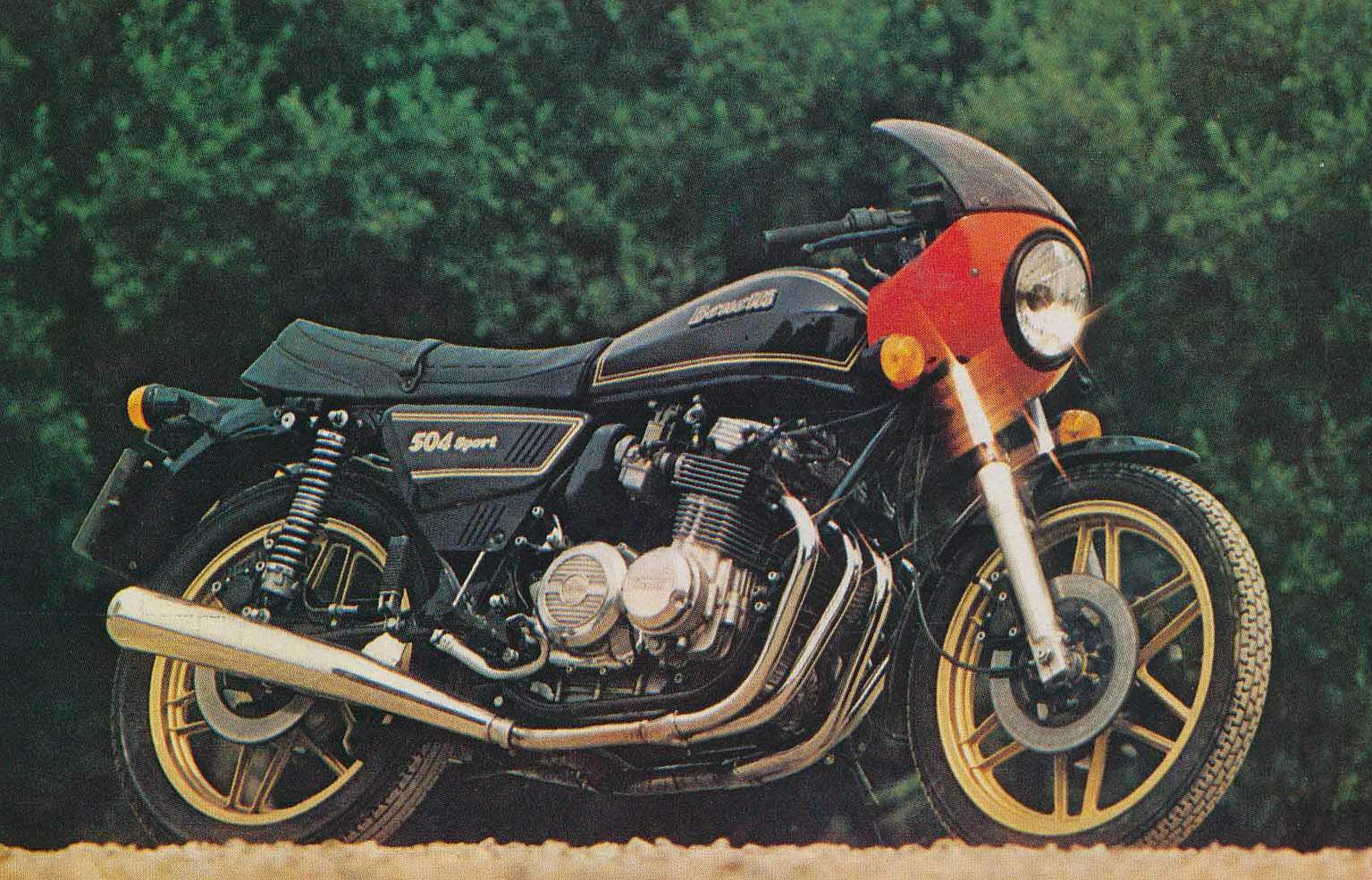
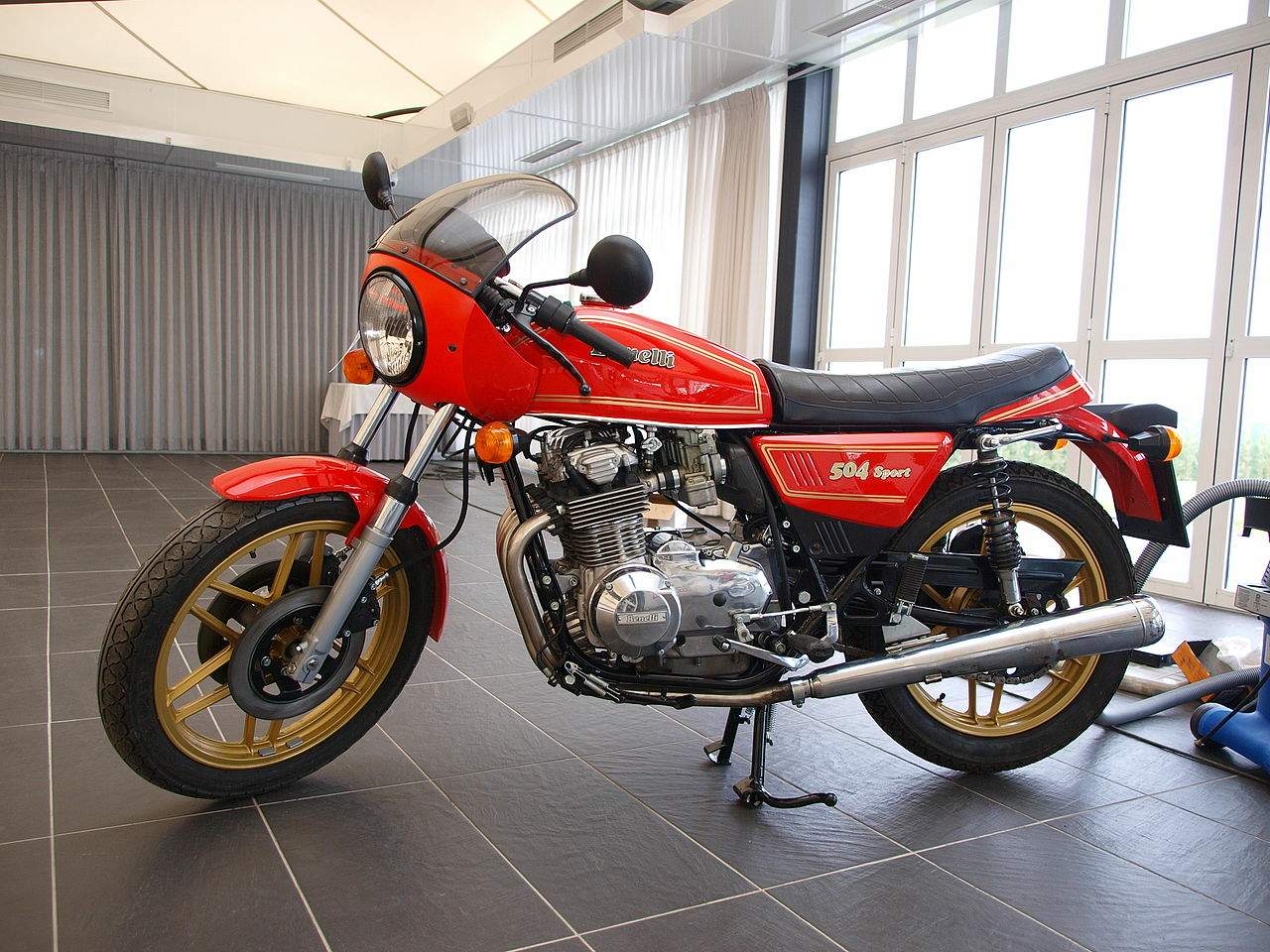
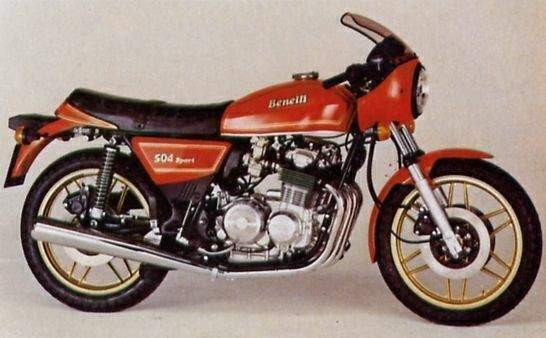
after being left overnight. One thing is sure with the Benelli 504 Sport; you could never mistake its intentions. It looks a sporting machine and in every facet of its character it acts like one. Which is a blessing for Benelli. For there's not much you could comfortably recommend in the standard version of their 500cc four. Since it is so very nearly a Honda four in the engine compartment, the machine suffers all the ubiquity of a Japanese four with the quirkiness of an Italian machine. But the 504 Sport displays style and flashiness rarely, if ever, found in Jap bikes. Finish is in a metallic black paint set off by striking gold cast-alloy wheels and a small Guzzi Le Mans. And it's a small bike that begs to be ridden fast. The power band is sharp and needs to be nursed along on the five-speed gearbox. And it's not until you're cruising above an indicated 80mph that the riding position feels at all comfortable. Otherwise the 504 Sport can be very awkward if you're not prepared to suffer the disadvantages of a super sporting motorcycle. At town speeds, the raised clip-on handlebar makes the wrists ache and the shortness of the riding position tends to be very cramped. Furthermore, the top lip of the screen obscures most of the instrumentation. Not that it matters much; it's pretty inaccurate. On top of that the bike feels sluggish unless you wring its neck, compared to the other two machines featured here. In fact, the Benelli is barely slower than the Kawasaki in a flat-out dash, mainly because of the wind-cheating riding position, with a top speed of around 108 mph. (We saw 115 mph once on a long downhill section of road.) Most of the problem is in the heaviness of the throttle return springs and the inflexibility of the engine. Both of these conspire to give the rider the impression that the bike is dragging a dead weight behind it.
Once into its best area, that is, when the rev meter is hovering in the 6,000 to 9,000 region, the 504 perks up appreciably and the real meaning of Italian motorcycling rings true. Like the Honda engine that the Benelli was copied from, the 504 Sport's motor is an overhead camshaft four-cylinder unit with the crankshaft running in plain bearings. Like the Kawasaki too, it has a Morse-type primary drive to a countershaft in the bottom crank-case-half with a set of drive gears to the clutch. Gearbox is a five speeder, the change being effected via a linkage, and the final drive is by a conventional Regina chain, unlike the Kawasaki's sealed roller chain. There are few changes to the 504 to bring its power from the 47bhp of the 500LS to a sportier 49bhp at 8,900 rpm. Bore and stroke remain the same at 56 x 50.6mm, though the pistons pump the compression up to 10.2 to 1 and the camshaft has more lift and overlap. Gearing is the same as the LS giving 5,900 rpm at 70mph. Apart from the use of alloy wheels and the interesting adoption of the Moto Guzzi linked braking system, there are few changes to the chassis either. At speed the bike feels taut and stable thanks to a shallow Steering Head Angle and a low centre of gravity. But the suspension is mismatched and that same front end geometry leads to a measure of resistance when you're hauling the bike from lock to lock at speed through the twisty bits. The front fork is under-damped, leading to some choppiness over bumps, a feature that is in conflict with the rear suspension which is undeniably hard. It could well do without this as the seat is similarly rock-like. Not that this necessarily detracts from the enjoyment of the Benelli. The four-into-two exhaust emits a jubilant growl and the hand controls are slick and easy to use. But there are enough annoying aspects of the Benelli to make the £1,742 list price only appealing to the true devotee. The connected braking system, in which the right-hand Brembo disc brake and the rear disc are operated by the foot pedal, isn't as powerful as we'd like. With so much braking area on tap and pleasant experiences of the system on bigger Guzzis we'd be inclined to think there was something wrong on the Benelli's. Also there was much too much engine
vibration getting through to the rider's feet. And neither was the bike very
economical with only 46.3 mpg overall.
Detailing is poor. The switchgear could have been much easier to use and the
energy expended in designing the ignition cut-out switch operated by the prop
stand (a real necessity since you can't see the stand from the seat) could have
been directed in this area. How do you transform an ordinary
motorcycle into a popular classic? Perhaps you refine it over a number of years
to make it appeal to the widest possible number of potential buyers. The proof? The Laverda Montjuic has been outselling the standard 500cc Alpino by three to one. And this is despite the race-replica being the most expensive 500 on the market at a shocking £2,095. But such is the appeal of a
super-sporting machine with a proven record in competition. And Laverda were
always aware of it since the lamented demise of the SFC, the production racer
based on the factory's now obsolete 750cc SF twin. The British Laverda importers have always adopted a more cavalier approach. And no sooner did they prove the reliability of the basic eight-valve double overhead camshaft Alpino unit by pulling off an impressive one-two in the 500cc class in the 1978 Barcelona 24-hour race at Montjuic Park than they realised that they were onto a winner in the home market. Furthermore they also realised that if they could offer a high performance 500cc machine in road trim, it would qualify for the tight production racing regulations currently enforced in UK meetings and beat the Yamahas previously dominating the class. They were right and the Montjuic sales have boomed. Competition record apart though it's
not difficult once you've ridden a Montjuic, to realise why the bike's so
appealing. It's got the purposefulness of a BSA Gold Star and the style of the
old SFC, which incidentally it can outperform comfortably. The frame is stock and retains the same Marzocchi suspension front and rear. The basic engine and six-speed transmission are unaltered too. However, the pistons give a compression ratio of 10.2 to 1 and the camshafts have revised timing with the effect that the compression pressure is upped to 150 psi from 115 psi. To cope with this the 32 mm choke downdraft Dellorto carburettors are recalibrated and the air cleaner is dispensed with while a megaphone-type extractor exhaust system to suit the cams also gives extra cornering clearance. The extra cranking pressure has had its effect and though the electric starter motor is retained and normally copes with its job well, the battery is soon to be uprated to make it foolproof. The overall result of the tuning changes is to up the power considerably and raise the maximum power revs to between 9,200 and 9,500 rpm. Importer Roger Slater has yet to put one of the engines on a dynomometer and will no doubt say that the engines make enough power to win the races they're after for publicity, but we'd confidently predict that it must be in the 55bhp region at the back wheel. Few would argue with that since owners have been complaining that they are running over the factory-stipulated rev limit of 9,500 rpm in top gear with the stock gearing of a 42 tooth rear sprocket - which gives 116 mph. Given the use of a 40-tooth sprocket the 125 mph that Slater claims for his bikes should easily be in reach. After all, with a 38 tooth sprocket in the Island this year their own bike was clocked at 129 mph through the Highlander and the 9,600 rpm that Peter Davies saw on the rev counter compares with the computed figures. What's more the bike went to 10,300 rpm on the drop to Brandish. That's 139 mph. . . In day-to-day use such heady performance figures are neither here nor there. And anyway there's little chance of proving them since Slater invariably uses the demo Montjuic as a spare for racing. So we tried a bike belonging to John Owen, one of Hexagon of Highgate's happy customers. A far too brief ride was enough to confirm that the Montjuic is indeed bound for a pla e in the motorcycling histoiy books. Laverdas have always been favoured for their good handling but the Montjuic raises the standard to new heights. It feels low and small, not surprising since the racing-style seat measures barely 30 inches from the ground. The handlebar is the same adjustable unit found on the Jota and along with the beautifully engineered and equally adjustable rear-set footrest controls, the riding position is perfect for fast and relaxed riding. But the bike is loud. In town you have to take real care to keep the noise down if you've any sort of conscience. Though we weren't able to test the decibel level it must break the limit quite easily. Fortunately the engine doesn't baulk at poodling around town should you be in a sensitive state of mind. The engine is very flexible, 2,000 rpm. It's very smooth too. Like the Alpino, the Montjuic's power unit has 180-degree throws and is strongly supported in four ball bearings. And to tame any vibration that might exist, a small counterbalancer geared to the crankshaft in the primary drive case offsets the rocking couple inherent with this sort of engine. Result is that the motor spins happily through the gears up to well over the 8,000 rev counter red line with no more fuss than a slight rattling of your eardrums. Complementing the performance the handling and suspension are tight and taut as you might expect of a machine that has been trimmed down to about 350 lb dry without changing the spring rates. And for the same reason the three Brembo disc brakes have no trouble in hauling up the lightweight bike from speed. Neither is the machine finicky. John Owen Reckons he has been getting 55 mpg in the 2,000 enjoyable miles he's run the machine. If you can live with such single-minded exotica, the Montjuic is an obviously rewarding machine to own.
|
|
|
Any corrections or more information on these motorcycles will be kindly appreciated. |