|
|

|
|
|
|
Classic Bikes
Custom Bikes
Individual
Racing Bikes AJP
AJS
Aprilia
Ariel
Avinton / Wakan
Bajaj
Benelli
Beta
Bimota
BMW
Brough Superior
BRP Cam-Am
BSA
Buell / EBR
Bultaco
Cagiva
Campagna
CCM
CF Moto
Combat Motors
Derbi
Deus
Ducati
Excelsior
GASGAS
Ghezzi Brian
Gilera
GIMA
Harley Davidson
Hero
Highland
Honda
Horex
Husaberg
Husqvarna
Hyosung
Indian
Jawa
Kawasaki
KTM
KYMCO
Laverda
Lazareth
Magni
Maico
Mash
Matchless
Mondial
Moto Guzzi
Moto Morini
MV Agusta
MZ / MuZ
NCR
Norton
NSU
Paton
Peugeot
Piaggio
Revival Cycles
Roland Sands
Royal Enfield
Sachs
Sherco
Sunbeam
Suzuki
SWM
SYM
Triumph
TVS
Ural
Velocette
Vespa
Victory
Vincent
VOR
Voxan
Vyrus
Walt Siegl
Walz
Wrenchmonkees
Wunderlich
XTR / Radical
Yamaha
Zero
Video
Technical
Complete Manufacturer List
|
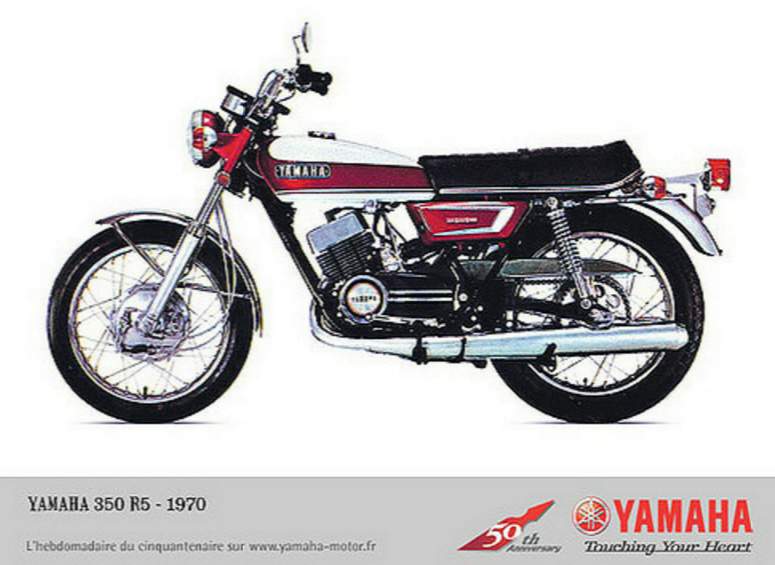
Yamaha YR5
Beginning with single-cylinder engines, Yamaha gravitated to an air-cooled
parallel twin two-stroke engine beginning with the YR3. The R5 was preceded by
the YR3 and was succeeded by the RD350, RD400, and RD400 Daytona. The R5 had
port induction for the intake and the RD350 had reed-valves.
Memories can be so misleading. As I turned on the 350cc twin's ignition and unfolded the kickstart for the first time, my head was already spinning with thoughts of good times aboard previous Yamaha two-strokes. The acceleration of my old race-tuned RD400C; the brilliant 350LC that I once thrashed across Europe; the spine-tingling scream of a 350 Power Valve with its throttle wound back to the stop. This time wasn't quite like that. The motor crackled into life easily, and a few minutes later I was cruising contentedly along at about 60 mph (97 km/h). But when I came to a straight and cracked open the throttle, the Yamaha's acceleration was gentle rather than dramatic. And when I reached the first good bend, my expectations of nimble handling were shattered by the reality of this bike's grabby front brake, diving forks, and rather vague steering. That's what happens when you mix memories of bikes spanning over a decade. Or, even worse, when you fall into the trap of judging a classic machine by modern standards. This Yam was in good nick with just 12,000 miles (19,300 km) on its clock—but it was, after all, a twin-cylinder bike built as long ago as 1970, and with a peak power output of just 36 BHP at 7000 RPM. Expecting it to provide blood-curdling acceleration all these years later was just a little unfair. The YR5—known simply as the R5 in the States—was a real star in its day, though. Yamaha came late to four-stroke super-bikes, releasing its debut model, the XS750, only in 1977. But the firm's dynasty of two-stroke middleweights provided some of the great bikes of the Seventies and Eighties, with a near-unbeatable blend of performance and value. And while the RD400 and the later, liquid-cooled LCs are more familiar to most riders, the models that started the legend were the air-cooled RD350 and the YR5, its look-alike predecessor.
In 1970, the year the this model was launched, Rod Gould won Yamaha's fourth 250cc world championship, following fellow Brit Phil Read's three titles in the Sixties. Its design could be traced back to the YR1 of 1967, and was shaped both by racetrack development and by Yamaha's smaller roadsters. The YR5 was the biggest of a visually near-identical family of 250, 200, and 125cc twins. Like the smaller models, the YR5 used a piston-ported, 180-degree crankshaft motor, in this case with dimensions of 64 x 54 mm for a capacity of 347cc. Yamaha claimed that the YR5's steel, twin-downtube frame was designed using knowledge gained through racing, where privateer Yams were already becoming popular. Suspension was the typical combination of narrow forks and preload-adjustable rear shocks, holding 18-inch diameter wire-spoked wheels. Brakes were drums at both ends, with a twin-leading-shoe unit up front. Skinny and simply built, the YR5 weighed just 150 kg (330 lb) with half a tank of fuel, and at a standstill it felt light and maneu-verable. Its mixture of burbling, rattling tickover noise and the unmistakable smell of two-stroke oil brought back memories of other Yamahas. For what was in its day a hard-and-fast sportster, the handlebars seemed ridiculously high. Forward-set footrests and the thick dual-seat added to the almost relaxed feel. So did the YR5's straight-line performance, for the little twin didn't come close to providing the high-revving thrills that I had expected. Why I had, I'm not quite sure. Some modern 125cc sportbikes make almost as much power, after all. Flat-out on an open road, the less-than-aerodynamic YR5 ran out of steam before 100 mph (160 km/h) however hard I tried to hide behind the clocks. At least the Yam had a broad spread of power, pulling cleanly and fairly smoothly from below 3000 RPM to the red-line. That enabled it to cruise at an indicated 90 mph (145 km/h), though hills would knock that figure down to 85 mph. High speeds soon became tiring, of course, thanks to wind blast from the upright riding position. Comfort was much better at slower speeds, though the YR5 didn't like being treated too gently. American riders who stuck to the freeway speed limit found spark plugs prone to fouling. Contemporary tests described the YR5 as a quick-handling machine, with its weight down low, good suspension, and excellent traction from its tires. This YR5's handling was certainly fairly quick. Despite the bike's 18-inch front wheel and old-fashioned steering geometry, the combination of light weight, wide handlebars, and narrow front tire meant it could be flicked into bends rapidly and effortlessly. Underdamped suspension at both ends ensured that it wasn't a good idea to get too aggressive, though. The soft forks and the Yam's rear-end weight bias made the YR5 feel very twitchy at the front, while even fairly modest cornering speeds had the rear end wallowing, too. Doubtless this bike's shocks had deteriorated with age, but even so it was obvious why so many riders fitted after-market units. This bike's front drum brake had plenty of power but was rather fierce, especially considering the narrow, ribbed front tire through which its power was being transmitted. Despite the tires, it wasn't hard to get the footpegs touching down. In case all that sounds too critical, I should add that riding the YR5 was still great fun, at least on a-twisty road, provided allowances were made for its age. And that's how it should be— because make no mistake, this was the poor boy's superbike of its time. Back in 1971, when this particular machine was built, it would have taken a well-ridden example of Honda's CB750 to stay ahead of the screaming stroker on anything but a long straight road. The same could be said of this bike's two-stroke successors such as the RD350, RD400, and RD350LC, as they continued to give larger bikes a difficult time for many more years. They were fast, furious, light, agile, good-looking,"and unbeatable value for money. Just like the original YR5 itself. From Cycle World, jun. 1970 "Winding roads, downtown traffic or 70 mph freeway grind, nothing seemed to make much difference to this stout two-stroke. Power is on tap from well down in the rev range to around 8000 RPM, where it begins to taper off. Mid range torque is noticeably better than with previous models, as the R5 pulls like a 500 when you twist the grip in fifth. The R5 may be described as a quick handling machine. As it has most of its weight down low, there is little top hamper to inhibit the rider from pitching the machine aggressively through his favorite set of bends... We would like to see the wheelbase extended slightly to slow down the quick handling and put more weight on the front wheel. The R5 offers substance, as well as appearance. Within limits, it will do things most of the more expensive superbikes will do, at lesser cost but equal fun value." Source Superbike of the seventies
|
|
|
Any corrections or more information on these motorcycles will be kindly appreciated. |