|
|
|
|
Classic Bikes
Custom Bikes
Individual
Racing Bikes AJP
AJS
Aprilia
Ariel
Avinton / Wakan
Bajaj
Benelli
Beta
Bimota
BMW
Brough Superior
BRP Cam-Am
BSA
Buell / EBR
Bultaco
Cagiva
Campagna
CCM
CF Moto
Combat Motors
Derbi
Deus
Ducati
Excelsior
GASGAS
Ghezzi Brian
Gilera
GIMA
Harley Davidson
Hero
Highland
Honda
Horex
Husaberg
Husqvarna
Hyosung
Indian
Jawa
Kawasaki
KTM
KYMCO
Laverda
Lazareth
Magni
Maico
Mash
Matchless
Mondial
Moto Guzzi
Moto Morini
MV Agusta
MZ / MuZ
NCR
Norton
NSU
Paton
Peugeot
Piaggio
Revival Cycles
Roland Sands
Royal Enfield
Sachs
Sherco
Sunbeam
Suzuki
SWM
SYM
Triumph
TVS
Ural
Velocette
Vespa
Victory
Vincent
VOR
Voxan
Vyrus
Walt Siegl
Walz
Wrenchmonkees
Wunderlich
XTR / Radical
Yamaha
Zero
Video
Technical
Complete Manufacturer List
|
Yamaha XV 1000 Virago
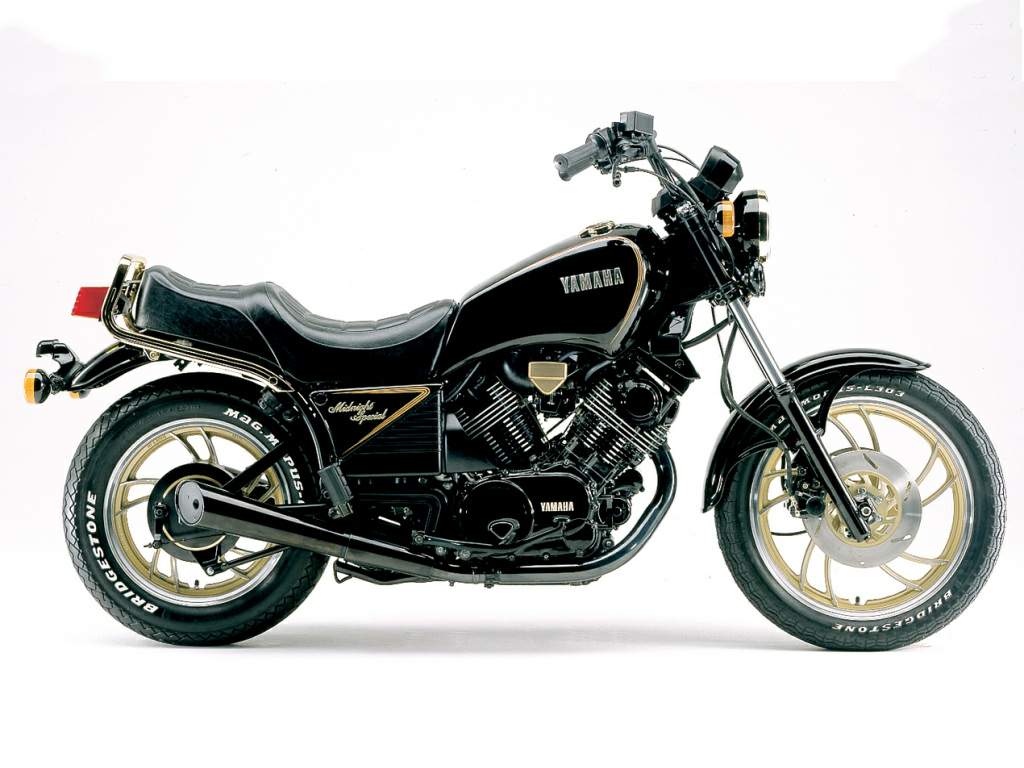
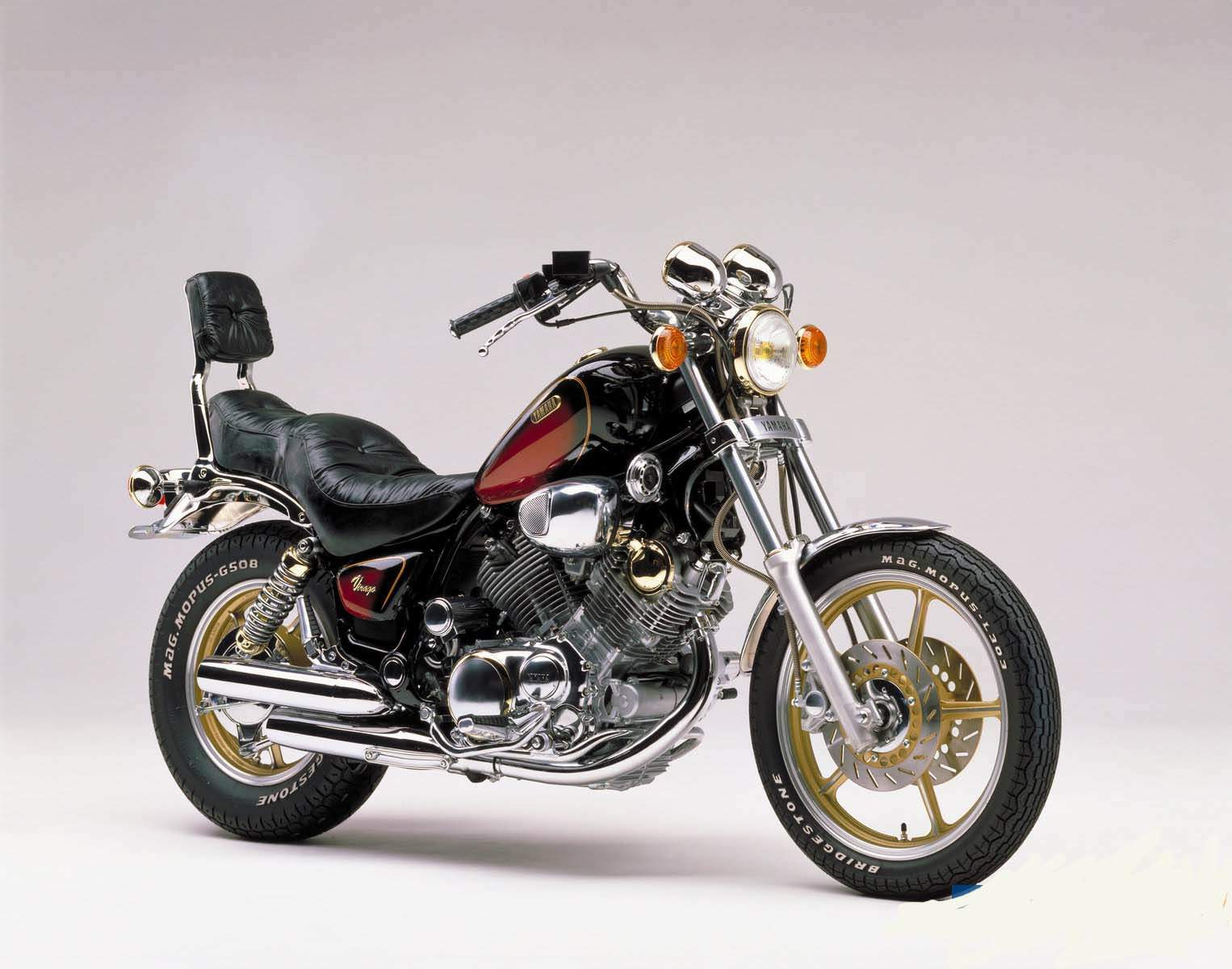
Set against the jet black of the newly paved parking lot, the Virago 1000 stood out like a silver-and-gold-sequined sore thumb. A bystander spectator might be a better description moved thoughtfully around the bike, letting his eyes wander from one sparkly detail to another. "'Well." he said after an appropriate pause, "the) finally got it right." Boy, have they. Yamaha, the Oriental company that first realized the sales potential of the chopperesque factory custom, has pulled out all the stops on this one. Company officials say that this third-generation Virago has benefitted from styling changes designed to make it look more "American." But we all know what that means: from its liter-sized slab of a V-Twin engine to its teardrop-shaped gas tank to its staggered, dual exhaust pipes to its undulating saddle replete with sissybar. this Japanese cruiser fairly shouts Harley-Davidson. And while Yamaha's spokesmen publicly stick to the company's "it's American, not Ilarley" position, behind corporate doors they're happily rubbing their hands together and sending Telex messages back to Japan requesting that I985"s allotment of Viragos be increased and pleading that the styling not be messed with, whatever it might be called. The Harley-look Virago, sou sec, is one of Yamaha's sales successes of ll)84. Company warehouses, which in the past have been piled high with the aftermath of Yamaha's explorations into styling never-never land, are empty of Virago 1000s (though sales of the less-flashy 700cc version have been lagging). Most dealers have already sold their last model and are clamoring for more. Purists who still dismiss cruiserbikes as some kind of tarted-up fad ought to look at the sales figures for a moment so the) could learn that these hikes are what .American riders want. And for more graphic proof, they should ride the Virago, then park it, well, just about anywhere. Within minutes people will be ogling the bike, asking questions, praising the styling and, more often than not, finishing their comments with. "Sure looks like a Ilarley." That last statement is delivered not with contempt, but rather matter-of-factly, almost as if the statement were synonymous with, "Sure looks nice." In fact, during our 2000-mile-long test of the Virago, a period that included countless roadside critiques, no one had anything but good words for the bike's styling, and most fell in love with it. If the Virago were a movie, Steven Spielberg would have directed it; that's how popular this bike seems to be with mainstream America. Certainly with previous Viragos, Yamaha has had the potential to build a genuine kick-ass American cruiser, but never quite delivered on the promise. Introduced in 1981 as a shaft-drive, Monoshocked 750, the first Virago was a steady if not spectacular seller. Augmented in later years by a 920cc version whose acceptance was at first hampered by video-arcade instrumentation, the Virago line always seemed to lack that certain spark of styling excitement. One tester went as far as to call the bikes "almost invisible." That styling mistake was not made this year. Chief among the cosmetic changes, or at least the moist commented on, is the gold trim that is spread around the bike. Yamaha has used gold-look plating before, usually on the inline-Four Midnight Specials, but never has its use been so blatant. When it came time for the stylists to decide which parts would get the plating (which is done by a process that Yamaha is very secretive about, saying only that real gold is not used), it seems they marked everything that was round for the treatment. The headlight rim, the rims around the turn signals, the instrument bezels, the locking gas cap, the rings around the fork sliders, the shock collars and the rings and emblems on the clutch and alternator covers were all colored gold. Keeping with the if-it's-round-it's-gold theme, the Virago's new-style cast wheels and even the edges of the front brake discs were sprayed with gold paint. What wasn't gold-plated was chromed, and the whole affair is topped off by sidepanels and a gas tank painted a bright red that Yamaha has the nerve to call Romanesque Crimson. But don't get tricked into thinking that Yamaha simply hoisted some gold- and chrome-plated trinkets out of the parts bin in order to transform the plain-Jane 920 Virago into a lOOOcc (actually 981cc) boulevard beauty. There are be-low-the-skin changes as well: the frame, for instance. In the past, Viragos used a frame with a pressed-steel backbone that housed the single rear shock and the air-cleaner assembly. That frame is history this year, replaced with one of similar design that still uses the engine as a stressed member. The difference is that the new Viragos have done away with the air-adjustable Monoshock suspension in favor of more-traditional twin rear shocks. The dual dampers are adjustable only for spring preload and rebound damping, and offer 3.8 inches of travel. This repositioning of the rear suspension components allowed more space for the engine's intake plumbing; and Yamaha took advantage of the situation by mounting the air filter a la Harley-Davidson on the right side of the engine, between the 75-degree vee-spread. The filter gets its own chromed cover and a similar cover graces the left side of the engine. That matching cover houses the intake opening for an air-induction system that delivers air into the exhaust ports to help the engine burn its fuel more efficiently. Also housed in the left cover is a decompression valve intended to minimize backfiring when the big Twin's throttle is rolled off. Yet another change afforded by the frame modifications is the inclusion of a half-gallon fuel tank just below the seat, augmenting the 3.3-gallon main tank. Gas drains from the main tank into the sub-tank, where an electric pump moves the gas up to the carburetor float bowls. Fuel tanks under seats aren't new innovations, of course: Gold Wings have had them for years to lower the center of gravity, and Honda's Magna and Shadow cruisers, like the Virago, use them so the main tank can be kept stylishly small. What is new here is the addition of an electrically operated petcock instead of the conventional spigot-type. When the engine starts blubbering, rather than fumble around under the tank for the petcock, the rider simply moves a switch on the right handlebar control pod from On to Reserve; from that point he has about eight-tenths of a gallon of fuel remaining. A red warning light in the tachometer face reminds him that the fuel is running out. Leading the retinue of gold and chrome down the road is a kicked-out front fork (the 920 Virago's steering an gle was 30 degrees, the 1000's is 32 de grees) that is longer than previous rago units, although travel is increas only a tenth of a inch to* 5.9 inches. The fork has no damping adjustments, but air can be added, through a single fitting on the left tube. Also new for '84 is an integral fork brace and twin, undrilled, unslotted brake discs. Even the brake calipers, which are painted silver with a touch of chrome, are new. Of course, all this talk of gold and chrome and changes just for the sake of styling sends purists—and you can count a lot of motorcycle journalists in that group—into a tizzy. They also point an accusing finger at cruiserbike ergonomics and the fact that those motorcycles won't unkink a swervy piece of asphalt with the consummate ease of a genuine sportbike. For those reasons, cruiser^ style bikes have often received a la basting in road tests, and some magi zines have even gone so far as to poke fun at the bikes and the people who b^R them. But those reviewers have missea the point, if not the entire boat. Not every motorcyclist in America has—or wants—a set of scuffed-knee roadrace leathers hanging in the hall closet, nor do many riders commute 50 miles each way, every day. And there is a sizable constituency out there that likes to be able to see a motorcycle's entire engine, not have it secreted away behind body panels and a cloak of fiat-black paint. Those same people like a bike that has real fenders, not an abbreviated plastic tail section. They like low seats and chromed exhaust pipes and round instruments and handlebars that reach out for them instead of the other way around. All of which is not to say that the Virago doesn't have its shortcomings. It does. The most glaring of these is the rear suspension. On anything but the smoothest of roads, the KYB-built shocks are simply overworked. The shocks have a soft spring rate for a smooth ride, but even with the preload set to its firmest setting, the rearsuspen-sion bottoms easily and gives a harsh . Adding luggage or a passenger just jravates the condition. Ride the Virago fast over a bumpy road and you'll a§gn be on a first-name basis with the chiropractor. Thankfully, the front suspension is better; it, too, is soft, but at least air can be added to firm things up. Ten psi worked well for general use, 15 psi was about right when the going got faster. Braking, or rather braking feel, also came under fire. "Vague" and "requires a lot of effort" were typical comments from our testers. Certainly a healthy stomp on the rear pedal is needed to get the stopping process underway. And that brake pedal—at 18 inches, one of the longest in motorcycling—does bend a little when heavy pressure is applied, a trait that doesn't help brake feel one bit. Up front, it's a fairly long reach from the right handlebar grip to the brake lever; and once you do get there and pull on the dogleg lever, there's not much difference between a gentle roll to a stop and a full-on screecher. Hard to modulate, in other words. The seat/handlebar/footpeg relationship also can be a pain. The key word here is can. Around town and on short highway excursions—situations in which the bike will spend most of its time—everything is hunky-dory. In fact, for that kind of riding the ergonomics are near-perfect. Ride the Virago for much longer than an hour, though, and you'll be singing a different tune. Like on nearly all cruiserbikes, the Virago's low seat, high-rise handlebar and far-forward footpegs mandate a bolt-upright seating position, so bracing yourself against a 60-mph headwind quickly becomes tiring. The seat itself, a master of deception if ever there was one, does its part to increase the long-distance discomfort quotient. Not only is the seat covered with bunched-up vinyl intended to look like wrinkled leather, but it has a cleverly disguised pleat between its rider and passenger portions that makes the one-piece saddle actually look like the seat and fender-pad combo used by those bikes from Milwaukee. Then there are the upholstery buttons attached to the seat and the sissy-bar pad that are, in reality, merely embossed into the vinyl. But the crudest hoax of all is that this seat, which looks so cushy, so inviting, turns into a thinly padded pretender once the tripmeter spins past the 75-mile mark. Again, the seat is perfectly acceptable around town; but riders who like to travel in the Then Came Bronson touring mode would do well to add a couple of inches of padding to the seat. A small windshield and a duffel bag to lean against wouldn't hurt, either. Handling is a mixed bag, as well. To be sure, the Virago, with its raked-out front end and 19-inch front wheel, won't cut and thrust with the tucked-in, 16-inch-shod street-racers. Nor was it ever intended to. What the Virago will do is scoot down a backroad at a brisk pace with a minimum of effort. Push harder, though, and the bike signals its displeasure by wagging its rear end—those less-than-adequate shocks at work again. Before that point, however, the Virago tells you to slow down and enjoy the scenery by dragging its footpegs in corners. Actually, the pegs are mounted extremely low in order to complement the low-rider seat, making them the easiest to grind of any footpegs in recent memory. But considering the Virago's intended market, footpeg-drag-ging is way out of context. Riding the Virago at a sane backroad pace, however, is not out of character, and much of the reason why is its engine. Because while it's possible to level criticisms at the bike's ergonomics, handling and, for some, its styling, finding fault with this lovable hulk of a V-Twin motor is hard indeed. The key ingredient in all this friendliness is torque. Peak horsepower for the 1000 is achieved at 6500 rpm, but the engine makes its maximum torque way down at 3000 rpm. Real-world translation: Snick the Virago through its five-speed gearbox as soon as possible and leave it in top gear. From 35 mph up to its top speed, the Virago doesn't need to be downshifted, even in passing situations that have liter-sized sportbikes cranking down two cogs. Changes to the two-valve V-Twin engine throughout the Virago's production run have been minimal, and the 1984 edition is no different. A 3mm increase in cylinder bore takes care of the 61cc displacement boost, but almost every other aspect of the engine remains the same. The electric-start mechanism has been beefed up in response to problems some 920 owners were experiencing with the unit, and overall gearing is slightly taller. That's about it for engine updating, a reflection that Yamaha got the basic design right the first time and that Virago owners aren't necessarily interested in having a bike with cutting-edge technology. Technical innovation it may not have, but you'd be hard-pressed to find an engine easier to live with. It chuffs to life easily in the morning and is warmed up even before the first run through the gears. Although the engine is solidly mounted in the frame and doesn't benefit from any counterbalancers, vibration really isn't a problem up to about 4500 rpm. Past that speed and up to the 7000 rpm redline, the shaking can be annoying. Still, 4500 rpm in top gear translates to an indicated 84 mph: Go any faster and you've probably got more to worry about than vibration. About the only negative comment that can be made in regards to the engine is that the rear cylinder weeped a small amount of oil onto its fins. Nothing drastic, just enough that a pass with a shop rag was needed every 500 miles or so. And despite the decompression valve under the leftside chrome cover, the Yamaha still backfired: no loud bangs, just a series of snaps, crackles and pops, as though the Virago were the world's largest Rice Krispy. In a way, though, the backfiring just adds to the engine's character. Because despite anything you may read to the contrary in the Laverda test elsewhere in this issue, the Virago's engine is one Oriental powerplant that has soul, a quality that often gets left out in the rush for the latest techo-marvel widget or the quickest quarter-mile time. It's that endearing aspect of the Virago, in concert with its Milwaukee-flavored styling, that lifts this motorcycle past all other Japanese cruiserbikes. You see, the Virago may have Made in Japan stamped on its steering head, but deep down, this chrome-and-gold charmer is red, white and blue through and through. 0Source Cycle World 1984
|
|
|
Any corrections or more information on these motorcycles will be kindly appreciated. |