|
|
|
|
Classic Bikes
Custom Bikes
Individual
Racing Bikes AJP
AJS
Aprilia
Ariel
Avinton / Wakan
Bajaj
Benelli
Beta
Bimota
BMW
Brough Superior
BRP Cam-Am
BSA
Buell / EBR
Bullit
Bultaco
Cagiva
Campagna
CCM
CF Moto
Combat Motors
Derbi
Deus
Ducati
Excelsior
Fantic
GASGAS
Ghezzi Brian
Gilera
GIMA
Harley Davidson
Hero
Highland
Honda
Horex
Husaberg
Husqvarna
Hyosung
Indian
Jawa
Kawasaki
KTM
KYMCO
Laverda
Lazareth
Magni
Maico
Mash
Matchless
Mondial
Moto Guzzi
Moto Morini
MV Agusta
MZ / MuZ
NCR
Norton
NSU
Paton
Peugeot
Piaggio
Revival Cycles
Roland Sands
Royal Enfield
Sachs
Sherco
Sunbeam
Suzuki
SWM
SYM
Triumph
TVS
Ural
Velocette
Vespa
Victory
Vincent
VOR
Voxan
Vyrus
Walt Siegl
Walz
Wrenchmonkees
Wunderlich
XTR / Radical
Yamaha
Zero
Video
Technical
Manufacturer List Contact
|
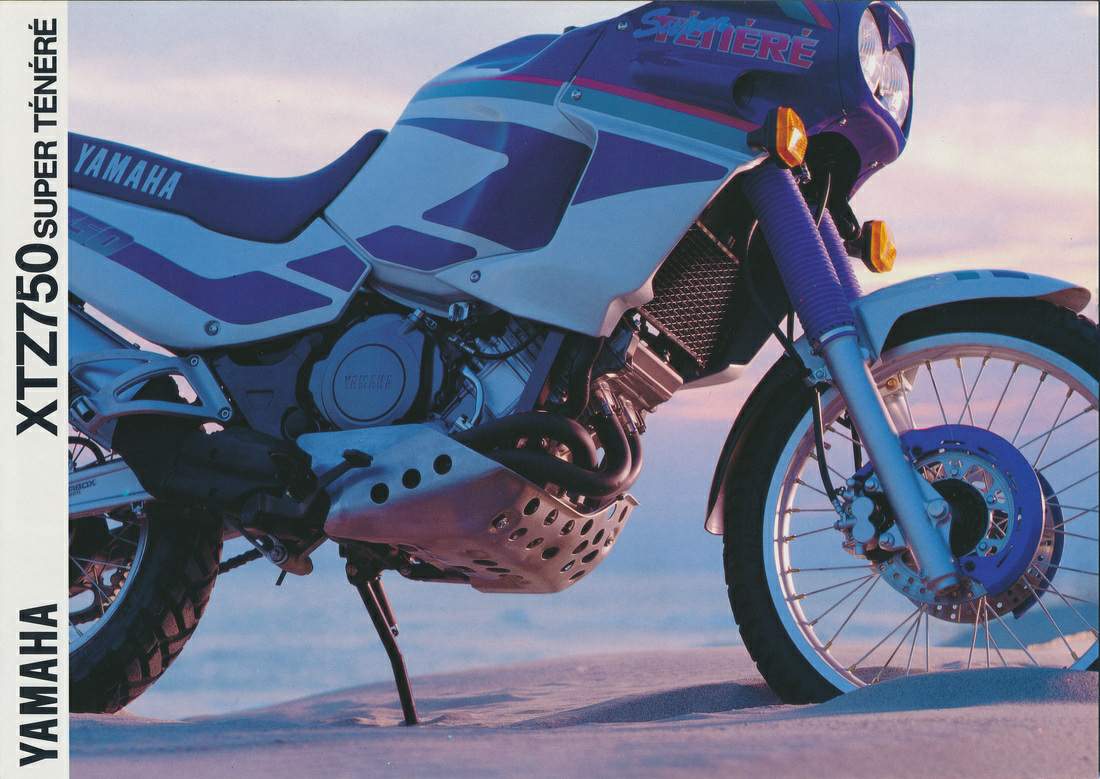
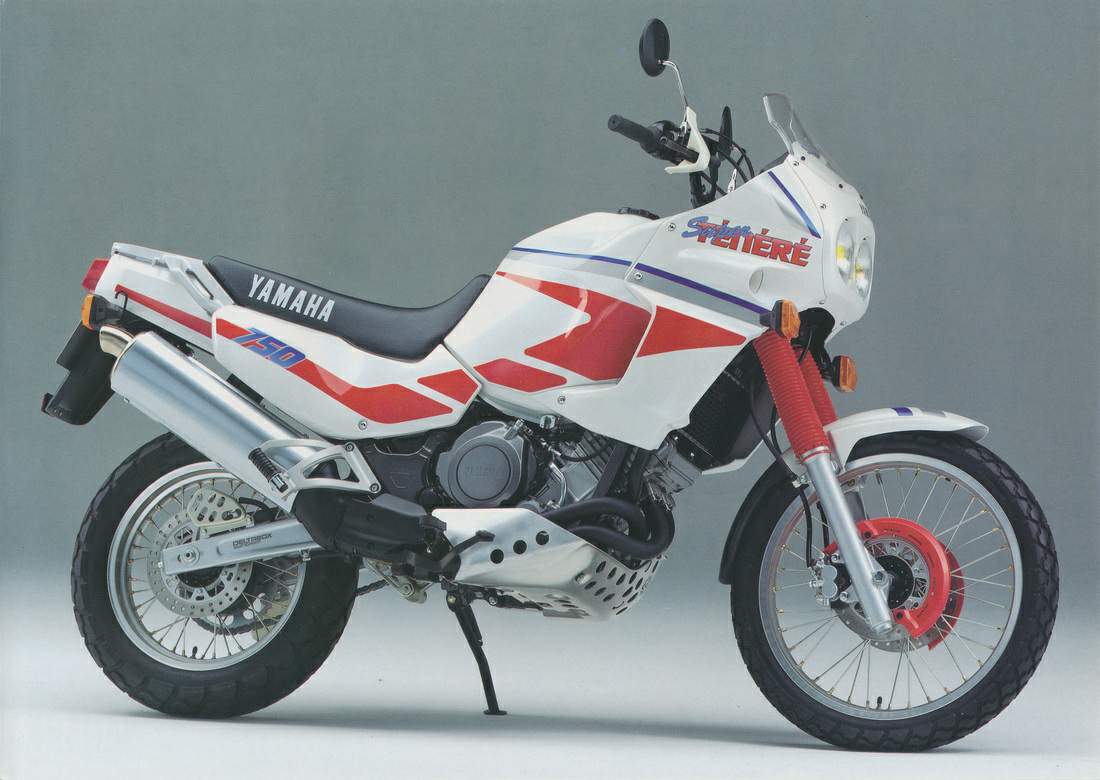
Yamaha XTZ 750 Super Ténéré
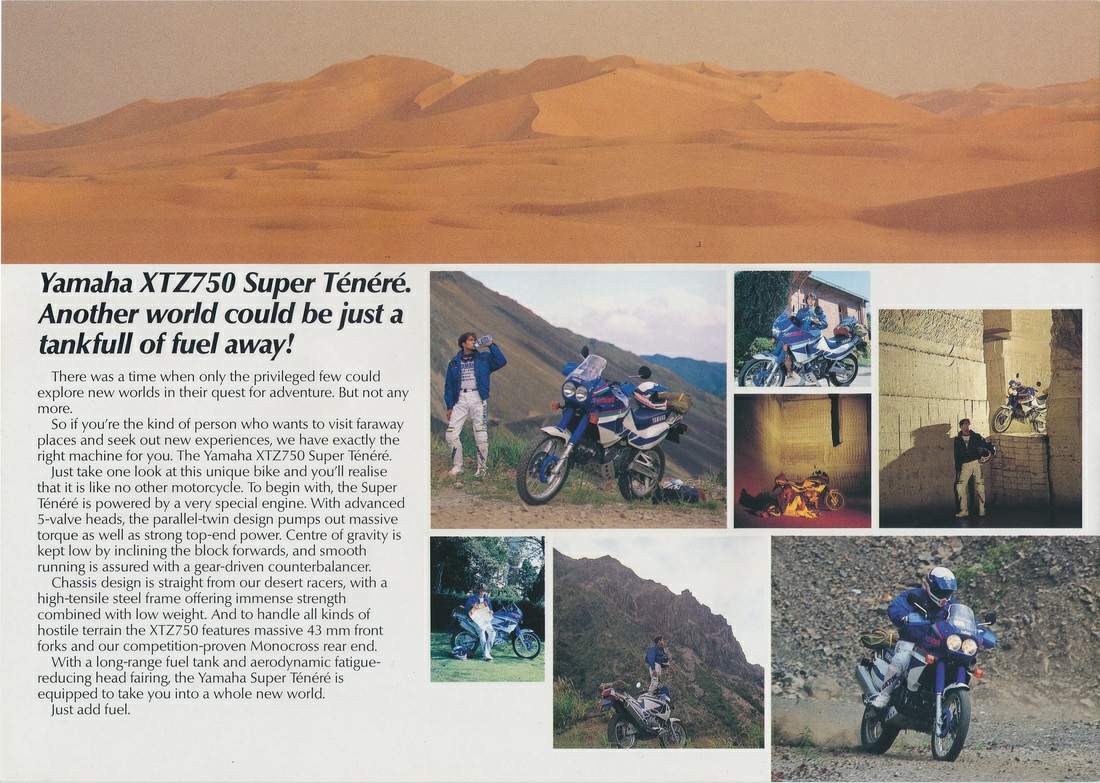
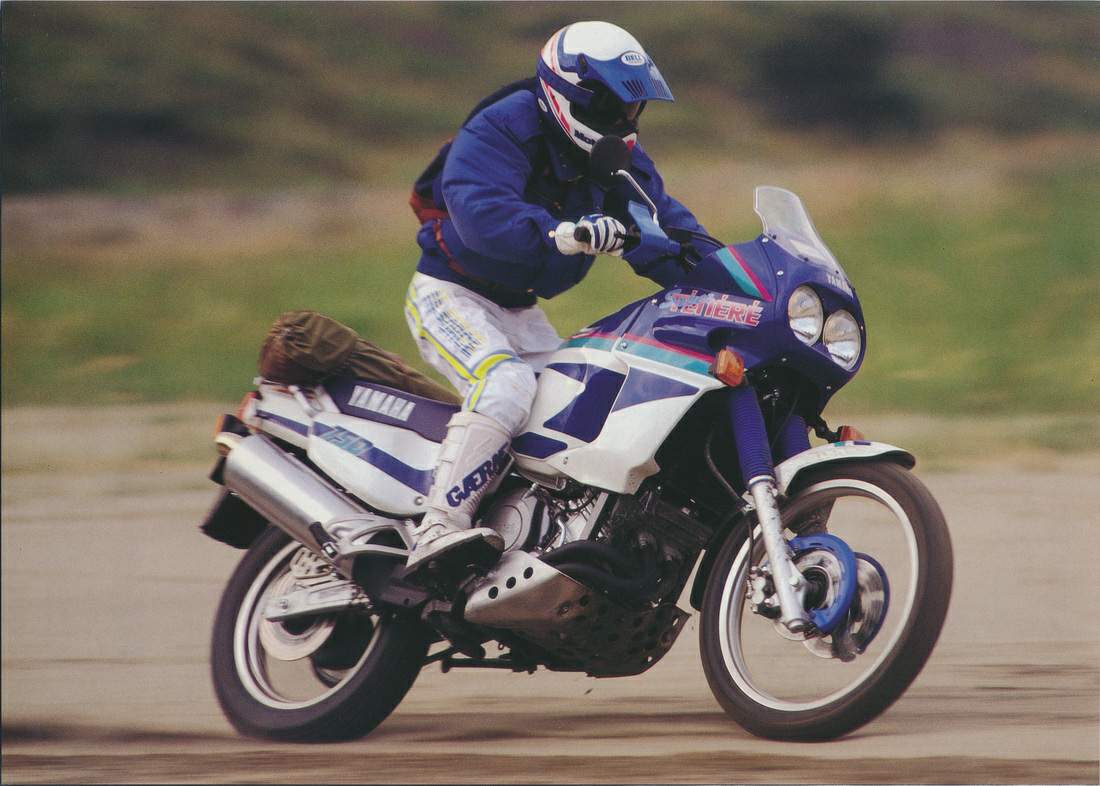
BANANA REPUBLIC HAS MADE A TIDY SUM SELLING CLOTHING designed to make the wearer look like a Beirut combat photographer, to people who've never been any closer to that war-torn city than the Moroccan restaurant up the street. And Yamaha is doing much the same thing with its XTZ750A Super Ténéré. Not that there's any attempt to deceive on either firm's part. Both are selling an image, one as romantic and about as tangible—as the scent of a dry desert wind, and one that can be safely purchased with none of the risks associated with the real thing. In Yamaha's case, it's the look of a Paris-Dakar Rally bike, a haute couture item in Europe for the past decade and a half, and the ultimate expression of European Mitty motorcyclist fantasies. It's also a shrewd move, given Yamaha's research that shows a trend toward high-powered dual-purpose machines among Euro-consumers. The bike you see here is a Canadian model, lent to us by Yamaha Motor Canada Ltd. Think of the bike's appearance in these pages as a trial balloon for the American market, and as a service to our many Canadian readers. Whatever you do, though, don't think of the Ténéré as a dirt bike, because Yamaha doesn't. You might get the wrong idea, from the Ténéré's glandular, P-D-look fairing and 6.8-gallon tank, long-travel suspension, and skywalker, 34.3-inch seat height. But the bike's Brobdingnagian bulk, and 518-pound wet weight should discourage any such notions. As incongruous as it might seem, beneath the Ténéré's Bedouin garb lies the soul of a tourer. But a no-shucks, rough-and-ready dirt bike? Get real. Notes from the off-road tester's log: Trying to ride this thing hard off-road is a mistake. It feels the same as when you've accidently run off the road on a street bike. Compared to real dirt bikes, the controls are terrible—stiff clutch-pull; clunky, long-reach levers; and no front-brake feel. The bike's big, clumsy and awkWard as it is, and a rider needs all the feel at his fingertips he can get. On sand, the front end washes out instantly. Novices shouldn't get anywhere near single-track stuff; you have to be real damn good to ride on anything other than fireroads. It can get you places off-road you couldn't get to on a street bike—but just barely.
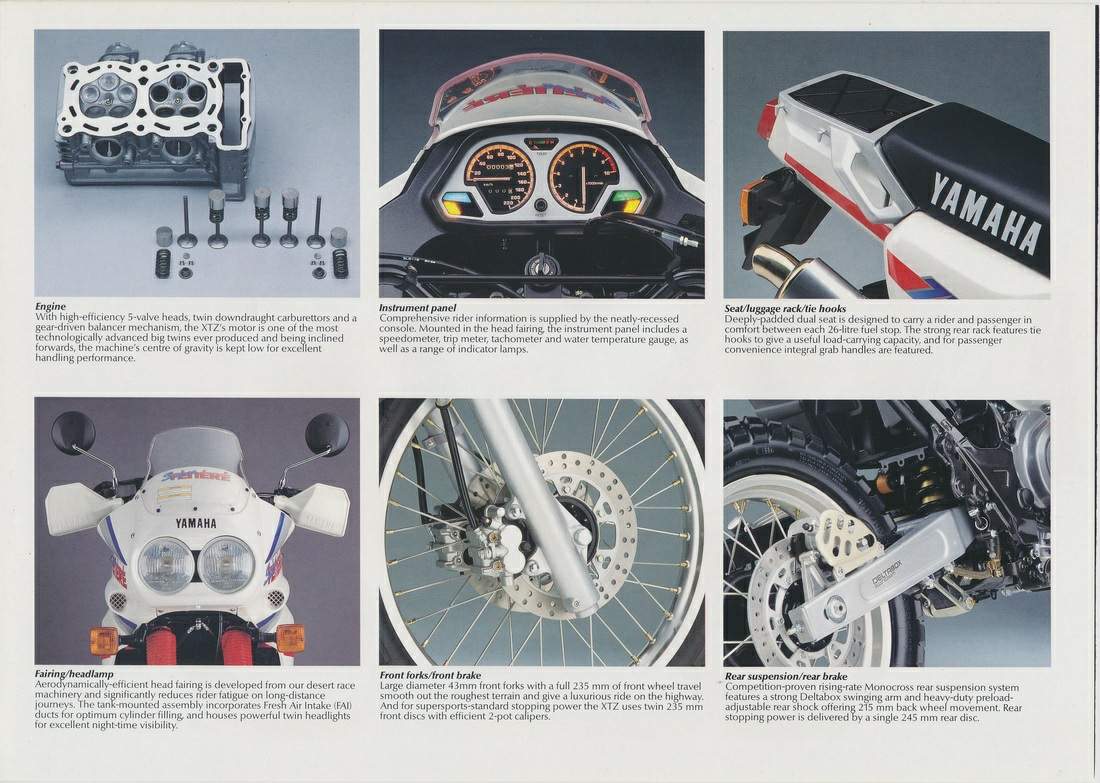
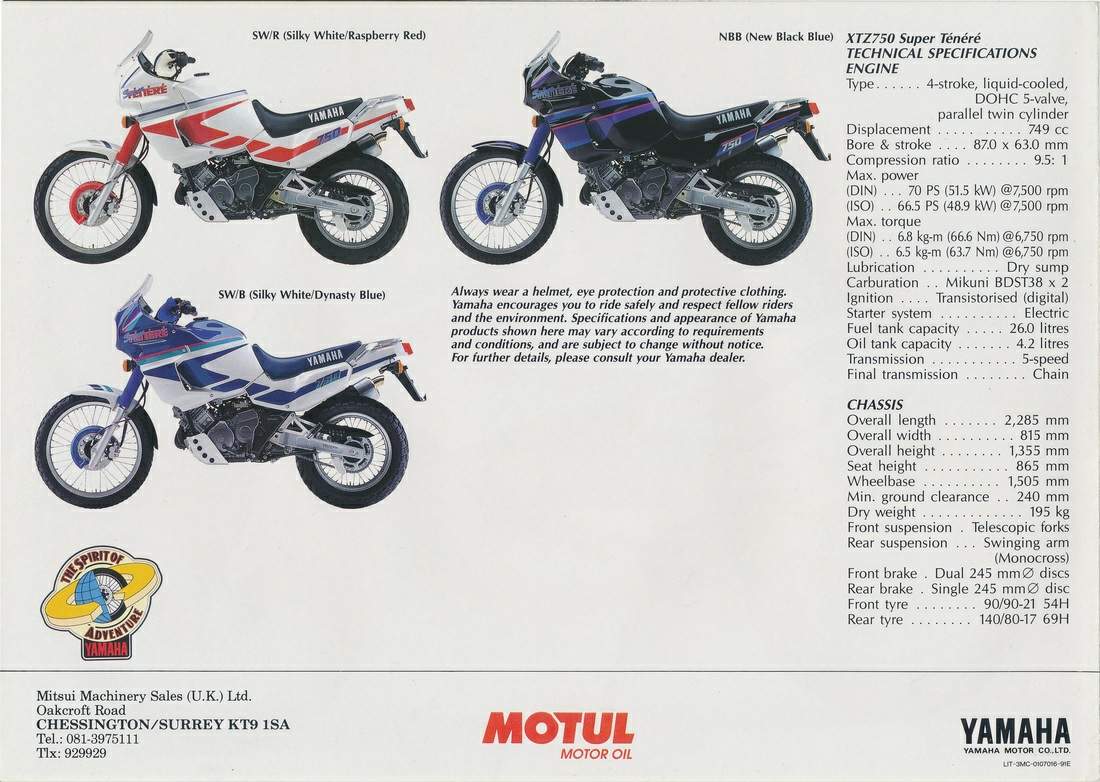
We could go on, but you get the picture. Experts leavened their criticism with praise for the trustworthiness of the front end and the bike's predictability in slides—under power, on fireroads, it's better than BMW's B100GS Paris-Dakar, or Kawasaki's KLR650 or Tengai. The heavier and taller the rider—with more weight to load the front end, and longer legs to make a flat-footed dab before the bike gets too far over-center— the greater the praise. The point, though, is that experts can compensate for almost anything short of loss of a wheel. Our 5-foot-10, 160-pound dirt donk found himself on the ground before he could say, "O positive." Every tester, though, regardless of size, experience, or hat size enthused about the Ténéré's powerplant. Each time a rider climbed off the bike, the test log entry started with, "Great engine," and each discussion of the Yamaha always mentioned the motor. An all-new design, it's the highest-tech parallel-twin in motorcycling, with deep thought given to compact packaging. In the bottom end, the crank and transmission shafts are staggered, allowing for shorter overall engine length than if the shafts were in line; the design also places the crank low in the cases, for a low center of gravity. Dry-sump lubrication keeps engine height down, and further lowers the eg. To help quell vibration from the 360-degree-crank twin, Yamaha tucked in two gear-driven counterbalancers.
Equally creative thinking guided Yamaha's engineers in configuring the Ténéré engine's top end. Cam drive is chain off the crank's end, which yield narrower, more compact cylinder bk and head than a center cam-drive syste The liquid-cooled cylinder and head an the mold of Yamaha's Genesis five-va design, first seen on the firm's groin breaking FZ750 in 1985, with the sa attendant benefits here. The 45-degr inclined top end allows nearly straij intake ports for good cylinder-filling fn the 38mm Mikuni flat-slide downdr carbs; the design also permits the gas ta to extend into the space over the ca where the carbs and airbox would be oi vertical twin, again to lower the i Viewed separately, none of the engin features are unique or even terribly ori nal; what is, though, is their application one engine. Yamaha provided few tuning specifications, but there's ample evidence for confident speculation. The Ténéré's incredibly broad powerband and flat torque curve suggest short-duration camshafts. Plus, the 9.5:1 compression ratio is unusually low for such an advanced cylinder head design, which suggests cams with narrow overlap; with less incoming charge lost through the exhaust valves on overlap, effective compression ratio is higher than the raw numbers would suggest. Compared to a two- or four-valve design, the Ténéré's five-valve setup flows better at low lifts, which, with short-duration, narrow-overlap cams, boosts low-end and midrange power. But the five-valve design also provides ample port area for good flow at high rpm. Essentially, with the Ténéré twin Yamaha was able to have its cake and eat it too, with power throughout the rev range. The proof can be found on the dyno, the strip, the street—and, yes, even in the dirt. Regardless of the road surface, the Ténéré's twin will charm your socks clean off, from the moment you punch the starter button. From cold, the engine lights off instantly, and the choke can be pushed in almost immediately; throttle response is crisp and instantaneous. Obviously, the garrote of Canada's version of the EPA fits more loosely than its Yankee counterpart's. In character, the engine is as docile and tractable as a Bedouin's camel on lithium, and it starts making usable power from rev one. You can lug it around all over town in fourth or fifth gear without a hint of protest, yet it revs on top, too, spinning easily past the 8000 rpm redline. On backroads, the bike achieves its best drives out of turns with the revs kept near the 7500-rpm power peak, but it doesn't demand such treatment. The easy-access power makes downshifting more of an exercise than a requirement. Only abrupt off-idle response and some driveline lash keep the engine from being totally hospitable. The dyno simply reaffirms what riding impressions suggest: The Ténéré twin is nothing short of a marvel, one of the strongest twins we've ever lashed to the pump. In fact, in recent memory, only Ducati's biggest twins, the 851 and 906, best the Ténéré's 59.8 peak horsepower and 43.7 pound-feet peak torque. Compared to twins closer to its displacement, the Ténéré stands head and shoulders higher, with 7 more horespower at its peak than Suzuki's VX800, 5 more than Ducati's 750 Sport, and a whopping 19 more than Honda's XL600V Transalp. Compared to 750 inline-fours, the Ténéré falls short on peak power, but approaches them in torque; it even outpowers Honda's torquey VFR750 in the mid-range, with 6 more horsepower at 6500 rpm. The terrain of the Ténéré's power and torque curves is wide and flat. In fact, the torque curve is one of the flattest in motorcycling, never dropping below 88 percent of its peak from 3500 rpm to redline. The Ténéré is no less eye-opening at the drag strip, besting such pure street-going hardware as the VX800, Ducati 750 Sport and Paso 906, with a 12.5-second quarter-mile sprint. Taller gearing puts the Yamaha at a disadvantage in roll-ons against the Sport and VX, and the 906 Paso's superior low-end and mid-range also help it best the Ténéré in top-gear comparisons. Although Honda's heavier VFR750F smacks the Yamaha in the quarter-mile, the two swap the advantage back and forth in roll-ons.
The Ténéré simply burns down bikes of its own kind: It's almost a second quicker and 10 mph faster through the quarter than Honda's lighter Transalp or BMW's mammoth Paris-Dakar, and substantially quicker in roll-ons. What the Yamaha does to a single such as Kawasaki's Tengai is too embarrassing to mention. Compared to the engine's glittering technical and performance credentials, the Ténéré's chassis hardware seems positively plain. Frame design is utterly conventional, with a single backbone and double downtubes, constructed of round-and box-section tubing, with a stamped-steel Deltabox swing arm. Suspension is by a normal, non-cartridge fork in front, and a rising-rate system in back with a single shock adjustable for preload only. Dual-disc brakes in front, a single disc at the rear, spoke wheels and trials-pattern tires complete the Ténéré's rolling stock—except for the dual-disc front brake, it's all pretty standard fare for dual-purpose bikes, of which the Paris-Dakar genre is an offshoot. On the road, the Ténéré's chassis performance offers a mixture of vices and virtues different from those normally associated with dual-purpose bikes. The first thing a rider has to deal with is the bike's almost overwhelming size and weight. It's long, tall, and top-heavy, especially with a full load of fuel. Of its kind, only BMW's R100GS Paris-Dakar, with its 59.6-inch wheelbase and 535 pounds, is longer and heavier than the Yamaha, with a 59.3-inch wheelbase and 518-pound weight. Extra-long-travel suspension—9.3 inches in front, 8.5 inches at the rear hikes the Ténéré's saddle into the stratosphere, at 34.3 inches; only Kawasaki's KLR650 is significantly taller. Shorter riders can find the Ténéré's weight and bulk intimidating at first, and even 5-foot-10 riders have to slide a cheek off the saddle to plant a boot flat on the pavement. But familiarity, and the upright seating position combined with the leverage offered by the wide, flat handlebar, breeds confidence, although not necessarily enough for a rider to hook the Ténéré like a barrel racer through tight traffic. The engine's stump-pulling low-end power launches the bike away from stops with a casual ease, effortlessly putting distance on other traffic. Initial suspension travel is stiffer than you'd expect from something so long-legged, enough so that lighter riders (under 160 pounds) tagged the Ténéré's response as harsh over small, abrupt bumps. Although overall ride quality falls short of that provided by BMW's R100GS and Honda's Transalp, average-weight riders had few complaints, some in fact eyeballing curbs to run over just to see if they could find a bump big enough to really upset the suspension.
During spirited backroad romps, the suspension sucks up bumps with the same easy competence; most paving imperfections you'll encounter are inconsequential, passing without notice beneath the Ténéré's legs. Steering is quick and light, thanks to the bar's ample leverage, but the Yamaha's weight and size keep it from feeling as agile as a single-cylinder dual-purpose bike—no surprise there. The bike takes a confidence-inspiring set in mid-turn, and the Bridgestone Trail Wing tires offer excellent grip. Despite the engineers' efforts to make the power-plant narrow and compact, routing the header pipes together on the right side pushes the aluminum skid plate and rear brake pedal out far enough that they drag before the tires lose traction. On tight, unfamiliar roads, the Ténéré has a couple of quirks that will keep the rider's hands full if he tries to bump the pace up to full sport-bike flight. Quick-flick steering is ill-advised, because the vibration-quelling rubber handlebar mounts tend to wind up before the front end gets the message, and abrupt steering inputs can overwhelm front-tire traction. The front brake offers almost no feedback, and its action isn't progressive: Dive into a turn too hot, and you get little initial stopping power. Grab harder, and you get more than you wanted, making the softly sprung fork nose-dive, which unloads the rear end and causes a mild oscillation. Smoothness is the key. The Ténéré works best when you ride it like a softly sprung shaft-drive machine: Do your braking early and gently, then guide the bike through the turn under power to keep it stable on its suspension, and accelerate out. Using such techniques, you can get a surprising turn of speed out of the Ténéré, although it's most at home at a less frenetic pace—as will be the rider.
Which is a fair enough description of sport-touring, an area where the Yamaha excels with talents that seem wholly out of keeping with its dirt-going garb. Of course, one could expect the supple suspension to suck up bumps over choppy pavement. And given the engine's Sahara-wide powerband, it's no real surprise the rider can maintain a rapid, no-sweat pace through open, sweeping turns using only a single gear. Fourth gives a usable speed range from 40 mph to 105 at red-line; for tighter roads, third is good for 30 to 86 mph. Engine smoothness contributes to full use of the broad powerband. Early in our testing, objectionable vibration seeped up past the dual counterbal-ancers, and through the handgrips at about 5000 rpm, or 72 mph. But after we'd put 1200 miles on the bike, the buzzing diminished almost to nothing. But you'd hardly expect the Ténéré's levels of wind protection and comfort from a bike whose appearance suggests it would be most at home wheelieing past the Sphinx. Hands stay warm behind en-duro-issue plastic hand guards, and the bulbous fairing shelters the rider from chest to knees, with no nagging turbulence from behind. There's enough wind roar coming off the screen to warrant wearing earplugs, though, and some testers wished for a slightly wider screen to deflect more air from their arms. But overall, the Yamaha offers the best weather protection of any of its breed. Those same qualities help make the Ténéré a good ship of state—interstate, that is—aided by outstanding range. The 6.8-gallon tank lets the bike wander almost 200 miles before it goes on reserve, and the seat staves off numb-butt and saddle-burn long enough to let you use it. Almost every motorcycle could benefit from such a seat: broad, flat, soft, and deep. Sheer size pays dividends for the Ténéré's rider on the open road, with spacious ergonomics. The pairing of roominess with the well-shaped and amply padded saddle gives the rider plenty of options to change position and relieve pressure points on a long ride, more so than on some pure touring machines. Add in compliant suspension and decent wind protection, and the Ténéré makes a relatively tranquil oasis on the road. Still, it's not really a touring bike at least not in the accepted American sense—any more than it's a sport bike or a dirt bike. Yamaha prefers the term "adventure tourer," suggesting comfortable high-speed travel en route to off-road exploration. Maybe so, but for most riders, the Ténéré's shortage of dirtworthi-ness means the adventure they get can either be more imagined than real—or more than they bargained for. Much like Banana Republic clothing, the Ténéré trades primarily on romance, while still offering a healthy dose of function. Even BR's photojournalist vest has plenty of useful pockets. The question remains: Is there a market in this country for the Super Ténéré? Yes, at least a small one. However, in the U.S., where Paris-Dakar-style Mitty-mo-torcycling is the exception rather than the rule, the Yamaha must prosper or fail on what it does, not what it seems to be. If the Ténéré offers a combination of performance and image that fits your needs, you can vote with your pen by writing to Yamaha Motor Corp., 6555 Katella Ave., Cypress, CA 90630. There's a faction in the company that's intensely interested in bringing the bike to this country. At the current exchange rate, though, the Ténéré would come in at $6000 or more; currently, it sells for $8599 ($7390 U.S.) in Canada, including that country's greater import duties. Only BMW's R100GS Paris-Dakar is more expensive. Whether or not the Super Ténéré ever makes it to the U.S., we want its engine— preferably powering a more street-focused stablemate to this desert dreamer. The Ténéré's powerplant— torquey, smooth, and compact—lingers in memory long after the image of a dozen African victories have gone. We've seen this before from Yamaha—a magical motor in a mystery chassis—in the Vision, and Yamaha let that transcendent V-twin slip away without it ever powering the motorcycle that would showcase its abilities. Here's hoping it doesn't happen again. Source Cycle Magazine 1990
|
|
|
Any corrections or more information on these motorcycles will be kindly appreciated. |