|
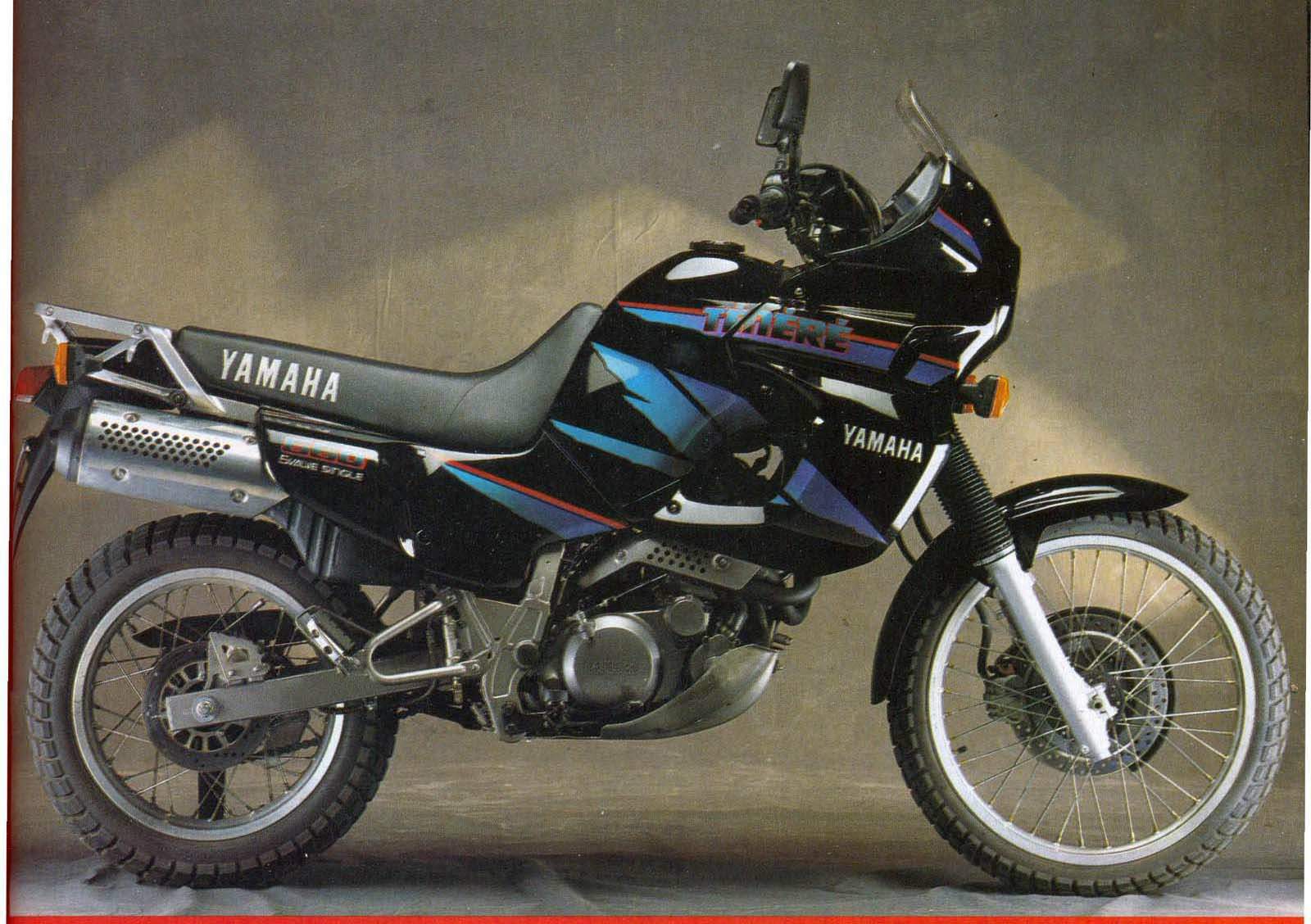
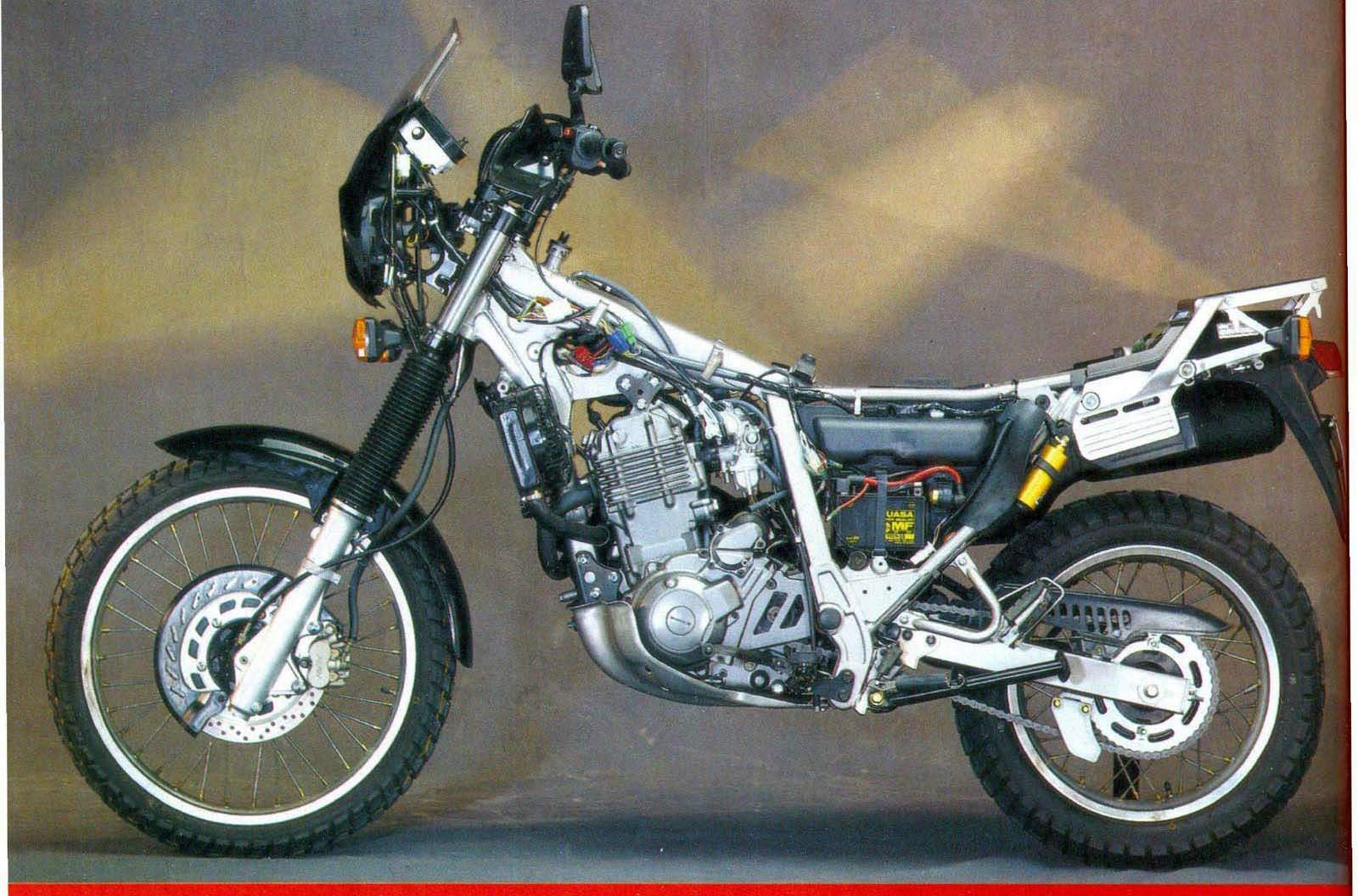
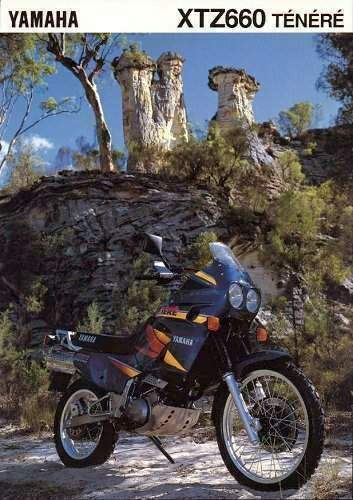
Yamaha XTZ 660Z Ténéré

|
Make Model |
Yamaha XTZ 660Z Ténéré |
|
Year |
1995-97 |
|
Engine |
Liquid cooled, four stroke, single cylinder,
SOHC, 5 valves per cylinder. |
|
Capacity |
660 |
|
Bore x Stroke |
100 x 84 mm |
|
Compression Ratio |
9.2:1 |
|
Induction |
CDI / electric |
|
Ignition /
Starting |
Transistor Controlled |
|
Max Power |
48 hp 35 kW @ 6250 rpm
(rear tyre 43.2 hp @ 6400 rpm ) |
|
Max Torque |
55.9 Nm @ 5000
rpm |
|
Transmission /
Drive |
5 Speed /
chain |
|
Front Suspension |
43mm Telescopic forks |
|
Rear Suspension |
Monocross adjustable for
preload, 5-way rebound damping |
|
Front Brakes |
Single 282mm disc 4 piston
caliper. |
|
Rear Brakes |
Single 245mm disc 1 piston
caliper. |
|
Front Tyre |
90/90-21 |
|
Rear Tyre |
120/90-17 |
|
Dry-Weight |
195 kg |
|
Fuel Capacity |
20 Litres (6.5L) |
|
Consumption average |
16.8 km/lit |
|
Braking 60 - 0 / 100 - 0 |
14.7
m / 40.8 m |
|
Standing
ź Mile |
13.9
sec / 146.3 km/h |
|
Top Speed |
160.0
km/h |
fifth generation: Streamlined
The last generation of the 5-valve XTZ 660 Ténéré appeared in 1994. This last
evolution had a completely new streamlined bodywork with a dual front headlamp
inspired by the famous Super Ténéré 750cc twin. There were no significant
mechanical changes to engine or chassis.

BMW has a bike to take on the established stars in
the competitive single-cylinder dual-sport class - the F650 GS Dakar. Mark
Fattore of Australian Motorcycle News tried it on for size against Yamaha's
loyal XTZ660 in July 2000.
Ever had anything to do with the United Nations? Sorry, silly
question, so let me fill you in on something. There is a large body of countries
that comprises the General Assembly, which gets together annually to debate on a
wide variety of issues - everything from the impact of cow flatulence on the
ozone layer to the question of reunification on the Korean peninsula. Outside of
the General Assembly, there are a number of nations which are granted observer
status - sort of like an apprenticeship in the big bad world of diplomacy.
Sure, they can watch what's happening and
drink the red cordial and eat the alfalfa sandwiches during regular breaks in
proceedings, but when it comes to actual participation and voting rights they
are lame ducks. And other countries probably laugh at them.
Now, I must admit there's been a bit of that
observer status feeling in me. You see, I've unfortunately managed to miss every
dual-sport comparo at AMCN since I started in 1996, all for a variety of
plausible reasons - except for one when I was domiciled in Japan trying to teach
English. But all the while, I knew what was happening - eg dirt bunny Mr Ed
struggling to keep his bike upright in slippery gravel - and I yearned to be a
part of it. Well, after a recent wild day aboard the stylish-looking Yamaha
XTZ660 Ténéré and the BMW F650 GS Dakar - hereafter the Ténéré and Dakar
respectively - that feeling of emptiness is no more.
TWO EXTREMES
Really, this match-up is the tale of two
extremes; the venerable veteran (Ténéré) against the new upstart (Dakar), which
in competition guise won the 2000 Dakar-Cairo rally under the control of French
maestro Richard Sainct.
The $8439 Ténéré has been available in
Australia since 1995, since then passing time without any major updates or
modifications. However, that doesn't seem to be hurting Yamaha's hip pocket too
much, with the Ténéré recording 54 registrations year-to-date - for a mature
product reaching the end of its life-cycle, that's a very sound outcome. The big
bonus is that the bike also copped a $360 drop in price since July 1, opening up
more leverage on the showroom floor.
The limited-edition Dakar, on the other hand,
is one half of the new F650 GS range, which also includes the standard
road-going model. AMCN staffer Rod Chapman attended the national launch of the
650 GS in April (Vol 49 No 19), after which the bike came into our hands for an
extended sojourn, culminating in another appraisal in Vol 49 No 22. With a
stonking new Rotax-sourced engine and all-round versatility, the F650 GS was
certainly lauded as a far superior product to its Funduro-monikored
predecessors, which date back to 1993.
The Dakar, meanwhile, is basically an adjunct
to the standard F650 GS - the same potent template, but with some extra off-road
hardware, including a 21-inch front wheel, (standard is 19-inch, with a 17-inch
rear), longer 210mm suspension front and rear, a higher screen (from the
marque's 650RR), hand protectors, a 870mm seat height and a longer front guard.
On the other side of the coin, there's no ABS option on the Dakar - in the bush,
that means diddly-squat anyway.
So while the standard F650 GS may have made
the initial move towards a dirt ideology, the Dakar has taken that mandate one
step further on.
THE REAL STUFF
Okay, that's the abbreviated history lesson -
how does it all translate to the real stuff? To find some answers, Mr Chapman
and myself set off for a day's riding, which fell into three distinct segments:
urban warfare, a 200km ride through the twisties and 100-odd-km through the bevy
of dirt roads that criss-cross the Great Dividing Range.
On first impressions, you can't help but
notice the Rotax-built, four-valve, liquid-cooled 652cc fuel-injected powerplant
in the Dakar is an absolute gem. The donk, while sharing many of the same
characteristics as the earlier carburetted Funduro incarnations, has a new
cylinder head that follows a grounding found in BMW's M3 car. BMW claims 50ps at
6500rpm for the Dakar, the same figure Yamaha quotes for the liquid-cooled,
five-valve SOHC Ténéré.
From a standing start there's very little
between the bikes, although as the wrist gets more willing, the Dakar comes into
its own - it's still pulling strongly at 120km/h while the Ténéré begins to cry
enough. In fact, the Dakar's strength over the Ténéré builds incrementally right
through the rev range, with most of its bullocking work done between 3000 and
6000rpm. Roll-ons in top gear confirmed that Dakar advantage.
As an illustration of what the Dakar engine
is capable of, in the Dakar-Cairo Rally, Sainct's machine pumped out an
intimidating 76ps in full-factory guise - that's reason enough why the engine
will continue to be a popular supermono choice in its updated guise, along with
the Ténéré's for that matter.
Both the F650s now have fuel-injection - the
only mass-produced, road-going single-cylinders to do so - which is claimed to
have added 2ps to the whole shebang. The BMS-based injection system is a
revelation and there's none of that well-documented lurching that besets some
fuel-injection systems. The Ténéré follows a more traditional path with a
relatively small 26mm carby, which goes a long way to explaining why its motor
has more mongrel in the bottom end and midrange - to the detriment of the top
end.
Both incarnations cruise along at 100km/h at
just a shade over 4000rpm - confirming the fact that these bikes are tailor-made
for long distance touring. On that note, the BMW averaged 18.2km/lt during its
time at AMCN and the Ténéré 16.6km/lt. With the latter's huge 20lt fuel tank,
that equates to about 330km with a full payload before reserve has to be
activated. Meanwhile, the BMW's 17lt tank will see out around 300km before the
fuel warning light is pressed into life.
I'M NOT DRIBBLING
You can't escape the fact - I reckon Aussie
basketballer Luc Longley has some clandestine sponsorship arrangement with the
R&D departments at BMW and Yamaha, as both have quite high seat heights,
straight from the motocross handbook. The BMW's (comfy) seat is 870mm, 5mm more
than the Ténéré. To be fair, that's a function of increased travel in the
suspension to accommodate the duo's off-road intentions, but at 172cm around the
city it caused me a few concerns - at lights, it's akin to that nervy feeling
when you're waiting for a plane's wheels to touch the runway on landing.
BMW has a ready-made solution to the seat
dilemma - there's an optional smaller seat (780mm), which is the standard seat
height on the F650 GS.
High seats are in themselves not a problem,
as long as they form a viable part of the bike's overall equation. For example,
there's not much point in pitching with a tarmac-friendly dual-sport with sticky
road-based tyres, 17-inch wheels, hard suspension and aggressive riding position
if the seat is too high for the average Joe Bloggs. Unfortunately, a few
dual-sports have fallen into that trap over the years.
Gladly, neither the Ténéré or the $11,980
Dakar (down from 13K pre-GST) do in this case, although the Dakar has probably
got more reason too with its greater dirt capability and suspension travel -
more on that in a moment.
A CUT ABOVE
After using roadside kerbs as a stationary
launching pad through the city, it was a soon a welcome change to venture into
some twisty terrain east of Melbourne. Really, this is one step away from utopia
for the Ténéré - open terrain where its fairing protection is top-notch, its
top-heaviness is not such a concern and the huge twin headlights do the job with
aplomb.
The Dakar is really a cut above in the twisty
stuff. Its peakier motor, tripled with a lower centre of gravity and shorter
wheelbase (1489mm versus 1495mm), leaves the Ténéré quite a way in arrears. A
key factor in the advantage is attributable to the location of the Dakar fuel
tank, which is mounted under the seat, concentrating the centre of mass to the
centre of gravity.
One area where Ténéré did have the runs on
the board in this environment was the brakes - its twin-piston Nissin set-up on
the front had the edge over the Brembos on the Dakar for both feel and power;
quite an achievement considering that the Nissins are forever trying to pull up
a heavier mass.
The Ténéré's suspension is definitely harder,
although that feeling may be exacerbated by the bike's harder and narrower seat.
On that score, the bike tends to struggle on a dirt road, as it would rather
skate over the bumps than soak them up. The Ténéré has slightly beefier forks
than the Dakar (43mm to 41mm), although both are non-adjustable units. On the
rear, both are adjustable for preload and rebound. Only the Ténéré has
compression adjustment.
The Dakar has a nifty remote 40-click preload
adjustment knob, which is located on the right hand side of the bike, near the
base of the cylinder. Suspension travel is 200m front and rear on the Ténéré,
with 210mm on the Dakar.
As mentioned earlier, the latter is more
dirt-like in its outlook with a combination of slightly more aggressive footpeg
positioning and softer suspension. And, of course, like the Ténéré, it does come
standard with a trail-based hoop that at least manages to keep things
respectable away from the blacktop. The Dakar has Bridgestone Trail Wings front
and rear and the Ténéré Dunlop Trailmaxs. Actually, it's a refreshing thought
that there are at least a few dual-sports that can be ridden with some
confidence away from the tar - for a lot of the brethren in this class it's
strictly a taboo subject.
INTEGRATION WINS OUT
Both the machines sport a smallish rear rack
for carrying luggage. And pillions haven't been forgotten about either, with
meaty grab rails mounted either side of the rear racks. And wait, there's a
little more on the Dakar - a lockable storage area to keep your maps safe for
when you compete in the Australian Safari.
So what's the bike of choice? Well, there are
some clearcuts - the Dakar has definitely got the upper hand on the Ténéré
through town and on middle-distance trips. Even on the more open stuff where the
Ténéré lifts its workrate, the BMW is there all the way with its heated hand
grips, plusher seat and higher screen.
Yes, you do pay for those privileges with the
Dakar - and it mightn't have the aesthetics to quite match the Ténéré - but even
so it's more of a complete package. In a word, integration at its best. I just
don't think I could shy away from that too easily.
Mark Fattore, Photos: Stuart Grant
BMW SPECIFICATIONS
ENGINE
Engine type: Liquid-cooled, four-stroke,
DOHC, four valves per cylinder, single-cylinder;
Bore x stroke: 100mm x 83mm;
Displacement: 652cc;
Compression Ratio: 11.5:1;
Ignition/fuel system: BMS electronic fuel injection;
Starting system: Electric;
Lubrication system: Dry sump.
TRANSMISSION
Type: Five speed, constant mesh;
Primary drive: Gear;
Clutch: Cable-actuated, wet, multi-plate;
Final drive: Chain.
CHASSIS AND RUNNING GEAR
Frame type: Rectangular steel bridge-tube
frame;
Rake: 29 degrees;
Trail: 113mm;
Wheelbase: 1489mm;
Front suspension: Non-adjustable 41mm telescopic Showa fork, 210mm travel;
Rear suspension: Monoshock with adjustable preload and rebound, 210mm travel;
Front/rear wheels: wire spoked wheels, 2.50 x 21in front, 3.00 x 17in rear;
Front/rear tyres (as tested): Bridgestone Trail Wing,100/90-19 front, 130/80-17
rear;
Front brake: Single 300mm stainless-steel floating disc with twin-piston Brembo
caliper;
Rear brake: Single 240mm Brembo stainless steel floating disc with Brembo
single-piston caliper.
DIMENSIONS AND CAPACITIES
Wet weight (claimed): 192kg;
Seat height (claimed): 870mm;
Oil capacity: 2.3lt;
Fuel capacity: 17ltFuel consumption (average): 18km/lt.
PERFORMANCE
Maximum power (claimed): 50ps@6500rpm;
Maximum torque (claimed): 6.12kg-m@5000rpm;
Top speed (claimed): 166km/h.
MISCELLANEOUS
Test bike supplied by: BMW Australia,
Springvale (Vic);
Recommended retail price: $11,980 plus ORC;
Warranty: 12-month/unlimited kilometer;
Colour options: White (Dakar).
YAMAHA SPECIFICATIONS
ENGINE
Engine type: Liquid-cooled, four-stroke,
five-valve SOHC, single-cylinder;
Bore x stroke: 100mm x 84.5mm;
Displacement: 660cc;
Compression ratio: 9.2:1;
Ignition: Electronic;
Carburation: Y26PV;
Starting system: Electric;
Lubrication system: Dry sump.
TRANSMISSION
Type: Five-speed;
Primary drive: Gear;
Clutch: Cable-operated wet multi-plate;
Final drive: O-ring chain.
CHASSIS AND RUNNING GEAR
Frame type: Box-section steel frame;
Rake: not given;
Trail: 112mm;
Wheelbase: 1495mm;
Front suspension.: Non-adjustable conventional 43mm forks with 200mm travel;
Rear suspension: Shock absorber with compression, rebound and preload adjustment
with 200mm travel;
Front/rear wheels: Wire-spoked wheels, 21 x 1.85 front, 17 x 2.75 rear;
Front/rear tyres: Dunlop Trailmax, 90/90-21 front, 130/80-17 rear;
Front brake: Single 282mm disc with twin-piston Nissin caliper;
Rear brake: Single 220mm disc with single-piston Nissin caliper.
DIMENSIONS AND CAPACITIES
Dry weight (claimed): 171kg;
Seat height (claimed): 865mm;
Oil capacity: 3.2lt;
Fuel capacity: 20lt;
Fuel consumption (average): 16.5km/lt.
PERFORMANCE
Maximum power (claimed): 50ps at 6500rpm;
Maximum torque (claimed): 5.8kg-m at 5250rpm.
MISCELLANEOUS
Test bike supplied by: Yamaha Australia,
Wetherill Park (NSW);
Recommended retail price: $8439 plus ORC;
Warranty: 24 mths/unlimited km;
Colour options: Dark green, blue.
Source Bikepoint
 |