|
Make Model
|
Yamaha
XS 850G |
|
Year
|
1980- |
|
Engine
|
Air cooled, four stroke, transverse three cylinder,
DOHC, 2
valves per cylinder. |
|
Capacity
|
826 |
|
Bore x Stroke |
71.5 x 68.6 mm |
|
Compression Ratio |
9.2:1 |
|
Induction |
3x 34mm Hitachi |
|
Ignition /
Starting |
Battery powered triggered /
electric |
|
Max Power |
79 hp 57.7 KW @ 8500 rpm |
|
Transmission /
Drive |
5 Speed / shaft |
|
Front Suspension |
Air assisted telescopic forks, 175mm
wheel travel. |
|
Rear Suspension |
Swing arm 4-way adjustable damping,
99 wheel travel |
|
Front Brakes |
2x 267mm discs 1 piston caliper |
|
Rear Brakes |
Single 267mmdisc 1 piston caliper |
|
Front Tyre |
3.25-19 |
|
Rear Tyre |
4.00-18 |
|
Wet-weight |
258 kg |
|
Fuel Capacity |
24 Litres |
|
Braking 60 - 0 / 100 - 0 |
13.3 sec / 98.2 mph |
Two years into its short life, the XS750 had lost much of its early reputation
as a high-performer: still having better-than-average handling, for the cc
class, the three had been overtaken in the horse-
power race by developments among 750-4s from the other manufacturers.
For 1980 Yamaha overbored the 750 by 3mm to achieve 826cc, and in the XS850 were
able to offer a three that was fully a match for any similar-capacity four, and
not a few 1000s.
The extra power of the 850 was not, of course, the result simply of additional
volume; the original cams had been reworked for more lift and dwell, the
carburettors increased in size to 32mm (and the make changed, from Mikuni to
Hitachi), the crankshaft strengthened.
The gearbox was beefed up, and a large Hi-Vo chain installed for primary drive.
A preload-adjustable front fork and rear units with normal five-position setting
gave handling that was at least as good as that of the lower-powered 750 . . .
significant achievement in view of th 125mph potential of the new model.
Road Test 1979
Of the big four Japanese manufacturers Yamaha have been the most innovative
in recent times. They remained aloof as their main rivals battled to produce
ever more powerful machines. Yamaha opted out of this performance race to
produce such machines as the SR500 single, the XS750 triple and more recently
the refreshing XV750 and 981 cc TR1, Japan's first attempt to build classic
in-line vee-twins.
While other manufacturers were hell-bent on performance alone Yamaha's
independent, common sense but exciting approach won much public respect,
illustrated when the XS750 was voted machine of the year by Motor Cycle
Weekly readers in 1977. Such reward is no doubt one reason why the XS750
still survives, albeit in the uprated XS850 package.
The luxurious XS850 offers a sensible, but in no way boring style of motor
cycling; it is a cosy, physically undemanding and untiring top gear workhorse -
engage fifth as low as 17 mph and you can forget the gearbox for the day. With
deft right wrist movements the rider is the complete master.
The power plant is super-smooth, showing its worst discord - minimal at that
- through the footrests at 4,000 rpm, 60 mph in top. This disappears again as
the rev counter needle swings round to the 9,000 rpm blood line.
The increased capacity of 826 cc is derived from sliding pistons from the
XS1100 four into larger 71-5 mm bores. The 850 is virtually three-quarters of
the 1,102 cc straight four as the two also share an identical 68-6 mm stroke.
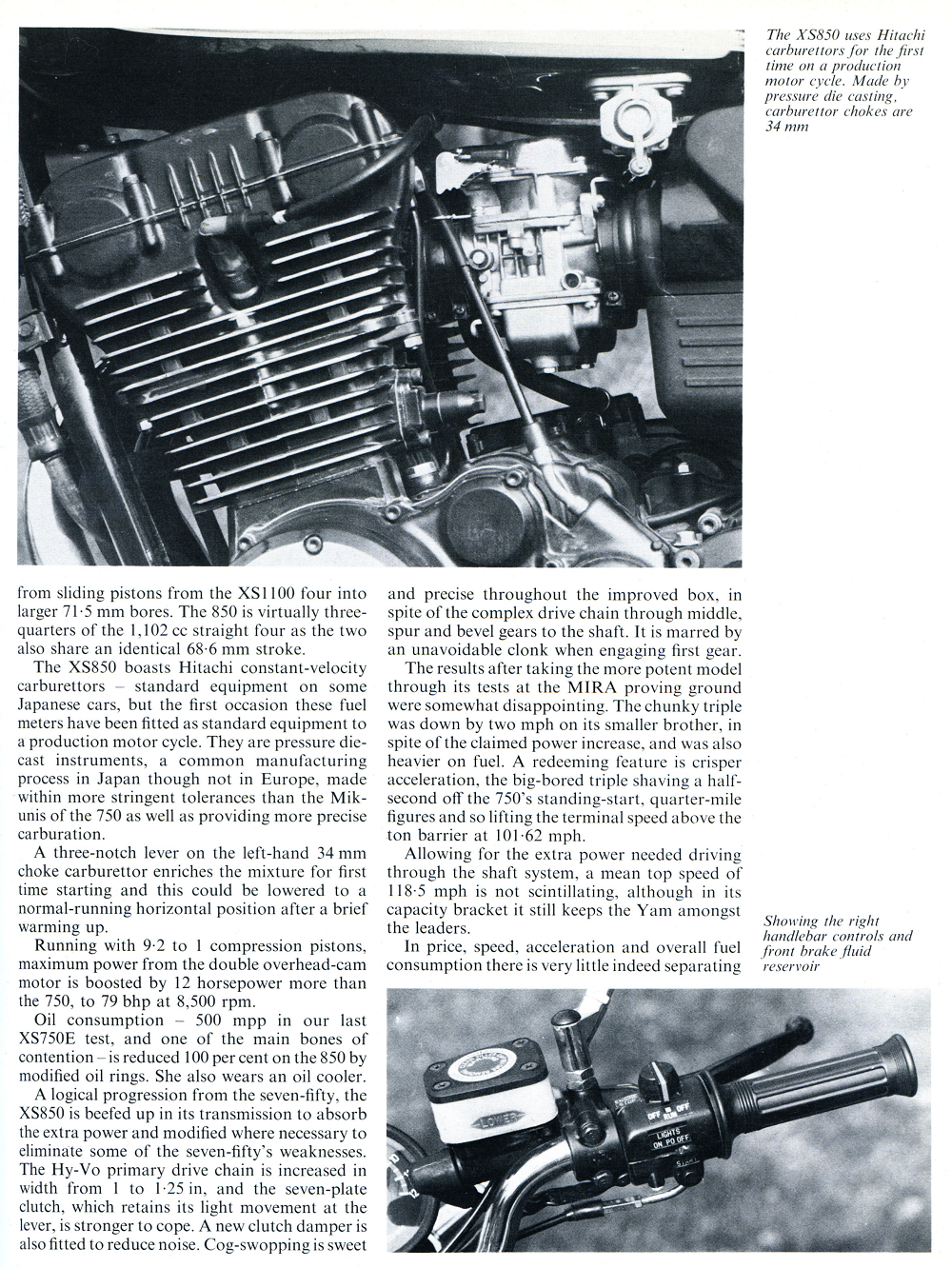
The XS850 boasts Hitachi constant-velocity carburettors - standard equipment
on some Japanese cars, but the first occasion these fuel meters have been fitted
as standard equipment to a production motor cycle. They are pressure die-cast
instruments, a common manufacturing process in Japan though not in Europe, made
within more stringent tolerances than the Mik-unis of the 750 as well as
providing more precise carburation.
A three-notch lever on the left-hand 34 mm choke carburettor enriches the
mixture for first time starting and this could be lowered to a normal-running
horizontal position after a brief warming up.
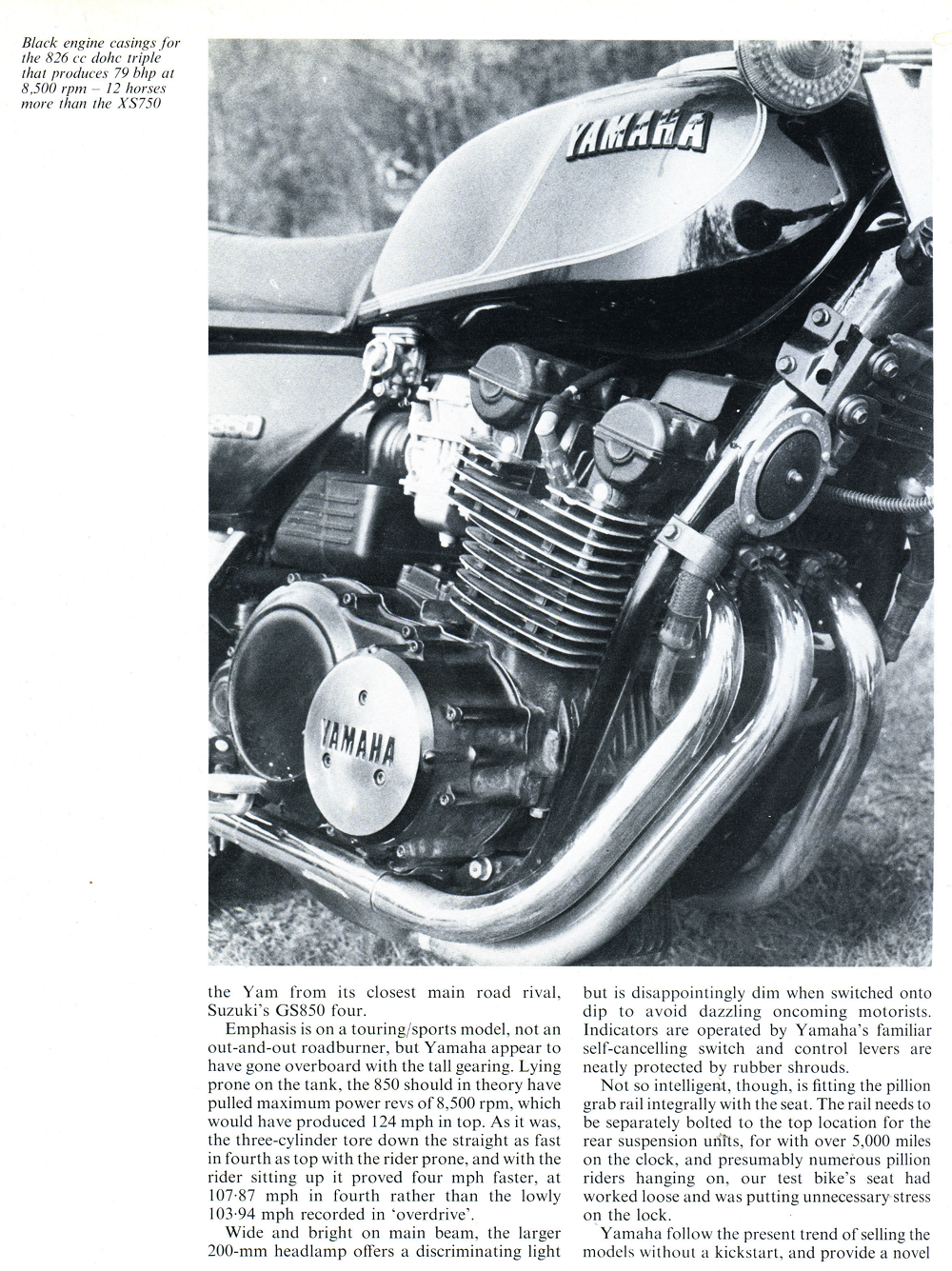
Running with 9-2 to 1 compression pistons, maximum power from the double
overhead-cam motor is boosted by 12 horsepower more than the 750, to 79 bhp at
8,500 rpm.
Oil consumption - 500 mpp in our last XS750E test, and one of the main bones
of contention - is reduced 100 per cent on the 850 by modified oil rings. She
also wears an oil cooler.
A logical progression from the seven-fifty, the XS850 is beefed up in its
transmission to absorb the extra power and modified where necessary to eliminate
some of the seven-fifty's weaknesses. The Hy-Vo primary drive chain is increased
in width from 1 to 1-25 in, and the seven-plate clutch, which retains its light
movement at the lever, is stronger to cope. A new clutch damper is also fitted
to reduce noise. Cog-swopping is sweet
and precise throughout the improved box, in spite of the complex drive chain
through middle, spur and bevel gears to the shaft. It is marred by an
unavoidable clonk when engaging first gear.
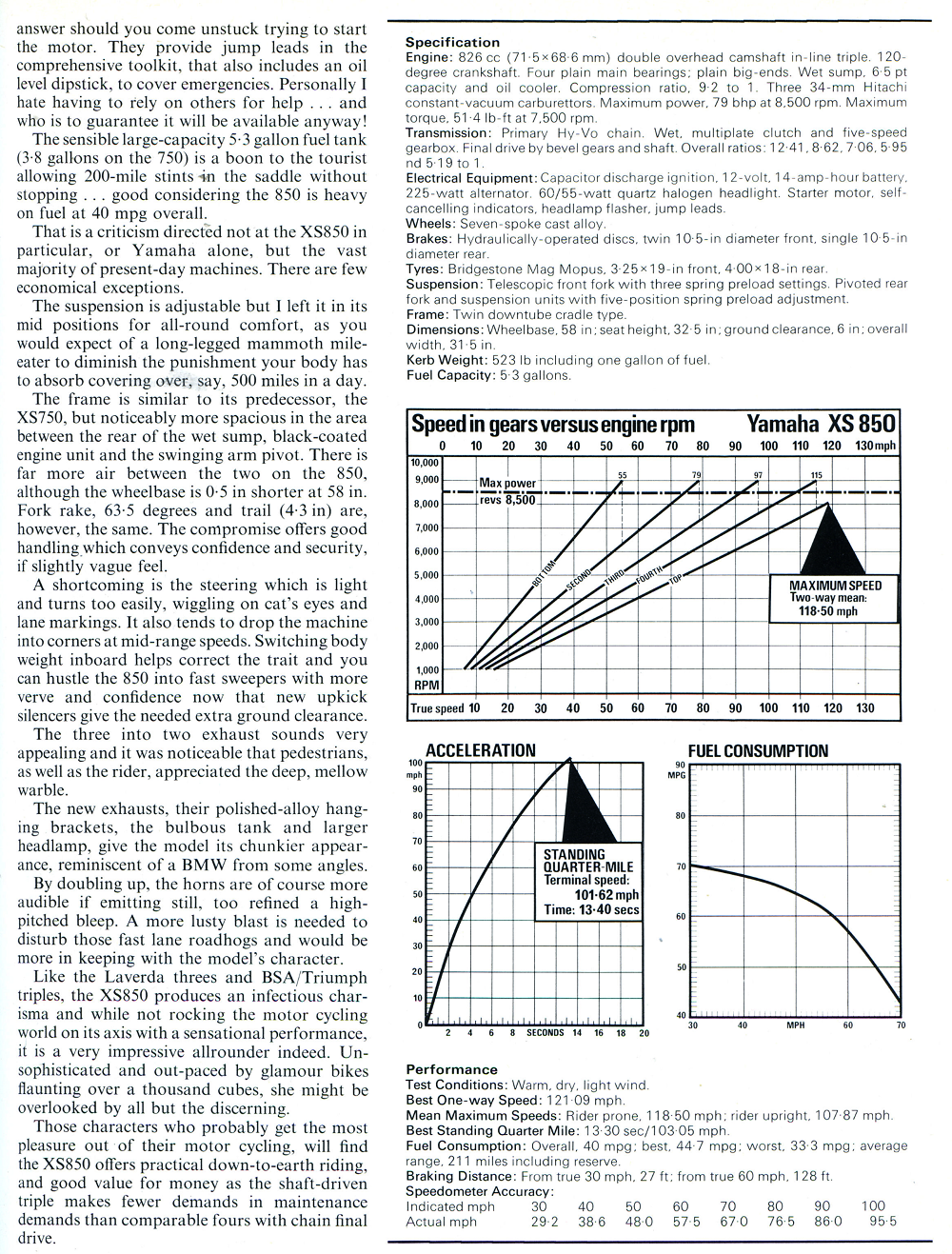
The results after taking the more potent model through its tests at the MIRA
proving ground were somewhat disappointing. The chunky triple was down by two
mph on its smaller brother, in spite of the claimed power increase, and was also
heavier on fuel. A redeeming feature is crisper acceleration, the big-bored
triple shaving a half-second off the 750's standing-start, quarter-mile figures
and so lifting the terminal speed above the ton barrier at 101-62 mph.
Allowing for the extra power needed driving through the shaft system, a mean
top speed of 118-5 mph is not scintillating, although in its capacity bracket it
still keeps the Yam amongst the leaders.
In price, speed, acceleration and overall fuel consumption there is very
little indeed separating the Yam from its closest main road rival, Suzuki's
GS850 four.
Emphasis is on a touring/sports model, not an out-and-out roadburner, but
Yamaha appear to have gone overboard with the tall gearing. Lying prone on the
tank, the 850 should in theory have pulled maximum power revs of 8,500 rpm,
which would have produced 124 mph in top. As it was, the three-cylinder tore
down the straight as fast in fourth as top with the rider prone, and with the
rider sitting up it proved four mph faster, at 107-87 mph in fourth rather than
the lowly 103-94 mph recorded in 'overdrive'.
Wide and bright on main beam, the larger 200-mm headlamp offers a
discriminating light
but is disappointingly dim when switched onto dip to avoid dazzling oncoming
motorists. Indicators are operated by Yamaha's familiar self-cancelling switch
and control levers are neatly protected by rubber shrouds.
Not so intelligent, though, is fitting the pillion grab rail integrally with
the seat. The rail needs to be separately bolted to the top location for the
rear suspension units, for with over 5,000 miles on the clock, and presumably
numerous pillion riders hanging on, our test bike's seat had worked loose and
was putting unnecessary stress on the lock.
Yamaha follow the present trend of selling the models without a kickstart,
and provide a novel answer should you come unstuck trying to start the motor.
They provide jump leads in the comprehensive toolkit, that also includes an oil
level dipstick, to cover emergencies. Personally I hate having to rely on others
for help . . . and who is to guarantee it will be available anyway!
The sensible large-capacity 5-3 gallon fuel tank (3-8 gallons on the 750) is
a boon to the tourist allowing 200-mile stints in the saddle without stopping .
. . good considering the 850 is heavy on fuel at 40 mpg overall.
That is a criticism directed not at the XS850 in particular, or Yamaha alone,
but the vast majority of present-day machines. There are few economical
exceptions.
The suspension is adjustable but I left it in its mid positions for all-round
comfort, as you would expect of a long-legged mammoth mile-eater to diminish the
punishment your body has to absorb covering over, say, 500 miles in a day.
The frame is similar to its predecessor, the XS750, but noticeably more
spacious in the area between the rear of the wet sump, black-coated engine unit
and the swinging arm pivot. There is far more air between the two on the 850,
although the wheelbase is 0-5 in shorter at 58 in. Fork rake, 63-5 degrees and
trail (4-3 in) are, however, the same. The compromise offers good handling which
conveys confidence and security, if slightly vague feel.
A shortcoming is the steering which is light and turns too easily, wiggling
on cat's eyes and lane markings. It also tends to drop the machine into corners
at mid-range speeds. Switching body weight inboard helps correct the trait and
you can hustle the 850 into fast sweepers with more verve and confidence now
that new upkick silencers give the needed extra ground clearance.
The three into two exhaust sounds very appealing and it was noticeable that
pedestrians, as well as the rider, appreciated the deep, mellow warble.
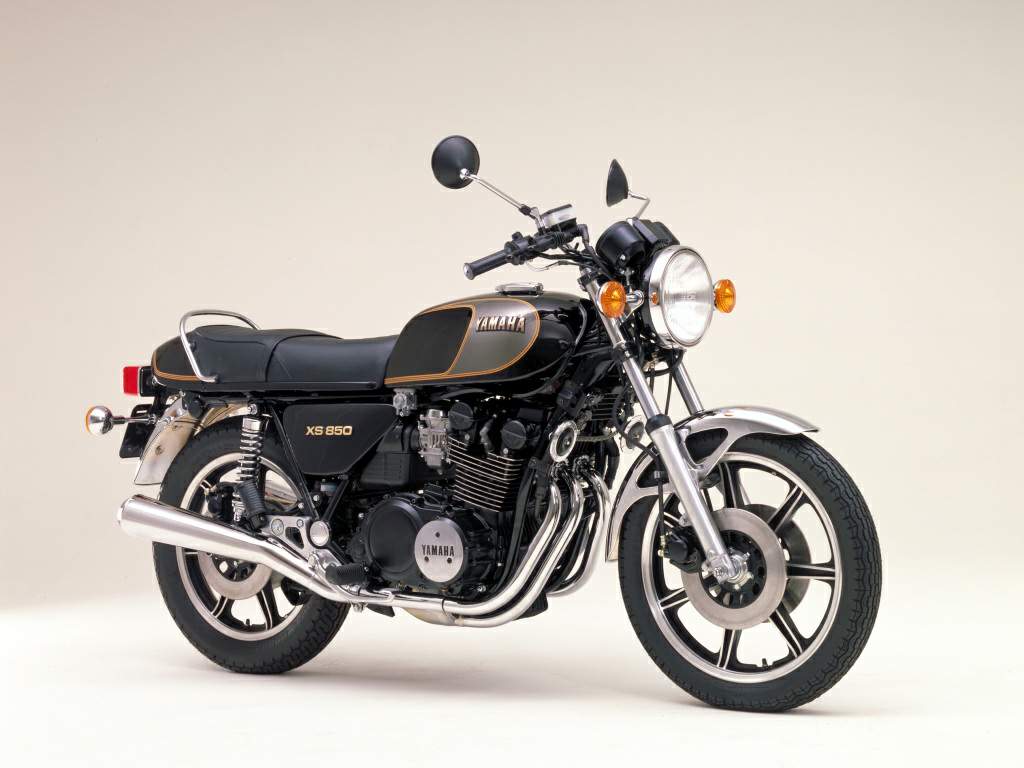
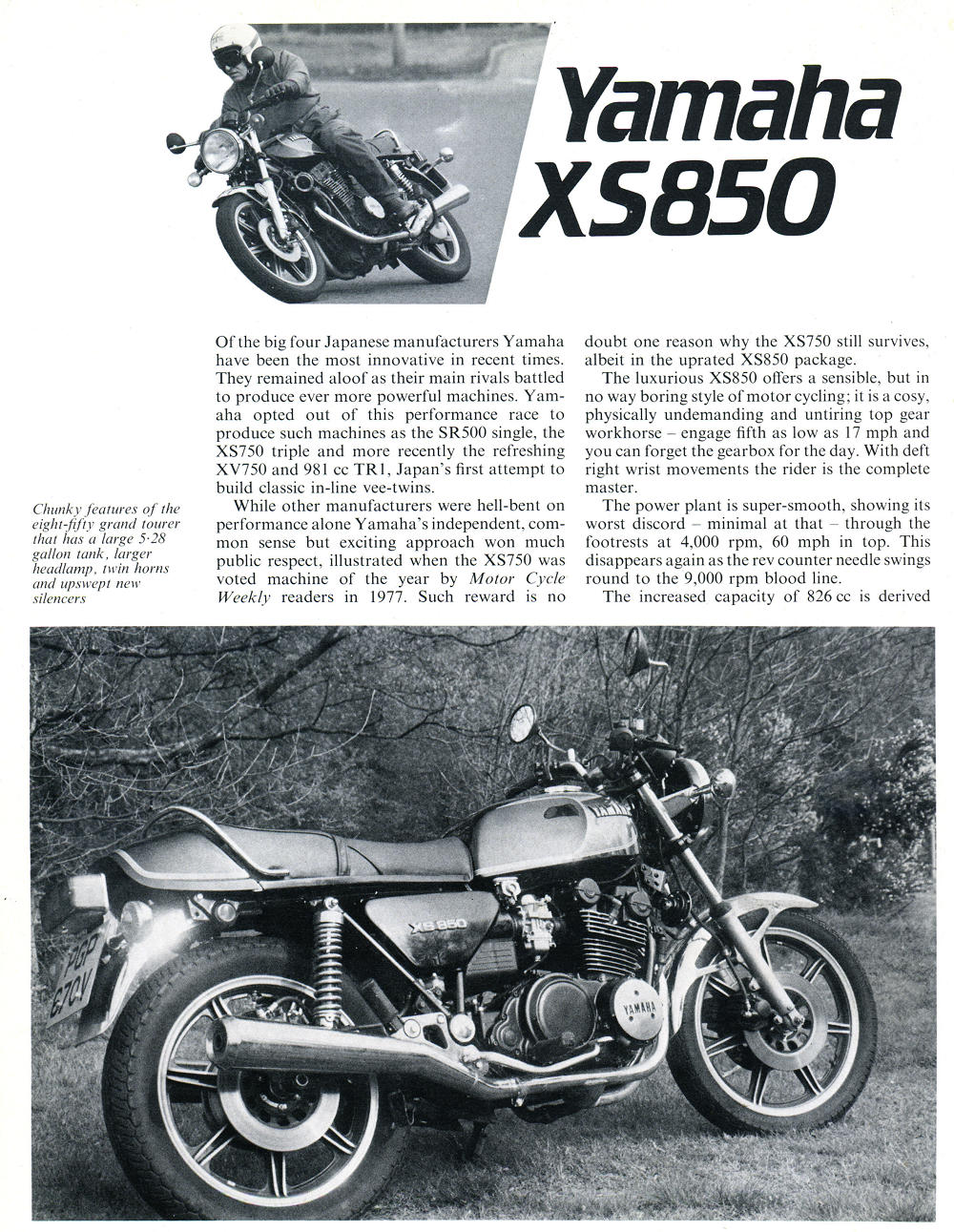
The new exhausts, their polished-alloy hanging brackets, the bulbous tank and
larger headlamp, give the model its chunkier appearance, reminiscent of a BMW
from some angles.
By doubling up, the horns are of course more audible if emitting still, too
refined a high-pitched bleep. A more lusty blast is needed to disturb those fast
lane roadhogs and would be more in keeping with the model's character.
Like the Laverda threes and BSA/Triumph triples, the XS850 produces an
infectious charisma and while not rocking the motor cycling world on its axis
with a sensational performance, it is a very impressive allrounder indeed.
Unsophisticated and out-paced by glamour bikes flaunting over a thousand cubes,
she might be overlooked by all but the discerning.
Those characters who probably get the most pleasure out of their motor
cycling, will find the XS850 offers practical down-to-earth riding, and good
value for money as the shaft-driven triple makes fewer demands in maintenance
demands than comparable fours with chain final drive.