|
|
|
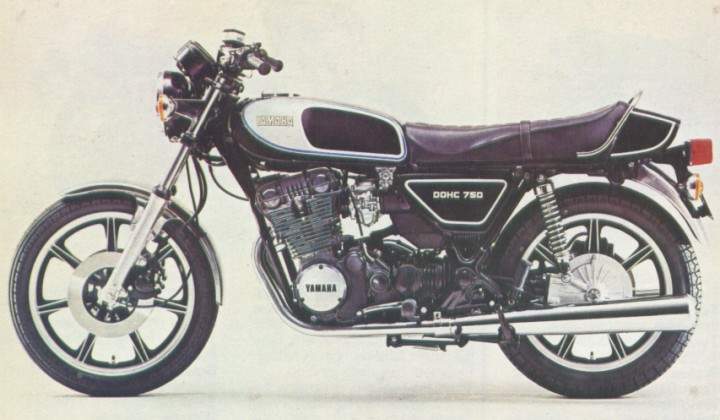
Yamaha XS 750
The second version of Yamaha's shafty is smoother, faster, cheaper and has more ground clearance than the original D -- and it's just as comfortable.
FOR A TIME THREE YEARS
AGO IT LOOKED like those interested in large-displacement street bikes were
faced with a stagnating pool of possible selections. Honda; offered
essentially one bike-the CB 750 - which had been evolving slowly for more
than a half-decade. There were three picks from Harley-Davidson (Sportster,
Super Glide and FLH), one from Suzuki (GT-750 Triple), one from Kawasaki
(Z-l), one from BMW (R-75) two from Norton/Triumph (an 850 Norton and a 750
Trident), and an additional smattering from such manufacturers as Moto
Guzzi, Laverda and Ducati. The interest of the major Japanese manufacturers
was riveted on the dirt bike market, and during the time that motocross
racing was exploding with new buyers and new technology, big street bikes
marched in place. The off-roaders revelled in their Golden Age. Because
various strengths and deficiencies were unmasked every weekend on motocross
tracks all over the world, we saw-and celebrated-more technical advances and
more evidence of fresh thinking than ever before in motorcycling’s history.
Such development speed is very expensive, as manufacturers like Yamaha, Honda and Suzuki found out. Motorcycles which become obsolete in six months or less are not exactly what you’d call your high-profit items, since production runs are by necessity short.
Too, the buyers of motocross and high-performance enduro
bikes were never the year-in, year-out motorcycling stalwarts that
manufacturers, distributors and dealers like to have on their warranty
registration lists. They were, and still are, potent consumers; but their
interest
IS
unpredictable and their
brand loyalty is non-existent, and when the majors were presented with
documentation of these facts in the form of unit sales figures, the Japanese
recognized that the time had come for them to get back to basics:
large-displacement street bikes of both touring and sporting
persuasions.
What happened? Instantaneous upgrading of existing street models and rapid-fire introduction of completely new bikes and new technology. In the past three years we have been introduced to a 750 four-stroke twin and a 900 Ltd. Z-l from Kawasaki, a shaft-drive and an Automatic from Honda, a 750 four-stroke four from Suzuki (to be followed by a 550 Four), and last year possibly the most innovative of all current Japanese big-bore street bikes: the Yamaha XS750D three-cylinder. It was, and is (the 750D was not offered until July of ‘76, so it has been brought forward for the ‘77 model year), a marvel: one-piece wheels, triple disc brakes, DOHC, a shaft drive arrangement made unconventional by the fact that it attaches to a transverse engine, a wondrously supple suspension system and the best paint scheme anybody’s ever seen on a Japanese motorcycle.
It was all-new eight months ago--and it has already been
updated. The XS750-2D, introduced to the Yamaha dealers in mid-January, is a
motorcycle of subtle hard-part refinements and styling alterations, some of
which were incorporated to nullify rider complaints, others representing the
kind of ongoing improvements manufacturers make as a matter of course.
But before we get into all that, you should understand that the Yamaha Triple (in either its ‘76 or ‘77 incarnation) is a bike we like. Why? Because it works, because it’s a capable, unintrusive, versatile and complete package, and because it doesn’t have to make up for inadequacies in one area with over-abundances in another. As such it flatters the consumer by assuming he will appreciate the 750’s accommodating good nature and all-around balance.
Although there is a touch of Laverda 1000 and Kawasaki KZ-1000 in the big Yamaha, the XS-2D is very much its own motorcycle. With the Laverda it shares its basic 3 cylinder, DOHC configuration; it’s similar to the KZ with regard to its system of valve adjustment (it is alleged by some of our readers that Yamaha adjusters fit Kawasaki tappets). The rest of its powerplant specifications are, well, normal. The valve sizes are 36mm inlet (same as KZ and Suzuki GS) and 31mm exhaust (one mm. larger); compression is 8.51 (KZ: 8.7:1, Suzuki 8.7:1). While the KZ and Suzuki have roller cranks and as a result can get away with a gear primary drive, the Yam has an automotive-style plain-bearing crank and delivers its power with a Morse Hy-Vo chain-just like the Honda and Kawasaki 550 and 650 in-line multis.
From that point rearward the Yamaha is
completely unique. A gear on the end of the transmission’s output shaft
mates a gear in the rear most reaches of the crankcase assembly. This gear
spins a shaft which carries the drive from the right side of the engine
across to the left, it splines into a heavily-supported spiral bevel gear.
This is effectively the “front” of the Yamaha’s drive shaft, which rotates
the rear wheel with a very automotive looking ring and pinion gearset.
Counting the massive and silent primary chain and with its sprockets, there
are no fewer than six points of mesh in the Yamaha’s fifth-gear power
delivery (a normal primary-gear, wheel chain-drive engine/transmission
has four, counting the two final drive sprockets).
As sturdy and over-engineered as all this
appears, the only price you pay is weight. But compared to bikes like the
Suzuki GT-750 and the new Honda 750 F2, the Yamaha is not out of line at 560
lbs. Rewards? Many. No hassle with a final drive chain; no oil on your back
or rear wheel; and surprisingly, a nice, short engine. Rough measurements
reveal that where the Yam engine is 16 ½-in. long, compared to 17 ½-in. for
the Z-1, 21-in. for a BMW R100S and 16 ¾-in. for the GS-750
Suzuki.
Not
only is the
XS engine short, its narrow - which was probably the point of the whole
exercise. A GS Suzuki engine is 23-in. across the beam, a Z-1 22 ¾-in. and
a Honda CB-550 19 ½-in. The Yamaha is 20 ½-in. wide. The narrower an engine
is, the lower it can be mounted without giving away cornering clearance.
The Yamaha motor is low - the center of its crank is roughly 15-in. off the
ground, compared to 16 ¼-in. for the GS and 16 ½-in. for the Z1.
Both “low” and “narrow” have obvious benefits. The lower the engine, especially a DOHC engine, the lower the seat height can be without cheating on the thickness of the padding. A narrow engine, since it can be located close to the ground without giving away cornering clearance, means that the fork pipes can be nice and short above the sliders, which adds precision to steering inputs and braking forces.
Our first test of the 750D revealed the
bike to be a good handler, limited by its tendency to bang the exhaust
system into the ground while negotiating right-handers. This year‘s 2D model
runs the center and right-hand cylinders’ exhaust gases through a collector
and into a common right-hand muffler; the left cylinder breathes through its
own muffler on the bike’s left side. The two communicate through a 38mm
balance tube just forward of the bike’s rear tire. As a result the 2D has a
pleasing symmetry that was missing on last year’s bike. More importantly,
the cornering clearance problem is gone. The 2D ranks with the KZ Kawasaki
and the GS Suzuki as having the most generous-and safe-quantities of
cornering clearance. Our tester never felt the need to even tighten up on
the shock springs; after 900 miles of bashing and thrashing the only points
of contact between the bike and the ground were the outer edges of the
center-stand feet and one footpeg.
The
fork pipe diameter has been changed from 35mm to 36mm, and new single-rate
fork springs replace last year’s dual-rate boingers. In back, shock travel
has been stretched 5mm, to 80mm total. Slightly different triple clamps add
4mm to the 750’s trail specification; rake remains as it was, at 27°.
It is obvious that Yamaha has cared deeply
about this bike’s stability at high speeds. For evidence, look under the
fuel tank. You won’t find the average big bike’s collection of curved
tubing and steel plate gussets. The main member supporting the top of the
steering head is fabricated of tapered box section steel sheet that’s 3 -in.
deep and 1 5/8-in. wide at the front, slimming to 1-in. deep and 1 1/4-in.
wide at the rear, 10 ½-in. aft of the steering head. There it joins a stiff
pressed-steel cross-member, which ties it into the chassis’ side rails. The
side rails themselves are lashed to the down-tubes just below and behind the
steering head with a pair of enormous triangular gusset plates, and the
down-tubes stay in touch with each other through another cross-brace
running horizontally between them just below the head. The whole assembly
is a structural tour de
force, designed never to flex
under cornering or braking loads, and you can tell by looking that it has
been a difficult part of the chassis to produce. Does it work? Yes - and almost yes. Given the stiffness of its cast wheels, its cornering clearance and the persistent rigidity of at least the front part of its chassis, the XS2D rates as a high-average brisk-speed handler, way ahead of the KZ 1000 and almost up to the level of the GS Suzuki.
The weight of its third member doesn’t seem to upset the rear dampers, the dual-disc front brakes can be clamped on while entering a corner without the tires getting levered out of alignment, and we could never induce that famed big-bike cornering wallow. Still, at an almost subconscious level, the XS isn’t quite there out on Racer Road. It may be the soft front fork damping, it may be the unsprung weight of the front wheel assembly, it may be those vibration-absorbing handlebar bushes complying slightly as the bike is pitched into a fast turn.
Whatever it is, or was, we couldn’t pin it
down, and have some doubts if it was really there at all. This aside we felt
that the XS was an exceptional handler. Its almost 4½-in. of trail means
that you have to do more than think about turning to introduce the XS
to a moderate- to high-speed bend, but once in it the bike has a neutral
feel and does not deviate easily from the line you’ve picked for it. At
more sedate speeds the 2D is light to the touch and accommodating without
seeming twitchy or top-heavy.
But low speeds, or at least low engine
speeds, are where the XS’s bank of 34mm constant -vacuum carburetors couple
up with the lash in the bike’s drive line to demand delicacy at the controls
if smoothness is what you’re after. The CV carburetors used on Japanese
bikes have never matched those used on BMWs for lurch-free low-speeding.
Unless the first taste of throttle opening is fed in with caution, engine
speed increases all out of proportion to how much you’ve twisted; and this
off-idle snappishness joins with the lash in the gearbox, the torsional
wind-up in the drive-shaft and the multitude of drive-line shock absorbers
to re-move precision from all but the most studied right hands. You can
learn to accommodate it in a short period; it’s not that big a deal. It’s
the only complaint we have about the bike’s power - producing and -
transmitting mechanisms.
The XS’s engine hits its best open-road
lick at 70 mph indicated, or just past 4000 on the tach. Fifty-five mph
speed limit or no, here’s where most touring riders cruise, and here’s where
the 2D functions at its absolute best. Up to that engine speed the
three-cylinder, 120°-crank 750 passes through a multitude of tiny resonances
which tingle various components: a handlebar end at this speed, a footpeg at
that speed, one mirror here, the other mirror there, the passenger pegs, the
seat. But at 70 it all just …stops, and the 2D assumes a balance and a
texture that ranks it with the best touring bikes in the world. What little
engine and exhaust noise there is trails away to a pleasant, silky
background presence, you settle into the 750’s long, comfortable seat (which
still forces your thighs and knees apart a bit) and think that you too just
might, someday, be able to understand the magic that the serious
long-distance touring riders are hooked on. If you like to juice it up once and a while, the 2D does that too-better than last year’s model. All we were able to wring out of Yamaha was information that the engine had been recammed. The specs supplied show that the inlet valve opens 4° earlier (at 40° BTDC) and closes 4° later (at 64° ABDC) than the D-model, and the exhaust valve opens 4° earlier (at 64° BBDC) and closes 4° later (at 40° ATDC). Duration is up to 284°, or 4° longer than the KZ/Z-1 or GS cams. The improvement, on paper, doesn’t seem like much - it is once the 2D hits the road or dragstrip. There’s a noticeable lift in the powerband once the engine attains 4500 rpm, a lift which was verified at Irwindale Dragstrip. In D form its numbers read 13.98 sec. @ 95.33 mph; the 2D howls through the quarter in 13.62 sec. @ 99.44 mph, a more than four mph increase with a three-tenth reduction in elapsed time.
The new cam profiles account for much of it; the
two-into-one/one-into-one exhaust system delivers the rest in the form of
improved midrange power. OK, it’s no KZ1000; nothing else is either. But
its engine performance has
been improved at no cost to smoothness
and but a tiny one to fuel consumption (one mpg less than the D, at 39), and
even the most conservative rider would admit that all else being equal, a
faster bike is more fun to own than a slower one.
Beyond the way it sifts through the
mountain corners and bores peacefully down the Interstate, there is much we
found charming about the 2D: the progressive, predictable feel of its disc
rear brake; the ongoing suppleness of its suspension components; the
adjustability of its front brake lever, which makes life easy for those who
have smaller hands: its self-cancelling turn signals, which are still so
intriguing that we watch like a hawk for the exact moment the flashing stops
and never forget for a second that they’re on, which ironically is the
precise human weakness they were designed to cover for; the little clear
plastic hose which covers the exposed threads of a seat cover attaching
screw and keeps you from nicking your fingers on it when you use the
grab-handle to rock the 2D up on its center-stand; the ingenious compacting
of all its forward shaft components. If the bike has felt resistance in the marketplace it is probably because its shaft-drive defines it in the minds of the wacka-wacka riders as a pure touring mount, while in the minds of the tourers it is “only” a 750 and consequently short on he-man displacement when compared to 850 and 1000 Guzzis, 1000 Hondas, 1000 BMWs, 860 Ducatis, 903 and 1000 Kawasakis, 1000 Sportsters and 1200 FLHs and FXs. It’s the kind of thinking that puts the 2D between a rock and a hard place, and the bike doesn’t deserve it. The 2D above all else is capable: smooth, fast, quiet, comfortable and good-looking. It is also a technical masterpiece, but you shouldn't consider it on that basis alone. You should consider it because it works, plain and simple, and because it can do so many things so well, and because it remains unflustered doing all of them.
Source Cycle magazine April, 1977 issue |
|