|
|
|
|
Classic Bikes
Custom Bikes
Individual
Racing Bikes AJP
AJS
Aprilia
Ariel
Avinton / Wakan
Bajaj
Benelli
Beta
Bimota
BMW
Brough Superior
BRP Cam-Am
BSA
Buell / EBR
Bullit
Bultaco
Cagiva
Campagna
CCM
CF Moto
Combat Motors
Derbi
Deus
Ducati
Excelsior
Fantic
GASGAS
Ghezzi Brian
Gilera
GIMA
Harley Davidson
Hero
Highland
Honda
Horex
Husaberg
Husqvarna
Hyosung
Indian
Jawa
Kawasaki
KTM
KYMCO
Laverda
Lazareth
Magni
Maico
Mash
Matchless
Mondial
Moto Guzzi
Moto Morini
MV Agusta
MZ / MuZ
NCR
Norton
NSU
Paton
Peugeot
Piaggio
Revival Cycles
Roland Sands
Royal Enfield
Sachs
Sherco
Sunbeam
Suzuki
SWM
SYM
Triumph
TVS
Ural
Velocette
Vespa
Victory
Vincent
VOR
Voxan
Vyrus
Walt Siegl
Walz
Wrenchmonkees
Wunderlich
XTR / Radical
Yamaha
Zero
Video
Technical
Manufacturer List Contact
|
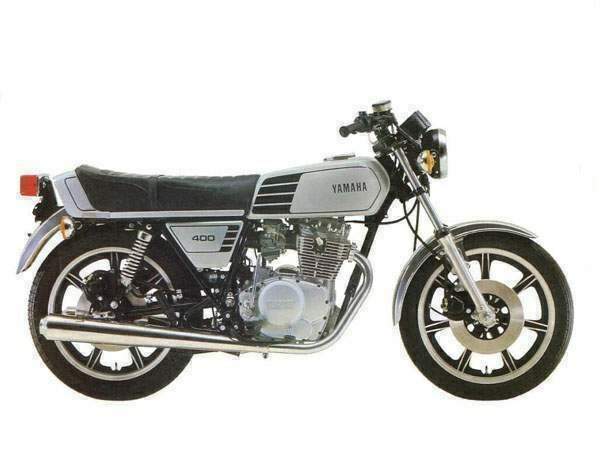
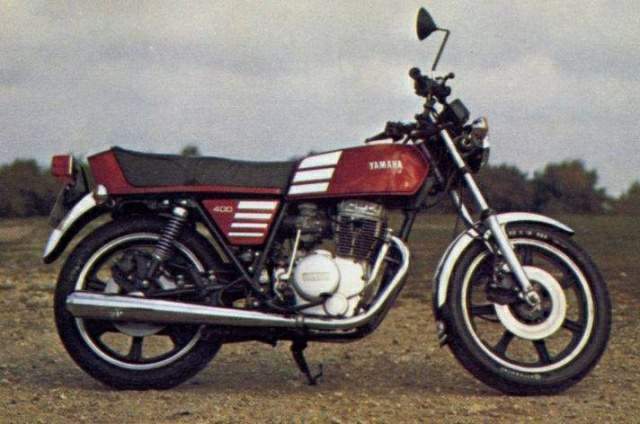
Yamaha XS 400
Yamaha have been trying to cater for all tastes and marketing machines with similar capacity in both two-stroke and four-stroke guises in the mid 70s. The XS400 is the company's four-stroke machine in the popular 400 class and is completely different from the RD400 two-stroke which has a much sportier image, even if in reality both bikes are just about equal in performance. The XS4Oo's nearest relation is the similar-looking XS360, and both have parallel air-cooled twin-cylinder engines driving through six-speed gearboxes.
The single-overhead-camshaft unit is very oversquare with dimensions of 69mm bore by 52mm stroke, and it can rev to 9000rpm, which is quite high for a twin. Unlike the other 400 twins in the same class, the XS does not have counter balance shafts, which means the motor does vibrate more than the opposition, but this is not noticeable above 45oorpm. More important than the bike's 38bhp is the torque produced which peaks at 22lbft at 75oorpm, but stays within 5lbft of that figure right down to 4000. On the road, this means that the Yamaha will pull strongly and evenly over a large speed band.
A top speed of 105mph can be achieved while acceleration over a standing start quarter mile takes a very creditable I4.o.secs. There are single disc brakes at the front to stop the bike which are mounted on attractive alloy wheels which, in turn, help take away some of the bulkiness of the bike's looks. Yamaha have also devised neat paintwork on the tank and side panels which helps break up the lines, again to make the bike appear smaller than its 3621b would otherwise suggest.
The standard of equipment on the middleweight Yamaha is equal to that of many Japanese machines, and betters them with an ingenious indicator system which is worked by a linkage to the speedometer. This means that the winkers stay on for a certain distance which has no bearing on time but just distance travelled.
|
|
|
Any corrections or more information on these motorcycles will be kindly appreciated. |