|
|
|
|
Classic Bikes
Custom Bikes
Individual
Racing Bikes AJP
AJS
Aprilia
Ariel
Avinton / Wakan
Bajaj
Benelli
Beta
Bimota
BMW
Brough Superior
BRP Cam-Am
BSA
Buell / EBR
Bultaco
Cagiva
Campagna
CCM
CF Moto
Combat Motors
Derbi
Deus
Ducati
Excelsior
GASGAS
Ghezzi Brian
Gilera
GIMA
Harley Davidson
Hero
Highland
Honda
Horex
Husaberg
Husqvarna
Hyosung
Indian
Jawa
Kawasaki
KTM
KYMCO
Laverda
Lazareth
Magni
Maico
Mash
Matchless
Mondial
Moto Guzzi
Moto Morini
MV Agusta
MZ / MuZ
NCR
Norton
NSU
Paton
Peugeot
Piaggio
Revival Cycles
Roland Sands
Royal Enfield
Sachs
Sherco
Sunbeam
Suzuki
SWM
SYM
Triumph
TVS
Ural
Velocette
Vespa
Victory
Vincent
VOR
Voxan
Vyrus
Walt Siegl
Walz
Wrenchmonkees
Wunderlich
XTR / Radical
Yamaha
Zero
Video
Technical
Complete Manufacturer List
|
Yamaha XS 1100SF Special
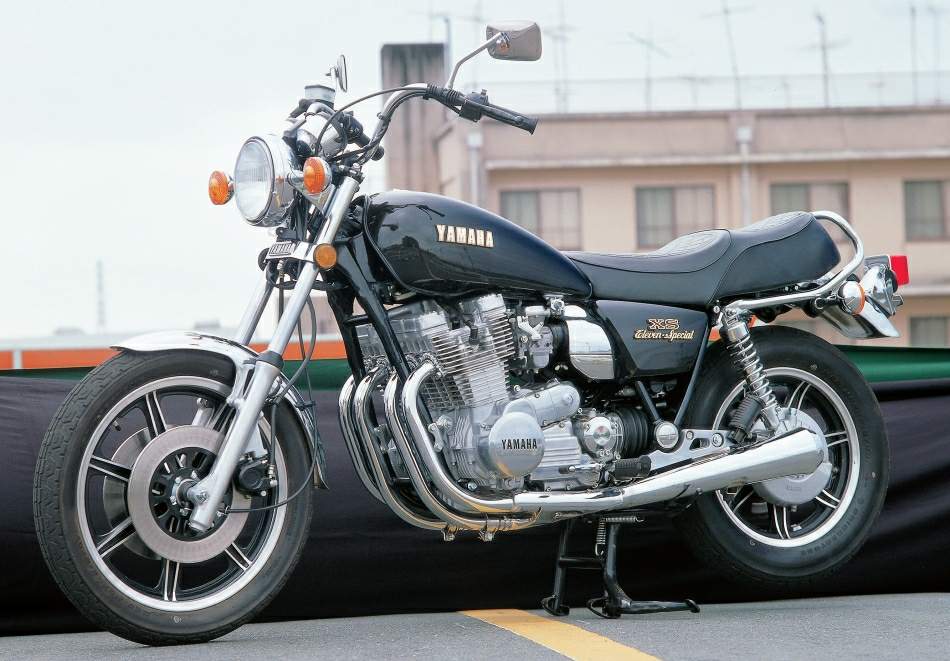
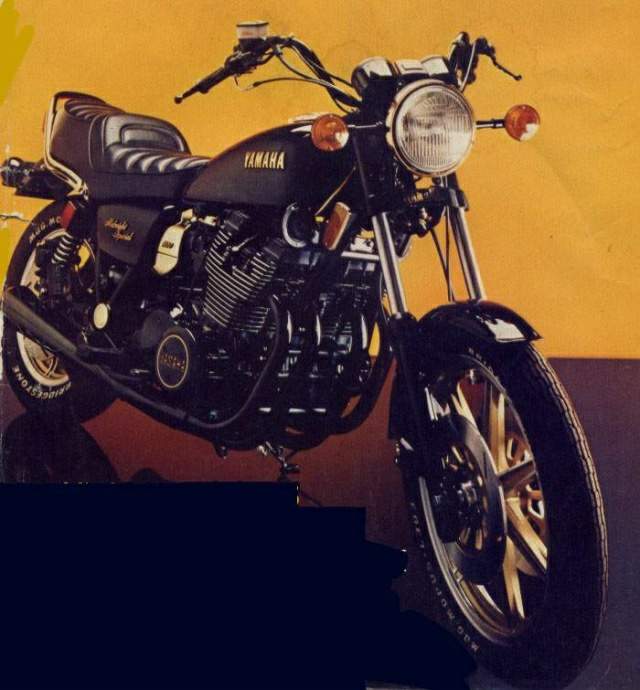
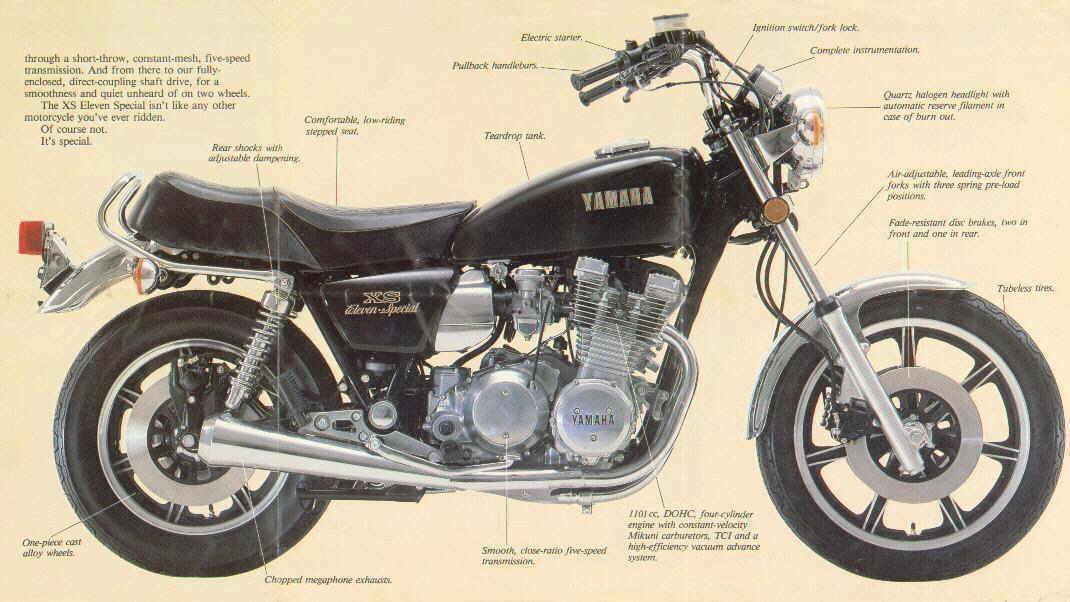
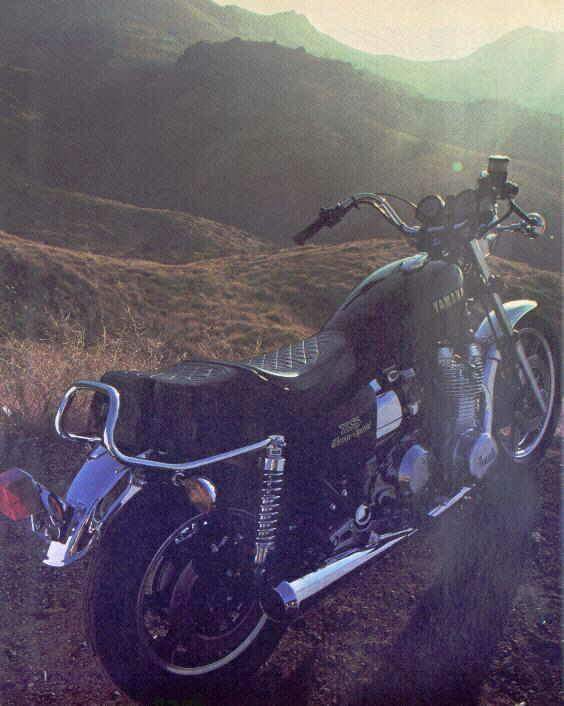
Subtle refinements prepare Yamaha's Eleven for 1980 Forget the rumors. There's no V-Four. No enlarged Elevens. Yamaha's flagship, For the third year in a row, is the XS Eleven. And the most Eleven you can buy is still the Special, with low, stepped seat, handlebars that would look appropriate on the hood of of a cowboy Cadillac, and the same clean styling that has made Yamaha's Specials a success story. There have been changes made to the Eleven, both mechanical and cosmetic. Are the changes improvements? The answer depends on the point of view. Take the motor, for instance. The big dohc inline Four stays essentially the same. Bore and stroke remain 71.5 x 68.6mm. There's still inductive electronic ignition, still with a vacuum advance and with the same settings. The compression ratio has been dropped to 9.0:1, the pistons and head have been changed so the combustion chamber is different, the better to meet more stringent 1980 emission standards. In addition, the intake valve head diameter has been increased from 36mm to 38mm and the exhaust valve size has gone from 31mm to 32mm. Given the same cam timing and profile, that should make for more horsepower, but there's more to it than that. Those four 34mm Mikuni constant vacuum carbs are jetted differently this year. There's no adjustment on the pilot jet. The needle jet is held in the leanest position. Main jets, which were a #137.5 in all carbs previously are now a #115 in carbs two and three and a #120 in the end carbs. No longer is there a kick starter shaft sprouting from the right side of the Eleven's five-speed transmission. Now there's a seal covering the hole. The Hy-Vo primary drive chain is the same and so are the gear ratios and the final drive. Because the 16-in. rear tire of the Special has a smaller outside diameter than the 17-in. tire of the standard Eleven, the road speeds in the gears are noticeably lower. Most of the chances that make the 1980 Special different from the 1979 Special could be called cosmetic. Rather than have a chromed tubular grab bar behind the seat, the new Special has a cast aluminum rail extending around behind the revised seat. Under the rear of the rail is a new taillamp tucked in tightly behind the seat. The rider's portion of the stepped seat is supposed to be two-thirds of an inch lower in 1980, but we measured a full inch difference in seat height between last year's Special and this year's test bike, at a figure of 31 in. Oh yes, that taillight didn't include the license plate light, which is now, located at the end of the rear fender where the license will hang.
Second most noticible change to the Special concerns the new brake discs. Last year there were triple solid discs. The fad has been to have drilled discs, supposedly to improve wet weather braking, and remove grit from the pads to reduce disc grooving, though it never seemed to make any difference. This year the hot set-up is to have the drilled holes placed in an irregular pattern or at a curve or an angle. The Eleven Special has slots, not holes. And the slots don't radiate directly out from the center of the hub, but slant out across the discs, all three of them. Other changes include the two chromed horns sticking out from each side of the engine, the one on the left being the low tone and the horn on the right being the high tone. Combined, they're loud and noticeable, both in terms of sound output and visual impact. Also, there's a flashing warning light switch on the left handlebar switch that flashes all the signal lights together when it's on. Side reflectors are moved about and the footpegs are larger this year. And don't forget the 85 mph maximum speedometer that's every bit as silly, on the Eleven as it is on any other 130 mph motorcycle. Some things on the Eleven haven't been changed. The original Eleven had a supple suspension that was high on comfort, but made the machine wallowy when it was loaded. Last year's Special introduced a revised suspension with air assisted leading axle forks and adjustable damping shocks. The forks and shocks aren't changed on the 1980 Eleven Special. The Special still has short mufflers, nicely tucked in and reasonably quiet. There's the same 4 gal. gas tank with the same sparkly black paint and the same locking hinged gas cap on it. The instruments, aside from the 85 mph speedometer, are the same and so are the instrument lights including the low gas warning light. The stepped seat on the Special, unlike most stepped seats, is surprisingly comfortable for either one or two riders. The wide footpegs make a comfy platform, almost like flootboards, while folding for spirited cornering and not transmitting vibration. Then there's the suspension. It's as good a touring bike suspension as has ever been offered. But it's on the wrong bike. Most companies that sell touring equipment don't offer equipment for Specials. We've had a 750 Special around the office for nearly a year now and the biggest problem we've had is finding accessories to fit it. The whiz-bang suspension should be on the standard Eleven. The air-assisted forks soak up bumps big and small while controlling the front half of the bike's 584 lb. weight. For normal riding the minimum 6 p.s.i. air pressure is fine. The only uses for which higher pressure would be needed would be if a heavy fairing were mounted or the bike were to be used for serious speeding on winding roads. Neither use is encouraged by the Special's styling. Rear suspension adjustment is much the same. For normal use the minimum damping gives the best ride, while the stiffer damping settings enable the Eleven to remain stable with heavier loads or when ridden faster. What the owner needs to know, though, is that one man's settings are another man's discomfort. The touring rider dials in control for full pack and the weekend cruiser comes back and says Hey, this bike is oversprung and underdamped. And it was, for that application. What each rider must do is tune to suit himself and the conditions of the moment. The combination of beefy shocks. 16-in. rear tire and a reduction in weight from the standard Eleven gives the Special the highest load carrying capacity of any motorcycle Cycle World has tested. Cleaner styling means less gingerbread which means less weight. About 20 lb. less weight than the standard Eleven at 584 lb., the Eleven Special is lighter, for instance, than the Suzuki GS850. It's well over 100 lb. lighter than the Kawasaki KZ1300. With a half tank of fuel, the Special has a load capacity of over 500 lb.
Even with this year's engine changes, the Eleven is an enormously strong motorcycle. Originally Yamaha claimed the Eleven had 95 horsepower. Now, it's probably under 90 bhp. Quarter mile times aren't in the 11's anymore. Trap speed is down 4 mph from the original Eleven. What the engine has gained with the bigger valves it has lost with the leaner jetting. Of course a power hungry owner could change carb jetting without much difficulty. The changes, in some states, would violate state air pollution tampering rules, but the raw material is still there. Engine performance has suffered in other ways than straight horsepower, too. In order to start the Special from cold the choke has to be full on and the throttle cracked a quarter of a turn. Our test bike wouldn't start with just the choke pulled out when cold. The bike then has to run for several minutes with the choke on. Usually the choke would be left full on for a mile then pushed halfway in for another mile and finally it would run, sort of, without choke. Still, there was a hesitation just off idle that was annoying and required revving the big motor excessively just to get rolling from a stop. A quarter mile time of 12.15 sec. at 109.48 mph is no slouch. It's just that we expect new motorcycles to be faster than last year's model. That is, until exhaust emission standards came about. Fortunately the emission standards have reached their most stringent level in 1980. There are no plans for tighter restrictions next year or the year after, on motorcycles, so maybe next year's Yamaha can once again run better as the engineers learn more about the motors. Those stylish slashes in the brake rotors haven't hurt the Eleven's stopping ability. With distances of 33 ft. to stop from 30 mph and 134 ft. from 60 mph, the Eleven's brakes are powerful enough. However when the discs heated up the front brakes could lock up unpredictably during maximum use. Whether the brakes work better in wet weather or not is unknown due to a lack of rain when the bike was tested. Yamaha's solid discs used in 1979 worked better than average in wet weather stopping with little drying-out time needed. Staff comments were divided on several of the Special's special features. Some testers feel the emergency flashers are a worthwhile safety device while others have no use for them. Some like the self-canceling turn signals and the low fuel warning light, others don't. The Eleven, in either standard or Special trim is not a machine for the spartan. Yamaha makes the 650 Twin for people who like kick starters and vibration. The Eleven is for those who appreciate all the sophistication a motorcycle can offer. The Eleven's motor is as smooth as any Six. Its sheer size and state of tune give a rider tire-destroying power at any engine speed over 3000 rpm. The clutch pull is lighter than the clutch on Yamaha's own 750. The transmission, which shifts with a loud clank is positive, but needs firm shifts from strong boots. In designing the Eleven. Yamaha didn't get carried away with technical overkill. Yes, there are dual overhead cams and an inductive electronic ignition, but these things aren't complications to the rider. Basic maintenance on the Eleven consists of changing oil and sparkplugs. It's not liquid cooled and the plugs can be easily changed without removing the gas tank. The eight valves are set with shims and adjusting the valves requires a stock of shims and a valve spring compressor tool, not usually part of the home mechanic's tool chest. Because of the Eleven's shaft drive, it hasn't been used extensively in competition, but the motor is proven bulletproof. Jim Bernard just rode the XS11-based Ron Teson/R.C. Engineering Top Fuel dragster-which uses a stock Yamaha crankshaft and main bearings in its super-charged engine - to a new E.T. record with a 7.57 sec. at 184.95 mph pass at Indianapolis.
For stock XS11s, the clutch is probably the weakest link of the machine. After half a dozen runs at the dragstrip the clutch in the test bike was slipping too much to continue testing. When it cooled off and was adjusted, it returned to normal performance. Going into its third year, the biggest Yamaha is wearing well. It's still the best touring machine we've seen. It's still a magnificent motorcycle. Unfortunately. it's not better than the original XS Eleven. Performance is down. In day-to-day operation the machine is less convenient to use due to its state of tune. The Special has added a refined suspension, but the real merits of the suspension can't be used because the Special doesn't lend itself to either sport or touring use. Finally, there's styling. The Special is a good looking motorcycle. It's clean and everything is shaped just right. But again, this year's Special isn't as good looking as last year's Special. The separate tail and license plate lights detract from the clean styling. The cast aluminum grab bar around the seat is attractive, but the entire machine, with more chrome and bigger reflectors on the side, looks ever so slightly more gaudy than the original Special. Maybe when the Specials are the standard models, Yamaha can reinvent the Special and introduce new, simpler styling with less excess. Source Cycle World 1979
|
|
|
Any corrections or more information on these motorcycles will be kindly appreciated. |