|
|
|
|
Classic Bikes
Custom Bikes
Individual
Racing Bikes AJP
AJS
Aprilia
Ariel
Avinton / Wakan
Bajaj
Benelli
Beta
Bimota
BMW
Brough Superior
BRP Cam-Am
BSA
Buell / EBR
Bultaco
Cagiva
Campagna
CCM
CF Moto
Combat Motors
Derbi
Deus
Ducati
Excelsior
GASGAS
Ghezzi Brian
Gilera
GIMA
Harley Davidson
Hero
Highland
Honda
Horex
Husaberg
Husqvarna
Hyosung
Indian
Jawa
Kawasaki
KTM
KYMCO
Laverda
Lazareth
Magni
Maico
Mash
Matchless
Mondial
Moto Guzzi
Moto Morini
MV Agusta
MZ / MuZ
NCR
Norton
NSU
Paton
Peugeot
Piaggio
Revival Cycles
Roland Sands
Royal Enfield
Sachs
Sherco
Sunbeam
Suzuki
SWM
SYM
Triumph
TVS
Ural
Velocette
Vespa
Victory
Vincent
VOR
Voxan
Vyrus
Walt Siegl
Walz
Wrenchmonkees
Wunderlich
XTR / Radical
Yamaha
Zero
Video
Technical
Complete Manufacturer List
|
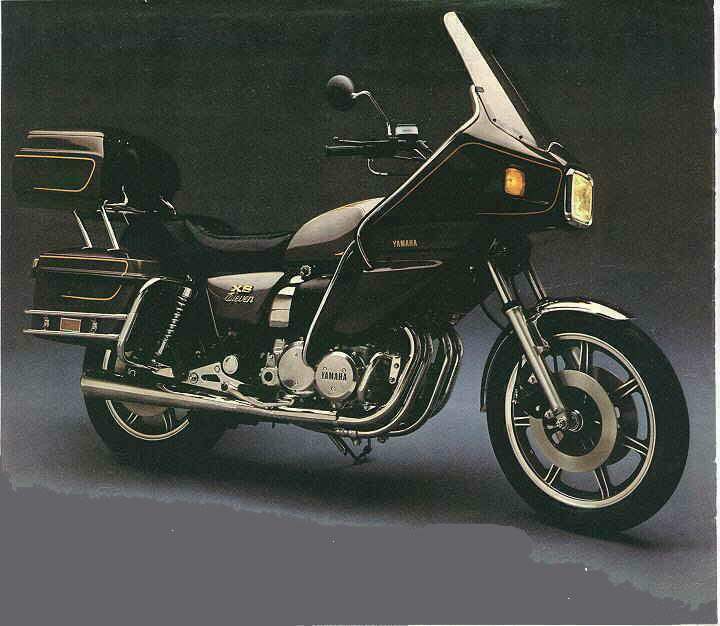
Yamaha XS 1100G
Rough Edged Freeway Bomber Now in its third year, the flagship of the Yamaha line, the XS1100G, is still one of the most awesome brutes available to a horsepower crazed American public. Although other big bore fours and sixes have been released since the XS11 made its debut, it still stands as a solid, reliable workhorse for long distance commuting or sport touring. Powered by an engine with a displacement larger than most of the cars on the road in Italy, the 1101cc four closes in on its targets like a heat seeking missile. Riding an Eleven in traffic means planning passes on several cars in advance. Its stable high speed manner and quiet shaft offer the rider a new level of confidence in his machine. The Eleven has already built quite a cult following, of sorts. It never ceases to get approving nods and comments at any point of conversation. For 1980, Yamaha scheduled only modest changes for the XS1100. Content with public acceptance, the "G" gets a restyled seat, adjustable shocks, a quartz halogen headlamp, full instrumentation, air forks and new paint. Most of the changes work; one doesn't quite hit the mark. That one is the seat. Its design is much more graceful, and the seat height is slightly lower than the earlier unit, which was the impetus behind the change. While the profile is lower, the overall width of the seat is increased to clear the frame rails. The cut down saddle shape isn't sharp enough for most riders. The front edge of the seat is wider, and considerably harder, than the area just a few inches aft. This throws a comfortable seating position off for most riders, except those over 6'2". If the rider sits up close to the tank, the bar/peg relationship is right. But in that position it is nearly impossible to put both feet down at a stop because the seat is too wide and too hard. If on the other hand, the rider slides back where a comfortable standing-at-a-stop position is possible, the bars and pegs are too far forward. This is all based on individual rider shape and riding style, but to a man, our testers (5-10 to 6-2 in height) minced on the seating position. The seat isn't peaked enough to be comfortable on long hauls, either, at least for most of our testers. With the new seat comes a stronger rear grab/lift bar that attaches at the upper shock mounts and on the chrome fender. Adjustable spring preload, complements the new adjustable damping feature on the shocks. For large increases in weight, a passenger and some baggage for instance, the preload and damping can be balanced to effectively match the changes in load. Up front, the forks are now air adjustable, to increase the springing rates to counteract down forces caused by fairings, or just increases in weight. Even the most finicky rider should find a pressure that suits him and the conditions. This year, the Eleven gets the rectangular quartz halogen lamp, a major improvement over standing lighting. The pattern and beam distance of the lamp can't be faulted. A retrofit on earlier models is highly recommended. Instrument angle, lighting and readability are all excellent. Still with us from last year are the transistor controlled ignition, constant velocity Mikunis, 17 inch rear wheel assembly, double discs up front, single disc at the rear, self canceling turn signals and tubeless tires on highlighted mirrors become useless. RIDING IMPRESSIONS What can one say about a machine with four times the power to weight ratio of a Corvette or Pontiac Trans-Am? The acceleration is stunning, but always controllable. It's awesome all right, but with composure and style. It's like King Kong in white tie and tails. What we kind of miss any more are the challenges from various hot or semi-hot cars that used to be an every day occurrence, until they got tired of getting snuffed at every light. A lot of guys no doubt started to look at bikes to fill the performance void created by emasculated, restricted automobiles. Even the performance cars that are left are embarrassing - despite a car magazine's efforts to the contrary. Really, now. Coupled to all this power is a quiet shaft drive unit that eliminates chain problems and adjustments. The chassis integrity is not compromised by the massive power output. The XS doesn't nod its steering head in high speed sweepers, like the biggest Kawasaki. But a couple of the same old annoyances are still there. The shifting is notchy, exuding a clunk with every up or down shift. And, we're sad to report, the 4,000 rpm buzz is still there, putting hands, buttocks and internal organs to sleep at an even 60 cruising in top gear. At this engine speed, the mirror's become useless. CONCLUSION Yamaha can probably expect to sell all of their XS1100G models this year, just as they did with the '79s. The combination of brute power, shaft drive and a loyal following will assure high sales. We'd like to see either a final drive gear change to move the buzz above 65 mph (the extra-legal limit just about everywhere) and a solution to the clunking shifting before we'd clamor down to the dealer with our checkbooks. Add to these unhappy aspects, a seat that's not particularly comfortable and we find that for what the XS is supposed to be - a large, comfortable, smooth and quiet freeway cruiser - it doesn't quite do it. Although the new two-tone silver/gray paint combo (one of two schemes available) hints at the sophistication of the Rolls-Royce Silver Shadow, it doesn't deliver on all the promises. It never hides the fact that there is a nuclear power plant between your legs. Source By the Staff of Modern Cycle 1980
|
|
|
Any corrections or more information on these motorcycles will be kindly appreciated. |