|
Yamaha
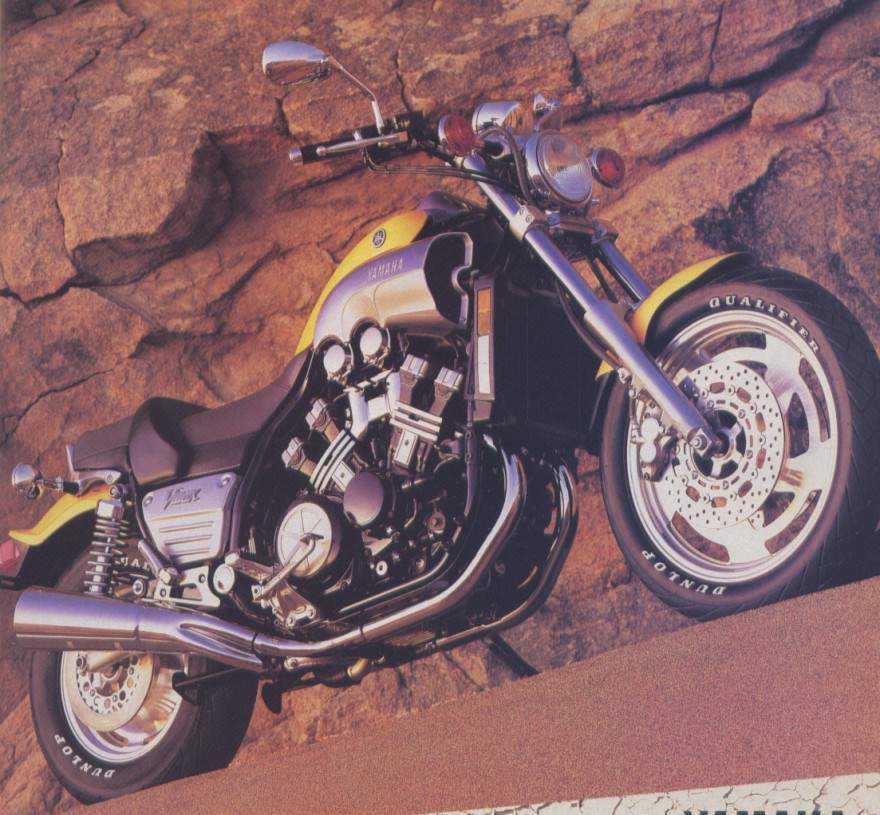
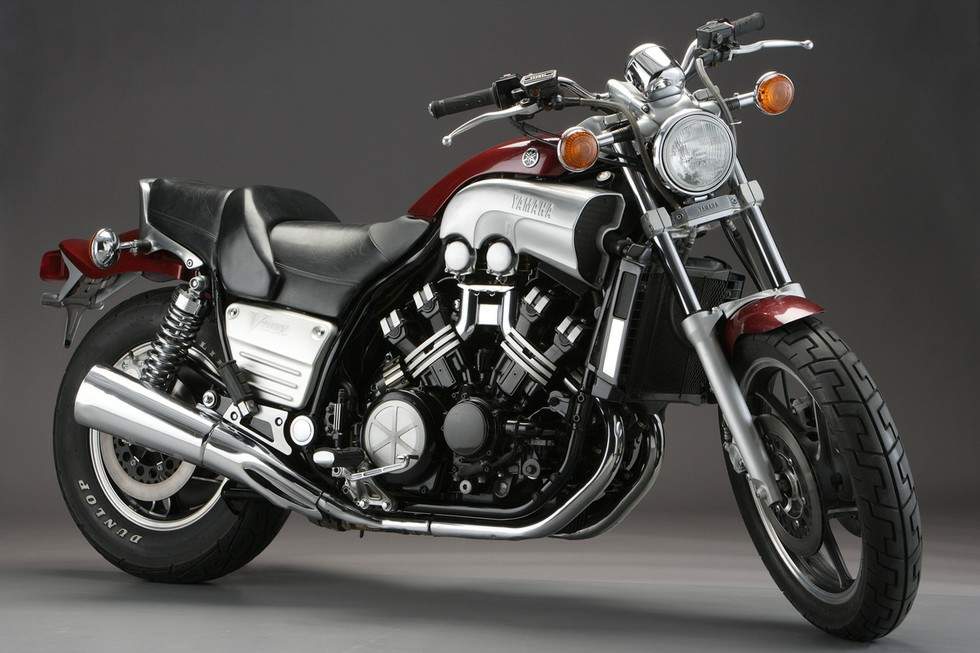
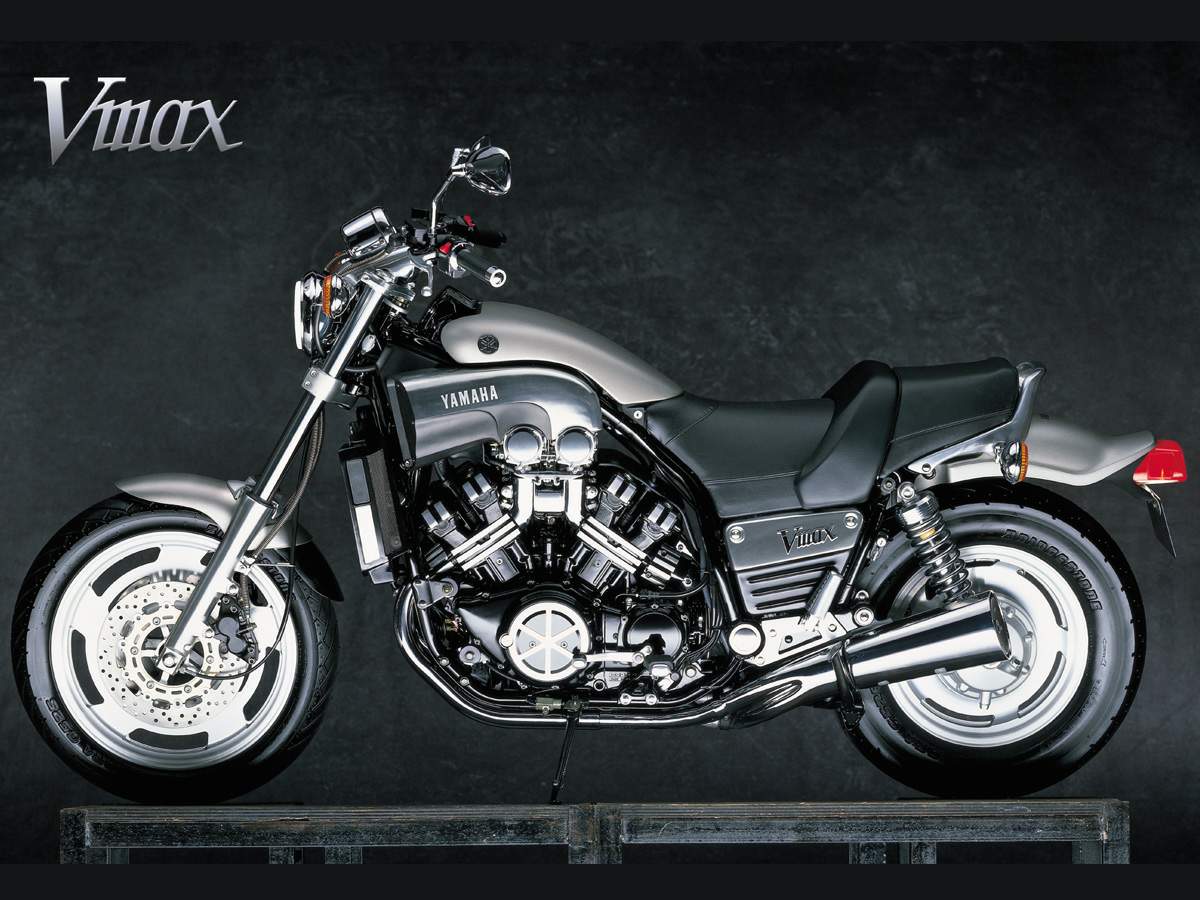
VMX 1200 V-Max

|
Make Model |
Yamaha VMX 1200 V-Max |
|
Year |
1995-98 |
|
Engine |
Liquid cooled, four stroke, V-four, DOHC, 4
valve per cylinder. |
|
Capacity |
1198 |
|
Bore x Stroke |
76 х 66 mm |
|
Compression Ratio |
10.5:1 |
|
Induction |
4x 38mm Mikuni CV |
|
Ignition /
Starting |
CDI / electric |
|
Max Power |
102 hp 74.4 kW @ 8000 rpm (rear tyre 97.88 @ 7700
rpm) |
|
Max Torque |
101 Nm @ 6000 rpm |
|
Transmission /
Drive |
5 Speed / shaft |
|
Front Suspension |
38mm forks non adjustable |
|
Rear Suspension |
Twin shock preload adjustable |
|
Front Brakes |
2x 250mm discs 2 piston calipers |
|
Rear Brakes |
Single 250mm disc 2 piston caliper |
|
Front Tyre |
110/90 -18 |
|
Rear Tyre |
150/90 -17 |
|
Dry-Weight / Wet-weight |
262 kg |
|
Fuel Capacity |
15 Litres |
|
Consumption average |
13.1 km/lit |
|
Braking 60 - 0 / 100 - 0 |
13.2 m / 39.0 m |
|
Standing
¼ Mile |
11.7 sec / 185.8 km/h |
|
Top Speed |
216.7 km/h |
|
Overview |
Motorcycle.com
|
|
Manuals |
vmaxoutlaw.com
/
diff.ru /
blackbears.ru |

Motorcycling's answer to the Titan IV, Yamaha's V-Max is showing its age,
but no other motorcycle delivers the same satisfying kick in the pants. From
the August 1999 issue of Motorcycle Cruiser magazine.
From the February, 2009 issue of Motorcycle Cruiser
Even turning the motorcycle's key to the on position generates a little shot
of adrenaline, as the fuel pump spools up with a turbinelike whine, hinting
at what awaits. But the real fun begins when you thumb the starter and that
1198cc V-4 awakens and snarls a challenge for all within earshot.
Ready? Throw a leg over the stepped saddle, point Yamaha's V-Max in a safe
direction and pull the trigger. It might be smoking now but this isn't the
gun -- it's the bullet. Snap the throttles open, and it fires down the road.
Depending on the heaviness of your throttle hand and the deftness of your
clutch control, this bike can explode from a stop with the rear wheel
spinning, or launch straight and sure with the front wheel just skimming the
pavement.
1999 Yamaha Vmax Engine Right View
Even obviously liquid-cooled...
read full caption
1999 Yamaha Vmax Engine Right View
Even obviously liquid-cooled engines can be pretty, especially when they
exude this much mechanical menace.
Sure, some big nasty sportbikes accelerate harder, but they all lay you down
into the bike so you can absorb the forces. The upright riding posture of
the V-Max means you feel all the acceleration ripping at your arms. You are
thankful for that big backstop in the saddle, which holds you in place as
the engine bellows like a Top Fuel car as it tears through first gear.
Although the wheelbase is shorter than what is found on most big cruisers,
it's long enough to keep Mr. Max from standing up and snapping over backward
the way some high-powered sportbikes want to do when you hold them wide open
in first gear.
If you haven't scared yourself yet, catch second gear with a short, light
flick of the lever and grab another handful. But be careful. Letting it run
all the way to the 9500-rpm redline in second gear jeopardizes your driving
record anywhere in the United States. The speedo is reading more than 75 mph
before the little tank-top tach shows redline in second gear.
1999 Yamaha Vmax Gauges View
The big business-like speedometer...
read full caption
1999 Yamaha Vmax Gauges View
The big business-like speedometer is complemented by the instrument panel
protruding from the top of the dummy tank. It offers tach, temp gauge and
warning lights.
If you miss it on your blast through second, the rush through third might
give you time to take note of one of the V-Max's special tricks. It's called
V-Boost, a clever bit of intake plumbing. When rpm reaches 6500, a valve in
a crossover manifold between the cylinders in each bank opens, allowing each
cylinder to draw through two carbs. It's something like the four-barrel-carb
arrangement used in cars. If you happen to have the opportunity and presence
of mind to notice while you are accelerating through that portion of the rpm
band, you can feel the surge as the extra breathing comes on line.
You don't have to ride the V-Max everywhere at full throttle, of course.
Even when you aren't berserking, the engine will impress you. You'll notice
throttle response, though slightly abrupt, is strong right off the bottom.
The engine ticks along contentedly at 1800 rpm, but wakes right up and yanks
the bike forward when you snap the throttle open. You can go from communing
with nature to talking to God in a heartbeat. Almost any situation, save an
inches-to-spare pass of slower traffic, gives you a choice of three gears.
When you do need every ounce of thrust, downshifting to first or second gear
provides you with more passing acceleration than any other stock sit-up bike
on the road.
1999 Yamaha Vmax Burnout View
With the throttle just cracked, there is nothing to hint at the monster
lurking within the engine until you tug, even gently, at the loud handle. If
the engine is lightly loaded, such as when riding at moderate rpm in the
lower gears, there is a gentle surging. Upshifting to increase the load or
simply accelerating lightly gets rid of it.
Clutch action is smooth and progressive, and you don't need a gorilla grip
to manage lever pull. Lash (that is, play in the drive train that is taken
up when you get on or off the throttle) is virtually undetectable, but there
is some chassis jacking that comes with shaft final drive. Because this
causes the shaft to rise when you get on the throttle, the jacking -- like
the riding position -- adds to the sense of acceleration.
1999 Yamaha Vmax Rear Wheel View
Awesome in 1984, the cast...
read full caption
1999 Yamaha Vmax Rear Wheel View
Awesome in 1984, the cast rear wheel -- though still wide -- is no longer
the fattest rubber out there. The multipiece saddle gets uncomfortable after
a few hours.
We don't mean to imply the riding position is that of a conventional
cruiser. Given its low, narrow, almost-straight handlebar and footpegs set
back practically under the rider's butt, the V-Max riding position is
certainly not standard cruiser issue. However, trying to hang on to this
kind of acceleration with your feet out in front of you and a wide pullback
handlebar might be too much to manage. The handlebar permits you to lean
forward to resist the forces created during acceleration, and the position
of your feet reduces the tendency of your upper body to roll backward.
Leaning forward onto the bar puts you in control and comfort when the V-Max
is hurling you down the road. The seat-handlebar-footpeg relationship also
works well when just trolling around town or out on the highway.
The liquid-cooled, 16-valve V-4 V-Max engine is very similar to the engine
used in the new Royal Star Venture and, just like the Venture, it uses a
counterbalancer to effectively suppress vibration. You know the engine isn't
electric but there aren't any buzzes that put your extremities to sleep or
make your backside tingle.
1999 Yamaha Vmax Handle Bar View
The low, narrow handlebar...
read full caption
1999 Yamaha Vmax Handle Bar View
The low, narrow handlebar offers plenty of steering leverage and helps
create a riding position to handle the forces created by the considerable
acceleration. The right handlebar includes a fuel reserve switch.
Although the three-section saddle is fine for short trips or daily use, the
crowned shape gets to most riders after a few hours of steady riding. This
and unimpressive range are the only factors that limit the V-Max as a
traveling machine for a solo rider. The suspension rarely makes the road
feel harsh and shaft drive completes a package that, except for the need for
frequent rear-tire replacements with some owners, is remarkably reliable and
easy to maintain. If Yamaha's power cruiser has a weak spot, it's handling.
Although it was less of an issue when it was introduced a decade and a half
ago, the machine isn't quite as steady in fast turns as we have come to
expect on current bikes. True, no other machine has to contend with the
VMX12's combination of weight, shaft drive and monster power, but we suspect
some juggling of steering geometry, tire sizes and suspension rates could
make the bike feel just as steady in corners as it does blazing off the
line. Some of the wiggling seems to occur in concert with the engine's
steady-throttle surging at low loads, which isn't a threat, just unsettling.
The slight stability shortage isn't dangerous, since it announces itself
gently, but it limits the bike somewhat.
Other aspects of handling get high marks. The bike steers lightly and it's
easy to manage at crawling speeds. Perhaps because of the narrow handlebar
and comparatively short wheelbase, it is easier to handle at creeping speeds
than some milder-mannered cruisers. The suspension, which includes
air-pressure adjustments up front and damping controls for the dual rear
shocks, offers acceptable control, though there is certainly room for
improvement. That chassis jacking related to the shaft final drive doesn't
interfere with control during cornering, though it does change the geometry
a bit more than most cruisers with power changes. Few riders will drag
anything in turns. The brakes are an even match for the power, though we
wish for better suspension rates up front to handle hard braking on bumpy
surfaces and better braking traction from the tires, which also feel
slightly dated.
1999 Yamaha Vmax Gas Cap View
Only the initiated know how...
read full caption
1999 Yamaha Vmax Gas Cap View
Only the initiated know how to reach the locking fuel cap beneath the
rider's seat back.
One V-Max ritual long practiced around here provides great amusement for
V-Max veterans at the expense of V-Max virgins. Staffers for Motorcycle
Cruiser and its sister publications who have never ridden a V-Max are
regaled with tales of block-long burnouts, shoulder-spraining acceleration
and other white-knuckle exploits prior to their first rides on the bike.
This is intended to distract the victim from the real issue. Just before
riding away, the mark is repeatedly warned to take it easy with the
throttle. And, just as he puts it in gear, he is told that the bike is low
on gas and should be filled promptly. In fact, the machine is already into
its reserve tank. Since the fuel selector is in the on position, the engine
will die moments after the virgin rolls out of the driveway. He will
probably see the low-fuel light glowing, which will send him searching for
the fuel petcock. However, the V-Max, which uses a pump to get fuel from the
under-seat tank to the engine-top carbs, doesn't have a conventional
petcock. If the neophyte is sharp, he'll spy the switch on the right
handlebar. This is actually a great feature, assuming you know where it is.
Instead of removing your left hand from the handlebar and feeling for the
petcock lever, you simply flip the switch with your right thumb. Of course,
you have to know it's there.
1999 Yamaha Vmax Front Wheel View
Although the brakes are respectably...
read full caption
1999 Yamaha Vmax Front Wheel View
Although the brakes are respectably strong, current tires offer better
braking traction than the V-Max rubber.
But that's just the beginning. When he gets to the gas station, he has to
find the fuel cap. Most of the rookies know it's under the seat, but it
usually takes them a long time to find the two levers behind the rear shocks
that must be pushed simultaneously to make the rider's backrest portion
spring up to reveal the locking cap. This also provides access to the
toolbox and document compartment. Uninitiated riders sent out to get gas on
the V-Max have sometimes spent most of an hour searching, not always
successfully, for the fuel cap. Pity the new staffer who comes back and
admits defeat. Once you know about them though, the peculiarities of the
fuel system are assets compared with conventional designs, and not just
because of their entertainment value.
Some other unique design features also have advantages. The space under the
cover that looks like a fuel tank is occupied by the airbox, fuses and
radiator overflow tank. Unlocking the metal cover provides quick access to
these components. A small panel, which houses the tachometer, a small temp
gauge and the warning light cluster, rises from the front of the dummy tank
area. The turn signals include a self-canceling feature. True to its 1980s
origins, the V-Max includes a centerstand which offers some security and
safety advantages as well as a valuable maintenance aid.
1999 Yamaha Vmax Rear End View
By jacking the chassis a bit,...
read full caption
1999 Yamaha Vmax Rear End View
By jacking the chassis a bit, the shenanigans involved with shaft drive
actually increase the sense of power. Although the shaft requires less
maintenance than a chain, it eats up a bit more power and adds weight.
The styling is also reminiscent of the bike's 1980s roots. The faux scoops
alongside the dummy tank would be a comic overstatement if the bike didn't
live up to its power claims so completely. Higher on our list of things to
change are the dated turn signals and some of the related mounting bracketry,
particularly up front. This year the front fender, dummy tank and
tailsection are finished in a textured carbon-fiber pattern (which was
created using a film applied to the parts) then covered with clearcoat.
For a discussion of the V-Max design and development process, see the Yamaha
Design Cafe. This story also includes interviews with the people responsible
for various aspects of the V-Max's creation. In addition, the site includes
a year-by-year history of V-Max changes.
The V-Max's ferocious reputation intimidates some riders, though not
necessarily the ones it should. While it is true more temperate motorcycles,
such as either of the Honda musclebikes (Magna and Valkyrie), have more
rounded personalities, the power of the V-Max won't get you into trouble
unless you let it. Sure, its ability to develop velocity with such immediacy
can get you in trouble, but it can also get you out of harm's way. Its
throttle still works both ways and does not need to be opened all the way.
It's not a safe place for riders who don't know their own limitations, but
for those who do, the V-Max is an unmatched kick in the pants.
IN BRIEF
High Points: Max power, attitude to match.
Low Points: Dated styling, more dated chassis.
First Changes: Beef up the chassis.
RIDING POSITIONS
1999 Yamaha Vmax Rear Side View
Cherney: And then there's your Yamaha V-Max -- a claimed 140 crankshaft
horses from the get-go, unchanged in 14 hair-raising years. You gotta wonder
what the hell they were thinking back in 1985; in '99 you still have to
pretty much strap yourself on the thing to keep from getting bucked off.
It's got attitude, it's got brawn, it's got a tough accent -- it's basically
the mutation of an alien slab and a Chevy musclecar on two wheels, with none
of the traditional styling cues you might find on, oh...any other vehicle on
the planet. Park it in front of a trendy bistro and watch the fashion police
react.
You sort of perch on the dark steed, reaching easily to its narrow bar and
settling onto the wide pegs. One might assume this is the usual upright
seating ergos -- not plush, but no racebike meat rack, either. It's after
you nudge the tach past seven thou that the V-Boost kicks in and the heart
of the beast really uncoils. You find yourself wishing you had more to grab
on to. Remember you're sitting bolt upright on the V-Max. The big heaping
gobs of power that issue forth with a snap of the throttle find you
straining against the wind to keep your head on your neck.
After you finally get a grip on the thing, you realize it steers a little
heavy. The brakes are serviceable but you'd feel better with triple discs
front and back, and maybe even an air bag thrown in for good measure.
I also found the fuel access a bit of a chore -- real James Bond-y. The
latch is secreted away behind the shocks, and it pops the rear seat open to
reveal the gas cap. If you're not refueling, the seating position is plenty
comfy (for around town). And the most important gauge of all, the
speedometer, is centered directly in front of your tearing eyes -- right
there in the middle of the handlebar.
And if they do find your head snapped off from wind shear, rest assured
it'll have a big sloppy grin plastered all over it.
Andy Cherney
If you're still livin' in the '80s and lovin' it, Cherney doesn't want to
hear about it at: Andy.Cherney@primedia.com
Brasfield: Every time I ride the V-Max, I think that there are 140 reasons
to love the V-Max and one reason to question that love. To truly appreciate
this bike, you need to get on it and get on the throttle. Once that V-Boost
kicks in you'll know the Supreme Being is a biker and She loves beefy V-4s!
If this bike doesn't put a smile on your face that threatens to split your
helmet in two, then you must be dead. Yep, no doubt about it, horsepower
rules -- all 140 of 'em.
And the reason not to like the Max? Styling. Like any cruiser that has been
around virtually unchanged for more than 10 years, the appearance could use
a little gussying up. Attend a cruiser function on a V-Max, and people
willing to ardently defend or condemn the VMX12's looks materialize around
it, which always makes for an interesting time. But when blasting through
the meat of the power curve, I can't help but think, "No style never goes
out of style."
Oh, and Yamaha, a word about the carbon-fiber-look bodywork. Blech! Either
produce a limited-edition V-Max with real carbon fiber or give it a paint
job. As far as I'm concerned, nothing says "wannabe" more than that fake
stuff -- which is an insult for a bike that's got the goods right out of the
box.
Evans Brasfield
You can ardently agree with or condemn Brasfield via his website.
Friedman: The V-Max is a fixture on the short list of machines I intend to
buy when I hang up my word processor. It is not an ideal musclebike, because
of its flawed handling, but it is the definitive two-wheeled hot rod.
Nothing out there launches you like Mr. Max. No other motorcycle rolls
around with that same dare-ya attitude -- and the ability to back it up.
1999 Yamaha Vmax Shadow Burnout View
Some folks from Yamaha will be visiting in the near future to talk about a
variety of cruiser-related topics, including power cruisers. This makes me
hopeful that the V-Max -- which has been around for 15 seasons with only
minor improvements -- may finally get a major upgrade, like a chassis that
is as good in corners as the current machine is off the line. But if any new
version loses a bit of this machine's kick-in-the-ass, then I'll have to buy
this bike, warts and all. I mean, who wants the second-fastest musclebike
ever?
Art Friedman
Give Friedman at kick in the ass at Art.Friedman@primedia.com or at
ArtoftheMotorcycle@hotmail.com.
SPECIFICATIONS
1999 Yamaha V-Max
www.yamaha-motor.com
Owners group: V-Max Owners Association
2004 Yamaha Vmax Side View
This is the 2004 V-Max, which...
read full caption
2004 Yamaha Vmax Side View
This is the 2004 V-Max, which is virtually identical to the 1999 model
tested here, and not too different from the original model from the 1980s.
Its MSRP is $10,899.
Designation: VMX12
Suggested base price: $10,499
Standard colors: Carbon-fiber
Standard warranty: 12 mos., unlimited miles
Recommended service interval: 7500 miles
ENGINE & DRIVETRAIN
Type: Liquid-cooled, 70-degree V-4
Valve arrangement: DOHC, 2 intake valves, 2 exhaust valves; adjusting shims
atop buckets Displacement, bore x stroke: 1198cc, 76 x 66mm
Compression ratio: 10.5:1
Carburetion: 4, 35mm Mikuni CV, V-Boost valve system
Lubrication: Wet sump, 5.0 qt
Minimum fuel grade: 87 octane
Transmission: Wet, multiplate clutch; 5 speeds
Final drive: Shaft, 2.851:1
CHASSIS
Wet weight: 617 lb
GVWR: 1100 lb
Wheelbase: 62.6 in.
Overall length: 90.6 in.
Rake/trail: 29 degrees / 4.7 in.
Wheels: Cast, 18 x 2.15 front, 15 x 3.50 rear
Front tire: 110/90V19 Bridgestone Excedra tubeless
Rear tire: 150/90V15 Bridgestone Excedra tubeless
Front brake: 2, 4-piston calipers, 11.7-in. discs
Rear brake: Double-action caliper, 11.1-in disc
Front suspension: 43mm stanchions, 5.5 in. travel, adjustable for air
pressure
Rear suspension: 2 dampers, 3.9 in. travel, adjustable for spring preload,
rebound damping
Fuel capacity: 4.0 gal (.8 gal reserve)
Seat height: 30.1 in.
Handlebar width: 27.7 in.
ELECTRICAL & INSTRUMENTATION
Charging output: 350 watts
Battery: 12v, 16AH
Forward lighting: 5.5-in. headlight, position lights
Taillight: Single bulb
Instruments: Speedometer, odometer, tripmeter, tachometer,
coolant-temperature gauge; warning lights for neutral, high beam, turn
signals, low fuel, low oil level
PERFORMANCE
Fuel mileage: 26 to 39 mpg, 34.0 mpg average
Average range: 136 miles
RPM at 60 mph, top gear: 3820
200 yard, top-gear acceleration from 50 mph, terminal speed: 91.4 mph
Quarter-mile acceleration: 10.87 sec., 124.0 mph
Source
Motorcycle Cruiser
 |