|
|
|
|
Classic Bikes
Custom Bikes
Individual
Racing Bikes AJP
AJS
Aprilia
Ariel
Avinton / Wakan
Bajaj
Benelli
Beta
Bimota
BMW
Brough Superior
BRP Cam-Am
BSA
Buell / EBR
Bultaco
Cagiva
Campagna
CCM
CF Moto
Combat Motors
Derbi
Deus
Ducati
Excelsior
GASGAS
Ghezzi Brian
Gilera
GIMA
Harley Davidson
Hero
Highland
Honda
Horex
Husaberg
Husqvarna
Hyosung
Indian
Jawa
Kawasaki
KTM
KYMCO
Laverda
Lazareth
Magni
Maico
Mash
Matchless
Mondial
Moto Guzzi
Moto Morini
MV Agusta
MZ / MuZ
NCR
Norton
NSU
Paton
Peugeot
Piaggio
Revival Cycles
Roland Sands
Royal Enfield
Sachs
Sherco
Sunbeam
Suzuki
SWM
SYM
Triumph
TVS
Ural
Velocette
Vespa
Victory
Vincent
VOR
Voxan
Vyrus
Walt Siegl
Walz
Wrenchmonkees
Wunderlich
XTR / Radical
Yamaha
Zero
Video
Technical
Complete Manufacturer List
|
Yamaha TT 500
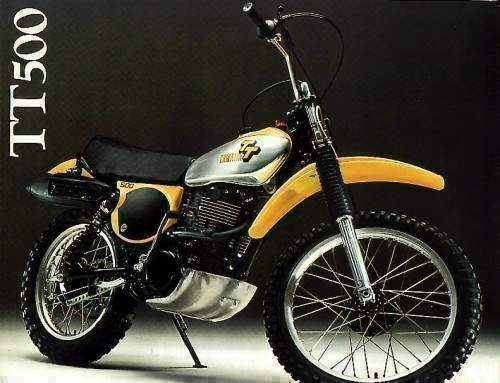
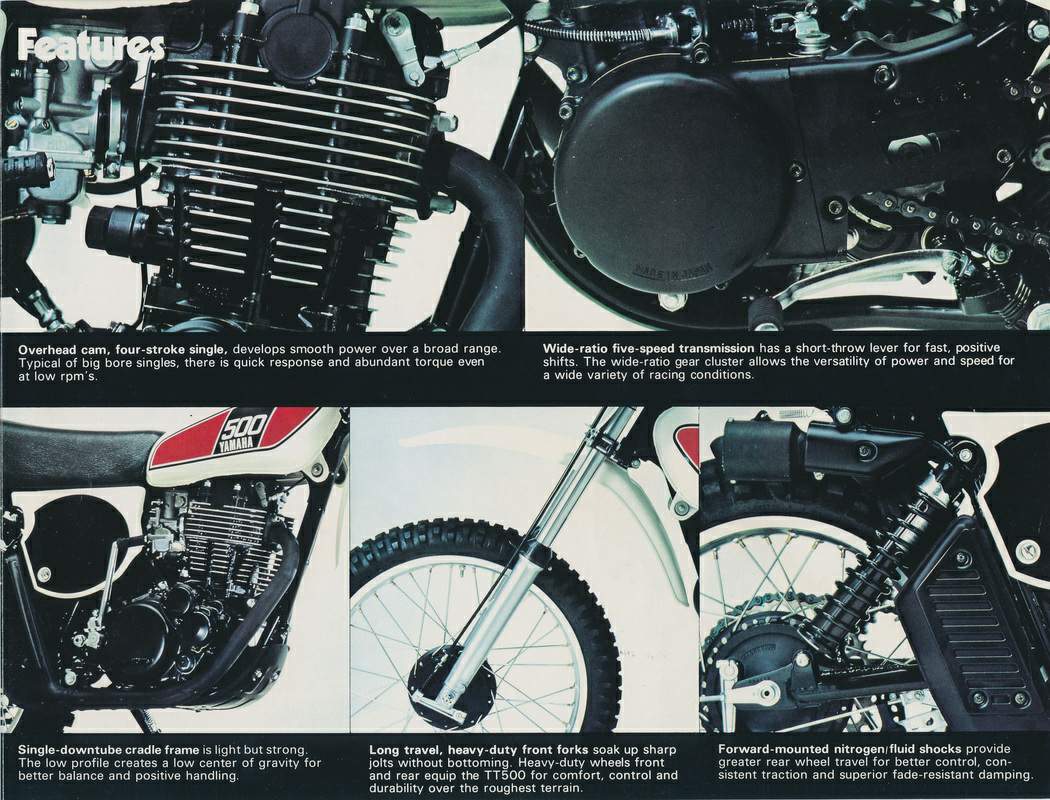
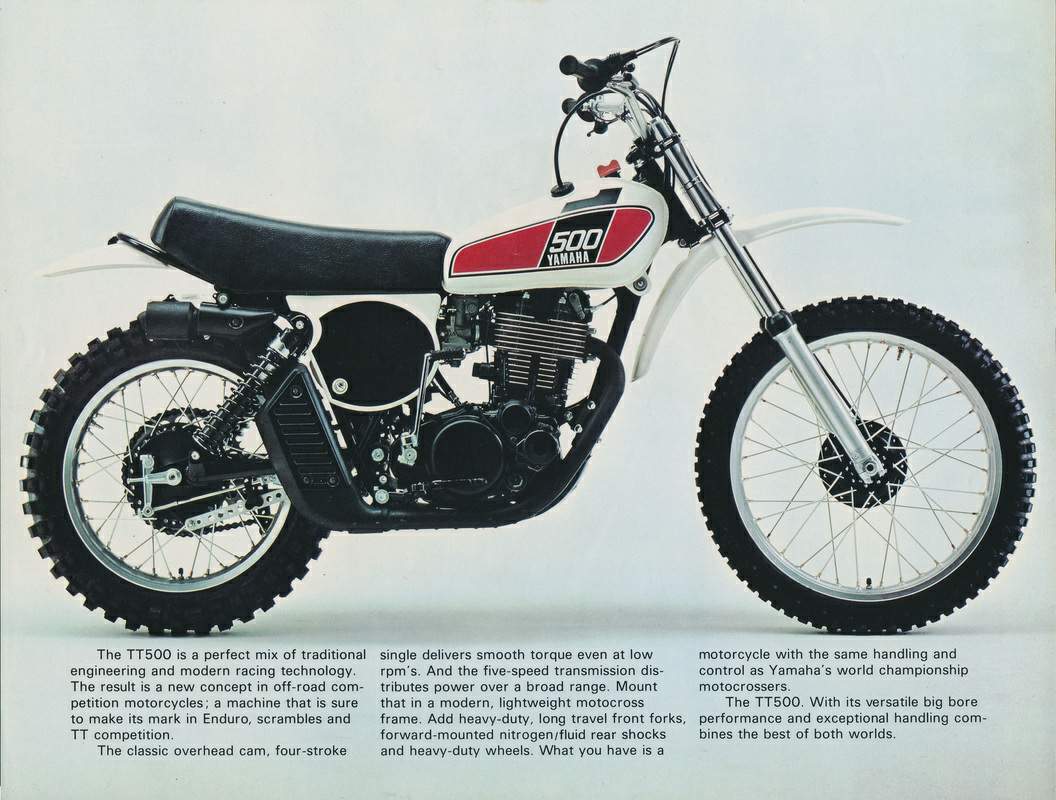
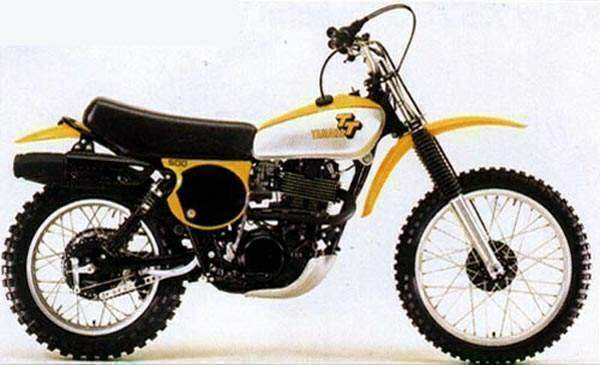
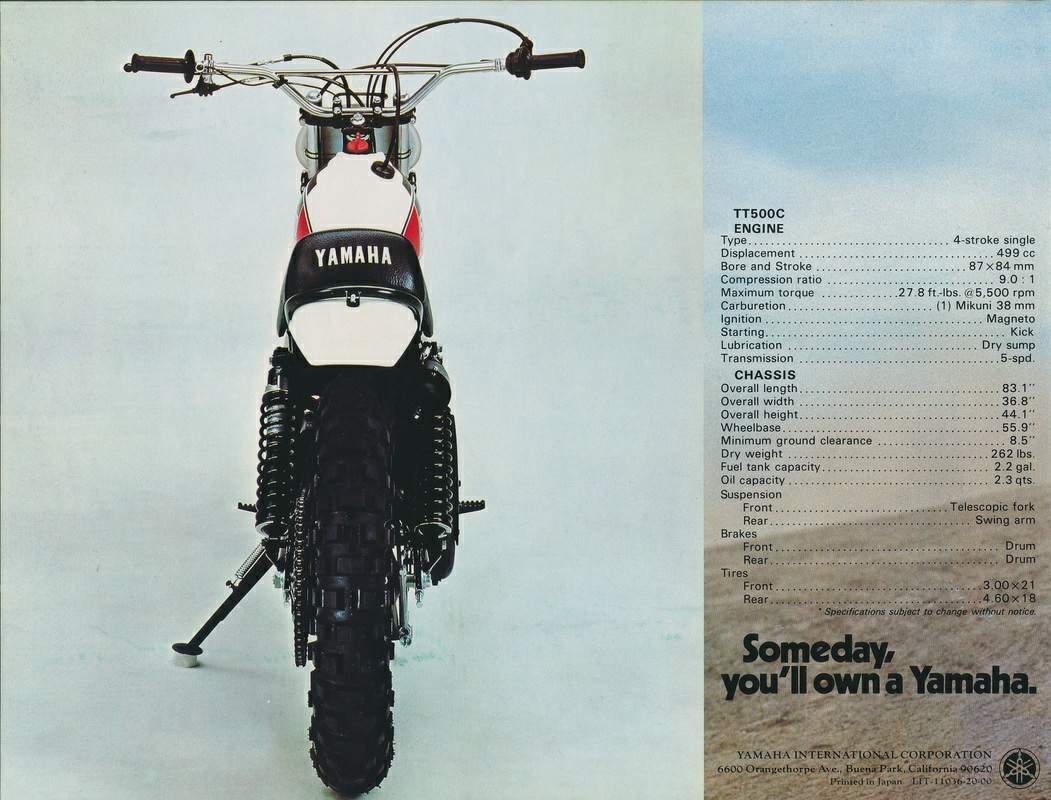
Road Test 1975 It was not long ago that thumpers ruled the earth. The two-stroke was nothing more than an underpowered, smoking, unreliable, noisy contraption. But through refinement, the two-stroke is now enjoying a popularity never before seen. If anything, two-strokes are overpowered, the smoking is absolutely minimal, their reliability has increased a hundredfold and the noise has certainly diminished considerably over the years. One of the things that has made it so easy for the ring-dings to surpass the thumpers in the play bike field is that for a long time thumpers made no progress. They were there, much as they had been for decades, untouched, mostly, because there wasn't really any fear of losing sales to those new-fangled smokebombs. Then Honda, realizing that it could easily capitalize on a four-stroke market that was in virtual hibernation, introduced the XL line, starting with the mild 250 and eventually developing the very potent 350. Honda was successful with its thumpers for several reasons. First, they were easy to start. For the most part, old BSAs, Matchless' and AJSs were a cantankerous lot. Second, Honda had parts available around nearly every corner. No waiting while 10 of the 12 parts you needed were ordered from an out-of-state distributor and the other two- parts were on the ocean, somewhere between the factory and the U.S. coast. And finally, the machines were light, for production four-strokes. If you fell off, it didn't take three men and a boy to right the bike. Initially, many people felt that for the first time Honda had really blown it. Thumpers had been pronounced dead several years before. But the Japanese proved once again to know more about the American market than even the Americans. Meanwhile, Yamaha was watching closely from the sidelines. No doubt the thought of reviving the thumper crossed their minds, but why risk it? Let Honda do the investigating research, development and marketing. Then, if Honda succeeded, move in with a model that would one-up the XLs. That's where the TT500 comes in. To be produced in both street-legal Enduro (XT), and play bike (TT), configurations, the new 500 ohc four-stroke from Yamaha is a tremendously versatile and appealing machine. The engine is a straight-forward two-valve Single. Bore and stroke measure 87mm x 84mm, yielding a total displacement of 499cc. The overhead cam is run by a chain off a sprocket on the right side of the motor. Chain pitch is identical to that used on the Yamaha 650 Twin. Tension is maintained by a rubbing-block tensioner that is easily adjusted from outside the engine. The camshaft itself is supported on both ends by ball bearings. Feeding the monstrous mill is a 34mm Mikuni carburetor. While the physical makeup of the carb, as well as the snappy response produced, indicates it to be a constant velocity mixer, it isn't. Two cables operate the Mikuni in a push-pull stunner; but rather than operate a butterfly as on a CV, they work through a reel, directly on the slide. The machine carbureted superbly the entire time we had it.
Delivering the engine's power to the five-speed transmission are a set of straight-cut primary gears. Normally, straight-cut primaries exude a loud whine. But the ones on the Yamaha were absolutely silent. The transmission is typically Yamaha both in operation and in the selection of ratios. Both are excellent. The machine can be chugged about in first gear at slow speeds. It isn't a trials bike, but then it isn't supposed to be. On some very steep descents you may want to pull in the clutch to keep the engine from stalling as you brake. Instead, activating the decompression valve through the handlebar-mounted lever will achieve much better results. One reason for this is the overly sensitive rear brake. It is the same confounded brake that is found on Yamaha's larger MX models. Decelerating in gear, the binder is easier to use, because the power impulses of the motor help overcome its sensitivity. But with the clutch in, it becomes a toggle switch, with no room for error. On the front end is an absolutely beautiful brake. It too has been pirated from Yamaha's MX models, and sports the magnesium backing plate off the YZs. Both hubs are laced to D.I.D. rims. Bringing the Yamaha to a quick stop from its 90-plus mph top speed is not frightening at all. Just watch it with the rear brake. The TT500 can scare you in other ways though. The exhaust system makes the bike so quiet that you find yourself entering fireroad corners way over your head. You don't realize how fast you're going. This system is designed to pass the 86-db limit. The one on the XT Enduro model is expected to put out a mere 81 db. You could pull wheelies in the church parking lot during High Mass and no one would know you were there. Air intake is high and to the rear of the bike. Impurities are filtered out by a washable foam element. Crankcase pressure is vented through a PCV valve. Any oil that might be pushed through the valve is trapped by a cone-shaped plastic stopper and returned to the engine once it is shut off. Vapors are directed through a hose and back to the intake tract. The single-downtube, mild-steel frame splits into twin cradles just below the first motor mount. A skid plate is mounted to protect the engine from rock damage. The massive upper backbone is the oil reservoir for the dry-sump engine. A double trochoidal pump draws oil from the reservoir and returns it. Capacity of the backbone is 2200cc.
Suspension is both old and new. The front forks are identical in appearance to what Yamaha has been producing these last few years. They also perform identically. That is to say, poorly. Not only do the forks pogo excessively, but they exhibit flexing traits at the triple clamps that make stability at speed in rough terrain mildly sketchy. The flexing you'll have to learn to live with if you're a banzai-type rider. The poor fork action will hopefully be a thing of the past by the time you read this. Our machine was the last of the pre-production prototypes. It is 99.9 percent the way it will be when sold. One of the things, however, that will be changed is the damping action of the front end. Travel there is already more than acceptable at 7.7 in. Shock absorbers for a machine such as this might present a problem. But Kayaba has those superb gas/oil DeCarbon-designed shocks that we've seen so much of lately. Suzuki uses them on the RM125, Kawasaki on the KX250 and 400, and Red Wing sells them as an after-market product. Each time we encounter them, we are sold more and more on their performance and near indestructability. The Yamaha's shocks didn't alter our opinion. Action is superb. Actually, in their cantilevered position (26 degrees from vertical), which offers 5.7 in. of axle travel, the shocks exceed the needs of the machine. Our lighter staffers felt that while the action of the shocks was outstanding, the springing was a little too stiff. It wasn't anything that they couldn't cope with, just a tad tight. For that same reason, they found that the rear wheel chattered under hard braking. Heavier staffers found neither trait to exist. No doubt the TT500 was designed to suit larger riders. Frame geometry is designed more for stability than for agility. With 30.5 degrees rake and a whopping 5.3 in. of trail, the TT500 should not feel as lithe and supple as it does. Yet it goes exactly where it's pointed. Occasionally the 3.00-21 Dunlop Sports up front would let go and the _front end would push. Dunlop tires are very good, provided the ground has some moisture in it. But Southern California's motorcycle playgrounds rarely have such ideal conditions. The 4.60-18 Sports Senior suffers from the same malady, only at a much lower level. The inherent tractive capabilities of the motor are the reason for the improved adhesion. Trailing the Yamaha is really a gas. The engine is just as much of a freight train as you'd expect. When lugging down to near idle speeds, there is a decided amount of snatch in the drive chain. Power impulses are violently strong and they transfer through the whipping chain to the rear tire, which lurches the machine forward in equally violent spurts. But once the engine gets above idle, the impulses smooth out. At about 3000 rpm (an educated guess), it begins to purr. Vibration is present, but by no means annoying. The motor can be wrung out as far as 9000 turns, although horsepower (which we would put at between 28 and 30), peaks at a lowly 6000. The torque band is as flat as a ruler.
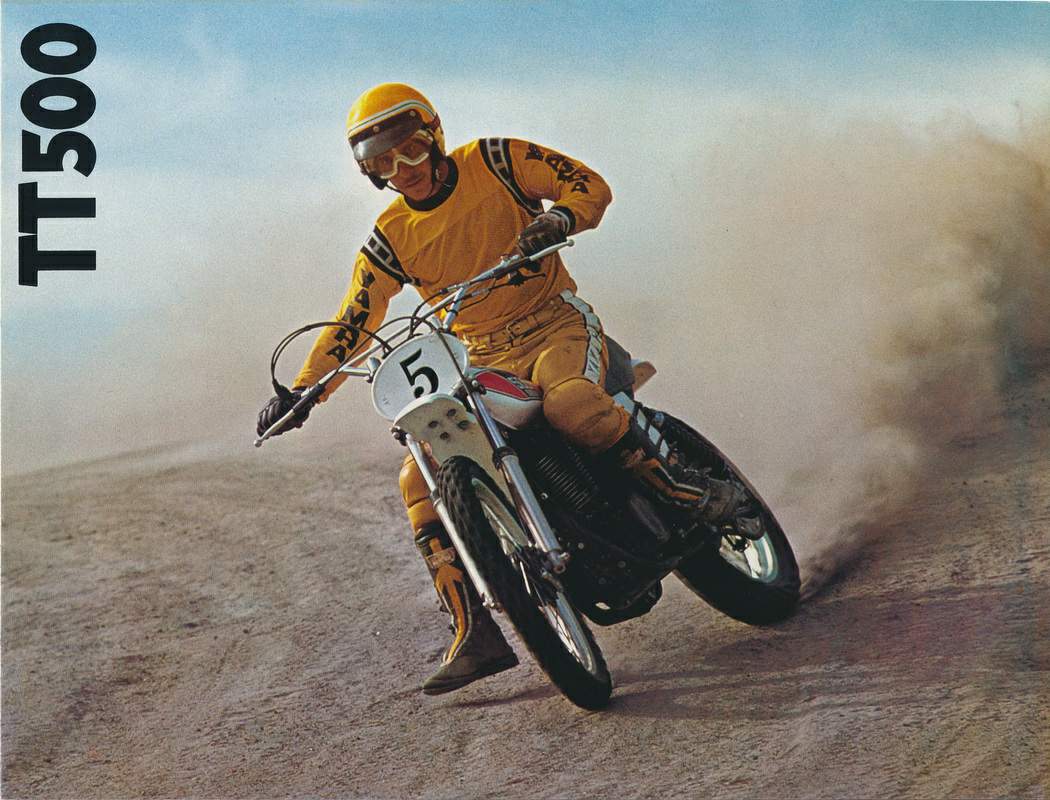
Just for fun, we motocrossed the Yamaha on a weekday. Instantly it tells you that, despite its relatively light weight (279 lb. with its 2.2-gal. tank half full), it doesn't want to be thrown about like a two-stroke. The 56-in. wheelbase keeps things in line, but it doesn't like to be driven through corners. The 500 wants to be driven in, spun around and blasted out. Try to corner it with the power on all the way through and you'll lose time. The engine provides fantastic traction, and as the bike gets a bite in a bend, it straightens right up, whether you're ready or not. This is why a quick square-off works best. Against some of the motocross talent that was on the track this particular day, there wasn't a single machine that the Yamaha couldn't pass. There also wasn't a single machine that it could run away from. Getting past was easy since you can get a much better drive out of corners with the thumper than with a two-stroke. And when we wrung out second gear and pulled a quick shift into third, the Yamaha jumped about 30 feet in front of the bike next to it. But the two-strokes have more power and they would catch us by the end of the straights, outbrake us into the turns—they're much lighter and were able to go in deeper before dropping anchor—where they'd pull even, and then get eaten alive by the Yamaha coming out. We don't recommend the Yamaha for motocross competition. But if you want to go and play motocrosser for the day, it is willing. You have to relearn a lot about cornering, but it's kind of fun to put it to the ring-dings. What Yamaha's new off-road addition boils down to is this. It is an easy-to-start, unadulterated 500cc thumper that has been fitted with modern suspension, an easy to service engine, a five-speed transmission, traditional Yamaha styling and a whole cylinder full of fun. Also it is versatile enough to be used as a motocross play bike, and can be fitted with lights from the Yamaha TY trials bikes (the lighting coil is already included in the magneto ignition). If we have any major complaints about the Yamaha they are these: to fit it with a speedometer for enduros requires the purchase of a DT400B front wheel, and the petcock doesn't have a reserve. We liked the machine so much that one staffer has already put one on order. As a general all-purpose off-road recreation machine, you just can't do better. Source Cycle Guide 1975
|
|
|
Any corrections or more information on these motorcycles will be kindly appreciated. |