|
Make Model |
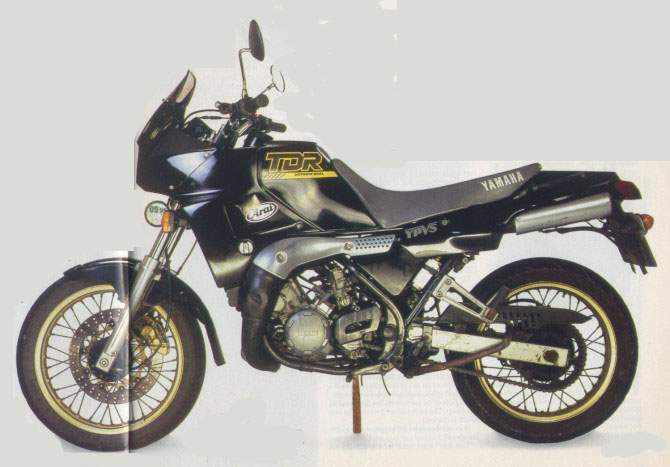
Yamaha TDR 250 |
|
Year |
1993 |
|
Engine |
Liquid cooled, two stroke, parallel twin cylinder, read
valve, |
|
Capacity |
249 |
|
Bore x Stroke |
56.4 х 50 mm |
|
Compression Ratio |
5.9:1 |
|
Induction |
2x 28mm Mikuni carbs |
|
Ignition /
Starting |
Transistorized |
|
Max Power |
46 hp @ 9500 rpm |
|
Max Torque |
3.6 kg-m @ 8000 rpm |
|
Transmission /
Drive |
6 Speed / chain |
|
Front Suspension |
Air assisted telescopic forks7-way adjustable
preload, |
|
Rear Suspension |
Single shock rising rate adjustable preload, |
|
Front Brakes |
Single 320mm disc 2 piston calipers |
|
Rear Brakes |
Single 210mm disc single piston caliper |
|
Front Tyre |
110/90-18 |
|
Rear Tyre |
120/80-17 |
|
Dry-Weight / Wet-Weight |
134 kg / 150 kg |
|
Fuel Capacity |
13.6 Litres |
With the TDR, Yamaha create a totally new category
in motorcycling. Powered by a two-stroke parallel-twin engine with YPVS and
"cross-up" exhaust system, the TDR boosts instant acceleration far exceeding
that of normal dual-purpose machines. The TDR is also the world's first
two-stroke bike to use a CD ignition with digital advance system.
Nimble handling and stunning acceleration for street use are combined with
unmatched off-road capabilities, thanks to sturdy front forks, the rising-rate
Monocross rear suspension, and front and rear disc brakes.
And as for looks, a tank-mounted head fairing rounds out the TDR's unique
styling theme. The 250cc class will never again be the same.
Styling was influenced by off-road
TECHNICAL HIGHLIGHTS
Powerful 249 cc, 2-stroke, parallel twin-cylinder engine with liquid cooling,
YPVS and crankcase reed-valve induction
Combination of CDI and digital timing advance system
High-efficiency "cross-up" exhaust system
Air-assisted front fork and rising-rate Monocross rear suspension system
Front and rear disc brakes and dual-purpose tyres
Unique styling and aerodynamic head fairing
The 2 stroke twin was based on TZR 250 street sports and delivered 50 HP
A tubular steel frame with a high mounted headstock gave agile handling on the
road and ensured some offroad capability too
Unusual: the cockpit with revcounter mounted on top of the fuel tank
TECHNICAL FEATURES
Engine
While essentially a TZR25O unit, a variety of modifications have been made to
better suit engine power delivery with intended use. Lowered first gear ratio
(45/14 against the TZR25O's 4 1/14) dramatically improves acceleration while
increasing off-road traction. Power is transmitted to the rear wheel via a
sealed, continuous-link chain for high durability and low maintenance.
The newly designed "cross-up" exhaust system, featuring "satellite-chrome"
plated silencers, is tuned for low- and mid-range power. lt ensures plenty of
ground clearance and free rider movement. The 28 mm flat-slide carburetors have
been re-jetted to match the different breathing requirements of the new pipe and
airbox.
The TDR is the world's first motorcycle to combine a CD ignition with a digital
timing advance system. Controlled by a 4-bit microprocessor, it ensures perfect
ignition timing at all rpm. The microcomputer also serves as a control unit for
the YPVS and side-stand switch, contributing to savings in weight and space.
Aside from the above modifications and new silver paint, the TDR engine shares
all the virtues of the TZR unit: efficient case-reed induction with fibre reeds
and 28 mm flat-slide carbs; YPVS; sealed liquid-cooling system with lightweight
radiator and coolant passageways around the exhaust ports; and Autolube oil
injection with YPVS-controlled pump. The TDR also shares the TZR's orthogonal
engine mounting system which reduces vibration.
This high-powered stormer will soon be the "quickest bike in town." Maximum
speed will exceed 100 mph - quite impressive, when one considers the upright
riding position. (A 240 cc version will be sold in France to meet local
requirements.)
Frame
Fabricated of high-tensile steel tubes, the double-cradle frame features high
strength and low weight. Both the top- and downtubes are narrowly spaced near
the steering head to permit a wide steering angle, and extensive gussettings are
used at this point for increased rigidity. Tapered roller bearings are used at
the steering head for increased durability and reduced flexing. Cast-aluminium
passenger footrest brackets are mounted on the rear sub-frame.
Suspension
An air-assisted, centre-axle front fork uses stiff 38 mm stanchions.
A steep 27-degree castor angle and 114 mm of trail contribute to the TDR's short
wheelbase and quick-handling characteristics. Front wheel travel is 160 mm. The
fork is adjustable for air pressure and spring pre-load, and is fitted with
rubber gaiters to protect the tubes from debris.
The rising-rate Monocross rear Suspension system features a De Carbon-type
gas/oil shock absorber with separate reservoir operated by a box-section
swinging arm of high-tensile steel. Rear wheel travel is 150 mm.
This suspension System is designed to provide an idealized compromise between
on- and off-road riding - with a slight street bias.
Brakes
The TDR uses front and rear disc brakes. The front disc is a 320 mm floating
unit operated by a 4-pot, opposed-piston caliper, while a 210 mm disc with
opposed-piston caliper is used at the rear (the discs are same as the TZR's).
Fairing, Instrumentation, Fuel Tank and Seat
Another unique feature of the TDR is its stylish tank-mounted head fairing. Tank
mounting frees the front end of excessive weight for light handling while
ensuring free rider movement. A square, 60/55W halogen headlamp is used, and the
turn indicators are mounted on flexible rubber stalks. Inside the fairing are
located the water temperature gauge and indicator lamps, while the speedometer
is positioned right in front of the steering head. The tachometer is situated at
the front of the fuel tank. This design minimizes inertia moment at the front
end. The 14-litre fuel tank has an aircraft-style cap and automatic, negative
pressure-activated fuel tap. The seat features thick padding and roominess, with
the oil tank, airbox, tool and glove boxes underneath. The ignition key is used
to unlock the seat. A pair of grab-rails are fitted on the rear cowl.
Wheels and Tyres
The 18-inch front and 17-inch rear spoked wheels have light aluminum rims and
will be fitted with either Metzeler Enduro 3 Sahara or Bridgestone Trail Wing
tyres for good traction on both tarmac and dirt. The low front fender directs
cooling air to the radiator.
The Yamaha TDR - adding a new dimension to the already exciting field of sport
riding.
1988 press kit Feature Map
TDR FEATURES
1) 2-stroke, 249 cc, liquid-cooled, crankcase reed-valve, parallel twin-cylinder
engine.
Yamaha Power Valve System (YPVS)
Mikuni TM28SS flat-slide carburetors and fibre reeds
Low secondary reduction for increased traction
Sealed, continuous-link drive chain
Sealed cooling system with alloy radiator & coolant passage around exhaust
ports
Autolube oil injection System with microcomputer-controlled oil pump
Yamaha's "orthogonal" engine mounting for reduced vibration
2) Capacitor discharge ignition with microcomputer-controlled, digital timing
advance System.
3) "Cross-up"lt's a muscle bike like no other. Designed exclusively for America,
not only to look good, but to deliver all the horsepower Americans ever dreamed
of. It'll accelerate fast enough to shift the motorcycling world on its axis.
We're talking raw power here and the rugged good looks that let everyone know
you mean business. The aggressive styling could have come straight from the very
best Custom shops.
In back there is motorcycling's biggest rear tire: a 150/90-15 monster that
looks big enough for a dragster. lt's wrapped around a new disc-type solid
aluminium wheel that looks sharper than any custom wheel around. The rear end's
set off by a skinnier front tire mounted on a 5-spoke 18-inch wheel. Both ends
are covered by chopped fenders and accented by deep chrome. There's even a
three-piece stepped seat with a lockable center section that pivots forward to
reveal the filler for an under-seat fuel tank that helps keep the V-Max's center
of gravity low. Between the bars is a chrome and gold speedometer: nothing else.
Where the fuel is stored on other motorcycles there's a large air filter
providing improved air flow to downdraft carbs. Mounted in a panel above the air
filter cover is a rev counter and a temperature gauge. There are lots of other
good looking features to impress everyone down at the drive-in, but when the
V-MAX starts rolling it's the incredible motor that will turn the heads. This
1198cc monster produces power like nothing else before it, thanks in part to a
radical cam and four massive valves per cylinder. Short ecliptical mufflers do
their part to boost power and let everyone know it too. But what really gets
this hot rod screaming is a unique new V-Boost System. At lower rpm each of the
four downdraft carburettors feeds its own cylinder. But as the revs rise a servo
motor opens a butterfly valve between each pair of inlet tracts. Suddenly there
are tow carbs feeding each inlet port on an intake stroke. lt's like having a
blower without all the mechanical losses. If anyone's unsure about the V-MAX's
powerful potential there are chrome and polished-aluminium highlights that trace
the power flow from the large air scoops below the tank, through the motor and
out the exhaust.
For anyone just looking the V-MAX spells power. Anyone that rides motorcycling's
first real hot rod will know that those looks aren't deceptive. Motorcycling
finally has the power and it took Yamaha's hot-rod V-MAX to move motorcycling
one major step forward.
FEATURES
Tires
The world's largest production-bike tire is used in rear. lt is a V-rated
150/90-15 with a V-pattern tread.
Shaft Drive
A newly designed shaft drive with stronger bevel gears transmits the V-MAX's
tremendous power.
FueI Tank
A 4-gallon fuel tank is mounted below the seat. Fuel is delivered by an electric
pump and an electric reserve switch is mounted on the handlebars.
Frame
The tubular steel frame has a specially lowered center section to reduce seat
height. The right front downtube and left rear frame tube are removable to ease
maintenance.
Shocks
Dual rear shocks have four-way adjustable rebound damping and five preload
positions for the massive chrome springs. Wheel travel is 100 mm.
Fork
A large 40 mm fork is air adjustable and has a balance pipe for ease of
adjustment. An integrated aluminium fork brace increases front-end stability.
Wheel travel is 140 mm.
Brakes
Triple ventilated disc rotors-282mm diameter-are gripped by large 45mm opposed
pistons.
Wheels
A newly designed 18-inch cast wheel is used in front. A radical 15-inch solid
disc wheel is used in rear.
Seat
The V-MAX has a 3-piece stepped seat design. The lockable center section pivots
forward to provide access to the fuel filler cap.
Controls
All handlebar controls are finished in silver.
Gauges
A single speedometer is mounted above the triple clamps. Separate tachometer and
temperature gauge are mounted on a tank-top panel. All gauges have white faces.
Air Filter
Air filter, fuses and hydraulic reservoir are mounted under a lockable
false-tank panel.
Cable Covers
Chromed springs cover the control cables.
Headlight
A small circular headlight is used.
Air Ducts
Air ducts above the cylinders help to highlight the flow of power from the
intake system, through the motor and out of the exhaust system.
Motor
Engine The 1198 cc liquid-cooled V-Four engine has double overhead camshafts and
four valves per cylinder.
Piston
A specially lightened piston and wrist pin improve engine performance.
Crankshaft
A new hardening and heat treatment process improve crankshaft and con rod
strength.
Valves
Large 30.5mm intake and 25.0mm exhaust valves are controlled by stronger valve
springs.
Camshaft
A special high-performance high-lift camshaft is designed to produce maximum
horsepower.
V-Boost
A unique V-Boost System gives a Turbo-like power boost to the V-MAX motor. Four
downdraft carburetors feed the cylinders through individual inlet tracts.
However, the tracts between cylinders one and two and cylinders three and four
are separated by butterfly valves. The valves are controlled by servo motors
that measure engine rpm. At approximately 6000 rpm the servos start to open the
butterfly valves until they are completely open at 8000 rpm. With the butterfly
valves open each cylinder on an intake stroke is fed by two carburetors, rather
than a more conventional single unit. Horsepower is considerably increased
especially in the mid-and high-rpm range.
Transmission
Power is transmitted through a five-speed gearbox and a shaft final drive.
Muffler
Short ecliptical mufflers help to maximize power output.
Carburetors
Four 35mm downdraft Mikuni carburetors mix fuel for the V-MAX motor.
exhaust system featuring satellite -chromed silencers.
4) Light, strong double-cradle frame fabricated of high-tensile steel tubes.
Tapered roller bearings are used at the steering head.
5) Sturdy 38 mm front fork is adjustable for air pressure and spring pre-load.
Provides 160 mm of wheel travel.
6) Rising-rate Monocross rear suspension uses a De Carbon-type gas/oil damper
and a box-section, high-tensile steel swinging arm. Rear wheel travel is 150 mm.
7) A drilled, 320 mm front disc stopped by a 4-pot, opposed-piston caliper. The
rotor is floating for precise control.
8) The rear brake consists of a drilled, 210 mm disc and an opposed-piston
caliper.
9) Stylish head fairing is mounted to the petrol tank for nimble handling. lt
houses a powerful 60/55W halogen headlamp.
10) Simplified instrument panel features tank-mounted tachometer for easy
reading.
11) The tank holds 14 litres of petrol and uses an aircraft-style filler cap and
a negative pressure activated tap.
12) Roomy, deeply padded seat is 820 mm from the ground. Separate passenger grab
bars are fitted to the tail cowl. The oil tank, air filter, tool and glove boxes
are situated beneath the seat.
13) 18" front and 17" rear spoked wheels have aluminum rims, and are shod with
Metzeler or Bridgestone high-grip tyres. Low front fender helps cooling
efficiency.
14) Lightweight cast-aluminium pillion footrest brackets.
Source
yamaha-motor.de