|
|
|
|
Classic Bikes
Custom Bikes
Individual
Racing Bikes AJP
AJS
Aprilia
Ariel
Avinton / Wakan
Bajaj
Benelli
Beta
Bimota
BMW
Brough Superior
BRP Cam-Am
BSA
Buell / EBR
Bullit
Bultaco
Cagiva
Campagna
CCM
CF Moto
Combat Motors
Derbi
Deus
Ducati
Excelsior
Fantic
GASGAS
Ghezzi Brian
Gilera
GIMA
Harley Davidson
Hero
Highland
Honda
Horex
Husaberg
Husqvarna
Hyosung
Indian
Jawa
Kawasaki
KTM
KYMCO
Laverda
Lazareth
Magni
Maico
Mash
Matchless
Mondial
Moto Guzzi
Moto Morini
MV Agusta
MZ / MuZ
NCR
Norton
NSU
Paton
Peugeot
Piaggio
Revival Cycles
Roland Sands
Royal Enfield
Sachs
Sherco
Sunbeam
Suzuki
SWM
SYM
Triumph
TVS
Ural
Velocette
Vespa
Victory
Vincent
VOR
Voxan
Vyrus
Walt Siegl
Walz
Wrenchmonkees
Wunderlich
XTR / Radical
Yamaha
Zero
Video
Technical
Manufacturer List Contact
|
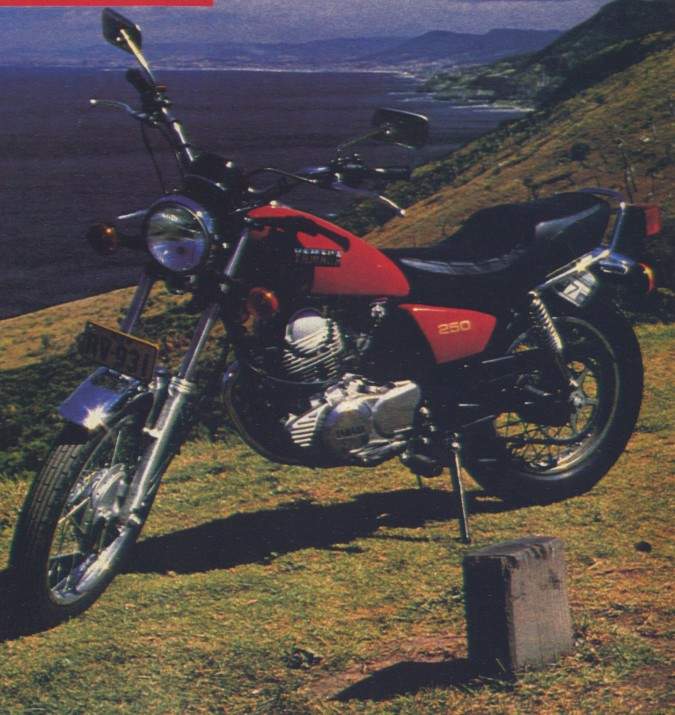
Yamaha SR 250
Review The styling approach of Yamaha's most recent street offerings has taken a turn away from the conventional. There was a time when all bikes were created equal i.e. RD250, RD350 etc, but that changed when Yamaha decided to do some trailblazing by chopperising their more popular road equipment. The first "revised" model to
reach Australian shores was the Yamaha XS650SF, (TWO WHEELS January
1979) — a high-bar, low-seat version of the ever-popular 650 twin.
Following that came mildly chopperised XS400s, 750s and 1100s. Their
most recent offering retains the style of those former machines but
combines several lessons learnt from past experience. This was obvious from the number
of pseudo-roadgoing XTs appearing with smooth tyres and flat bars.
It's surprising Suzuki didn't realise the potential and convert
their SP370 to street trim also, but that's another story. But, best of all - just like the
650SF, the SR250H looks just a little bit butch. Internally the SR looks very similar to the XT, with a bore and stroke of 73.5mm and 56.5mm respectively giving a 239 cm3 displacement. The engine is decidedly oversquare (by about 30%) yet gives very usable low £peed torque. Compression ratio is a moderate 8.9:1. At the bottom end, a built-up crankshaft runs in single row deep groove ball bearings whilst the big end of the connecting rod wears a needle roller bearing. Cylinder head design is quite conventional with only two valves operated by a chain drive from the main crank. To improve efficiency and reduce friction, the single overhead camshaft sits in a set of deep groove ball bearings instead of the usual bushed bearings or plain alloy. Engine vibration is not too bad. Yamaha uses a gear driven counter balancer which works efficiently at low rpm but not so well towards the high end. Noise level is also well taken
care of and the SR250 is extremely quiet for a Performance of the bike feels substantially better than it looks on paper. The SR will accelerate quite rapidly and smoothly in almost any gear without fuss. Its maximum torque comes in at between 6000 and 7000 rpm and it's a very usable powerband for city work. Unfortunately, the open road does test the limits of the SR. Its single cylinder's power does not match that of twin cylinder 250's and therefore under hard work conditions, the bike starts to show its limits. For example, we found that two-up and into a strong headwind the SR was stretching to hold 100 km/h on the flat in top gear. This failing could be put down to two things, i.e. the low engine specific power output of 41.0 kW/litre and the high weight to power ratio to 21.5 kg/kW, both of which give a 15% advantage to the CB250RS Honda. One very impressive note though
is the excellent fuel consumption. Our test bike achieved a best
touring consumption of 29.2 km/I (82.4 mpg), slightly less than the
250RS Honda at 30.2 km/I. City riding returned 27.5 km/I (77 mpg),
substantially better than 24.3 km/I for the 250 Honda. Overall we
averaged 27.8 km/I (78.5 mpg) out of the SR250 which is very good
for the type of transport it provides. The dragstrip running and
dynotesting of the SR250 was plagued with many problems because of
the lack of a tachometer. We solved the dynotest problem first (an
explanation later) which in turn allowed us to cross reference the
bike's roadspeed with an actual engine speed in each gear. So we did
have, in a roundabout fashion, a tachometer for running the bike on
the strip. The running of mid 16's put
forward in other road tests appears too fast considering the fact
that the similarly equipped and geared XT250 could only run 17.6
sees (TWO WHEELS June 1980). This arrangement then allowed us
to match bike roadspeed with engine revs in each gear. The test
figures we achieved were as predicted, i.e. rather lower in all
cases than the four-valve RS250 Honda. These figures are somewhat lower
than the RS250 Honda which returned 11.6 kW at 8500 rpm and 12.6 Nm
at 8000 rpm. The SR250 dyno curves are however very similar in shape
to those of the Honda, i.e. almost constant torque value from 3000
rpm to 8000 rpm and gradually increasing power curve. Most of the
engine action happens within the 7000 rpm to 9000 rpm region, a
power-band that needs to be utilised extensively on the open road.
In the city however, adequate performance can be achieved from the
SR by keeping the engine revving between about 3000 rpm and 7000
rpm. The single cylinder Gear ratios turned out to be well
chosen for road work considering they were originally designed for
trails. Our slightly higher self-imposed redline of 9000 rpm allowed
the SR to run to 43, 67, 90, 114 and 139 km/h in gears 1 through to
5. Top gear as mentioned previously did find the going a bit tough
under hard riding conditions and one could not expect to cruise
comfortably on the open road at more than about 120 km/h. Suspension, frame and handling The rear consists of KYB shocks inclined moderately forward and surrounded by a variable rate spring. Spring preload is adjustable over five settings and generally the second lowest setting is adequate for one-up city riding. Two-up (depending on the road) needs the highest setting to retain the bike's original handling characteristics. With a passenger present, the combined load might pass through a position directly above the rear axle. This does not do anything for the bike's handling. One up, the bike does handle well around town, once one is accustomed to the light feel of the front end. The riding style suits commuter riding ideally with almost every rider being able to place his or her feet squarely on the ground (every bike rider's dream). Medium and high speed cornering is quite steady due mainly to the bike's low centre of gravity. The bike can be thrown around with some confidence. Braking These fears were not particularly
justified. In the 60 km/h to zero stops, the SR fared very well when
compared to similar but better equipped machines. Our best stop of
12.1 metres was very close to that obtained by the Honda 250RS with
its front disc setup. Over the higher speed stops, the limitations
of a half width single-leading-shoe brake did become obvious. Quite
dramatic drop-off of braking power was felt even during the first
hard stop from 100 km/h. The cable operated front brake, although
providing good feel and easy leverage, had to be adjusted up mighty
high to stop the brake lever from being pulled onto the handlebars. Bits and pieces The most striking aspect of the SR250H is the quite obvious low budget look about it. Lets face it, to knock out a 250 single for around $1300, one has to really get serious about savings. For that reason, the SR250 does have a spartan appearance — just a straight single colour (non metallic) paint job with a Yamaha badge on each side of the tank and a 250 decal on the side covers. Wire wheels complement the look. The most notable omission is the
tachometer. There are no super-looking square indicators (although
those fitted do bend), and beautiful pinstripes along the tank are
definitely out this year. X On the positive side,
engine appearance is very good, the alloy work and finning are of
high quality as always. Chromework on the exhaust pipe is very good
and overall the appearance of the powerplant is appealing. Riding position, as mentioned previously, is good but long-legged people could find the leg angle too acute when feet are on the pegs. The large, wide and high handlebars give very good steering leverage. Thankfully they aren't rubber mounted like those on the 650SF Yamaha. One grievance with the bars is that once in the riding position, one's elbows just hang there and get tired. The forearms are neither straight nor are they supporting any of the rider's body weight, as they would be under normal conditions. Out on the open road the situation gets worse and after about an hour's riding the rider's forearms are usually very tired. A nice set of flat bars would most likely solve the problem.
The seat is also too short and fat to
provide comfortable accommodation for passengers. Most pillion
passengers end up sitting on the grab rail behind the seat wearing
their knees around their chest because of the high footpegs.
Conclusion Source Witch Bike 1980
|
|
|
Any corrections or more information on these motorcycles will be kindly appreciated. |