|
|
|
|
Classic Bikes
Custom Bikes
Individual
Racing Bikes AJP
AJS
Aprilia
Ariel
Avinton / Wakan
Bajaj
Benelli
Beta
Bimota
BMW
Brough Superior
BRP Cam-Am
BSA
Buell / EBR
Bullit
Bultaco
Cagiva
Campagna
CCM
CF Moto
Combat Motors
Derbi
Deus
Ducati
Excelsior
Fantic
GASGAS
Ghezzi Brian
Gilera
GIMA
Harley Davidson
Hero
Highland
Honda
Horex
Husaberg
Husqvarna
Hyosung
Indian
Jawa
Kawasaki
KTM
KYMCO
Laverda
Lazareth
Magni
Maico
Mash
Matchless
Mondial
Moto Guzzi
Moto Morini
MV Agusta
MZ / MuZ
NCR
Norton
NSU
Paton
Peugeot
Piaggio
Revival Cycles
Roland Sands
Royal Enfield
Sachs
Sherco
Sunbeam
Suzuki
SWM
SYM
Triumph
TVS
Ural
Velocette
Vespa
Victory
Vincent
VOR
Voxan
Vyrus
Walt Siegl
Walz
Wrenchmonkees
Wunderlich
XTR / Radical
Yamaha
Zero
Video
Technical
Manufacturer List Contact
|
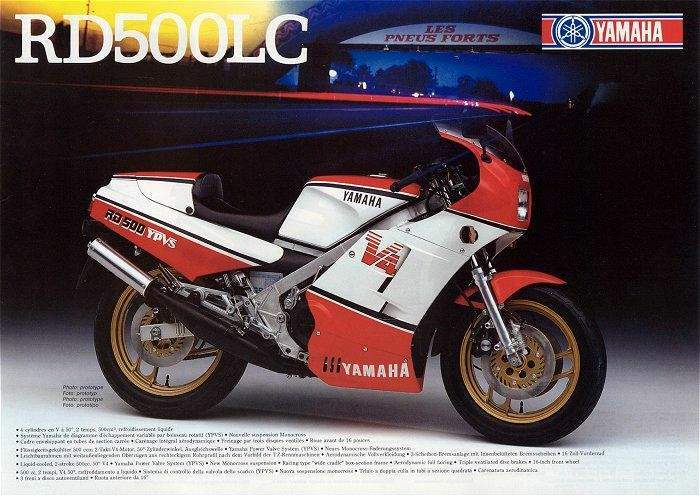
Yamaha RD 500LC YPVS
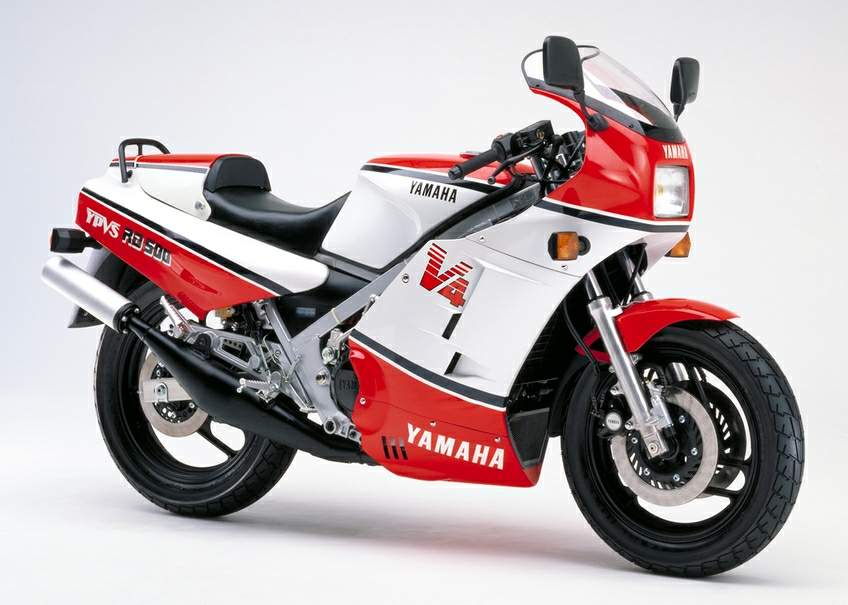
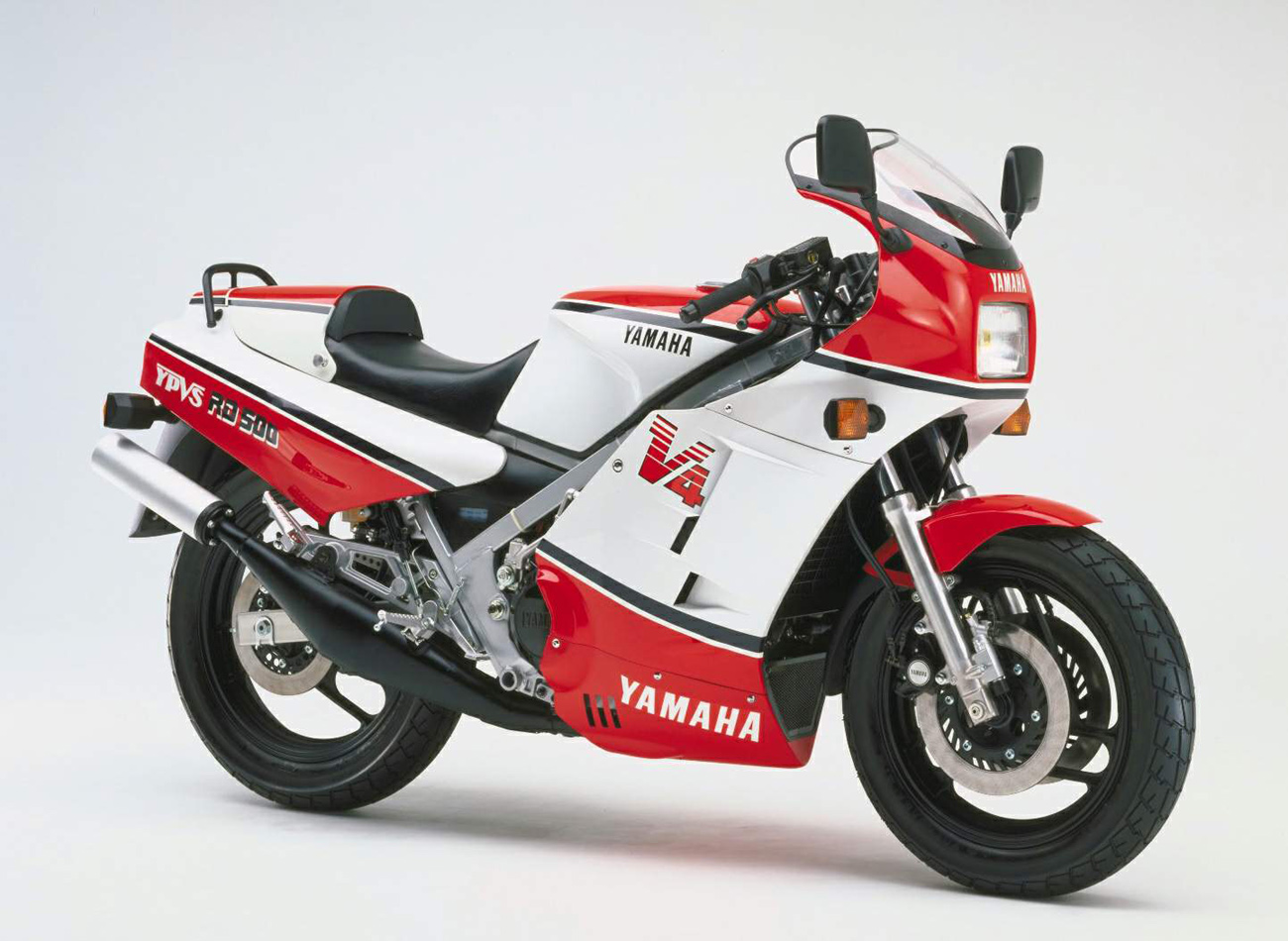
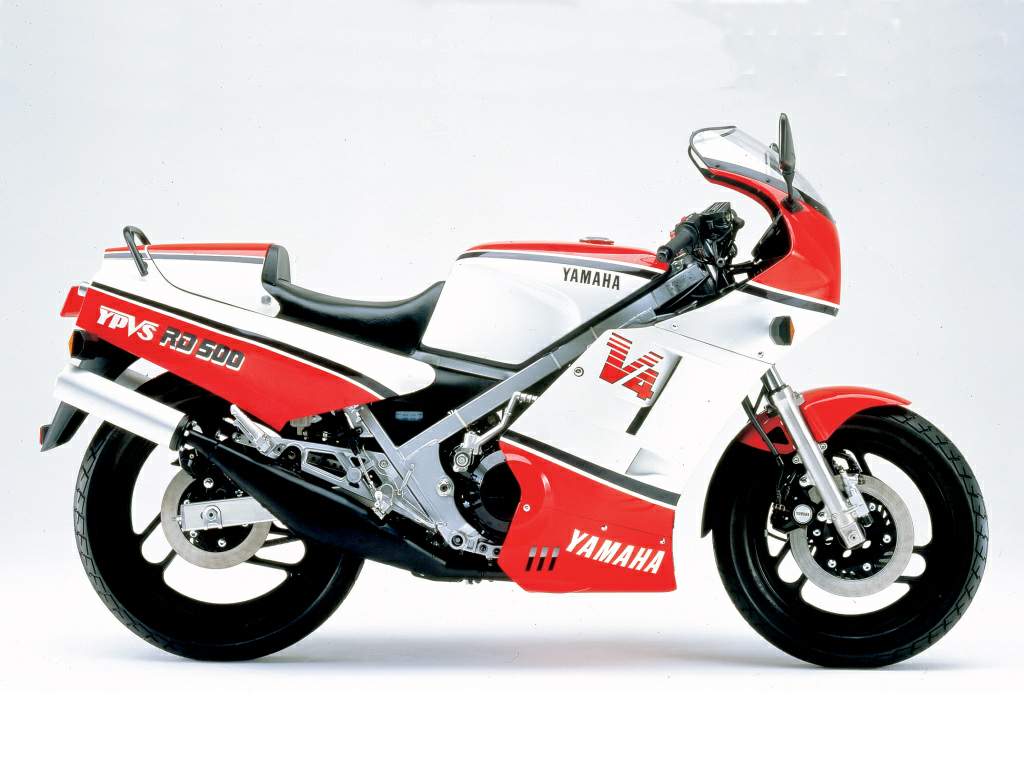
Street going two-strokers died in 1979 right?, The Yamaha RD400 failed to return with the geese in "the spring of 1980, and that was that. Extinct. When the water-cooled RD350LC appeared, first in Canada and then in the United States, it wasn't an authentic rebirth just a cameo appearance for those few dedicated RD-lovers, right again? And the juggernaut of popular preference for big four-strokes rumbled ahead uncaring. Two-strokes were still dead. Emissions had killed them once, public lust for big four-strokes had killed them twice, and now the grass was green on the grave. Two-stroke technology didn't die - it just wasn't seen on the street-bike side of the showroom floor. What about those torque-laden motocrossers, light as air, and factory road racers with wonderful 4000-rpm powerbands and the BMEP of a good four-stroke? Yes, there was progress aplenty, but it was invisible to pavement riders. On the other hand, every scrap of four-stroke streetster progress was instantly on sale and ready for immediate delivery. Now how about all that unexpressed, bottled-up two-stroke progress? What kind of street bike would all that make? Don't tax your imagination. Yamaha has now built the RZ500. This hot pipe dream come to life is pretty much a road-going replica of the factory Yamaha OW80 now leading the 500 road racing World Championship. Like the OW, the RZ has an aluminum chassis, a V-four, two-stroke, water-cooled, reed-valve engine, a sideloader gearbox, Power Valve cylinders, magnesium side cases, and, above all, the look of the $1000-a-pound missile which rolled so very carefully to European start grids. Pipes jutting from everywhere, aluminum mufflers, eye-trapping detail in the footpeg plates, alloy foot controls, streamlining in team paintwork. Food for the eyes, sustenance for the imagination. And not available in the stores. At least not here, not yet. What are Yamaha's intentions? Unknowable right now. Let's not ask. Let's gaze upon the parts. The RZ500 is light and powerful 413 pounds dry and near 90 bhp. When the technology went in, the weight came out out of every part. Road racing over the last five years has been a hothouse of design competition, producing not only innovation but also attention to detail making earlier work look coarse. Engineers questioned every use of material in this machine. Fasteners are down-sized. Thinwall castings abound. Traditional parts have oozed into new forms just a bit lighter, easier to make accurately, and better in function. The result is a street motorcycle weighing only about 100 pounds more than its parent racer. See this forged aluminum kick-start lever folded shyly away behind the fairing? It weighs nothing in comparison to the steel part on the old RDs. And just as on the real racers, covers have the official "MAGNESIUM" cast into them for the skeptical. The engine's architecture is pure road race. Two cranks each drive the big clutch gear directly without any heavy, power-consuming jackshaft. Between them is a balancer shaft, all three capped by the cover casting carrying the four separate Power Valve cylinders. Below, the gearbox inserts into the main casting from the left, echoing the quick-change gearboxes of current GP bikes.
The forward pair of cylinders lies horizontal, the rear pair inclines forward at about 20 degrees from vertical. The intakes enter from the vee while one pair of exhausts shoots straight back from the rear cylinders and the other sweeps up from beneath the engine. The 56.25mm iron-linered cylinders are secured to the crank-cover casting by their base flanges, not by through-studs. This gives maximum freedom for generous transfer port layout. Because the engine is only two cylinders wide, the cylinders can sit on the same 112mm centers that give the current TZ250s their giant, sweeping transfer port arches. The cylinders must be separate castings because of the way the Power Valves are assembled in them, but the conventional circular-squish heads are cast in pairs. Is this engine just a heavy wedding of two old RD250s? If it were, it would weigh over 160 pounds, but in fact this engine, with its large ignition, is actually ' lighter than the 120 pounds of the 1980-81 magnesium TZ500 engine. Detail design has achieved this. Crank bearings require solid support all the way across, while gearbox shafts need strong carriage only at their ends. This makes it reasonable to put the cranks in one case split with its heavy sections, and to put the gearbox into a shell whose ends are the only parts of substance. Each cylinder stud feeds its stress into a heavy boss that carries it directly to the main bearing saddles, and elsewhere the cases are only thick enough to keep the fluids and gases where they belong. Thick where they must be, thin where they may be. Isn't water-cooling heavy? Each of these cylinders, even with its water-jacketing and Power Valve, is over a pound lighter than an air-cooled RD250 cylinder. Each RZ head (cast in pairs) weighs only one-third as much as the RD parts. Added up it more than pays for the pump and radiator. On to the 50mm-stroke crankshafts. Their flywheels are seven millimeters smaller in diameter than the old RD crank's and two and a half pounds lighter. Surprisingly, they are also lighter than the current TZ cranks. Motocross influence shows in the flywheels, deeply and smoothly scooped out around the rod big-ends. This provides for balancing better than expensive drilled holes and gives the intake process an inviting space to head for. As on the 350LC, the hollow crankpins are integral with the inner wheels. The con-rod forgings are as economical in design and material use as the TZ parts and turn on silver-plated big-end cages as the racers' always have. Five millimeters shorter than the racing parts, they allow for shorter and therefore lighter cylinders.
Motocross also inspired the cast pistons. Instead of the lumpy, mass-production look of the old RD parts, behold the smooth, dense texture of racing parts. The undersides of the wristpin bosses are relieved next to the rod small-end because there is less stress there. Why send extra metal along just for the ride? The keystone top rings are only 1.25mm wide—a figure seen only in racing engines until not so long ago. The conical upper surfaces of these rings crush and eject carbon as the pistons rock, preventing long-term deposition that might stick the rings. The second ring has the same width but is of rectangular section. Even the wristpins are lighter. The standard 16mm, they now have larger, smoother holes through them. The old wristpin clips with their tangs have gone, and no one will mind having to use a scribe-point to pull these new ones. No tangs means nothing to break off inside your engine. TZ owners know all about this. Look down into the crankcases or up into the bottoms of the cylinders and you'll be struck by the enormous volume there. This hints at the technology that makes this motorcycle possible right now; philosophically this RZ engine is far closer to the latest racing designs than to any past street engine. Much has been learned in the last five years, and most of it is right here. After 1945, two-strokes were just grubby substitutes for real engines— transportation specials. As certain dedicated fanatics worked with them they shed their dumpy image and emerged as powerful if difficult devices. The first winning designs of the 1950s had powerbands measured in hundreds, not thousands, of rpm. Later they were built with 10-, 12-, and even 18-speed gearboxes because they desperately needed them. Ports were small back then, and pumping fresh charge up through them from the crankcase called for high crankcase compression ratios. Even today some people, mesmerized by this idea, mutter about "crankcase stutters." Small ports and high case pressure combined to squirt the mixture out of the transfers so fast it looped through the cylinder and out the exhaust port at every speed but one— peak power—where the fast-moving piston could chop off the outflow before most of the charge had been lost. Good power might result, but only very high up. The simple pipe concepts of that time made the matter worse, offering no apparent solution to the powerband problem. For street use, the charge-loss problem was "solved" by using port sizes and timings so restrictive almost no mixture ever arrived in the cylinder so hardly any got lost - those were the days of the five-horsepower 125s. In time ports got bigger, and designers realized the exhaust pipe was potentially a better and more controllable pump for the fresh charge than was the crankcase. With such better pipes, capable of prolonged and deep suction, it turned out that engines with big, low-compression crankcases had better powerbands and were no less powerful than the best of the older engines. What a lovely discovery! The more mixture in the case, the more there is for the pipe to draw through the cylinder to scavenge and fill it. Power rises. At lower speeds, the low-pressure case doesn't squirt its mixture quickly to the exhaust to be lost—it just flows the mixture in slowly so that much of it is trapped and burned for power. The RZ engine has the generous transfer port area, the large-volume crankcase, and the fat, high-suction exhaust pipes of a modern two-stroke racing engine. Good power, good band width, good economy and moderate emissions are the result. Years ago, port timings were the big secrets, but after about 1960 everyone settled on figures that have remained essentially fixed. Only the sizes and directions of ports have changed: a racing engine opens its exhaust at about 79-83 degrees ATDC and opens its transfers about 35 degrees later. A sport engine opens the exhaust at 85-90 degrees ATDC and its transfers 25-30 degrees later. A trials engine may open the exhaust at 100 degrees and transfers 15-20 degrees later.
Blowdown is the timing difference between exhaust and transfer openings, and determines how much time is made available for cylinder pressure (up at 80-120 psi even after expansion by the power stroke) to blow down low enough for transfer flow to begin. At high rpm, the piston moves fast, so adequate blowdown requires long timing, but on the bottom, when the piston is moving slowly, a much shorter timing is adequate too much would only risk charge loss. The Yamaha Power Valve, raising and lowering the top of the exhaust port, is a device for changing this blowdown timing according to rpm: the engine pulls like a racer on the top end and like a trials machine on the bottom—a very nice combination. When the RZ's Power Valves are fully open, the exhaust opens at 85 degrees ATDC just as in the old RDs, while at the bottom of the range it is opening at more like 98-100 degrees ATDC. Why the RD-like timing? Remember, this is a street engine, not a racing engine. It has do to things like be easily ridable, get reasonable fuel mileage, and even pass certain emissions standards one day. It can't necessarily do all these things with yawning exhaust apertures. The performance advantage over the old RD comes from the size more than from the timing of these holes. The RD's exhausts were only 32mm wide, but these new ones are a huge 39mm—only one millimeter less than those of the current TZ250 road racer's. That's 70 percent of bore diameter, something we were told even just a few years ago was impossible without ring snagging. Well, Yamaha has built a lot of wide-port MX and road racer engines since those days and has learned a thing or two. Proper port shape is gentler in pressing the rings back into their grooves after the bulging trip across the port, and, ductile ring materials accept this service without snapping. Transfer ports open a whopping 38 degrees after exhaust opening, so there is plenty of blowdown for 10,000-plus rpm performance here. The transfers, opening at 123 degrees ATDC, are rather late in comparison with racerly numbers of 114-116 degrees, but higher transfers would in turn require higher exhausts, and soon the RZ would just be a pure race engine. Watch the piston move toward BDC; it uncovers only part of the transfer port windows. This means there is plenty more to come from this engine in the future.
Power from all this huffing and puffing reaches the six-speed gearset through a big wet clutch whose plates have the same dimensions as those of the TZ750 racer. Any engine whose shafts don't all lie in a single horizontal case split has a gear lubrication problem. How to lube the shafts and gears at the top of the engine? Submerge those at the bottom and while oil churning losses are bad enough, potentially running to many horsepower, the oil would foam right out the breather from all that gear action. Yamaha's answer is to put a small Eaton-type gearbox lube pump at the bottom, drawing oil from the sump area around the shift-drum and delivering it in correct quantity to the several meshes. The pump saves far more power than it consumes, for now the transmission is well lubricated without heavy churning loss. On modern GP road-racing engines a tuner can pull the dry clutch in about five minutes while his helper pulls the lower pipes and drains the gear oil. The tuner pulls the primary cover while the assistant tackles the drive sprocket in another five or 10. Unbolt the "door" holding the gear cluster into the gearcase and slide the whole thing out shafts, gears, shift-drum, and selector forks. Lay it out on the bench and exchange ratios to tailor the gearbox to the circuit. In under 40 minutes, the rider is rolling back out with the right ratios. Obviously at the Grands Prix, this capability is essential. The RZ is built in similar fashion, but for a different reason. A compact V-four cannot be built as a single-case-split engine, so this racing "sideloader" construction is the most sensible way to carry the gears. Remember, too, that Harley-Davidson motorcycles had this construction for many years before it became popular at the GPs. The RZ gearbox, rendered in street-bike fashion, has four dogs at each engagement to cut down on backlash, something that street riders have been known to worry about. In racing, three dogs or even two make more sense because the primary goal is strength and quick, certain engagement. Few dogs and big spaces between them give you this, but they also give the backlash that some folk don't want. Neither are the RZ's dogs undercut as those in a real race engine would certainly be. In racing this draws the gears into engagement and keeps them there during hard, clutchless shifting. On the street, this design is not yet accepted. Truly remarkable, however, are the extremely close ratio separations, almost identical to a pure-racing TZ750's:
RZ500 Separations 1st 2.250 2nd 1.685 3rd 1.363 4th 1.166 5th 1.043 6th 0.960 TZ750 Separations 1st 1.722 2nd 1.286 3rd 1.042 4th 0.893 5th 0.808 6th 0.750
What does this mean? If you upshift the RZ from first to second, your revs will fall by 33 percent—change up at 10,000 and the engine will fall back to 6700. From fifth to sixth the upshift will drop you back to 9100, close indeed, and keeping the engine right in the good meat of the powerband when it needs it the most. What are the drawbacks? Well, you won't win any uphill stoplight drag races with a passenger on this motorcycle—first gear is just too tall, too close to top gear, to permit that. On switchbacks and compound sweepers, though, you'll be glad those ratios are as tight as they are. Yamaha has sized this transmission for horsepower growth and vigorous use. The gears aren't the skinny bacon-slicers used in certain other engines you've seen. Good. Up between the two cranks, and driven by the front one, lies the engine-speed balancer. With its bearings and drive gear this addition weighs less than three pounds. Before you purists sniff at this, think a moment. Isn't it possible these three pounds in the engine are saving far more weight in the chassis? Engines that don't vibrate like a 10,000-rpm washing machine with a load of bowling balls can actually be used as part of the chassis without shattering every weld in 10 hours' running. And if the engine is stiffening the frame, maybe that frame doesn't have to be as heavy. Some people may think it was romantic, back when men were men, to finish the day seeing double from engine vibration, but today such experiences are both stupid and unnecessary. The RZ balancer corrects primary imbalance arising from the vee angle being less than 90 degrees and from the wide separation of the two cranks. As with square-fours, the RZ's diagonal piston pairs come to TDC together. Intake location was the major problem Yamaha faced on the RZ500. With conventional exhaust location, the natural place for the intakes is in the vee. On a four-stroke the intakes attach to the heads, relatively far apart. On a two-stroke V-four the intakes attach far down in the vee, either to cylinders or directly to the case. On the Yamaha OW70 and OW80, the absence of air filters reduces the problem to having special carburetors made that just fit the space. Street bikes must have filter and airbox, and they will fit easily if you can do without the radiator and front wheel, for that's where the parts would end up. And what about the problem of keeping all intake system parts tilted slightly toward the engine so that in slow running fuel won't condense in pools and blorp into the engine to foul its plugs?
Yamaha's solution was to put the carburetors at the sides of the vee, pointed outward and mounted on rubber right-angle-manifolds that will give airflow specialists nightmares. To get all the parts to line up, two different kinds of cylinders, pistons and intake schemes are used on the RZ500. The rear cylinders carry cast-in conventional reed boxes, while the fronts get their mixture through case reeds bolted to the crank cover. All four reed cages are the very same moderate-sized parts seen on the RD series. The rear pistons have reed windows, while the front have only slight intake-skirt arches. All this twisting and turning results in less power than Yamaha might have liked this machine to have had, but it does provide the motorcycle with places for all its parts. Between the cylinders run the Power Valve links, connecting each pair of cylinders with the bellcrank down in the vee, rotated by cables from the control motor frame-mounted behind the engine. The carburetors, bolted together in staggered pairs, have their throttles linked for operation by double, push-pull cables—no sticking throttles on this machine. Chokes also link to a single control; otherwise the aluminum 26mm VM-type carburetors are much like those of the venerable RD. The airbox is stuffed under the fuel tank, just behind the steering head. Air enters through two flared horns, descends through a thin sheet of foam filter, and turns outward to meet the "elephant ears" conducting the flow to the carb pairs on either side—all very civilized and fit together marvelously considering the dense packing of the parts. The first sight of all those hoses, cables, and wires almost obscuring the engine was like looking upward under a luxury car's dashboard. The only reason working on the RZ isn't quite as bad is because you aren't lying on your back with your heels higher than your head. The cooling system is also civilized because, unlike the TZ racers', there is no need for air-bleeding during fill. Every high point that could trap air or steam has a line running back to the header tank, making the system self-bleeding. A large plastic-impeller waterpump moves the coolant around, just as in the recent MX machines. The radiator has a large area, but a thin section. By contrast, racing radiators always have two, three, or even four rows of cooling tubes. The RZ's has but one. Why? Racing machines move fast enough to push air through a dense core, but at highway speeds a four-row cooler would act like a wall to the air. An electric fan cools the core at low speeds or when idling. Oil is certainly not premixed with the fuel on any modern two-stroke street bike. A four-outlet Autolube pump draws injector lube from a fairing-mounted tank and sends it to the reed boxes; from there it coats engine internals on its way through. Electric power and ignition timing come from a large external-magnet alternator on the left end of the front crank. Both the rotor and its housing are bolted on; they could easily be replaced by a racing mag-CDI unit. The outside diameter of the rotor carries two "bumps" that induce ignition trigger signals in a case-mounted coil.
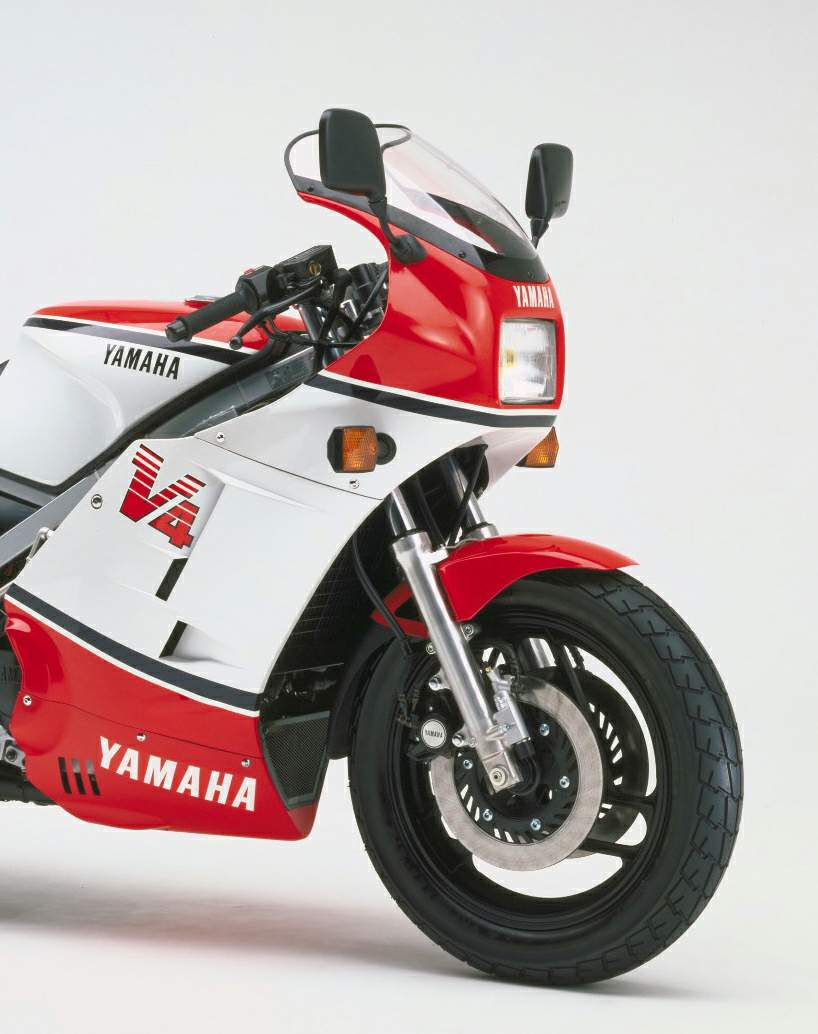
The only heavy items on the whole machine are the pipes, and, of course, there are reasons for this. Heavy pipes don't crack or rust as quickly, and the double-wall construction of the up-pipes is necessary to keep the rider's bottom from frying. Foil and composition insulator baffles protect other crucial parts—battery, tank fuel outlet, and Power Valve control motor—from exhaust heat. Engine removal requires unbolting a part of the lower right frame tube, and this piece gives a good idea of the general lightness of the chassis as a whole. The bike is short; its steering head sits at a steep and racerly 25 degrees, and the front wheel is a 16-incher. This adds up to instant handling. The machine can't be called spartan because everything a street bike must have is here. You do have to start the engine with your foot, but it's not hard to do and you might even get to like it. It makes a rider a participant, feeling those compression events bouncing under his foot in the instant before the engine fires. What about it, Yamaha? What does it all mean? Are you guys just using up this technology to amortize old development accounts, or are you serious about putting the two-stroke engine to work again? Because of their natural exhaust-gas recirculation, two-strokes don't make hard-to-eliminate NOx emissions, so if some combination of technologies can get the unburned hydrocarbons down where they need to be, the two-stroke isn't as polluting as some other engines. What'll it be? Fuel injection? Catcons? Digital engine controls? We'll just have to await developments, but right now, if you're lucky enough to chance a ride on the FiZ-4, you should see the closest cousin to a Grand Prix machine that's ever been, and maybe get a glimpse of the Superbike future. Source Cycle 1985
|
|
|
Any corrections or more information on these motorcycles will be kindly appreciated. |