|
|

|
|
|
|
Classic Bikes
Custom Bikes
Individual
Racing Bikes AJP
AJS
Aprilia
Ariel
Avinton / Wakan
Bajaj
Benelli
Beta
Bimota
BMW
Brough Superior
BRP Cam-Am
BSA
Buell / EBR
Bultaco
Cagiva
Campagna
CCM
CF Moto
Combat Motors
Derbi
Deus
Ducati
Excelsior
GASGAS
Ghezzi Brian
Gilera
GIMA
Harley Davidson
Hero
Highland
Honda
Horex
Husaberg
Husqvarna
Hyosung
Indian
Jawa
Kawasaki
KTM
KYMCO
Laverda
Lazareth
Magni
Maico
Mash
Matchless
Mondial
Moto Guzzi
Moto Morini
MV Agusta
MZ / MuZ
NCR
Norton
NSU
Paton
Peugeot
Piaggio
Revival Cycles
Roland Sands
Royal Enfield
Sachs
Sherco
Sunbeam
Suzuki
SWM
SYM
Triumph
TVS
Ural
Velocette
Vespa
Victory
Vincent
VOR
Voxan
Vyrus
Walt Siegl
Walz
Wrenchmonkees
Wunderlich
XTR / Radical
Yamaha
Zero
Video
Technical
Complete Manufacturer List
|
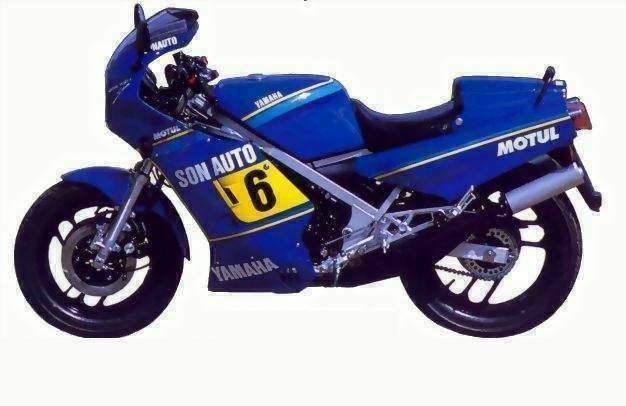
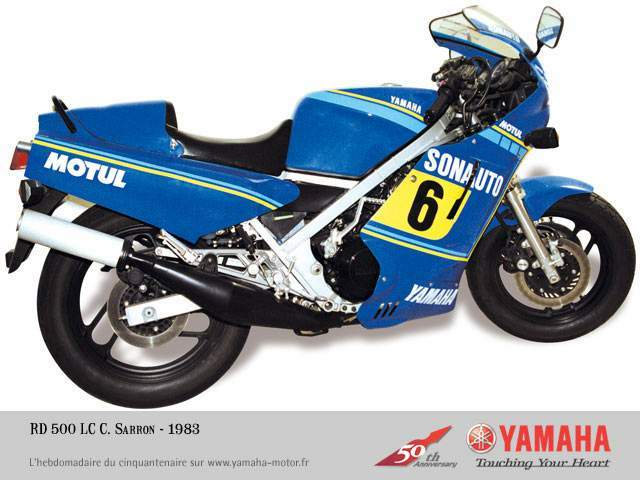
Yamaha RD 500LC Christian Sarron Replica
Few superbikes have been as eagerly anticipated as the RD500LC. In 1983 the long-standing success of Yamaha's middleweight two-stroke twins, combined with the factory's success in 500cc grand prix racing, made a 500cc four-cylinder race replica seem the logical next step. Such was the demand that some magazines went as far as publishing spoof road •tests of a machine that did not exist.
When Yamaha finally put the real thing into production in the following year, few who rode one were disappointed. The RD500LC looked superb, with a racy full fairing in red and white colours similar to those of the factory OW76 that Eddie Lawson was riding to victory in that season's world championship. Like Lawson's racer, the 500LC was powered by a liquid-cooled V4 two-stroke engine. The roadster produced 90bhp. weighed an equally impressive 392lb (178kg) dry, and screamed to almost 14()mph (225km/h).
Two-stroke heritage Rather than being developed directly from the racebike engine, the LC's 499cc, 50-degree V4 powcrplant was essentially two RD250LC units with bottom ends geared together, and with a gear-driven balancer shaft to reduce vibration. Induction system, engine porting and exhaust design were very different to the OW76 racer's, but bore and stroke dimensions of 56.4 x 50mm were almost identical, and the roadster also shared features including exhaust power valves. Apart from the addition of lights and other roadgoing necessities, the main chassis difference between roadster and racer was that the RD50()LC's frame was made from square-section steel tubing instead of aluminium. This was still one dramatically purposeful streetbike though, with high quality chassis parts including anti-dive equipped telescopic forks, plus a single rear shock unit positioned horizontally beneath the engine.
The Yamaha's look and specification were mouth-watering, and its performance lived up to expectation. In typical two-stroke fashion the V4 felt flat at low revs, then came into its power band at 6000rpm with a crackle of its exhausts and a blast of acceleration that sent the lightweight machine shooting forward at breathtaking rate. That meant that in top gear it came alive only at about 100 mph (161km/h). Fortunately. Yamaha had supplied a good pair of mirrors.
Even more importantly, the 500LCS handling was a match for its motor. As well as light and quick steering, aided by its 16-inch front wheel, it was stable in slower bends and high-speed curves alike. Sometimes the front end got slightly twitchy when the bike hit a bump under acceleration. But that was no real problem, and the Yamaha's powerful triple-disc brake system was among the best in motorcycling.
Yamaha had succeeded in creating a bike that felt like a racer on the road, and the RD500LC proved its ability on the track with victory, against many big four-strokes, in Australia's prestigious Castrol Six-Hour production race. In the showrooms it was less successful, despite all the pre-launch hysteria. Drawbacks included poor fuel consumption, vibration, mediocre finish and a high price. Perhaps the real problem was that the RD500LC was just a little too much like a real racebike for its own good.
Source of review: Fast Bikes by Roland Brown
|
|
|
Any corrections or more information on these motorcycles will be kindly appreciated. |