|
|
|
|
Classic Bikes
Custom Bikes
Individual
Racing Bikes AJP
AJS
Aprilia
Ariel
Avinton / Wakan
Bajaj
Benelli
Beta
Bimota
BMW
Brough Superior
BRP Cam-Am
BSA
Buell / EBR
Bultaco
Cagiva
Campagna
CCM
CF Moto
Combat Motors
Derbi
Deus
Ducati
Excelsior
GASGAS
Ghezzi Brian
Gilera
GIMA
Harley Davidson
Hero
Highland
Honda
Horex
Husaberg
Husqvarna
Hyosung
Indian
Jawa
Kawasaki
KTM
KYMCO
Laverda
Lazareth
Magni
Maico
Mash
Matchless
Mondial
Moto Guzzi
Moto Morini
MV Agusta
MZ / MuZ
NCR
Norton
NSU
Paton
Peugeot
Piaggio
Revival Cycles
Roland Sands
Royal Enfield
Sachs
Sherco
Sunbeam
Suzuki
SWM
SYM
Triumph
TVS
Ural
Velocette
Vespa
Victory
Vincent
VOR
Voxan
Vyrus
Walt Siegl
Walz
Wrenchmonkees
Wunderlich
XTR / Radical
Yamaha
Zero
Video
Technical
Complete Manufacturer List
|
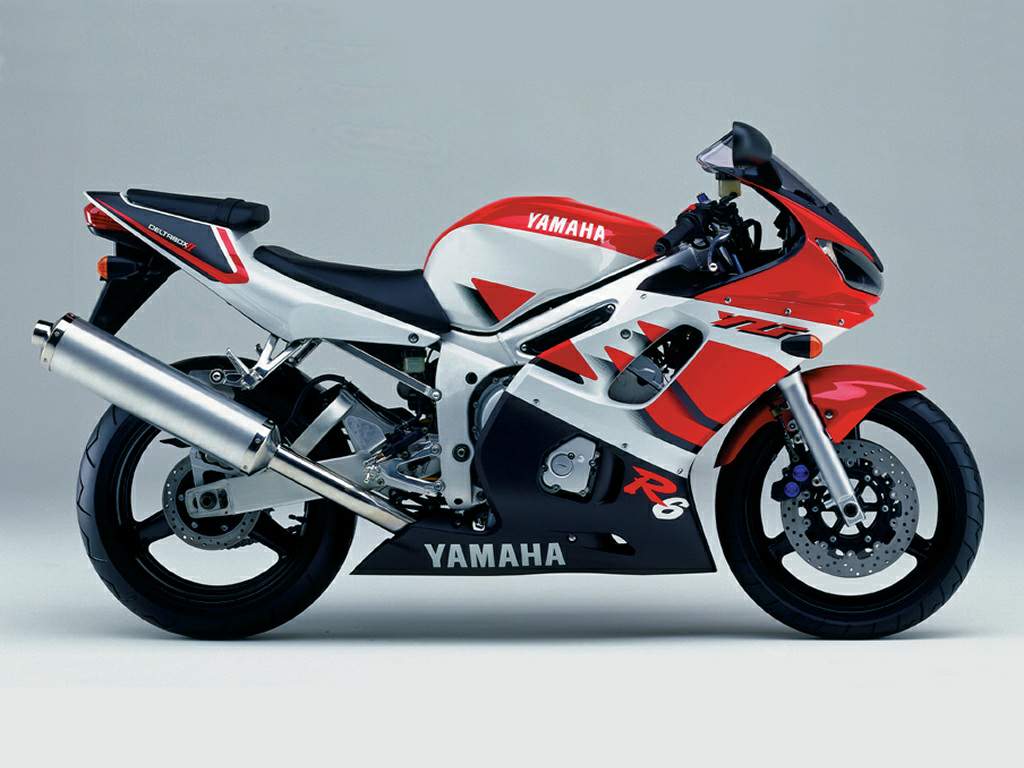
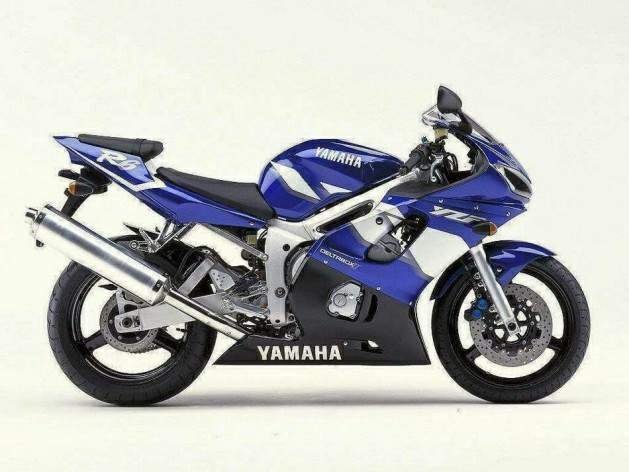
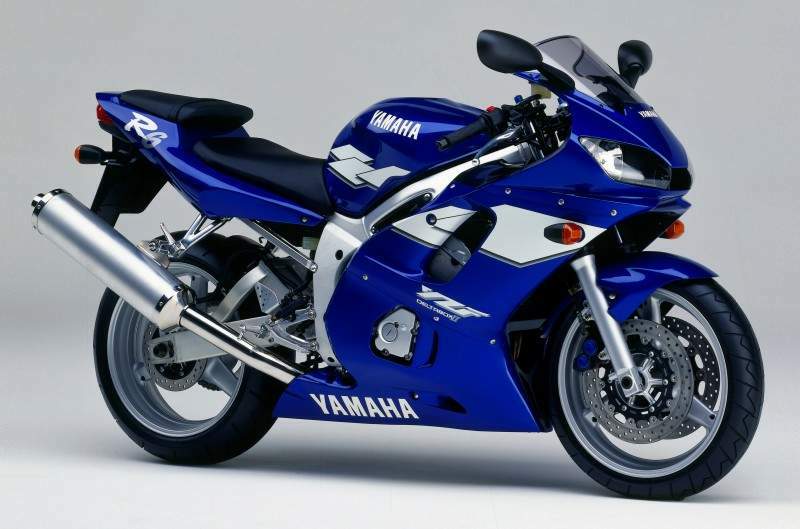
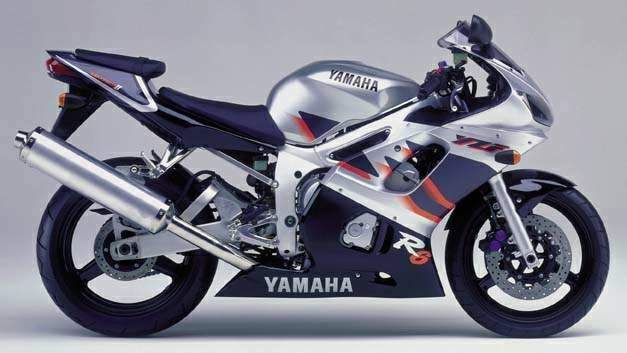
Yamaha YZF-600 R6
By 1999, Yamaha's Thundercat had already been relegated to fourth place in the sports 600 market: Kawasaki's ZX-6R and Suzuki's GSX-R600 were both better performers, especially on track, while Honda's CBR600 was the better all-round performer. Luckily for Yamaha, it had a replacement waiting in the wings. The firm's R1 had taken the litre-class sportsbike world by storm the year before, and its new R6 used many similar design concepts to similar good effect. The R6's all-new engine was a conventional 16-valve inline-four layout, although it used the double-split crankcases of the R1. This allows the gearbox input and output shafts to be 'stacked' one above the other, giving a shorter, more compact engine design. A bold, central air intake in the sharp top fairing leads to a pressurized 'ram-air' box which feeds the engine with cool, dense air through four 37mm (1.5in) Keihin carburettors. Like the engine, the chassis uses well-developed conventional technologies and design rather than revolutionary techniques. The twin-spar aluminium frame is very short and stiff, and while the aluminium swingarm is longer than normal for improved roadholding, the monoshock rear suspension and right-way-up front forks are standard road bike parts. Although the front brakes give class-leading performance, they are the same Sumitomo calipers used on the Thundercat. 600cc Shootout The hype has been intense: At the end of '98, pervasive rumors claimed that Yamaha was developing a 600 supersport counterpart to their ground-breaking YZF-R1. Honda, it was said, was tooling up a fuel-injected replacement to the F3. Suzuki? Nothing new here, they just kicked butt on the race track, taking home the coveted AMA 600cc Supersport Championship in 1998 on their supposedly out-dated GSX-R600. Meanwhile, Kawasaki redesigned the ZX-6R, melding both track performance with street-going comfort, offering a combination of light weight, comfort and performance that proved so popular in Great Britain that for the first time in years the ZX-6R outsold Honda's CBR600F3. Parity in the 600 class, it seems, had been achieved. Pete Rozelle wept from his luxury box in the sky. Some of the rhetoric proved to be true: Both Honda and Yamaha developed two all-new 600cc supersports: The still-carbureted but significantly refined CBR600F4 and the R1's close cousin, Yamaha's YZF-R6, respectively.
Overview Back to the real world, early 1999 to be exact. You've impatiently waited for the new machines to come out, and now it's time to plunk down some hard-earned money. So you want to know the skinny, right? Well, to aide in your quest, Motorcycle Online enlisted the help of reigning AMA Pro Thunder and 250 Grand Prix Champions Paul Harrell and Roland Sands to help us out in our 1999 600 shootout. We chose to test the motorcycles using stock tires since many of our readers will use them until they are worn out and because changing tires can significantly change the characteristics of a motorcycle. Not that it mattered much, because the tires are very similar -- the Honda, Yamaha and Suzuki are shod with Dunlop D207's street tires and the Kawasaki comes with Bridgestone BT56s. The only drawback in using stock tires was that track and drag strip times would suffer -- surprisingly, we struggled more at the drag strip with the relatively slick stock tires than at the race track -- otherwise using stock tires didn't favor one bike over another. Each bike's performance stood on factors not related to tire selection. Still, for those of you who are fit to be tied that we didn't swap tires, flame us now. The most anticipated bike heading into the shootout had to be Yamaha's YZF-R6, a motorcycle seemingly designed to elicit over-the-top superlatives from the motorcycle press. We rode the CBR600F4 at the Las Vegas Speedway and came away impressed with it's superb balance. We looked forward to putting more miles on the ZX-6R as it'd been months since we rode one. It had also been a while since we rode the GSX-R600, two years in fact, back in our 1997 test, and we were interested in seeing how it faired against the new generation 600s on the Streets of Willow Springs, at the Carlsbad Raceway Drag Strip and highways of greater Los Angeles. The oldest platform in the test, the Suzuki GSX-R600 has been tweaked throughout its three-year lifespan. In 1998 it received a larger airbox, revised exhaust system, different cam timing and reshaped ports to improve power across the powerband, and in 1999 Suzuki fitted the Gixxer with revised carburetor intake funnels, different jetting and a new igniter box for improved high rpm power.
Peak power was improved: The GSX-R600 made 91.9 bhp at 10500 rpm and 45.1 ft-lbs of torque at 9500. That's a decent jump over our 1997 test model that posted 88.7 bhp at 12,000 rpm and 43.4 ft-lbs at 10,000 rpm. The driveline lash that was so prominent on our 1997 test bike wasn't noticed in this year's model, but the riders complained of a flat spot around 10,000 rpm. We noticed carburetion difficulties on the 1997 GSX-R600 and we suspect that Suzuki still hasn't sorted out this problem. "It doesn't really feel like a flat spot," quipped Editor Plummer after drag strip testing, "but rather, it seems that either the carburetor needles are wrong or the throttle slides are rising at the wrong rate, either too slow or too fast, but in any event the power feels flat when you're on the gas and shift gears at redline -- there's a highly noticeable lag in the power. In a sense, that's good news, and jetting is easily correctable, while some strange cam/exhaust pipe problem isn't." The Suzuki made the least amount of peak horsepower, a factor that might have helped produce the slowest times at the drag strip -- 11.149 seconds for the quarter-mile at 124.84 miles per hour. However, we believe that imprecise carburetor settings were the most likely culprit, as Editor Plummer -- who does the drag strip testing -- felt the Suzuki "would have hauled ass" on the drag strip if the carburetion problems were solved. In addition, the GSX-R600 was our least favorite street bike in this test, with many testers complaining of inordinate amounts of vibration, especially at higher rpms. The uncompromising riding position on the GSX-R didn't win a lot of positive feedback and the bike never felt quite right unless ridden at a ten-tenths pace. "Suzuki pays more to club racers than anyone else in America." Also in it's favor, the Suzuki GSX-R600 has been around for a few years and
there is a host aftermarket parts available for racers, not to mention the
Suzuki Cup -- at over a million dollars, Suzuki pays more to club racers than
anyone else in America. 1999 Kawasaki ZX-6R Last year something rare happened over in Great Britain: For the first time in years the top selling 501 to 700cc class motorcycle was not a Honda, it was the Kawasaki ZX-6R. Aiming at the CBR600F3, the ZX-6R offered light weight, high performance and excellent handling characteristics along with improved aerodynamics, weather and wind protection, and relaxed ergonomics for a more comfortable street ride. The design worked, and Honda was forced to play catch up. In 1997, the ZX-6R placed last in our comparison. Vague front-end feedback along with low-profile stock Bridgestone tires resulted in a front end that "pushed" and "tucked" in corners. Even with race-compound tires the vague feedback on the 1997 ZX-6R continued and the lack of front-end feel was responsible for relegating the old 6R to last place. The 1997 ZX-6R had very narrow triple clamps that didn't give much turning leverage. Kawasaki engineers addressed this by widening the handlebars, which also made the ZX-6R more comfortable, even though we thought the old ZX-6R was not an uncomfortable motorcycle. Kawasaki also stiffened the chassis and improved the suspension. As a result handling improved all around. At 445 pounds with a full tank of gas, the new generation ZX-6R is also about 18 pounds lighter than its predecessor, but is still the heaviest motorcycle in the test. Throttle response on the ZX-6R was excellent, so was the positive-feeling gearbox and strong clutch (try as we might we couldn't fry the clutch at the strip). The linear power delivery and higher-profile stock Bridgestone BT56 tires helped the ZX-6R post the fastest times in the quarter mile. With peak power outputs of 94 bhp at 12,750 rpm and 44.2 ft-lbs at 10,500 rpm the 6R ripped off a 10.937 second quarter mile at 127.41 miles per hour at the slower, slicker, sea-level Carlsbad Raceway (the 1997 ZX-6R posted a 10.79 quarter-mile at the LACR, a faster track at higher elevations that also posts very generous corrected times, usually by about three or four tenths of a second). Stoplight to stoplight Kawasaki intends to be the fastest, and with the ZX-6R they're living up to their promise: "The Kawasaki rocks!" barked an elated Plummer after ripping off a 1.7-second 60-foot time and a high 10-second quarter mile. "It's the only bike with precise throttle response and inherent traction off the line -- if you want to smoke your pals at every street light, you'll be hard-pressed to find any bike, big or small, that'll run with the 6R from zero to 60." A comfortable, easy-to-ride street bike with a great engine, smooth throttle response and wide powerband that handled well on the street, the ZX-6R lagged behind the Honda and the Yamaha at the track. It's at least 10 pounds heavier than the competition, feeling slow entering corners and not reacting well to mid-corner line changes. The six-piston caliper brakes -- which are the same excellent Tokico calipers used on the GSX-R and the Team MO race bikes -- didn't have the same initial bite as the others, so consider changing brake pads if you own one. The ZX-6R's fastest lap at the Streets of Willow Springs was Roland Sands' 1:14.31, faster than his best GSX-R time but almost a full second slower than the fastest times recorded by the CBR600F4 and the YZF-R6.
On the road, the R6's performance is manic. The powerful engine redlines at 15,500rpm, and is best kept above 8000 revs for best progress. There's a step in the power curve here, and another around 11,000rpm, above which the really strong power lives. The short, sharp chassis is a joy on twisty roads, although the suspension is a bit soft for really intense track riding. For 2001, the R6 received a minor update, with a new sleeker tail unit that incorporated a lightweight, low-maintenance LED rear light, a first on a production motorcycle. Source Motorcycle.com 1999
|
|
|
Any corrections or more information on these motorcycles will be kindly appreciated. |