|
|

|
|
|
|
Classic Bikes
Custom Bikes
Individual
Racing Bikes AJP
AJS
Aprilia
Ariel
Avinton / Wakan
Bajaj
Benelli
Beta
Bimota
BMW
Brough Superior
BRP Cam-Am
BSA
Buell / EBR
Bultaco
Cagiva
Campagna
CCM
CF Moto
Combat Motors
Derbi
Deus
Ducati
Excelsior
GASGAS
Ghezzi Brian
Gilera
GIMA
Harley Davidson
Hero
Highland
Honda
Horex
Husaberg
Husqvarna
Hyosung
Indian
Jawa
Kawasaki
KTM
KYMCO
Laverda
Lazareth
Magni
Maico
Mash
Matchless
Mondial
Moto Guzzi
Moto Morini
MV Agusta
MZ / MuZ
NCR
Norton
NSU
Paton
Peugeot
Piaggio
Revival Cycles
Roland Sands
Royal Enfield
Sachs
Sherco
Sunbeam
Suzuki
SWM
SYM
Triumph
TVS
Ural
Velocette
Vespa
Victory
Vincent
VOR
Voxan
Vyrus
Walt Siegl
Walz
Wrenchmonkees
Wunderlich
XTR / Radical
Yamaha
Zero
Video
Technical
Complete Manufacturer List
|
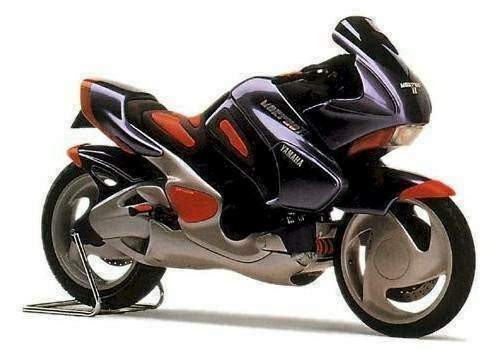
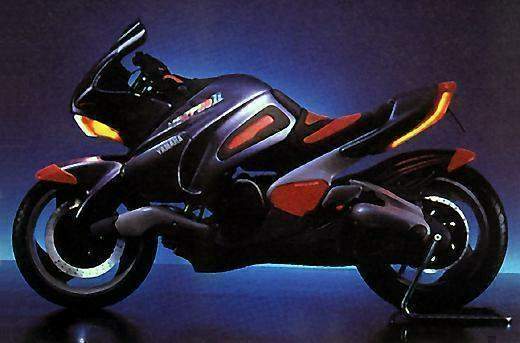
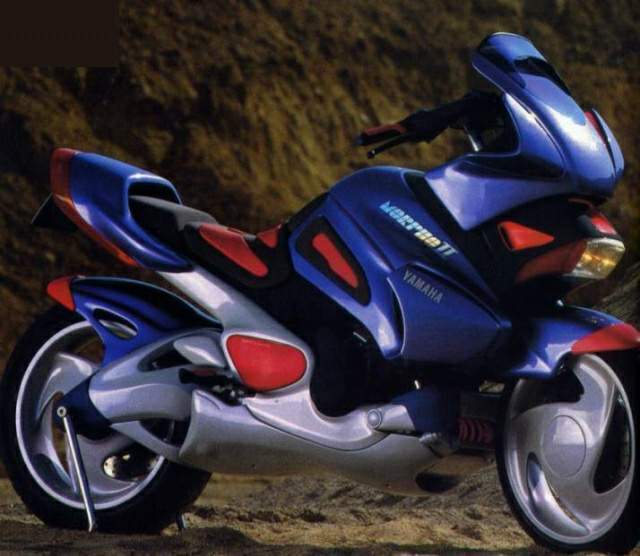
Yamaha Morpho II Concept
Yamaha's Morpho II showbike: two-wheel steering. Do I hear a few "so whats" and "ho-hums?" I wouldn't blame you. The auto industry, with vast ballyhoo, introduced four-wheel steering a couple of years ago, but the results have been substantially less than revolutionary. Why should bikes with two-wheel steering be any different? Here is why. When the driver of a car initiates a turn, he steers into the turn and the front of the car reacts almost instantly, being accelerated laterally by the side-thrust of its front tires. This swings the chassis, steering the rear wheels, and soon the entire vehicle is turning the corner in a steady state. On a bike, the whole process is vastly delayed by the necessity of first rolling the machine over into its turning attitude—by countersteering. Only then can the front end "turn-in" in the same sense that a car does. To shorten this roll-over delay, motorcycles are given the lightest possible steering (minimum trail and rake angle, minimum-gyro-mass front wheels) and extremely short wheel-bases. This works, but there is a price to be paid for it in reduced stability. Steep steering-head angles, reduced trail and smaller front wheels all speed up steering—and they all make machines twitchier, too. Conservative-minded English bike-dynamics researcher Geoffrey Rowe believes some modern sportbikes and all race-bikes are too twitchy for most riders.
In any control system, stability and responsiveness are opposed qualities. If you make the system extremely stable (a 1970s Ducati, for example), then it resists the operator's efforts to control it just as strongly as it rejects undesirable inputs such as bumps. If you now make the system very responsive (a modern 400 sportbike), it responds not only to you, the rider, but to every little breeze and bump. At their best, modern sportbikes are a tolerable compromise between responsiveness and stability, but the definition of responsiveness keeps changing. Last year's best becomes this year's third choice. Development—and users' preferences—alter standards. Just before World War II, full elevator control in U.S. training aircraft required 18 inches of stick movement. Any less and pilots complained of twitchy response. Five years later, 7 inches was regarded as generous. Twenty years ago, Ducatis with 4.5 inches of trail and 31 degrees of rake were considered to have sporty steering; now, the same machines are perceived as charming period locomotives. As a motorcycle is countersteered by its rider, the front tire contact patch develops a side-thrust. Because the patch is not directly under the machine's center of mass, but is ahead of it, this has the effect of both dragging the front of the machine sideways (out of the turn direction) and beginning to roll the bike over (into the turn direction). This lateral movement at the front acts on the wheelbase, using it as a lever to steer the rear wheel, as well. It, too, begins after some delay to develop sidethrust. Now both tires steer out from under the machine, causing it to roll over in the desired direction. The machine is stopped from crashing over on its side by reversing the side-thrusts of the two tires, balancing gravity against centrifugal force. Note the importance, in this description, of the machine's wheel-base: It is the lever that steers the rear wheel. A given lateral movement of the front tire in countersteer will swing a short wheelbase through a bigger angle than it will a longer wheelbase. This is why, to make machines steer quickly, ultra-short wheelbases are used—wheelbases so short that sacrifices are made in other performance areas to achieve them. What sacrifices? A short wheelbase limits the rates of both acceleration and braking. With grippy modern tires, twisting the throttle or pulling the brake lever too hard will stand the machine up—either on its rear wheel or its front wheel—and it can't accelerate or brake any harder than that. If bikes could be built on longer wheel-bases and somehow still steer quickly, they could accelerate harder in lower gears and brake harder— without performing wheelies or stoppies. Two-wheel steering will fix this. When the rider initiates a turn by countersteering, both wheels will turn in the same direction simultaneously, jerking the rug out from under both ends of the machine together, causing instant roll-over. Wheelbase will be completely irrelevant to the speed of this maneuver. How might it work? (Yamaha isn't telling us yet.) Initially, both wheels will steer together. The rider will countersteer until the machine is snapping over as fast as desired, and then relax his pressure on the bars in normal fashion. The rear wheel will then follow the front in returning to center, but then lock there until the rider makes another large-amplitude steering movement. Turn-in will be manual, as with a conventional bike. In effect, both wheels will steer together for rapid roll maneuvers, while the front alone will control the machine for slower maneuvers or for fine control. With this system, wheel-base can be chosen to maximize acceleration/deceleration ability— without slowing the steering. At the recent WERA Atlanta roadraces, I asked Kenny Roberts about the Morpho II and its two-wheeled steering. He instantly replied, "That thing could give GP bikes a whole new shape," and launched into discussion of the possibilities. There is a lot more to KR as team manager than being an avuncular riding coach. He has a finger in pies we don't even imagine. Other solutions to the wheelie stoppie problem exist. One that has been considered is variable-height suspension. When running on the straight-accelerating, cruising, or braking—the suspension will hold the machine at a low ride height, maximizing its resistance to standing up. Initial review of such a system shows that it might be worth as much as 1.5 seconds per lap at Daytona. And we all know what improved braking can sometimes be worth on the street. As the rider rolls the Variable Ride Height bike over for a corner, stored onboard hydraulic pressure will raise the ride height in proportion to lean angle, keeping the parts off the asphalt. Although this sounds upsetting and weird, if the height change occurs during roll-over, it will actually smooth the maneuver; as a normal bike rolls over, its center of mass falls, momentarily taking some weight off its tires at a very inconvenient moment. As the VRH bike rolls over, its suspension will extend, limiting this tire-unweighting. Beyond that lies active suspension, which is no longer just a curiosity on Formula One cars. The Morpho II is so equipped, and it is a working option on such cars as the Nissan Q45. Purists will write in, as they always do, complaining that the growth of complexity will take all the interest out of motorcycling. But is the human mind complex? Is it interesting? IS BY KEVIN CAMERON 1992
|
|
|
Any corrections or more information on these motorcycles will be kindly appreciated. |