|
|
|
|
Classic Bikes
Custom Bikes
Individual
Racing Bikes AJP
AJS
Aprilia
Ariel
Avinton / Wakan
Bajaj
Benelli
Beta
Bimota
BMW
Brough Superior
BRP Cam-Am
BSA
Buell / EBR
Bultaco
Cagiva
Campagna
CCM
CF Moto
Combat Motors
Derbi
Deus
Ducati
Excelsior
GASGAS
Ghezzi Brian
Gilera
GIMA
Harley Davidson
Hero
Highland
Honda
Horex
Husaberg
Husqvarna
Hyosung
Indian
Jawa
Kawasaki
KTM
KYMCO
Laverda
Lazareth
Magni
Maico
Mash
Matchless
Mondial
Moto Guzzi
Moto Morini
MV Agusta
MZ / MuZ
NCR
Norton
NSU
Paton
Peugeot
Piaggio
Revival Cycles
Roland Sands
Royal Enfield
Sachs
Sherco
Sunbeam
Suzuki
SWM
SYM
Triumph
TVS
Ural
Velocette
Vespa
Victory
Vincent
VOR
Voxan
Vyrus
Walt Siegl
Walz
Wrenchmonkees
Wunderlich
XTR / Radical
Yamaha
Zero
Video
Technical
Complete Manufacturer List
|
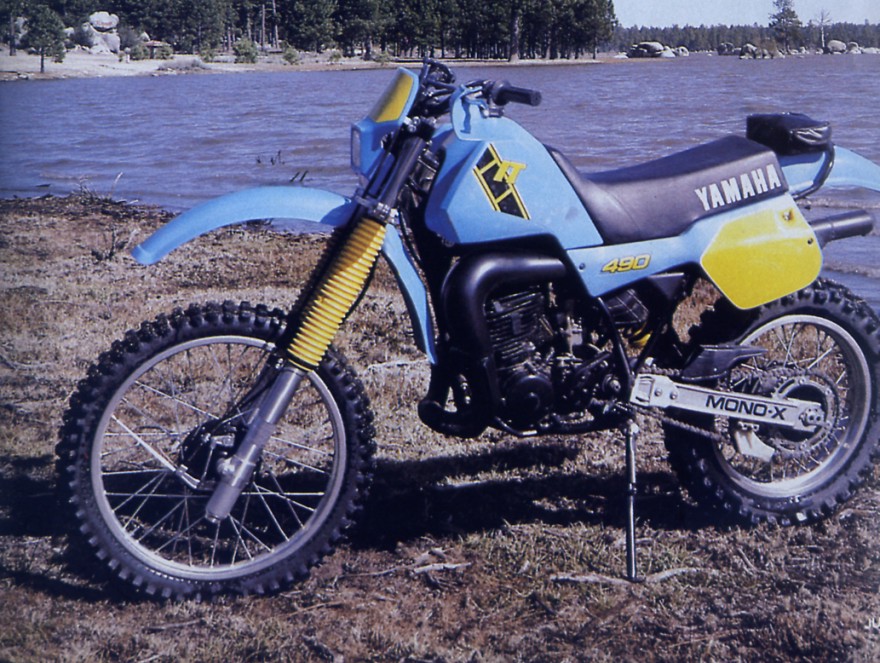
Yamaha IT 490
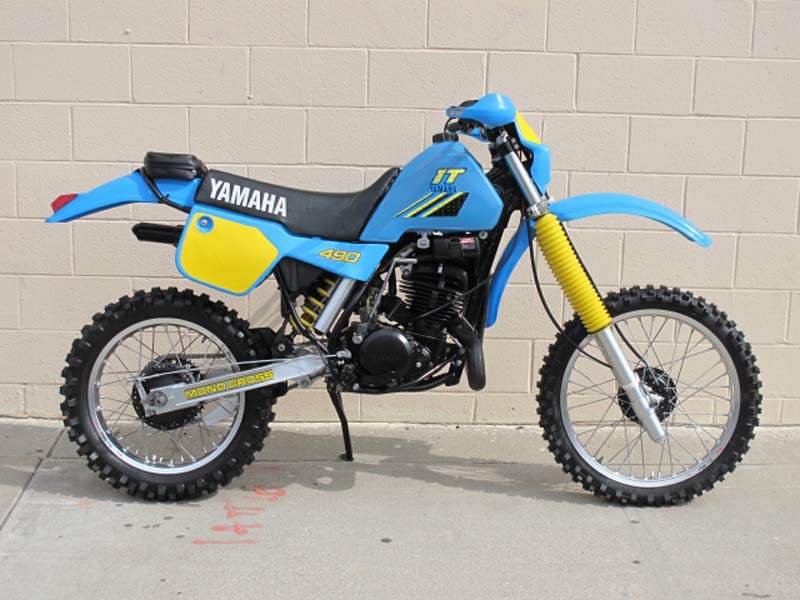
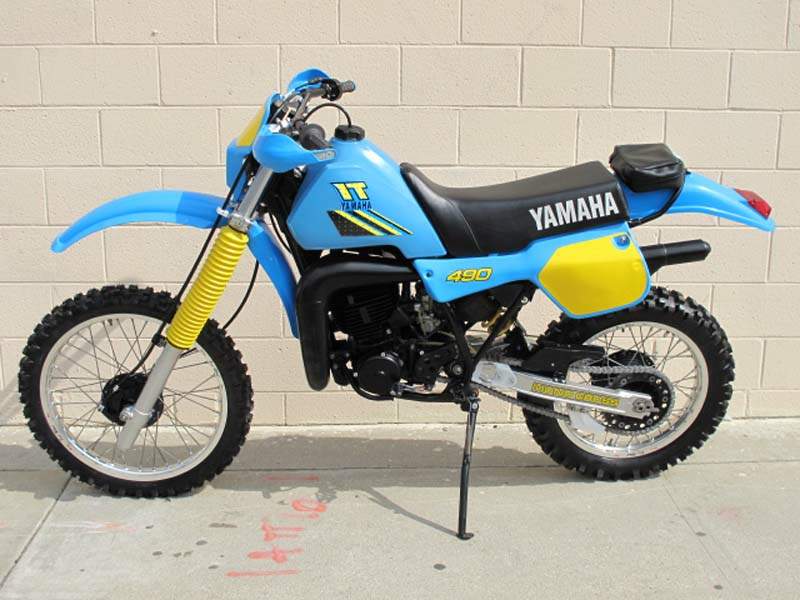
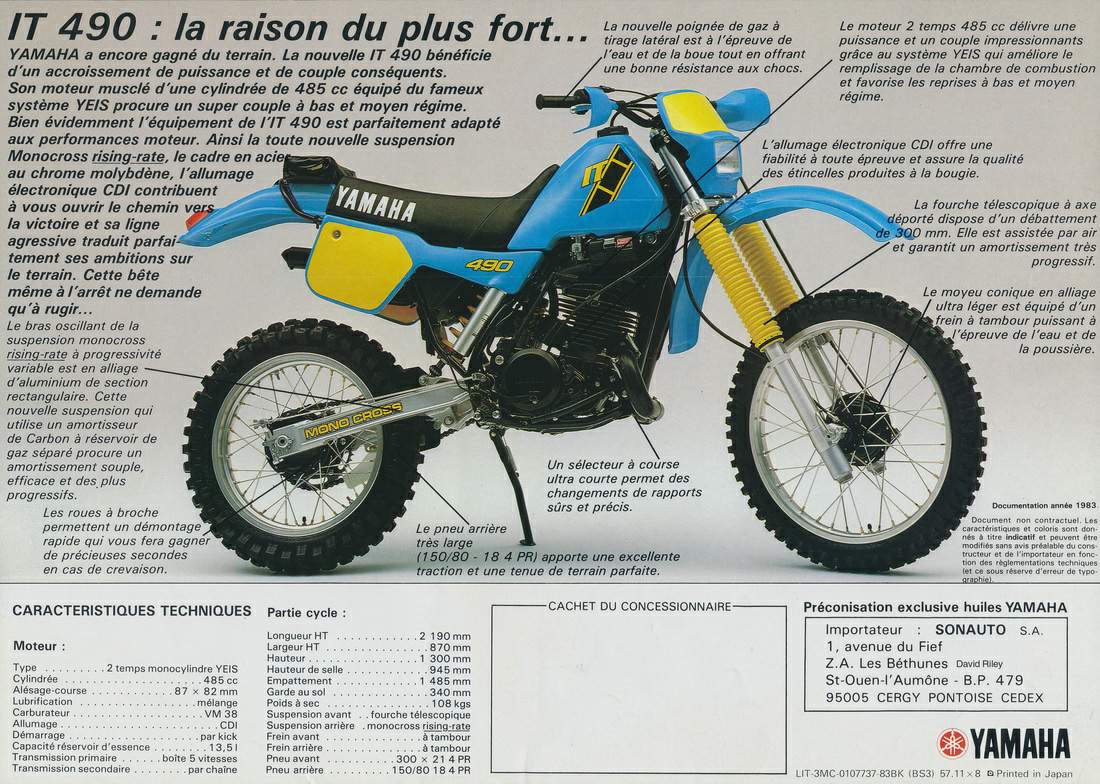
The Yamaha IT 490 model is a Enduro / offroad bike manufactured by Yamaha . In this version sold from year 1983 , the dry weight is 125.0 kg (275.6 pounds) and it is equiped with a single cylinder, two-stroke motor. The engine produces a maximum peak output power of 35.00 HP (25.5 kW) @ 6000 RPM and a maximum torque of 42.03 Nm (4.3 kgf-m or 31.0 ft.lbs) @ 5500 RPM . With this drive-train, the Yamaha IT 490 is capable of reaching a maximum top speed of . Regarding the chassis characteristics, responsible for road holding, handling behaviour and ride confort, the Yamaha IT 490 have a frame with front suspension being 43mm Telescopic adjustable forks and in the rear suspension it is equiped with Mono shock, adjustable spring preload and rebound damping . Stock tire sizes are on the front, and 150/80-18 on the rear. As for stopping power, the Yamaha IT 490 braking system includes Expanding brake (drum brake) size at the front and Expanding brake (drum brake) size at the rear.
For about seven years now, Yamaha's big-bore IT has been one of life's constants. As sure as sunrise, if you'll pardon the cliché, Yamaha has cranked out updated and refined enduro/high-performance playbikes which rank right at the front of the pack. Yamaha stands next to Husqvarna as producer of the most consistently excellent machinery for serious cross-country work, and it's no coincidence that these two companies have the most aggressive and successful off-road racing programs. This commitment pays off in the form of tradition: Yamaha and Husky have had competitive bikes (and the most championships) year after year while every other manufacturer has had either hit-or-miss victories, offered less-than-competitive machinery or skipped production altogether. Indeed, Honda has just now attained the stage of producing competitive four-strokes, Suzuki has dropped out of the middleweight and open-class picture, Kawasaki has paid more attention to the small-displacement KDXs than the 400-420 class, Can-Am is out of the enduro market completely, and Maico offers only slightly altered E-versions of their motocrossers. Yamaha has taken an unusual—and conservative—route to develop the IT line. As a rule, their engineers have judiciously applied YZ technology to the ITs a model year after introducing it on the motocross bikes. This has allowed the designers the freedom to carefully choose the technology they want to borrow, but the ITs, good as they've been, always seemed to miss being as good as they could be. Hang on. This year it's different. The new ITs are not just motocross bikes with lights (nearly a sure bet for mediocrity), but they do feature the latest updates fresh from the drafting board—the same techno-tricks which the YZs are using for the first time in '83. And if you're looking for changes from the knobbies up, you've come to the right bike. Put the IT-K next to last year's J-model and you'll swear it's cut from a different mold. The big news in the powerplant is the bump in displacement from 465 to 487cc, accomplished simply by increasing the cylinder bore two millimeters. This follows the large, seven-millimeter increase in stroke which boosted the IT's displacement from 425 to 465cc in '81. Aside from the trendiness involved in increasing their open-classers' engine sizes, most manufacturers are nudging 500cc because more displacement is the most straightforward route to better power.
And better power the 490 has. You won't find the increase at the peak of the power curve, but who wrings out an open-class enduro bike to 8000 rpm? You'll find it instead in the basement and mid-range. In fact, if the IT made thumpity-thump sounds, you probably couldn't tell you were on a two-stroke. The dyno backs up the seat-of-thepants impression; the IT is even with or stronger in horsepower and torque than the KTM 504 from 3000 to 6000 rpm, and a lot stronger at the top-end. In tight, twisty and steep areas that kind of power helps make riding a breeze. Lug the 490 down to a walk and it pulls like a bull with a snap of the throttle. In one of our favorite riding areas we found it was a gas (and a change) using the mid-range to make riding less strenuous, powering up fairly steep hills instead of charging them like madmen. Part of the credit for the excellent low- and mid-range also goes to this year's addition of Yamaha's Energy Induction System (YEIS). This setup consists of a rubber tube running from the intake tract to a tubular canister. Dispensing with brand names, we point out that the principle of the canister/tube and their effect were discovered by a 19th century acoustical engineer named Helmholtz, hence the generic name of the system—Helmholtz resonator. The canister develops its own resonance (the frequency of which is determined by the dimensions of the system), which offsets the natural resonance developing in the intake tract. The result is smoother fuel delivery at low rpm, helping to prevent surging or flat spots. As much as we dwell on the midrange, don't be misled—the IT has formidable top-end power too. With about 35 horsepower at its peak, the 490 won't blow by any big-bore motocrossers, but it's certainly strong enough for throttle-to-the-stop Hare Scrambling or the occasional Two Day event. Cross-country running or fireroading is a blast; it's easy to slide the IT or cut through deep sand in practically any gear. Yamaha uses its proven gearing for the open-classer. The primary gears (63/24) and the final drive sprocket pairing (14/44) have been used for the last few years by the 425 and 465, and the five transmission ratios have served all the big ITs back to the 400. That's fine by us. Each ratio is evenly spaced: second allows you to fade nearly to a standstill without bogging the engine, third and fourth are fine for fast rough trailing and they let you take advantage of the wide powerband, and fifth produces a top speed which should satisfy dry lake fanatics and fireroad crazies alike.
The only blemish with the gearbox is an imprecise feel at the shift lever. The IT rarely catches a false neutral, but sometimes our testers poked at the lever and found they hadn't shifted at all—they were still in second or third or whichever gear they had been in. It's obvious that refinement and modification of a proven design lead to optimum engine performance. But you can scratch those words right off the page when you want to talk about the IT's chassis and suspension. The 490 may use some parts from last year's running gear, but you'll have to look hard to find them. Breaking precedent, Yamaha designers applied new suspension technology to both the YZ and IT lineups simultaneously. In '82, if you'll remember, the YZs (and the IT175) got a new rising-rate rear suspension system in response to Honda's and Suzuki's progressive-rate affairs. But it was a hurry-up move, and last year's YZs suffered in suspension performance compared to the CRs and RMs. No matter. The IT-K uses both a newly designed fork and the new Monocross system (the 250 and open-class ITs having never used the YZ-J rear setup), and both systems are winners. Up front the IT has a YZ-style unit, complete with 43mm fork legs and air caps. Though the fork does not have externally adjustable rebound or compression damping, Yamaha has added an internal device they call a proportioning valve to adjust compression damping automatically. The spring-loaded valve has a series of orifices and is located at the bottom of the damping rods; it obstructs the flow of oil through the rod at low and medium fork slider speeds. Thus, the P-valve acts in concert with the orifices in the damping rod to provide resistance to oil flow. On the compression stroke, oil is forced through the normal circuitry in the damping rod—through the unobstructed upper orifices and through the lower ones past the P-valve. As fork slider speed increases (when you hit a bump harder or at higher speed), oil pressure overcomes the P-valve's spring resistance, physically lowering the valve and removing it as an obstruction, at which time oil flow is unobstructed. The intention here is to avoid a hydraulic lock during sudden and extreme compression. If you looked at the damping rate change on a graph, you'd see there's greater damping this year particularly at medium fork slider speeds, and a little less damping at the very fastest speeds. At the rear there's no mistaking the new Monocross suspension. The shock no longer tucks away under the gas tank—Yamaha has long been trying to get away from that. Early Monocross designs had the shock enclosed by the frame's backbone, then it was external but parallel to the backbone, then adjusted rearward and fitted with a remote reservoir. All were halfway measures; heat buildup and consequent damping fade plagued each one. The '83 arrangement has the top of the shock mounting to the base of the backbone and the bottom of the shock connecting to the aluminum swing arm via a pivoting aluminum linkage. The L-shaped arm attaches to the shock at the top of the "L," then to a short frame-mounted strut (which pivots at both of its ends) at the bend of the "L," and finally to tabs welded on to the bottom of the swing arm at the bottom leg of the "L." As the swing arm moves, changes in the angles of the linkage system alter the rate at which the shock compresses—hence mechanically progressive springing. A new lighter, aluminum-bodied damper complements the '83 Mono-cross system. It features threaded preload collars (allowing about two inches of adjustment), a bump foam to soften impact at bottoming, and adjustable rebound damping. A single heavily knurled knob sits at the bottom of the shock. Unlike the YZ shocks, which have separate knobs for compression and rebound damping, the IT shock has adjustable rebound damping only, a difference warranted by economics. The basic design is that in use since the IT-Gs: a tapered needle moves in or retracts from a damping orifice in the shock, restricting or freeing oil flow and thus altering damping. Actually, the needle position also affects compression damping, but only minutely (about five percent); compression damping is mainly controlled by separate orifices.
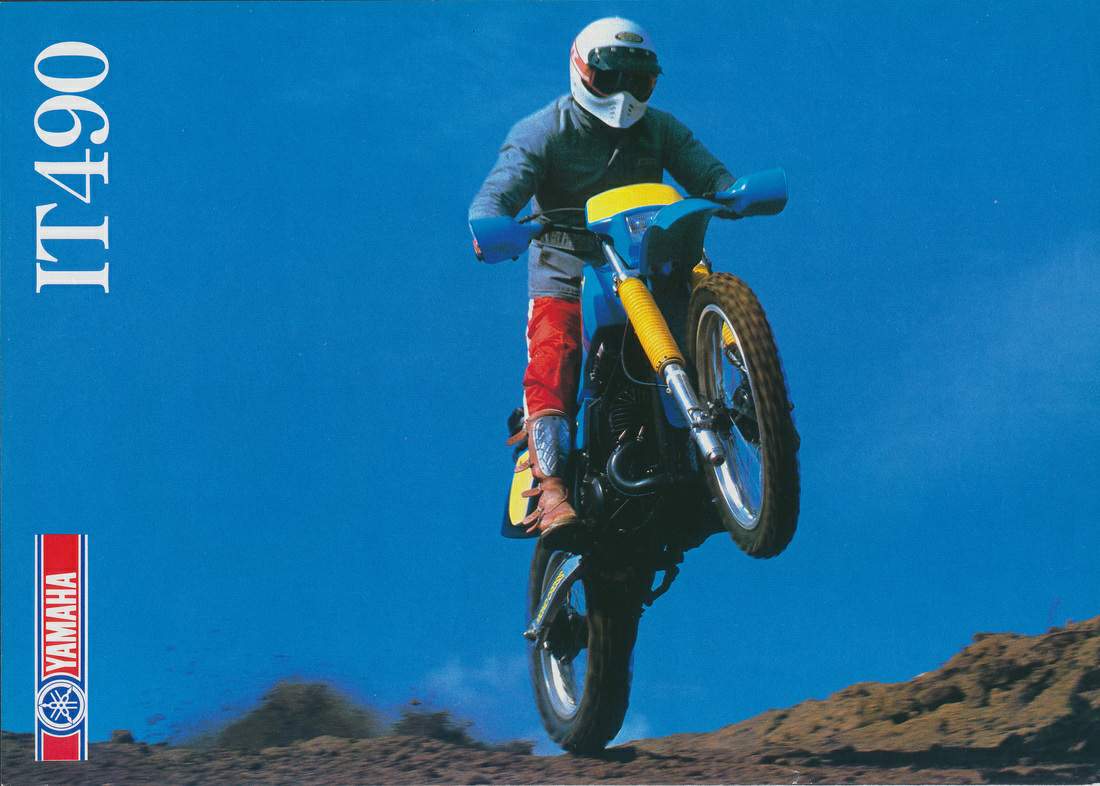
If you haven't guessed by now, that updated linkage system required a new frame. The 490 incorporates both YZ-style innovations and traditional IT designs. The IT490, like the YZ490 and the IT250, uses a single downtube frame which splits below the crankcase to cradle the engine. This necessitates an offset exhaust port in the cylinder in contrast to the liquid-cooled YZ250 engine, which uses a centrally located exhaust port. (The choice here is understandable; center-port cylinders theoretically allow maximum efficiency, and peak horsepower across the power spread at all times is the ultimate goal with 250cc motocrossers, not so much the case with enduro bikes or open-classers.) The IT's frame, as we mentioned, features a new backbone and various braces and tabs which protect the cases, thus allowing Yamaha to dispense with heavy skid plates, while still maintaining some protection, and accommodate IT-only accessories. The redesign also allowed the engineers to make some subtle changes, like moving the handlebar an inch forward to reposition rider weight and alter the steering. If you're interested in specifications, you'll want to know that the new frame has a one-half-degree steeper head angle and 0.4-inch longer wheelbase, and all the changes have pared off five pounds. Conventional wisdom has it that the geometry changes would largely offset each other (steeper rake for quicker steering versus more wheelbase for greater stability); but don't jump to conclusions. The IT actually both steers more precisely and has a little more stability than previous models—a result of all aspects of the new geometry working as a package. So the '83 IT remains what it has always been—an off-road machine whose most likable attribute is versatility—only now it's better doing its variety of chores. As an "International Trials" bike, the IT has always suited high-speed cross-country work better than tight woodsy plodding (which is predictable—it's sized right between Husky's enduro and motocross/XC bikes). Though the 490 doesn't steer like a Husky WR, it certainly handles as well as an XC at high speeds. In short, the IT is ideal for fast cross-country work and moderately tight woods work. Its suspension performance fits right in its job description. Having just shy of 12 inches of suspension travel front and rear, the IT can obviously handle more than your basic 24-mph average enduro speed. When cutting a fast trail you'll find the suspension responding quickly with consistent damping to bumps of all sizes and shapes—sharp jutting edges to whoops. Don't be surprised, though, to find the suspension, front and rear, bottoming fairly regularly. Manufacturers in general, Yamaha included, have learned that the original rising-rate rear systems offered too much progressiveness, so that the middle of the shock stroke was too soft and the end too stiff. For the past couple of years most bikes with progressive springing have felt as if their suspensions were always either mushy or suddenly near bottoming. Consequently, the '83 rear systems uniformly offer a less sudden rise in progressiveness. Further, Yamaha is recommending no air in the fork (though caps are fitted), relying only on the coil springs. At any rate, the IT's bottoming is relatively gentle, it informs you that you're taking advantage of all its travel, and you always have the option of stiffening front and/or rear to eliminate it completely. If you use the IT primarily for cross-country work but occasionally for tight woods, you'll be glad to know the bike is somewhat adjustable. The fork legs can come up in the triple clamps about an inch before they hit the handlebar, not only quickening steering but lowering the seat height for more graceful operation when you're snaking around switchbacks or paddling over the crest of a hill. Yamaha switched to a YZ-style double-leading-shoe front brake in the H-model year, and they've carried it over to the K-bike. It's a fine unit, providing as much power as you'll ever need and good feel at the lever. This year the IT uses a new full-floating rear brake, which makes braking over sharp stutter bumps easier by allowing the rear wheel to operate independently of the rear suspension, thus going a long way toward preventing lockup. To match the internal modifications, Yamaha also gave the '83 IT a facelift. The 490 uses the full-coverage seat developed by Team Yamaha motocrossers. This softens impact if you get in a tank-slapper and allows you to slide forward on the tank in fast cornering with greater assurance that you'll come out of the experience still a tenor. Altered tank and sidecover styling also creates a new look, and yellow fork gaiters and a yellow shock spring add color. All in all, the '83 machine is as unmistakably new in the garage as on the trail. Competition riders—cross-country or enduro—will find the IT once again at the head of the pack. The Husky WR is more specifically designed for tight enduros than the IT, but the 490, with some fine tuning, is certainly competitive for such events. But what a waste not to get out and fly! That's what the IT is best at: cross-country work—the faster and rougher the better. Take one out for that kind of ride and you'll be completely satisfied.
|
|
|
Any corrections or more information on these motorcycles will be kindly appreciated. |