|
|
|
|
Classic Bikes
Custom Bikes
Individual
Racing Bikes AJP
AJS
Aprilia
Ariel
Avinton / Wakan
Bajaj
Benelli
Beta
Bimota
BMW
Brough Superior
BRP Cam-Am
BSA
Buell / EBR
Bultaco
Cagiva
Campagna
CCM
CF Moto
Combat Motors
Derbi
Deus
Ducati
Excelsior
GASGAS
Ghezzi Brian
Gilera
GIMA
Harley Davidson
Hero
Highland
Honda
Horex
Husaberg
Husqvarna
Hyosung
Indian
Jawa
Kawasaki
KTM
KYMCO
Laverda
Lazareth
Magni
Maico
Mash
Matchless
Mondial
Moto Guzzi
Moto Morini
MV Agusta
MZ / MuZ
NCR
Norton
NSU
Paton
Peugeot
Piaggio
Revival Cycles
Roland Sands
Royal Enfield
Sachs
Sherco
Sunbeam
Suzuki
SWM
SYM
Triumph
TVS
Ural
Velocette
Vespa
Victory
Vincent
VOR
Voxan
Vyrus
Walt Siegl
Walz
Wrenchmonkees
Wunderlich
XTR / Radical
Yamaha
Zero
Video
Technical
Complete Manufacturer List
|
Yamaha GTS 1000 / ABS
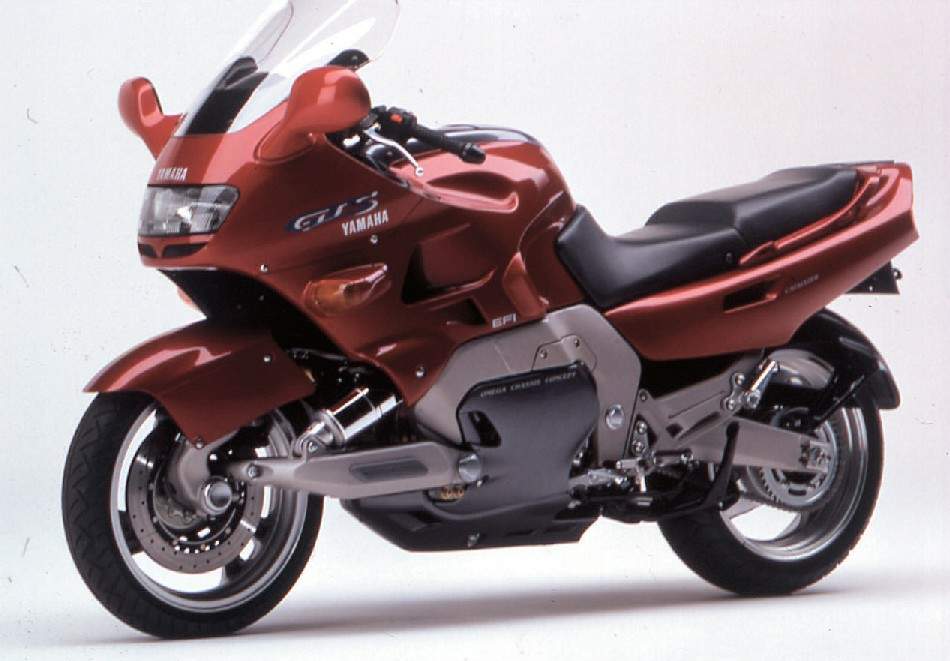
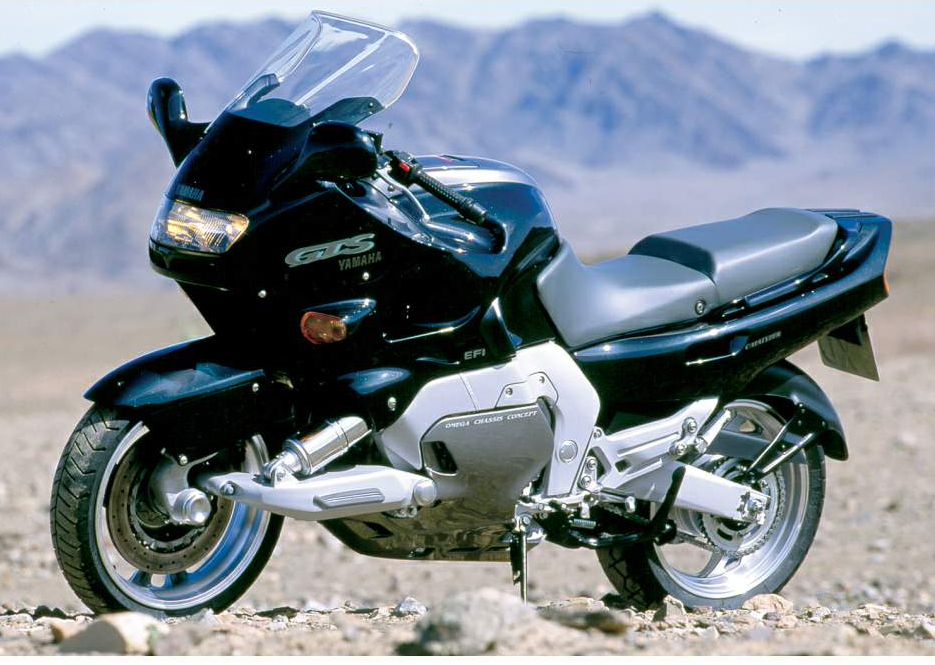
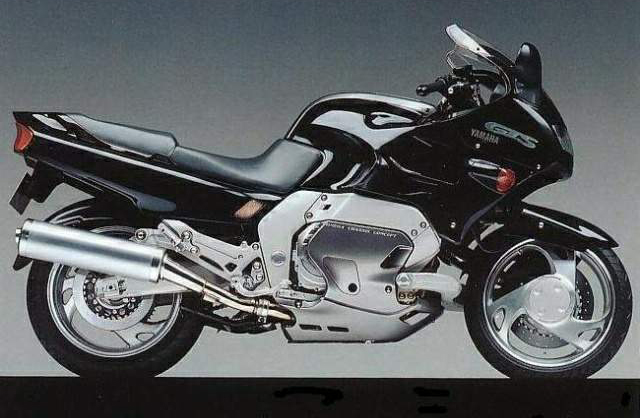
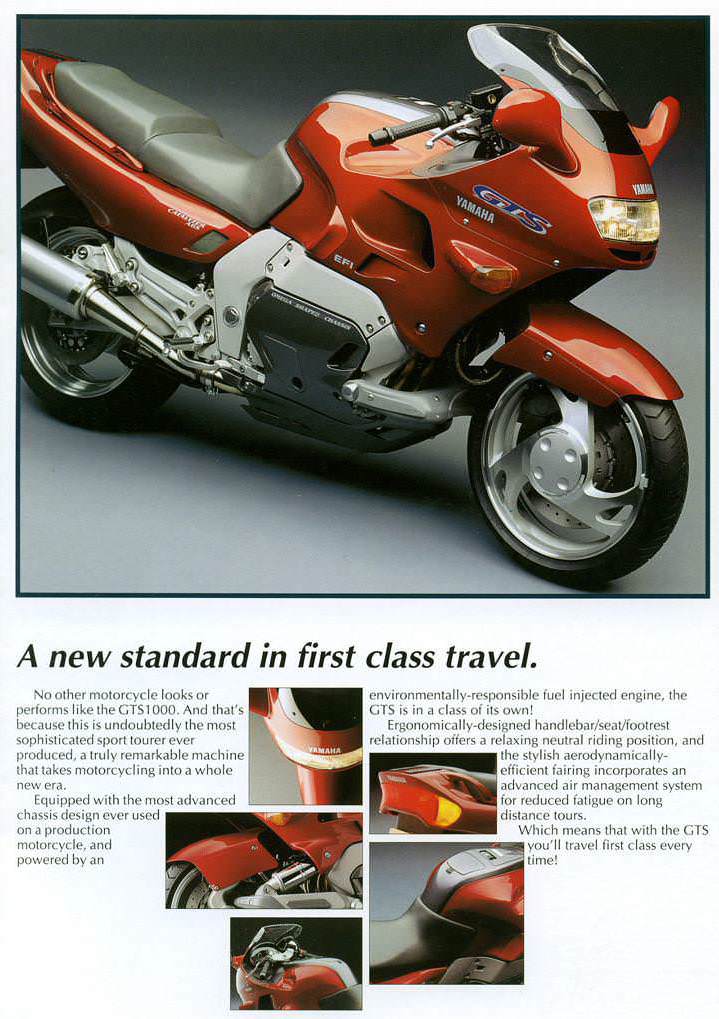
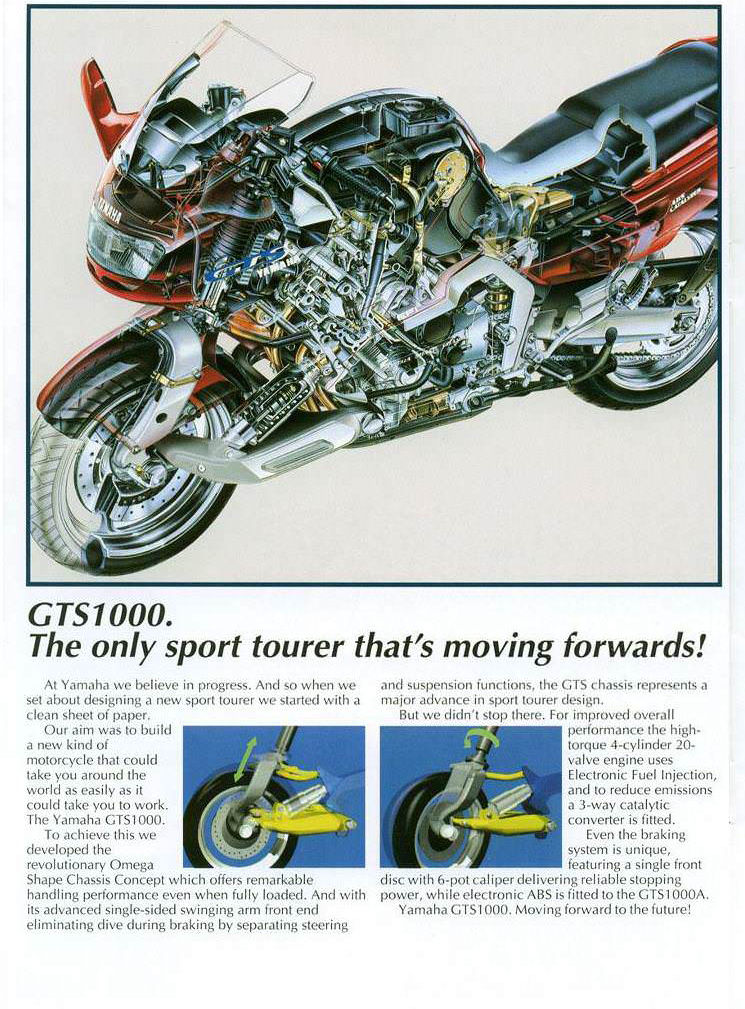
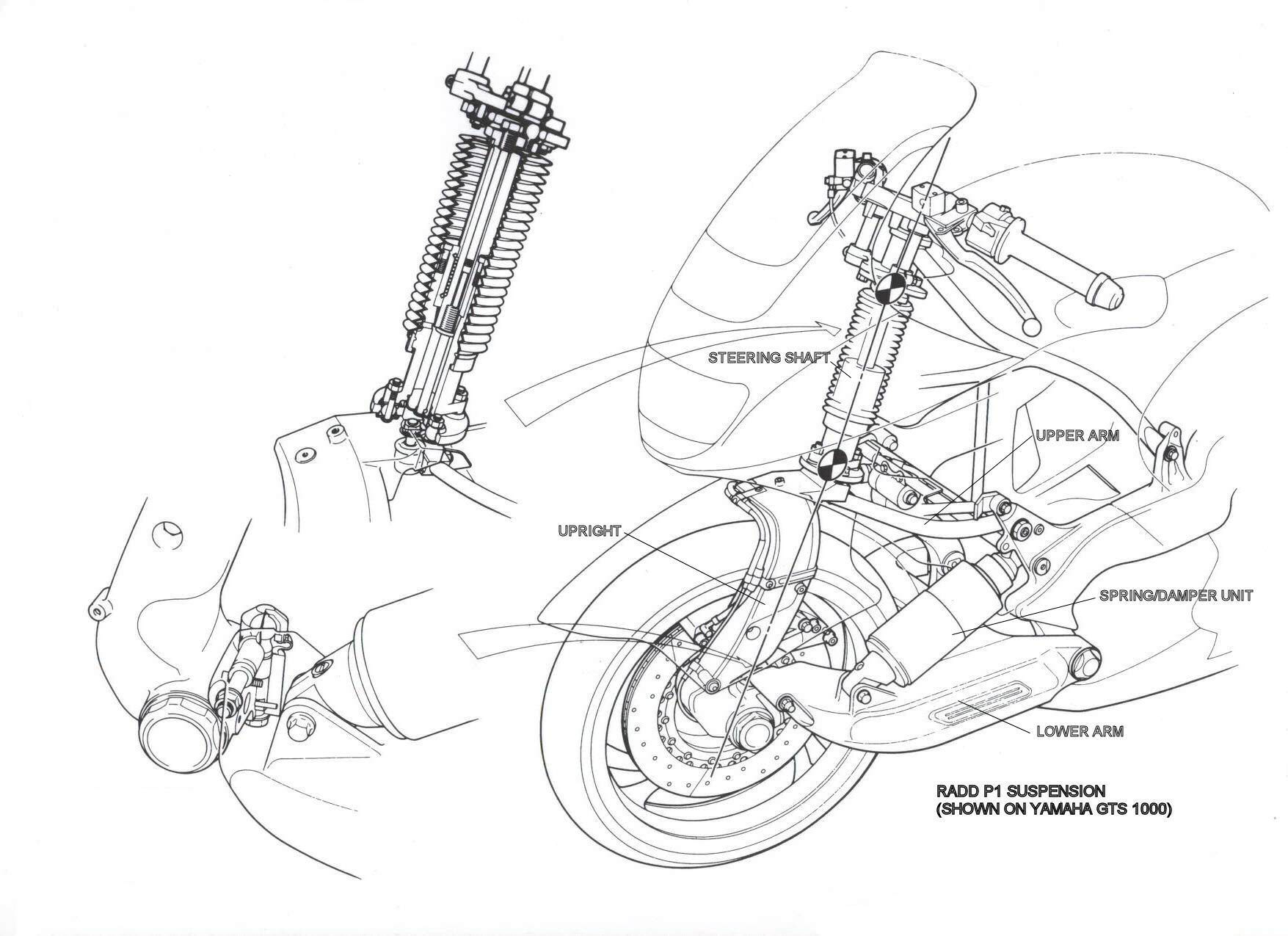
As the first mass-produced bike of the modern era with non-telescopic front suspension, the GTS1000 was an innovative machine that Yamaha hoped would trigger a brave new world of chassis design. Like the Tesi ID that had been built in tiny numbers by Bimota, the GTS featured a forkless front end whose theoretical advantage was that it separated the distinct elements of suspension and steering. Suspension was handled by a horizontal alloy beam leading from the front wheel hub to a pivot on the C-shaped aluminium frame. A diagonal shock linked the two.
Steering was accomplished using the vertical strut that led up from the hub to a telescoping steering box which took up suspension movement, and was linked to the handlebars. There was no room for a brake disc on the left, so the GTS was fitted with a single, central front disc and six-piston caliper with ABS.
Power came from Yamaha's FZR1000 cooled and angled-forward cylinders, 20 valves worked by twin overhead camshafts, and capacity of 1002cc. Fuel injection, softer cams, narrower intake ports and reduced compression ratio combined to reduce peak output from I40bhp to 100bhp at 9000rpm. The rest of the bike represented Yamaha's attempt to bridge the gap between adrenaline-pumping sportster and long-distance tourer. Its styling was streamlined, although this was a physically big and heavy machine. Its riding position was more sports than touring, giving a slight lean forward to near-flat handlebars, plus plenty of legroom.
Effortless cruising Straight-line performance was reasonable, although in comparison with the FRZ, the four-cylinder engine seemed to have lost more top-end power than it had gained lower down. The GTS pulled reasonably well from below 3000rpm, and kicked again at 6000rpm, cruising lazily at 100mph (I6lkm/h) with power in hand for a top speed of around I40mph (225km/h). But the GTS was uninspiring at high revs, and faded well before the I0,500rpm redline. Its suspension system impressed with its ability to absorb bumps without the steering being affected. Handling was biased towards stability rather than agility, partly because there was no fork dive to quicken the steering entering a turn. Its stability was often welcome, but during slower-speed manoeuvres the GTS seemed tall and unwieldy. The Yamaha's most impressive braking was done with the bike banked over into a turn,
Forkless Pioneer - the RADD MC Yamaha's GTS front suspension layout had been designed ten years earlier by James Parker, an American bike enthusiast and engineer whose firm RADD was based in Santa Fe, New Mexico. Parker developed his idea with a Honda XL600-based prototype that was tested by future 500cc world champion Wayne Rainey. This led to a striking Yamaha FZ750-powered prototype, the RADD MC2, built in 1987 in conjunction with Motorcyclist magazine and Los Angeles studio GK Design. Yamaha then bought rights to Parker's design, and contracted the American to help develop the GTS1000. when its front suspension kept working in a way that a telescopic system could not approach.
There was plenty of outright stopping power, too, although the ABS system was too sensitive. Unfortunately several failings, unrelated to suspension design, limited the GTS1000's appeal as a sports-tourer. Fuel consumption was poor and the tank range small. The fairing was narrow, and its screen generated turbulence. Worst of all the GTS was extremely expensive. Those factors, and the absence of any major advantage in most situations, resulted in poor sales. The Yamaha's failure ensured that telescopic forks would dominate motorcycle front suspension for years to come.
Source of review: Fast Bikes by Roland Brown
|
|
|
Any corrections or more information on these motorcycles will be kindly appreciated. |