|
|
|
|
Classic Bikes
Custom Bikes
Individual
Racing Bikes AJP
AJS
Aprilia
Ariel
Avinton / Wakan
Bajaj
Benelli
Beta
Bimota
BMW
Brough Superior
BRP Cam-Am
BSA
Buell / EBR
Bultaco
Cagiva
Campagna
CCM
CF Moto
Combat Motors
Derbi
Deus
Ducati
Excelsior
GASGAS
Ghezzi Brian
Gilera
GIMA
Harley Davidson
Hero
Highland
Honda
Horex
Husaberg
Husqvarna
Hyosung
Indian
Jawa
Kawasaki
KTM
KYMCO
Laverda
Lazareth
Magni
Maico
Mash
Matchless
Mondial
Moto Guzzi
Moto Morini
MV Agusta
MZ / MuZ
NCR
Norton
NSU
Paton
Peugeot
Piaggio
Revival Cycles
Roland Sands
Royal Enfield
Sachs
Sherco
Sunbeam
Suzuki
SWM
SYM
Triumph
TVS
Ural
Velocette
Vespa
Victory
Vincent
VOR
Voxan
Vyrus
Walt Siegl
Walz
Wrenchmonkees
Wunderlich
XTR / Radical
Yamaha
Zero
Video
Technical
Complete Manufacturer List
|
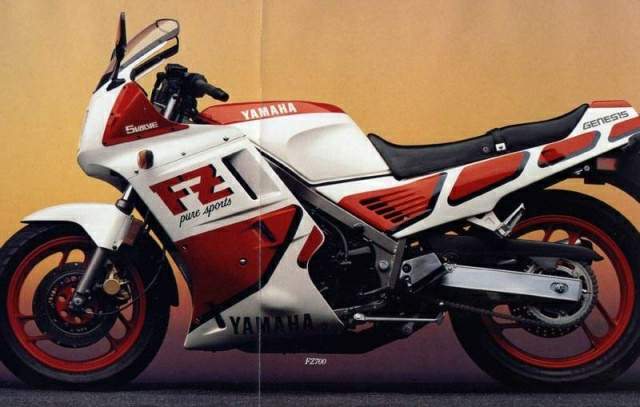
Yamaha FZ 700
When the FZ750 was introduced in 1985, it created quite a stir. There had been two-valve engines, three-valve engines and even four-valve engines, but the radical, race-ready five-valve Genesis design was fresh, beautifully executed and performed famously on the street and on the track. It brought home the fact that motorcycle engine technology was leading the entire engineering world—not even Formula One cars had as many valves as their drivers had fingers. The valves got all the attention, but the layout of the bike is just as radical. Fuel is heavy; chassis designers want to get it as low as possible. Upright cylinders and the traditional bank of carburetors behind them force intake ports into contortions that slow airflow at high rpm. The solution is to cant the engine radically forward at about 45 degrees. This gets the weight of the cylinders down and forward, where it belongs, and allows the carbs to be mounted high, with the light but bulky airbox above them. And the fuel can now sink into the frame where the carbs used to be. It's simple, elegant and, like most other advancements, it causes observers to wonder why it had never been done before. But even a breakthrough design is only as good as the competition's next major model change. The FZ is now the oldest 700/750 sport bike from Japan. Suzuki followed with the feather-light, oil-cooled production-race-oriented GSXR. Honda backed up the original 750 Interceptor with the smooth, fast and refined VFR. And late last year, Kawasaki started selling the 750 Ninja, another slick combination of arm-ripping acceleration, lancet-sharp handling and real-world ergonomics. The FZ was revolutionary—but can it still run head to head with the hot young punks on the block? Yamaha has its own revolutionary sport 750 this year, the rare, expensive and exotic FZR. Its Deltabox aluminum frame and race-ready brakes, wheels and radial tires are exciting, but its over-$6000 price and severely limited availability will take it out of the hands of even the most rabid street rider. So the FZ700 is now Yamaha's loss-leader sport bike for the masses. Ogle the FZR on the showroom floor, but put your down payment on the tariff-beater. The displacement has been dropped to 697cc by the simple expedient of destroking the crankshaft; the pistons move 48mm in the 700, 51.6mm in the 750. The pistons have changed radically; they are much lighter than before, with almost no skirt area at all. The rings are also narrower and lighter, and the rods, like those in the new FZR750 and FZR1000, are lighter and stronger. Lightened reciprocating parts (Yamaha claims the piston-ring-rod assemblies are 13 percent slimmer) are often the basis of an all-engine weight-loss program; with less mass flopping on the crank throws, the crankshaft journals can be reduced in size, the crank can be made lighter, and the cases that support the whole mess can be pared down as well. Yamaha hasn't gone that far; the crank and cases are just as beefy as before; meaning the new 700, with its trimmed-down bouncing parts, should be even more durable than the nearly bulletproof 750. The valve gear, with its three-intake, two-exhaust layout, is unchanged. Tiny bucket-and-shim lifters, cleverly stacked inside the two-layer head assembly, act on the valves directly. The hollow camshafts must be removed to adjust the valves, so Yamaha made sure the process would occur infrequently; the light valves, sintered metal seats and general high quality of the parts let Yamaha call for valve adjustment every 27,000 miles. The previously redundant exhaust system, however, has been cut in half. Like Suzuki's GSXRs and Yamaha's own FZ600, the new 700 uses a four-into-one system with a single muffler on the right side. The exhaust timing has also been juggled to work with the new pipe; lift is the same as before, but the exhaust cam opens the valves on a new schedule. Digital electronic ignition is all the rage in Japan these days, and the FZ has it. There are no moving parts, other than electrons, and the new system allows designers to adjust timing at as many as 22 separate rpm points, letting them fine-tune the spark to follow the engine's needs exactly. The obviously new parts of the 700 are on the outside. The fairing is more substantial; the upper part is close to the old one but with triangular contraptions at each forged handlebar to keep airflow off the rider's hands. Air intakes at the front of the hand fairings duct cold air to the airbox area in a variation on Yamaha's YEIS intake ducts on the new FZRs. The '85 750 was naked below the waist; the '86 came with a chin fairing. Now the '87 is completely clothed, with the engine almost completely covered by wraparound ABS. The windshield is 50mm (about 2 inches) taller to further separate the rider from the windblast. The side panels are resculptured, with Ferrari Testarossa-style cheese graters directing airflow out of the central chassis section. The tank and seat are unchanged, although the seat seems more comfortable than on previous FZs. The chassis remains as it has always been: long, low, rigid and a little quirky. The frame is steel, but don't sneer—it's the same frame Eddie used last year to carve 'em up at Daytona, so most riders on street tires should be happy with its rigidity. The wheelbase is a tourer-like 58.9 inches, and although we don't know where it came from, there's an extra 0.4 inch (10mm) between the axles that wasn't there last year, according to the spec sheets. Eddie likened his racer FZ to a Winnebago last year, but that's in comparison to his 54-inch, 250-pound YZR GP bike. Most of the rest of us find steering moderately quick but with a propensity to require fairly serious changes in steering input with changes in braking or throttle. The 700, like its 750 progenitor, wants to stand up in corners, especially slower ones. Touching the front brake lever increases the stand-up tendency greatly; the relatively soft fork springing gives the rider a few milliseconds to adjust his steering as the change occurs, but the first few applications of brake while leaned over will have most riders bobbling their lines a bit. It's possible to slam the FZ over with the brake on, but takes a fairly heroic push on the handgrip to do it. Moving the throttle around in a corner also affects the line profoundly. Rolling off the throttle tightens the line, and rolling it on widens the exit. Our riders found themselves consciously using the throttle to steer instead of the handlebars be- cause adjusting the throttle gave smoother, more predictable results. The FZ just feels as if it wants you to leave the handlebar alone once you're committed to a corner. The long wheelbase and relatively soft front end encourage the rider to stay smooth with his steering inputs to avoid disturbing the chassis' equilibrium. With the stock Bridgestone Exedras, the 700 shows a propensity to push the front end when the rider's adrenaline level hits condition red; compared to its competition in the class, the FZ takes a considerable amount of planning to get through a corner with equal speed. Replacing the pointy and short-lived front skin with a more rounded high-performance tire is recommended by experienced FZ hot shoes. A couple of the trick features of the FZ750 are gone on the budget-minded 700. The rear shock once had Yamaha's slick, adjustable rebound damping, which adjusted the rates automatically as the remote preload adjuster was spun. The new shock is not adjustable, and preload is changed at the bottom with a simple locking ring. And, alas, the centerstand is gone. The holes are there if you want to install your own. The brakes, as always, are excellent; the 267mm front discs and double-action calipers respond well to a light touch and don't fade until the right rider, on the right racetrack or downhill canyon, starts to really work them over. The rear disc may be overkill; it's the same size and caliper style as the front and can be locked up easily by a rider with an inattentive right foot. An '85 or '86 FZ750 owner would feel right at home with the revised motor. Throttle response is a bit quicker due to the reduced mass of the parts flailing around inside. The FZ has long been known for an excellent spread of power, and the 700 doesn't seem to have lost much as its displacement has shrunk. Usable power begins with the tach needle barley off the pegs and builds to a raspy, impatient crescendo as it winds to its 11,000-rpm redline. The powerband is wide but progressive, and the FZ has a way of always delivering a little more power than you expected with a given throttle opening, making it a very exciting, satisfying engine to work with on a mountain road. Our FZ700 was run at Baylands Raceway, where excellent traction tends to give bikes a slight edge over those run at Los Angeles County Raceway, our usual high-desert test venue, even after the quarter-mile runs have been corrected for weather conditions. The 750s from the Japanese have consistently run neck and neck at the strip—the differences are so slight in performance, none of the machines can be called a clear winner. With the Honda and the Yamaha now 700s, we would expect them to run a bit behind the Suzuki and the Kawasaki, but we'll have to test them all on the same day and at the same track to know for sure. Our 700 ran a best quarter of 11.40 seconds at 117.2 mph. With the weather factored in, that translates to a 11.37 at 117.5, just a little faster than the Honda VFR700 (at 11.70 and 114.8) and slightly weaker than the industry-wide 11 seconds and small change runs made by the 750s. The 700 suffered in the top-gear roll-on compared to its bigger, older brother. It got to 75.8 mph 200 yards after the throttle was popped open at 50 mph, which put it 3.3 mph slower than the '85 FZ and 3.4 faster than its closest competition in displacement, market position and price—the'86 Honda VFR700. The FZ's street manners are admirable but not perfect. Five-valve Yamahas have always had nOtchy throttle response right off idle; the FZ750, 700 Fazer and even the long-departed Maxim X tended to lurch a bit as the throttle was pulled off the stops in a slow corner. The FZ head may be right at the limit of valve area to get acceptable air velocity at low speeds; it seems the Mikunis are having a hard time mixing the air and fuel properly at small throttle openings and still getting past the EPA's pipe sniffers with passing grades. The FZ700 still has a glitch here, but it didn't seem as bad as on previous models—perhaps the new finely honed digital ignition is compensating for the minor inadequacy of the carburetion. The solidly mounted motor has no counterbalancing, and a small amount of buzziness finds its way to the rider. Our machine tingled in the bars and the tank at 4500 rpm, which happens to be an indicated 60 mph in sixth, right where most riders will ride most of the time on an open highway. The vibes are noticeable but not particularly annoying, and one always has the option of downshifting to fifth to move the buzz point away from a given road speed. The 700 has a new cushion ring on the clutch to give smoother engagement; we didn't notice a significant difference in feel or in drag-strip performance. The six-speed trans is a trouble-free shifter but still doesn't haveihe light touch and silky feel of a good Suzuki or Kawasaki gearbox. The FZ is aging gracefully. It has kept up with the times as its competition has evolved and yet retains the character that stood the original '85 model apart from the mainstream of engine and chassis design. With its new bodywork and paint, it's a much flashier package than before, and the combination of moderately comfortable riding position, bulletproof and soul-stirring motor and fully competent handling make it a viable choice in the marketplace. Its main competition, the Honda VFR700, is $50 cheaper, a year newer in design, a bit more comfortable and a bit easier to ride—but that won't stop a dyed-in-the-leather Yamaha partisan from opting for the closest he can get to an Eddie-at-Daytona replica. 11 Source MOTORCYCLIST/APRIL 1987 71
|
|
|
Any corrections or more information on these motorcycles will be kindly appreciated. |