|
|
|
|
Classic Bikes
Custom Bikes
Individual
Racing Bikes AJP
AJS
Aprilia
Ariel
Avinton / Wakan
Bajaj
Benelli
Beta
Bimota
BMW
Brough Superior
BRP Cam-Am
BSA
Buell / EBR
Bullit
Bultaco
Cagiva
Campagna
CCM
CF Moto
Combat Motors
Derbi
Deus
Ducati
Excelsior
Fantic
GASGAS
Ghezzi Brian
Gilera
GIMA
Harley Davidson
Hero
Highland
Honda
Horex
Husaberg
Husqvarna
Hyosung
Indian
Jawa
Kawasaki
KTM
KYMCO
Laverda
Lazareth
Magni
Maico
Mash
Matchless
Mondial
Moto Guzzi
Moto Morini
MV Agusta
MZ / MuZ
NCR
Norton
NSU
Paton
Peugeot
Piaggio
Revival Cycles
Roland Sands
Royal Enfield
Sachs
Sherco
Sunbeam
Suzuki
SWM
SYM
Triumph
TVS
Ural
Velocette
Vespa
Victory
Vincent
VOR
Voxan
Vyrus
Walt Siegl
Walz
Wrenchmonkees
Wunderlich
XTR / Radical
Yamaha
Zero
Video
Technical
Manufacturer List Contact
|
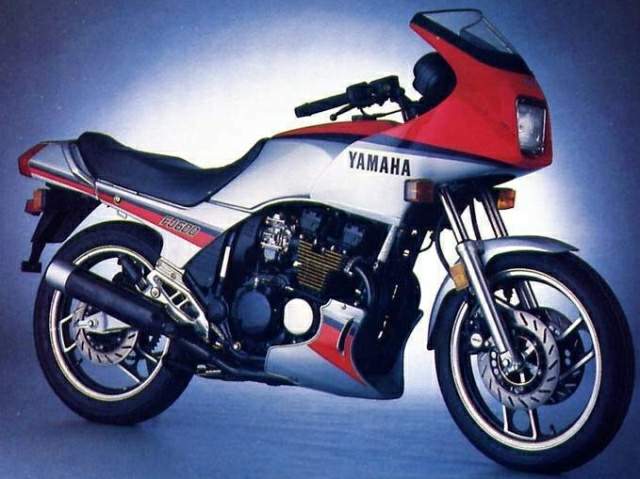
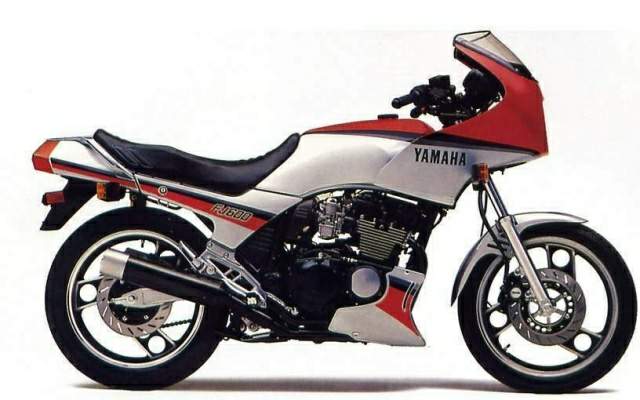
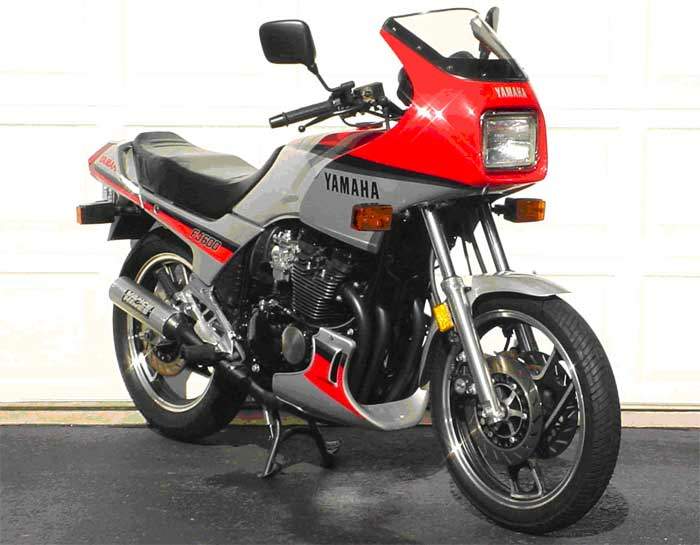
Yamaha FJ 600
As a look-alike little brother to the FJ1100, the FJ600 promises true sporting performance. Though a few engine parts were borrowed from previous machines, the FJ600 is essentially all new and aimed squarely at sports riders. The 16-valve engine features valve sizes normally reserved for 750s: 31.5mm intake, 27mm exhaust and the four carbs boast large 32mm Venturis. Power is transmitted to the chain-driven rear wheel through a six-speed gear box. A frame-mounted fairing, triple discs, DeCarbon-type single-shock rear suspension system and long-travel front suspension with integrated fork brace adorn the short (56.1-inch wheelbase), low-slung chassis.
1984 Review Yamaha's middleweight will get its sport
reputation the hard way— by earning it. For those who adhere to sport chic, that makes
the 600, despite its FJllOO-inspired bodywork, nearly naked at the cotillion.
The engine is based on the eight-valve Seca 550
powerplant, and is extremely compact. And, more was done to the original 528cc
motor than the bore-and-stroke that brought its displacement up to 598cc. In
revamping the 550's engine Yamaha engineers altered combustion-chamber shape,
valve sizes, cam profiles and timing, carburetor size and airbox capacity, all
to achieve one specific goal: performance. Even fuel mileage took a back seat to
engine performance: YICS, Yamaha's mileage-boosting interconnected inlet
plumbing, was" dropped when it was found the engine pulled stronger—although at
a somewhat higher fuel-consumption rate—without it. Above that engine speed, though, the 600 is all
sport-bike, and easily revs to its 10,500-rpm redline in five of its six gears.
And in sixth, the prototype FJ600 we rode managed almost 10,000 rpm—and an
indicated 125 mph—down Willow's back straight. And the 600's relatively quick steering geometry
(26 degree Steering Head Angle, 4.17 inches of trail), lets you flick the bike
through those corners without muscling it—and without turning it twitchy at
speed. Hauling down from speed is equally predictable, thanks to the 600's
excellent triple-slotted-disc brake setup; the only flaw we found in the 600's
braking was a tendency toward nosedive in full-on stopping. Overall, from ride
quality to Ground Clearance to ergonomic layout, the 600 displays impressive
performance credentials, either for closed circuits or the open road.
|
|
|
Any corrections or more information on these motorcycles will be kindly appreciated. |