|
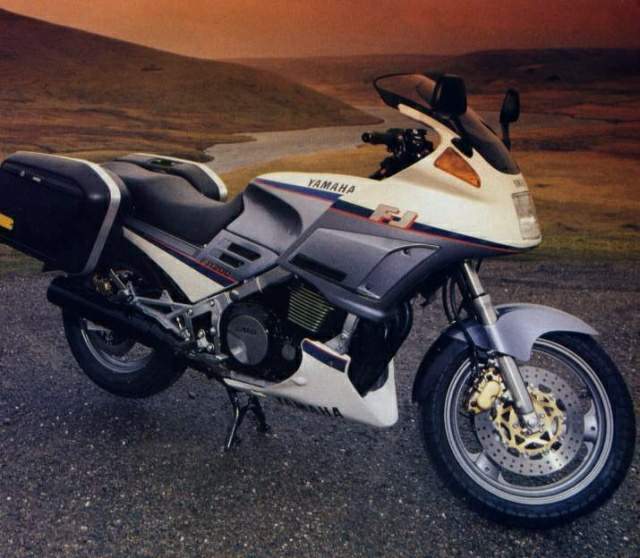
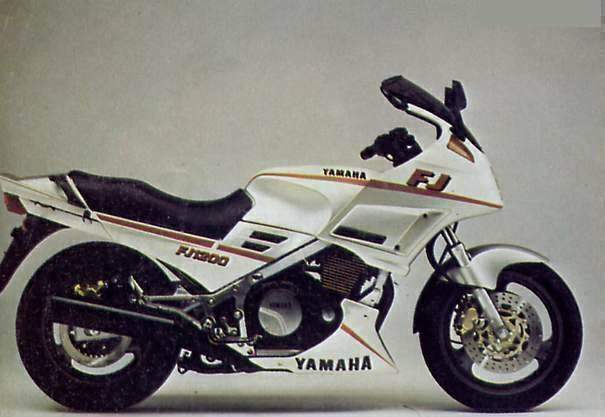
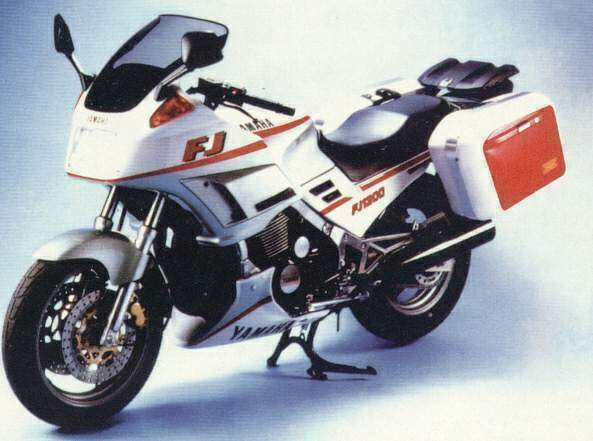
Yamaha FJ 1200

|
Make Model |
Yamaha FJ 1200 |
|
Year |
1988-89 |
|
Engine |
Air/oil cooled,
four stroke, transverse four cylinder, DOHC, 4 valves per cylinder. |
|
Capacity |
1188 |
|
Bore x Stroke |
77 x 63.8 mm |
|
Compression Ratio |
9.7:1 |
|
Induction |
4x 36mm Mikuni carbs |
|
Ignition /
Starting |
CDI / electric |
|
Max Power |
130 hp @ 9000 rpm (rear tyre 112.5 hp @ 8600 rpm) |
|
Max Torque |
108 Nm @ 7500 rpm |
|
Transmission /
Drive |
5 Speed / chain |
|
Front Suspension |
Telescopic with 3-way preload and damping
adjustment |
|
Rear Suspension |
Monocross monoshock 5-way preload and 5-way
damping adjustment |
|
Front Brakes |
2x 282mm discs |
|
Rear Brakes |
Single 282mm disc |
|
Front Tyre |
120/70 V17 |
|
Rear Tyre |
150/80 V16 |
|
Wet-Weight |
255 kg |
|
Fuel Capacity |
22 Litres |
|
Consumption average |
14.5 km/lit |
|
Braking 60 - 0 / 100 - 0 |
14.1 m / 40.0 m |
|
Standing
¼ Mile |
10.9 sec / 200.3 km/h |
|
Top Speed |
244.3 km/h |
|
Overview |
Cycle Review |
|
Manuals |
Yamaha FJ-1100/FJ-1200 -
Clutch Modification |

In 1984, Yamaha reentered the
super-bike fray after years of neutrality. The long-awaited FJ1100 was big,
last and refined - the first open-class street bike from Yamaha to be taken
seriously, an immediate force to be reckoned with by the other factories.
There were faster, sharper bikes that year, but none of them had the FJ’s
whole-cloth competence. The Yamaha embodies a classic balance of comfort and
performance that has lengthened its lifespan far beyond that of the other
open-class soldiers it once fought, which have long since faded away.
Since 1984 the deck has been shuffled more than once: positions and players
have changed. In the natural progression of things, the FJ has gone from
warrior to elder statesman. Pulled from the U.S. market last year due to a
surfeit of unsold 87 models, and now returned from exile, the FJ is no
longer the flagship of Yamaha’s engineering acumen. Instead, Yamaha has
sharpened the FJ's focus on the sport-touring market, where it now competes
with such machines as BMW's K100RS, Suzuki's 1100 Katana and Kawasaki's
ZX-10.
Other liter-class motorcycles make more peak horsepower and handle better
than the FJ, but it has taken on a smooth, gray-at-the-temples character
those adenoidal upstarts lack. The Yamaha's beauty becomes apparent as its
odometer racks up miles. Many motorcyclists will be hard-pressed to find a
more comfortable bike for a rider and passenger, short of a full-dress
tourer. It's still one of the hardest-accelerating motorcycles around, and
well considered suspension upgrades have seen to it that the FJ's legs have
more than enough life to run with the rookies.
In fact, the only things that stop this bike from still being the Superbike
King are Yamaha's own FZR1000 and Suzuki's GSXR-1100. But those are birds of
a much different feather, with more emphasis on high performance and less on
utility. The tightest of them (the FZR) weighs 66 pounds less than the FJ.
Their more modern engines make greater peak power that results in higher top
speeds, and they have more advanced chassis. But strap your significant
other to either of those brutes for more than 50 miles and it's only a
matter of time before papers are served.
The FJ can still bang fairings with the youngsters, up to a point beyond the
limits of most riders, but experience has taught it certain things that come
with middle age. It has learned to, well, prolong the act of riding. Rather
than going at a full-throttle, toe-curling sweat to completion of an outing
in the shortest possible time, the FJ wants to satisfy its rider over a
period of hours, over hundreds of miles.

In fact,
long-distance riders not of the bolt upright, full-dress school may find the
FJ more comfortable than the land yachts. Set full soft, it rivals their
cushy rides, easily absorbing a variety of bumps, holes and ripples. The
fairing and windscreen - 50mm taller and 60mm wider this year, with bulges
to keep windblast off the rider's hands - encapsulate an average-height
rider's torso in still air. The seat is thick, wide, and feels lower than
its 30.1-inch height. Wide and high clip-ons cant the rider slightly
forward, while rubber-mounted footpegs place his feet slightly to the rear.
Overall, the FJ offers splendid accommodations.
In keeping with the bike's enhanced emphasis on long-haul comfort, backseat
riders have been granted rubber-mounted footpegs and a less pronounced slope
to their portion of the saddle. One veteran passenger gave the Yamaha high
marks, faulting it only for a still-too-steep perch which slid her
insistently forward.
Weight and sheer size are the major chinks in the FJ's armor when it comes
to backroad battle with newer liter-bikes. At 588 pounds wet, it's
considerably heavier than the modern repli-racers; the FZR 1000 weighs 522
pounds, the GSXR 100 weighs 532. The FJ's wheelbase stretches to 58.7
inches, while the biggest FZR's wheelbase is 57 inches, and the GSX-R's a
stubby 56.7. All other things being equal, a shorter wheelbase makes for a
nimbler motorcycle. Still, at speed, the FJ seems smaller than it is, and
feels light on its feet. Aggressive riders, though, who like to flick into
corners, will find the steering a little on the slow and heavy side.
In the sport-touring venue, the FJ's weight and size hurt it not at all.
Over a long haul the bike's mass makes it feel like a 7-series BMW
automobile - totally relentless and unruffled, solid as a very supple rock,
the smoothest of engines begging for more throttle.
The Porsche-like dashboard further reinforces the FJ's image as a
Euro-cruiser. Three large instruments - a tachometer surrounded by a
speedometer and a fuel gauge - light up a warm and readable orange at night.
There's also an easily accessible fuel-reserve switch in the left-side
fairing inner. A digital clock keeps track of the time; not such a small
thing when you need to know but your watch is buried under your left sleeve
and gauntlet. Remove the bodywork, and it reassembles with solid, logical
precision. Everything about the FJ says function without frillery. Here we
are. Let's you and me snort some road. Fuel capacity of 5.8 gallons gives
the bike a range of about 250 miles, longer than that of most riders.
A few minutes with a screwdriver and a 14mm wrench turns the same bahnburner
into a capable swerve-blaster. The FJ has what Yamaha refers to as
"programmed suspension" at both ends. Twisting the fork's three-position
spring preload adjuster also alters rebound damping (and compression
damping, to a lesser degree), or damping and preload can be adjusted
independently. The DeCarbon-type rear shock has some of the most accessible
adjusters on the market; pull the seat, pop off the right side panel and
they're right there. Twisting the preload adjuster turns a sprocket and a
tiny chain that crank the shock's preload collar up or down, while adjusting
damping accordingly. As with the fork, the shock's preload and damping can
be set separately. The shock adjuster offers five numbered positions, with
quarter-steps between each one for a total of 17.
The single-rate rear spring is 18-percent stiffer for '89, and the shock's
linkage has been rearranged for more-progressive action. Fork springs are
dual-rate items as before, but both rates are now approximately 15-percent
stiffer. Yamaha says it was after "increased sport-bike feel." We say the
change compensates for the underspringing of previous FJ's. Stiffer springs
also brought a welcome increase in ground clearance. You have to ride the FJ
hard to grind away the footpeg feelers, and very hard to nick the
centerstand.
With the rear spring at the third position and damping at the fourth, fork
spring preload in the second setting and damping at the third, Cycle's
fastest expert found the FJ entirely trustworthy, if somewhat cumbersome,
around the tight streets of Willow Springs racetrack. Although that track is
a relatively smooth one, the FJ's heft actually helped filter out what bumps
there were, and it does likewise on bumpier backroads. Since the unsprung
weight (wheels, tires, brakes) of a big bike isn't usually much greater than
that of a small one, such weight accounts for a smaller proportion of the
larger bike's total. As a result, suspension inputs affect the mass of the
larger bike less. Bumps don't upset the FJ, making it an unshakable platform
upon which to flail away at handlebars, levers and tarmac. The big Yamaha is
wonderfully stable in a straight line, too.
That excellent stability results in part from replacing the old 2.75 by
16-inch front wheel with a lighter, cast-aluminum hollow-spoke 3.00 by
17-inch wheel and lower-profile tire. The rear is also a hollow-spoke
design, but in the same 3.50 by 16-inch size as before.
The diameter of the low-profile, 70-series, 17-inch Dunlop K330 front is
within millimeters of that of the 80-series 16-incher it replaces. Rake and
trail remain the same at 27.5 degrees and 4.4 inches, as do the Kayaba
fork's 41mm stanchion tubes. But the bike feels more stable, at least partly
because the 70-series tire has less sidewall to flex.
Tire choice greatly affects a sport-bike's feel. The FJ was originally
designed around 16-inch Pirellis purpose-built for Bimota. The front tire,
although designated a 120/80, was actually 128mm wide. That tire's width and
profile created steering torques that tried to stand the previous FJ up
abruptly when braking into corners. It also contributed to the bike's
unwillingness to change lines in mid-corner.
The new 17-inch front Dunlop, though also designated a 120, is considerably
narrower at 117mm, and helps the FJ's steering considerably. The tendency to
stand up under braking while leaned over is much less pronounced, and the
bike changes headings in mid-corner more readily, although it still requires
more effort than do modern superbikes. Overall, the new tire makes the bike
feel more precise, and minimizes its handling quirks at the bargain cost of
a minor increase in steering effort.
While fitting those new wheels, Yamaha engineers decided to graft on new
front brakes, as well. Larger, 298mm floating discs replace the old 280mm
solid-mount rotors, and they're squeezed by four-pot calipers in place of
the previous model's twin-piston units. Yamaha's ineffectual anti-dive has
been shown the dumpster and is rarely missed; especially now that spring
rates are stiffer. The radially vented rear disc is unchanged, and is still
one of the best rear brakes around, offering excellent feel and power -
especially with a passenger. The brake upgrade doesn't necessarily allow the
bike to stop any faster but the '89 does require less effort, and feeds back
reliable information.
Some things never change, thankfully. This motor will still leave bruises on
your heart from constantly banging it into your spinal column. A regimen of
gradual refinement has made it even stronger throughout its rev band.
Displacement increased to 1188cc with 3mm-large bores in '86, and the '89 FJ
improves or that engine with a more precise, digitally controlled
spark-advance unit. A new electric fuel pump satisfies the 36mm Mikuni
constant-vacuum carburetors, which have one-size-leaner main jets for fewer
nasty emissions.
This is a civilized motor. Yank the fairing-mounted choke knob to its stop
for initial fire-up, and the FJ immediately assumes a dignified 1200-rpm
idle - none of this 4000-rpm-or-nothing stuff that grates on the
sensibilities of the mechanically sympathetic.
Below 3000 rpm, the air-cooled, double-overhead-cam, 16-valve engine sounds
semi-agricultural, with no water jacketing to absorb noise. Vibration
through the grips is readily apparent low revs, up to about 50 to 55 mph in
top gear; it's not particularly bothersome unless you have to ride that slow
for while. By 60 mph, wind carries away whatever sounds the engine might be
making. The FJ has a top-gear sweet spot from 65 mph up to the vicinity "go
directly to jail," and its mile-wide powerband means there's a deep, easily
tapped pool of acceleration anywhere within that zone. Deceptively smooth
and quiet - ticket-prone, in other words - it's a bike your insurance broke
and lawyer will love. Around 8000 rpm the smooth engine again becomes a bit
buzzy, and in top gear the FJ can't hurl itself forward from 120 like
superbikes of more recent vintage.
The new FJ runs nearly identical quarter-mile times as Cycle's original
FJ1100 clocking a best of 11.03 seconds at 123.7 mph, to the '84's 11.07
seconds at 124.8. An '86 FJ1200 Cycle tested ('750s vs. l000s," July 1986)
ran 10.78 at 127.1, with one horsepower less than our original FJ1100. What
that proves, again, is that the last tenths of quarter-mile times are highly
dependent upon rider skill and weight, traction on a given day, wind,
humidity and the position of Jupiter's moons.
At everyday speeds, the FJ1200 is simply a phenomenal performer. Let's talk
roll-on acceleration from 45 to 70 mph. Pay attention here: With the
exception of the 88 V-Max Cycle tested - and only in third gear, mind you -
the FJ's roll-on numbers are better than those of any production motorcycle
we have ever measured. The V-Max beats the FJ in third gear by two-tenths -
2.15 seconds to 2.35 - but the FJ outmuscles the VMax by 0.25 second in
fourth and fifth. The FJ is faster in roll-ons than both of its
predecessors. Faster than the FZR 1000. Faster than either of the 1100
Suzukis. Faster than the ZX-10. Fast enough to make you a speeding bullet.
Yamaha, pursuing peak power with its five-valve Genesis design, has
apparently decided upon a different role for the FJ1200, that of designated
torque-monster.
The FJ powerplant does more before 3500 rpm
than most engines do all day. At that engine speed, 60.6 foot-pounds of
torque are available. The FZR1000 can't work up to that until 3000 rpm
later. As to horsepower, at engine speeds most common in street riding, the
FJ buries the upstart FZR with 10 to 15 horsepower more all the way from
3500 to 7500 rpm. The FJ's 102.7 peak comes at 8500, right where the FZR's
power curve steepens on its way to 114.9 horses at 10,000.
Such compelling power, combined with almost
armchair-like comfort, makes it hard to fault the FJ in its role as
traffic-blaster and road-swallower par excellence. Recruit a passenger,
strap on some soft luggage, and try to conceive of a more pleasant
long-distance, high-performance conveyance.
Time has been good to the FJ. It has fought its
battles, and gallantly, but it is not nearly ready for retirement. The younger
lions claw and bite harder, and their lifespans will be short if history is any
indication. Yamaha's FJ1200 is a survivor because it is an intelligent machine,
one with wisdom tempered by fire. Rather than doing one thing excellently, it
does everything very well.
Reprinted without permission from Cycle Magazine,
July 1989.

|