|
|

|
|
|
|
Classic Bikes
Custom Bikes
Individual
Racing Bikes AJP
AJS
Aprilia
Ariel
Avinton / Wakan
Bajaj
Benelli
Beta
Bimota
BMW
Brough Superior
BRP Cam-Am
BSA
Buell / EBR
Bultaco
Cagiva
Campagna
CCM
CF Moto
Combat Motors
Derbi
Deus
Ducati
Excelsior
GASGAS
Ghezzi Brian
Gilera
GIMA
Harley Davidson
Hero
Highland
Honda
Horex
Husaberg
Husqvarna
Hyosung
Indian
Jawa
Kawasaki
KTM
KYMCO
Laverda
Lazareth
Magni
Maico
Mash
Matchless
Mondial
Moto Guzzi
Moto Morini
MV Agusta
MZ / MuZ
NCR
Norton
NSU
Paton
Peugeot
Piaggio
Revival Cycles
Roland Sands
Royal Enfield
Sachs
Sherco
Sunbeam
Suzuki
SWM
SYM
Triumph
TVS
Ural
Velocette
Vespa
Victory
Vincent
VOR
Voxan
Vyrus
Walt Siegl
Walz
Wrenchmonkees
Wunderlich
XTR / Radical
Yamaha
Zero
Video
Technical
Complete Manufacturer List
|
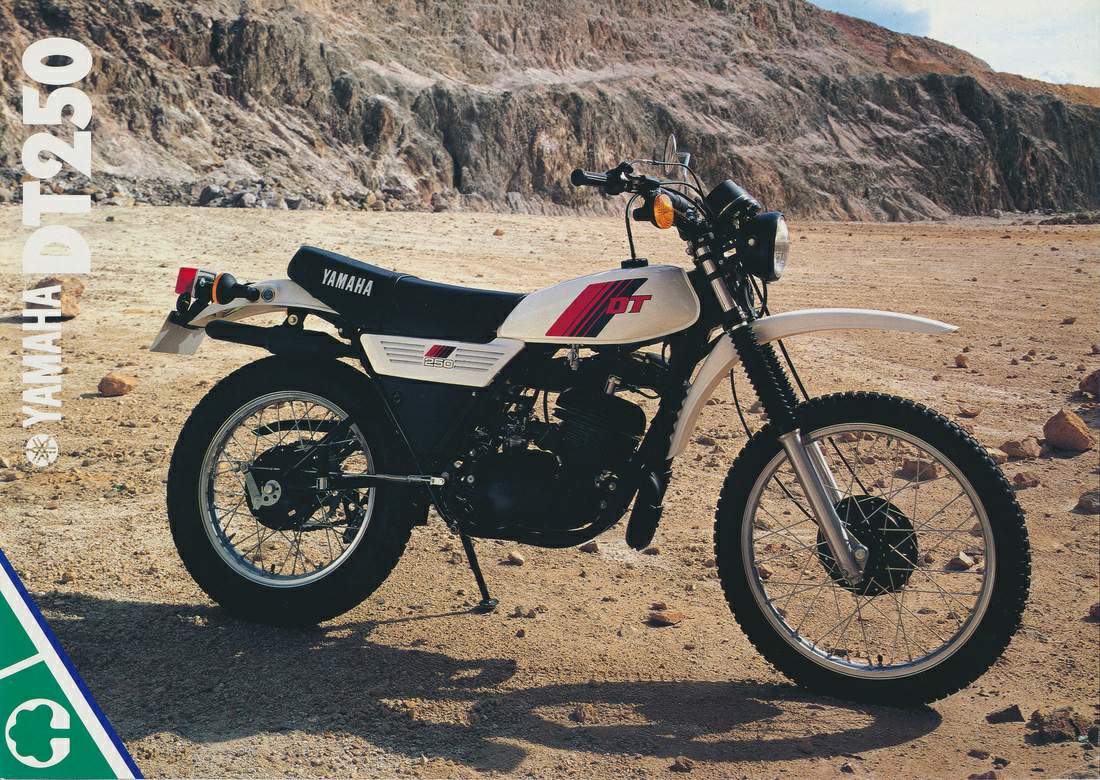
Yamaha DT 250
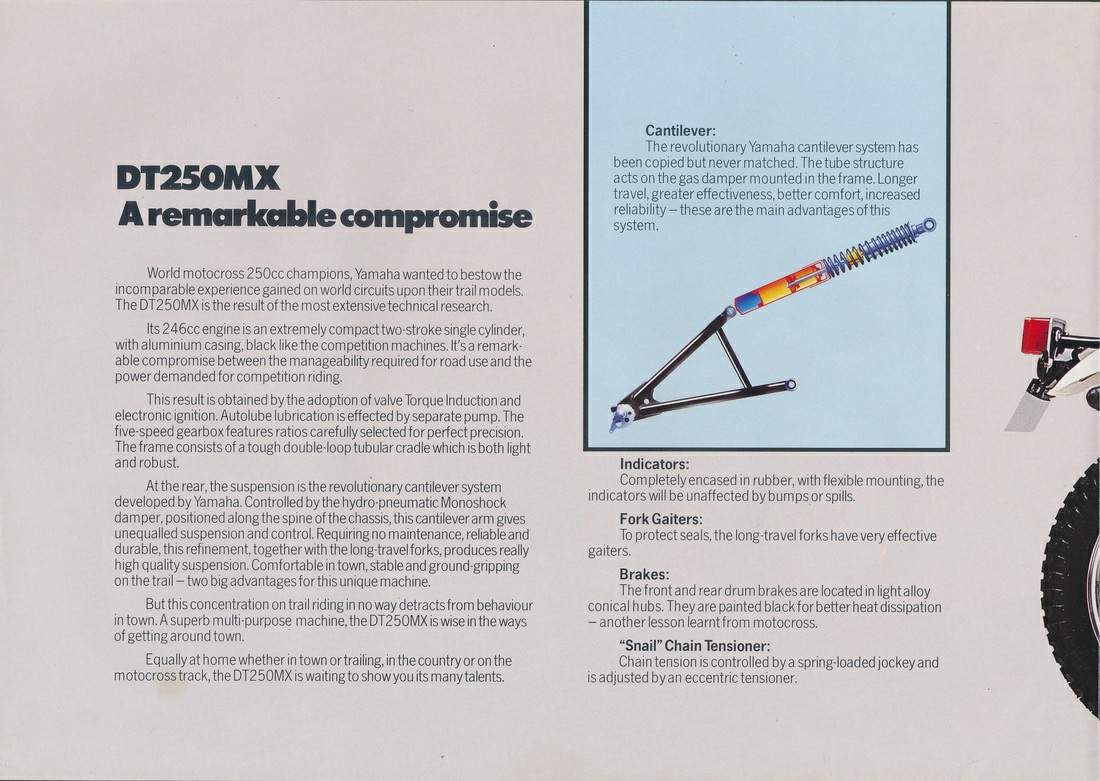
Road Test If you believe in the perfectibility of machines and in Alice in Wonderland, then you believe that someday dual-purpose bikes will be do-everything, go-anywhere motorcycles. Tire technology will progress to the point where one rubber compound will function as a knobby and as a slick. Secret plastics will be formulated and single-cylinder bikes with lights, turn signals, luggage racks and skid plates will weigh only 200 pounds. Motorcycles will also cost less and less, like pocket calculators, thanks to the wonders of high technology and mass production. Sound pretty farfetched? It certainly ought to. Knobbies don't work well on the street and never will. Plastic swing arms and frames may be coming, but they won't be cheap, and expensive components contradict the very nature of a street-trail bike. By definition, a dual-purpose bike 1) is inexpensive, 2) has reasonably good suspension for off-road riding, and 3) is reliable for long-term street service. All dual-purpose bikes have severe limitations; that's the automatic result of such axioms as "low-buck suspension units have low performance levels." So we have the dilemma of all dual-purpose bikes. They're designed for the casual motorcyclist who can justify buying a bike only if it's moderately priced. But as soon as you place a price restriction on any machine, average performance is inevitable. Though at the top of the class' price range, the DT250F is still competitively priced at $1474. Compare that with the Honda XL250S ($1425), Kawasaki's KE250 ($1349) and KL250 ($1449), and the Suzuki TS250 ($1349). As a descendant in the long line of street-trail bikes which began with the DT-1 in 1968, the DT250F benefits from a barrage of generally worthwhile refinements. Its engineering credentials (if not the materials used) are up-to-the-minute. Some noteworthy major developments which at least keep up a trendy appearance include the addition of reed-valve induction (1972), the switch to the YZ-proven monoshock rear suspension (1977), and this year's major update—the change from breaker-point ignition to a capacitor-discharge system. Slow but steady progress has been characteristic of dual-purpose bikes in general, and that means that the five available 250s all offer about the same features. For example, the Yamaha, like its other two-stroke rivals, has an automatic oil-injection system that holds 1.1 litersof oil. Oil injection eliminates the hassle of manually mixing oil with the gas and makes a quart of two-stroke oil go farther. The DT burns a quart about every 250 miles. For dirt riding, the DT has several noteworthy features, none of which are unique to Yamaha. The DT-F's front turn signals tuck in unobtrusively, and the rear ones flex on their rubber mounts during a fall. With 277mm (10.9 inches) of Ground Clearance and an aluminum skid plate, you can bounce the 250 over some pretty nasty terrain without worrying about damaging the crankcase. The folding footpegs (at their bottom outside points) are 343mm (13.5 inches) off the ground, and that height helps the rider avoid wrapping his toes around the pegs. Black dust covers seal out dirt from the fork tubes, and several other items, such as the quarter-turn throttle and through-the-frame exhaust pipe, make living with the DT easy during a trail ride. In all the really important respects—engine and suspension performance and reliability—the DT250 is either near or at the front of its class. This year the strong and reliable 246cc engine has had a technological chin-lift to make it attractive to the EPA. Yamaha's Research and Development Department has revived the DT's exhaust plumbing so that the bike can meet current EPA emissions standards. Most non-racing two-strokes are in danger of being choked and finally snuffed by emission regulations. Yamaha isn't standing for it. The 1979 RD400 street bike has been kept within the emissions limits and made faster all in one swoop. The DT's new emissions-control unit, however, isn't as elaborate or sophisticated as the RD's; the DT's Pulsating Air System cleans its exhaust but also detracts a little from the engine's performance.
In the Pulsating Air System, a small air filter and airbox are mounted on the bottom of the frame's backbone above the engine. The airbox has a one-way reed-valve assembly leading into a hose, which is connected with a fitting on the cylinder about an inch above the exhaust port. A drilled passage in the cylinder completes this airway, which terminates inside the exhaust port. The exhaust gases leaving the cylinder create a vacuum that naturally draws fresh air through the reed assembly down the hose and into the exhaust port where it mixes with the escaping exhaust. Fresh air (which contains about 18 per cent oxygen) combines with a lot of the unburned hydrocarbons—the unwanted elements in exhaust emissions. Oxidation of some of the hydrocarbons produces non-polluting carbon dioxide and water (vapor). This sort of system is not new, but it works. Among others, the Chevrolet Cosworth Vega and the new GM front-wheel drive cars use similar antipollution devices. Only a few other changes have been made to the F-model's engine. The duration that the cylinder's transfer ports are open has been reduced a few degrees of crank rotation to give the DT a little more mid-range punch. The 250 needs abundant mid-rpm power because other significant changes have taken place in the intake tract. A few years ago engineers discovered that a two-stroke's intake air-howl makes an incredible amount of noise. Since the Db(A) restrictions have also become more severe, Yamaha now quiets its street-trail bikes by limiting the flow of air into the intake tract. But that limit prevents the DT machines from revving above a moderately high redline. With the 250, that's 7000 rpm—a modest rpm ceiling for a small two-stroke. Since the DT-F has a built-in rev-limiter, Yamaha has chosen to boost the 250's mid-range and give up on high-rpm power. No other changes have been made to the powerplant. The aluminum cylinder has a pressed-in iron liner, and the two-ring piston rides on needle bearings. On the trail, the Yamaha keeps on chugging long after the tires have lost traction. There's not much power available under 4000 rpm, but if the rider keeps the DT in its 4000-to-7000-rpm powerband, the Yamaha can run hard on ordinary forest trails. Around town, the DT accelerates quickly, so the rider has no problem keeping out of the way of aggressive auto drivers. On the freeway, the 250 turns 5100 rpm at an indicated 55 mph. In that moderately high rpm range the engine does not actually strain, but there is enough high-frequency buzzing and general vibration to make extended rides (over 20 minutes) uncomfortable. Both the induction and exhaust sys. terns work pretty well. An oiled foam air cleaner is tucked away behind the right side cover; it's easily accessible after the removal of the locking panel and filter cover. An eight-petal reed valve passes fuel to the cylinder via a 28mm Mikuni carburetor. From pilot to main jet, the 1979 carb has been leaned out to help the 250 meet emissions standards. Throttle response is generally clean, and starting is rarely a hassle. The up-and-through exhaust pipe has an effective silencer and the Forestry Service-approved spark arrestor allows legal rides on public lands. A transmission with nearly ideal gear ratios helps out the DT immensely. Though the 250 doesn't pull hard in its high-rpm range, the widely spaced ratios take advantage of the engine's mid-range power. First (2.538:1) is low enough for the rider to handle tight switchbacks without slipping the clutch. Second, third and fourth gears are the cogs the rider uses most often. For dirt and street riding, the middle gears pull the DT along between 10 and 45 mph, and that's the optimum range for sane trail riding and legal in-town cruising. Fifth gear is an overdrive, and it's a big numerical jump from fourth gear. On the street there's little danger of the 250 falling off its powerband during the change from fourth to fifth, but to make that change-up in the dirt the engine must be kept pulling over 5500 rpm. If it's ever necessary to slip the clutch, you'll find that a couple of things happen: the clutch fades quickly, losing any sort of precise feel at the lever; later it returns to normal during a short cooling period. In typical use, the 13-plate clutch jerks a little off the line, but it's only noticeable on the street where there's maximum rear-wheel traction to underscore the grabbiness. There have been a couple of important DT chassis refinements. Following the pattern established by the YZ and IT Yamahas, the DT-F's steering-head angle has been sharply reduced from last year's figure, down to 28.5 degrees from 30.5. The decreased rake shortens the 250 slightly, producing a 1420mm (55.9-inch) wheelbase, and reduces the fork's trail to 120mm (4.7 inches). Both on the trail and on the street, the mild-steel frame's new geometry makes the DT handle much better than previous Yamaha dual-purpose bikes. Tight forest trails demand steering precision, and the Yamaha meets that demand. With very little extra effort, the rider can guide the DT exactly where he wants it. Only one drawback—a tendency to wig-wag the front end at high speeds in sandy areas—accompanies the steep head angle. But for the 250, that's only a theoretical liability: 99 per cent of the time, the stock Dunlop trials tires slow the rider long before any high-speed instability becomes apparent. During the standard run to the supermarket, nearly always including a bout with stop-and-go traffic, the 250 handles nimbly, steers quickly and, most importantly, safely. All three of the available two-stroke dual-purpose bikes weigh within three pounds of one another. Full of gas, the DT weighs 290 pounds; the Suzuki TS250 and the Kawasaki KE250 weigh 288 and 287 pounds, respectively. Surprisingly, the four-stroke Honda XL250S weighs only 278; Kawasaki's KL250 upholds four-stroke tradition by being the heaviest-298 pounds. Mass alone is not the whole story. Weight bias influences handling also, and it's in this category that the DT deserves credit. The Yamaha feels as light as the Honda XL. Though 290 pounds is terribly heavy for a dirt bike, at least its weight is distributed evenly. The 250 doesn't have the problems normally associated with a heavy bike: there's no chassis flex apparent over rough ground, no overt tendency to side hop over whoops and no objectionable top-heaviness. On paper, the DT's suspension units appear respectable. The fork has 195mm (7.68 inches) of travel. Longer fork legs are new for this year; they place the axle in the forward-mounted position and require more fork oil than the E-model did. Though the DT's rear suspension unit shares the "monoshock" name with its IT/YZ second cousins, there's actually a considerable difference between the shock absorbers that the DTs, ITs and YZs use. For instance, the DT's rear shock (with 3.5 inches of travel) has a shorter stroke than the YZ250's, and it doesn't have a thermostatically controlled damping adjustment valve or cooling fins on the mono body. With 152mm (6.0 inches) of rear-wheel travel, the DT is down not only on the superlative YZs but also on the Honda XL250 with its 7.0 inches of travel. When called into use, the suspension units don't let you down, but neither do they dazzle you. Spring rates are on the heavy side and are suitable for a 170-pound rider with boots and helmet on. The stiff suspension provides a precise ride on the street and allows the rider to feel the road, but in the dirt the stiff springing can't make up for the limited wheel travel front and rear, which results in frequent bottoming over really nasty terrain. During trail rides it also becomes apparent that the fork's damping action is just average: on the compression stroke the front end's response to small bumps is not smooth enough to provide a really comfortable ride. Several miscellaneous chassis features deserve note. By far the most creditable among these is the front brake. Powerful and fade-free, the brake won't lock the wheel unless the rider really wants to. The non-floating rear brake—with its torque tab attaching to the swing arm directly off the backing plate—often chatters during hard braking. There's no good reason for the Yamaha to have a hard and narrow seat, but it does. Neither is there good excuse for its smallish 2.2-gallon gas tank. Even when the DT is clicking off 40 miles per gallon, which it regularly does, the bike goes on reserve after 80 miles. That's fine for a nice trail ride, but if you run many errands around town you'll become a regular in the gas station lines. A 35-watt headlight is powered by alternating current from the charging /lighting coil. This means your headlight is on only when the engine is running. That light—or its 35-watt high beam—provides an adequate swath of brightness for nighttime street runs or low-speed midnight dirt rides. From the same charging/lighting coil, alternating current goes to a rectifier where it's converted to direct current to recharge the six-volt, six-ampere-hour battery, which powers the brake light. There's a lot to be said for dual-purpose bikes as a class. In theory, they're practical, inexpensive, versatile and fun. Meeting emissions requirements, of course, is the big problem the two-stroke dual-purpose bikes face in the real world. For the moment, the performance of their four-stroke counterparts has not been so severely compromised by federal standards. There's no doubt the noise and emission limitations have taken their toll on the DT-F. No matter how artful and creative Yamaha has been in its DT-engineering and the company has been—the rev limit prevents the 250 from producing a respectable amount of horsepower, and lack of high-rpm power is the bike's most serious shortcoming. Working within another restriction cost—the DT is ipso facto heavy: materials that are both light and strong are inevitably expensive whether they are used for frames or emission valves. Without the weight advantage that a two-stroke traditionally has over a four-stroke, there's no compelling reason to opt for the Yamaha unless you're dead set on a two-stroke or have some other important consideration, such as dealer service. The DT-F does suggest—loud and clear—that Yamaha has the technical resources to keep their two-strokes competitive in the dual-purpose arena. Even so, there's still the nagging problem of costs. But should high-tech two-strokes prove too expensive for the dual-purpose market of the future, Yamaha always has a four-stroke option to exercise.
|
|
|
Any corrections or more information on these motorcycles will be kindly appreciated. |