|
|
|
|
Classic Bikes
Custom Bikes
Individual
Racing Bikes AJP
AJS
Aprilia
Ariel
Avinton / Wakan
Bajaj
Benelli
Beta
Bimota
BMW
Brough Superior
BRP Cam-Am
BSA
Buell / EBR
Bullit
Bultaco
Cagiva
Campagna
CCM
CF Moto
Combat Motors
Derbi
Deus
Ducati
Excelsior
Fantic
GASGAS
Ghezzi Brian
Gilera
GIMA
Harley Davidson
Hero
Highland
Honda
Horex
Husaberg
Husqvarna
Hyosung
Indian
Jawa
Kawasaki
KTM
KYMCO
Laverda
Lazareth
Magni
Maico
Mash
Matchless
Mondial
Moto Guzzi
Moto Morini
MV Agusta
MZ / MuZ
NCR
Norton
NSU
Paton
Peugeot
Piaggio
Revival Cycles
Roland Sands
Royal Enfield
Sachs
Sherco
Sunbeam
Suzuki
SWM
SYM
Triumph
TVS
Ural
Velocette
Vespa
Victory
Vincent
VOR
Voxan
Vyrus
Walt Siegl
Walz
Wrenchmonkees
Wunderlich
XTR / Radical
Yamaha
Zero
Video
Technical
Manufacturer List Contact
|
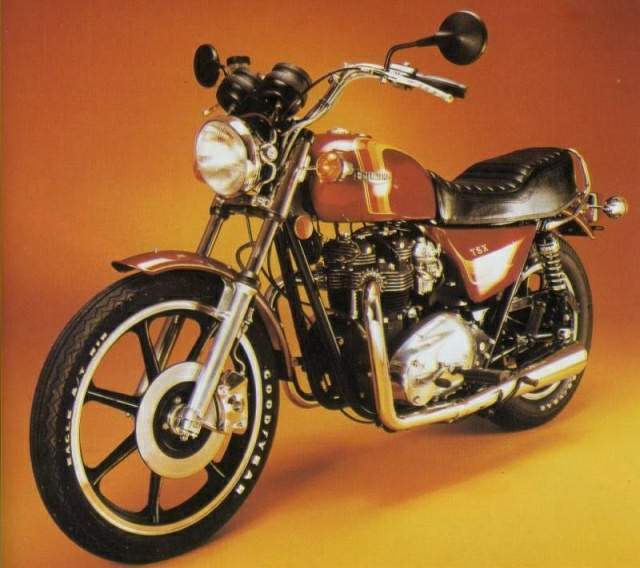
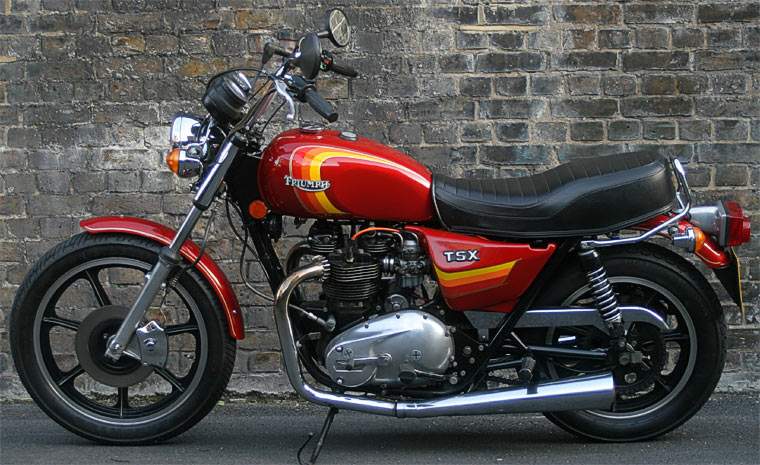
Triumph TSX 750
By 1983, Triumph was once again struggling to survive. Public opinion was being led by the nose by openly hostile media who remained vitriolic about the radical decline of the motorcycle sector that had once buoyed the British economy and the British sense of national pride. Worse still, it was Japanese and German companies who had, in many ways, out-competed the British both on the racetrack and on the saleroom floor. However, the truth was that the Meriden factory was still populated with dedicated men and women who were producing high-quality machines. Admittedly, upper management had, by this stage, completely lost the plot and was desperately looking for an escape. It came in the form of a property developer who had no personal interest in motorcycles but, rather, liked the site on which the famous Meriden factory was located. In the midst of all this, the factory workers produced 371 TSX 750s: 100 for the US, 200 for the UK and 71 for the rest of the world. Approximately one-third of that total number of bikes were finished in the black which makes this mint example a very exceptional machine indeed. Essentially a restyled Triumph Bonneville, the TSX was distinguished by its lowered chassis and 16-inch-diameter rear wheel, with the engine offset in the frame to accommodate this. Other changes unique to the model included a stepped seat, black-coated engine casings and engine with polished fins, restyled passenger grab rail, shortened front and rear painted mudguards (the latter having a black plastic mount for the vehicle number plate), mirror-polished alloy, short megaphone mufflers, Morris alloy wheels (then made by Performance Machine) and ‘retro’ graphics. Paioli rear suspension units, with plastic top shrouds, were sited at a more acute angle further back on the swinging arm to lower the seat height. A Brembo rear brake was fitted in place of the usual Automotive Products (AP) Lockheed item, which remained at the front. All in all, it was a well-supplied piece of kit for the day and one that now captures a unique and defiant period of Triumph history.
|
|
|
Any corrections or more information on these motorcycles will be kindly appreciated. |