|
|
|
|
Classic Bikes
Custom Bikes
Individual
Racing Bikes AJP
AJS
Aprilia
Ariel
Avinton / Wakan
Bajaj
Benelli
Beta
Bimota
BMW
Brough Superior
BRP Cam-Am
BSA
Buell / EBR
Bultaco
Cagiva
Campagna
CCM
CF Moto
Combat Motors
Derbi
Deus
Ducati
Excelsior
GASGAS
Ghezzi Brian
Gilera
GIMA
Harley Davidson
Hero
Highland
Honda
Horex
Husaberg
Husqvarna
Hyosung
Indian
Jawa
Kawasaki
KTM
KYMCO
Laverda
Lazareth
Magni
Maico
Mash
Matchless
Mondial
Moto Guzzi
Moto Morini
MV Agusta
MZ / MuZ
NCR
Norton
NSU
Paton
Peugeot
Piaggio
Revival Cycles
Roland Sands
Royal Enfield
Sachs
Sherco
Sunbeam
Suzuki
SWM
SYM
Triumph
TVS
Ural
Velocette
Vespa
Victory
Vincent
VOR
Voxan
Vyrus
Walt Siegl
Walz
Wrenchmonkees
Wunderlich
XTR / Radical
Yamaha
Zero
Video
Technical
Complete Manufacturer List
|
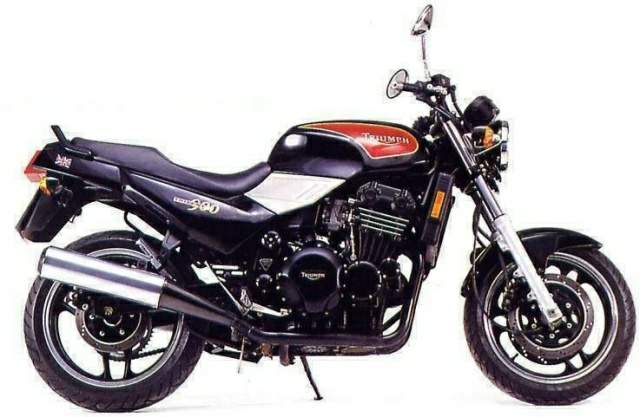
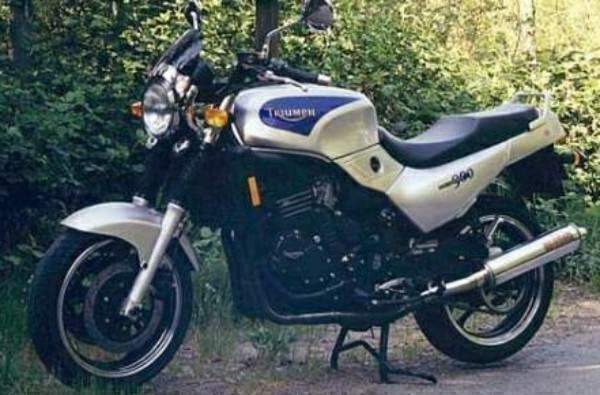
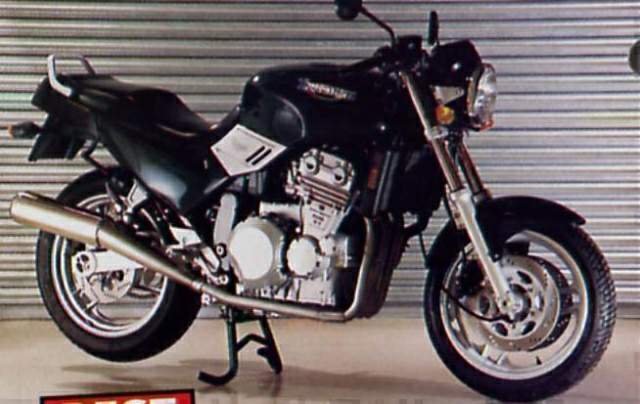
Triumph Trident 900
Make no mistake, though, this bike is much better than either of the latter. When Triumph designed the Trident, they looked at the classic design of that era and at the materials available today, and came up with a bike that is actually better than the sum of its parts. Classic design dictated an upright seating position, exposed motor, and a large round headlight out in the open, not wrapped in plastic bodywork. Modern technology allowed wide wheels and radial tires, excellent brake and suspension components, and a reliable water-cooled motor. Together, they make for a surprisingly competent do-it-all motorcycle. "The heart of the new Triumph is the same basic mill as the rest of the 900s in Triumph's lineup save for the Thunderbird which gets different cases and pistons." Dual overhead cams activate four shim-over-bucket valves per cylinder driven by a right-side cam chain. A straight-cut primary gear delivers the power to the multi-plate hydraulically actuated wet clutch through to a six-speed transmission chain final drive. Intake is through a bank of three Mikuni 36mm semi-flat slide constant-velocity carburetors, and the charge is sucked into a 10.6:1 compression 885cc motor and lit by a digitally controlled electronic ignition. Exhaust gasses are routed through a three-into-two exhaust pipe where the middle pipe splits near the cylinder head and diverts its contents to the outer two pipes just under the oil pan. Maximum horsepower is a claimed 98 stallions at 9,000 rpm. The engine is a stressed member of the high-tensile steel frame, eliminating down-tubes and giving the motor a clean, uncluttered look. Cooling is handled by a large radiator tucked in tight beneath the steering head. Out from behind the front wheel, the radiator receives copious amounts of air, keeping engine temperatures cool under even the most demanding conditions. Multiple back-to-back runs at the drag strip -- where we got a best time of 11.84 at 113.84 mph -- couldn't get the temp gauge to register more than half the gauge's range. Don't expect to see the temperature warning light very often. The Trident and the Thunderbird are Triumph's only models to come without an adjustable front suspension. The Trident's 43mm legs are quite rigid, and while the spring rate and damping are perfect for highway cruising, they are too soft and quick, respectively, for sporting use. Also, riders significantly heavier than the staff average of 160lbs may want heavier springs and oil. The rear shock is adjustable for spring preload and rebound damping. Adjusting the shock on the Trident is easier than on any other stock bike we've tested: Lift the seat and the hydraulic preload reservoir adjusting nut is immediately accessible. Turn the 10mm nut and the ball bearing inside rises or lowers indicating the amount of spring preload. Changing the damping is even easier. Just reach down with your left hand and turn the four-position dial. The third position is adequate for even hard solo sport-thrashing, the fourth and stiffest setting should only be needed when riding two-up. The rear swingarm is a box section aluminum unit that incorporates an eccentric chain adjuster. Thus, adjusting the chain is almost as easy as the shock -- simply loosen the pinch bolts on either end of the swingarm and pull back the wheel by hand till the chain has the proper tension, and retorque the pinch bolts. The combination of stout fork legs, a rigid frame and swingarm, and a good rear shock add up to a very stable, controlled ride that works well for freeway cruising. Crank up the shock and backroad scratching is surprisingly easy. The wide bars offer plenty of leverage for hustling the claimed 466 pound (212kg) dry weight machine through the twisties, and the Pirelli radials offer good traction and feedback. Wheels are 3.5 x 17" front, and 4.5 x 18" rear fitted with 120/70 ZR17 and 160/60 ZR18 tires. Calipers are two piston units all around. Nice looking and comfortable brake and clutch levers offer four position adjustments, though even small hands wanted the levers to be at maximum distance from the bars. The bars themselves are mounted on top of the upper clamp around the fork legs leaving the fork caps exposed for easy maintenance. The clip-on style bars angle back nicely but would feel better with more drop. Mirrors are effective and positioned well, without much vibration-related distortion; helped, no doubt, by the smoothness of the 120 degree three cylinder motor. Complaints about the bike were limited to the lack of front running lights, the wimpy front suspension and the inconvenience of having to remove the seat to access the helmet lock. Coming in at $2000 under the next highest priced model, the Thunderbird, the $7995 Trident is positioned to be the foundation of Triumph's new world market. Only time will tell if it is a successful gamble, but we've got our money in Triumph's corner. Impressions:
I thought this bike was going to be a three cylinder version of a 1985 Ninja 900, but I wasn't even close. This bike has impressive running gear -- 43mm forks and a big aluminum swingarm -- and a solid chassis to boot. The motor is a sweet sounding triple with enough power to ride two up and not feel overworked. Passenger accommodations are roomy and with the addition of a set of Triumph bags, the Trident could easily be a weekend tourer. It also makes a great canyon scratcher. I guess what this is leading to is that I like this bike a lot, and would trade in my old GPz550 for one in a heart-beat. Plus it's cool when people come up to you and tell you all about that old Triumph they had way back when, and how they thought Triumphs were gone forever. Based on the solid performance of this bike, I think Triumph will be around for years to come, and give the Trident four (out of a possible five) stars. 2. Brent Plummer, Editor The Trident did nothing for me -- all aspects of the front suspension are mushy and in need of work, while the engine and rear shock are, well, uninspiring. Sure, a set of Progressive Suspension fork springs, some heavy fork oil and a couple of afternoons to dial it in would fix the droopy front end (who has the time?) and I guess the humane riding position would make me grow to love the Trident, but who want's to spend eight grand on something they have to rationalize to like? Not me. And I don't think I'd ever get used to the peaky Trident engine, which lacked torque. No, if I were buying a standard, I'd either spent five grand on a red Honda CB750 (hydralic lifters means no maintenance!) buy a matching Aerostich suit and some saddle bags, then pocket the rest of the cash -- or I'd scrounge up another couple of grand and get a BMW R1100R. Actually, now that I've searched our database for bikes under 8,000 dollars, I see that Harley's 1200 Sportster -- with that torque monster Evolution engine -- has a suggested retail of 7,300. So if I had the cash and could find a dealer that doesn't price gouge, I'd get me a HOG
|
|
|
Any corrections or more information on these motorcycles will be kindly appreciated. |