A lot of industrial history has been made since
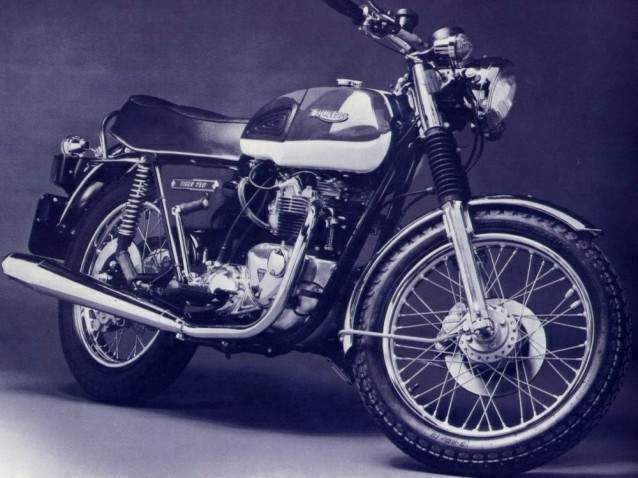
the then-new 744 cc Triumph Tiger was tested back in February of 1973. At that
time it was being built at Meriden under the BSA-Triumph group banner: but
that banner was already in tatters, and later in the year came the shotgun
marriage with Norton Villiers.
Rightly or wrongly, the new management declared
Meriden would be closed and sold, that Triumph twins were 'outdated' and would
be dropped in favour of the more modern Nortons.
The outcome was the famous sit-in, and the
ultimate formation of a workers' co-operative to purchase and re-open the
Meriden factory. The Bonneville 750 came back into production and, now, Prince
Charming has also kissed its single-carburettor cousin, the TR7RV Tiger 750.
Substantially (and understandably), the model
is as it was when put to sleep in 1973, with the only major changes a
hydraulically-operated disc brake instead of drum-type and, of course, the
transfer of the gear pedal to the left side as required by transatlantic
regulations. There are, too, later-pattern silencers, and a new and attractive
fuel-tank colour scheme of deep bottle-green and ivory.
Rather oddly, in the interim, the overall
weight (as checked on the MIRA weighbridge) appears to have crept up by around
30 lb, and not even the makers can suggest a reason. Even so, at 448 lb the
Tiger is still just about the lightest seven-fifty around, which is why it can
give a very noble account of itself, notwithstanding the fact that its power
output of 49 bhp at 6,200 rpm is outgunned by more exotic rivals.
It is unsophisticated - but relaxing with it.
At 70 mph, the machine is merely ambling along, the motor turning over lazily
on little more than a smidgeon of throttle. This gait can be kept up for mile
after mile, hour after hour, with the minimum of effort by rider or engine.
During the time the bike was in our hands, it
came in for a variety of uses, including motorway dashes, a trip to the
Victory Trial in mid-Wales, a two-up tour, and general town and country
utility work. From all of this it emerged with a 46 mpg fuel consumption -
rather disappointing, and some 12 mpg down on the corresponding 1973 model.
No logical explanation could be found, but
possibly the pads of the disc brakes at front and rear rub the surface lightly
when in the 'ofF position and contribute to this increase in consumption.
The use of front and rear disc brakes can be
regarded as an advance when applied to racing bikes - but they seem hardly
necessary on this type of roadster, for they perform no better than good
twin-leading-shoe drum brakes. The TR7RV's stopping figure from 30 mph was a
quite commendable 30 ft 4 in. However, the same model stopped in 30 ft when
fitted with a rear drum brake.
On the road, a two-finger stroke of the lever
was enough to cut the speed, and at the same time the disc gave a slightly
more positive feel to the rear brake pedal. But it is all a matter of what one
gets used to, and there will still be a strong body of unconvinced sceptics.
So how did the discs perform in rain? There was
very little rain during the period of the test, but on the one-and-only
rain-showery day (and it would be the one we picked to do the touring story!)
they caused no worry.
The Triumph is really comfortable. The seat
height of 32 inches might seem a little high, but is compensated for by giving
the seat a narrow nose, so the rider can reach the ground without strain.
However, the seat could do with being a couple of inches longer. If the rear
face of the seat were to be vertical, instead of sloping forward at top, it
would make all the difference when carrying a passenger.
Ideally, a footrest position about an inch or
two more to the rear would have been better but this, of course, is dictated
by the position of the gear pedal. The pedal is slightly too far in front of
the rest, and upward changes were best made by moving the foot forward until
the heel was pivoting on the footrest; it came as second nature after a while.
It is an excellent gearchange, though, slick and positive.
One thing the Tiger can provide is a big
helping of power from way low down, and that shows up in the acceleration
figures; around 14 sec for a standing quarter-mile from a 'cooking'
seven-fifty cannot be bad!
For the standing quarter-mile, we gave it the
whole dragster treatment - lean-forward stance, smoky, snaking getaway.
Wheelies, even. However, we were not impressed with the almost knobbly tread
of the standard K70 rear tyre and reckon we could have got better figures with
the K70 HS version fitted to the previous TR7RV or a TT100.
The use of a K70 studded tyre on the front was
difficult to understand, too, and with 1,800 miles on the speedometer, the
tread showed distinct signs of ratcheting.
However, that did not seem to affect the
handling, and the extent to which the model could be laid over in complete
confidence was evidenced by the flat ground away on the centre-stand extension
pedal.
At low speed, the steering was rather heavy on
first acquaintance, growing lighter as speed rose, but the novelty of this
soon wore off and, thereafter, it was accepted as normal.
There is some vibration present, at some
sectors of the range, but it would not be a true-born Triumph if there were
not. We have to confess that the Tiger was a whole lot smoother at 70 mph than
some Triumphs we have ridden.
On the other hand, after putting it full-whack
through the timing traps for a 113 mph mean you realise there are more
sophisticated models around. Take it above the 6,000 rpm mark, and you get the
distinct impression that there is a lot of machinery clanking around.
All right, so there may be. But on most
highways, the number of chances of whacking a bike up to 113 mph can be
counted on the fingers on a boxing glove. In more conventional riding
conditions, the Tiger 750 does very well.
This is one of ye olde-fashioned machines which
does not have the nicety, or the complexities, of an electric starter. The
very long-shanked kick starter is more than adequate to spin the crankshaft
over with little muscular effort.
For once, here was a Triumph which did not call
for the morning ritual of freeing the clutch plates, and although it did
appreciate closing of the air lever for the first few seconds, that could be
opened again almost immediately.
The air lever is mounted, somewhat
inconveniently, on the front face of the air cleaner box and it had the
annoying habit of partly closing itself with the machine in use. Something
else the factory might consider relocating is the re-setting knob of the trip
odometer drum. This is shrouded by the headlamp shell, and proved nigh-on
impossible to operate without the expenditure of a large number of cuss-words.
On the credit side, there was nary a drip of
oil on the garage floor in nearly three weeks of use; and the centre stand was
one of the best we have come across, requiring just a flick of the toe to
hoist the model at almost the centre-point of balance, making access to either
wheel a simple matter.
Another good point was the speedo-meter-when
checked against M IRA's electronic timing gear it proved to be spot-on
accurate, all the way up to the top of the scale. So, ninety on the clock
really was ninety, with nothing added for rider flattery.
A fast, night-time run through the twisty lanes
of the upper Teme Valley showed the effectiveness of the 45-watt main headlamp
filament and, on switching to the motorway, a 70 mph after-dark cruising speed
was held with ease.
The green 'main beam' indicator lamp in the top
face of the headlamp shell was too bright and distracting, which sorely tempts
you to cover up this new-fangled nonsense with a strip of sticking plaster.
And that, really, is about all that there is to
say. The TR7RV Tiger 750 is a Triumph in the traditional style - lively,
gutsy, tractable, and with the handling bred of a whole basket-full of
production race victories.
If, performance-wise, it works out at just
about on a par with the Bonnie, then that's the Bonnie's hard luck. Why have
two carbs, when you can do it all with one?