|
|

|
|
|
|
Classic Bikes
Custom Bikes
Individual
Racing Bikes AJP
AJS
Aprilia
Ariel
Avinton / Wakan
Bajaj
Benelli
Beta
Bimota
BMW
Brough Superior
BRP Cam-Am
BSA
Buell / EBR
Bultaco
Cagiva
Campagna
CCM
CF Moto
Combat Motors
Derbi
Deus
Ducati
Excelsior
GASGAS
Ghezzi Brian
Gilera
GIMA
Harley Davidson
Hero
Highland
Honda
Horex
Husaberg
Husqvarna
Hyosung
Indian
Jawa
Kawasaki
KTM
KYMCO
Laverda
Lazareth
Magni
Maico
Mash
Matchless
Mondial
Moto Guzzi
Moto Morini
MV Agusta
MZ / MuZ
NCR
Norton
NSU
Paton
Peugeot
Piaggio
Revival Cycles
Roland Sands
Royal Enfield
Sachs
Sherco
Sunbeam
Suzuki
SWM
SYM
Triumph
TVS
Ural
Velocette
Vespa
Victory
Vincent
VOR
Voxan
Vyrus
Walt Siegl
Walz
Wrenchmonkees
Wunderlich
XTR / Radical
Yamaha
Zero
Video
Technical
Complete Manufacturer List
|
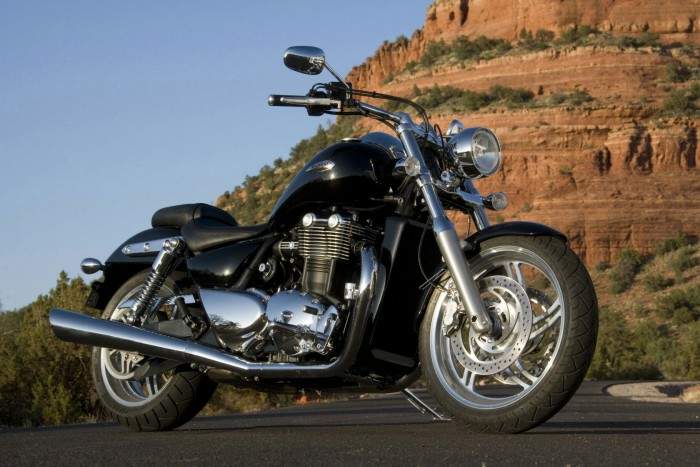
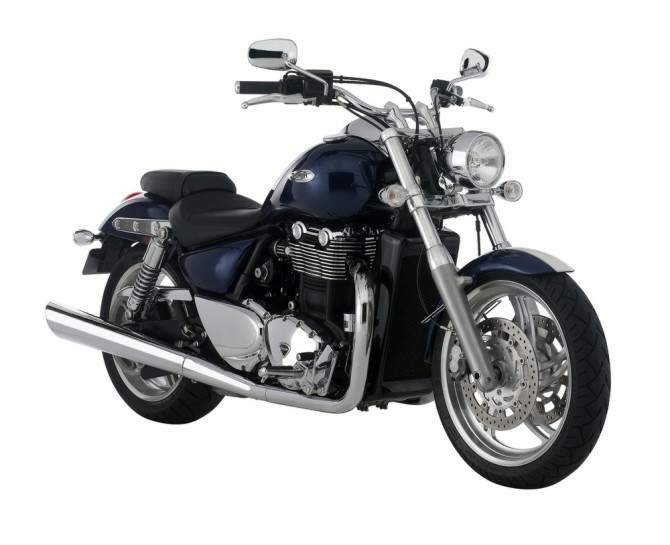
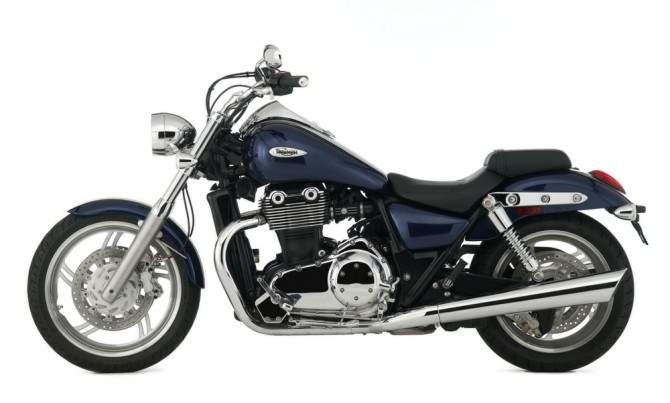
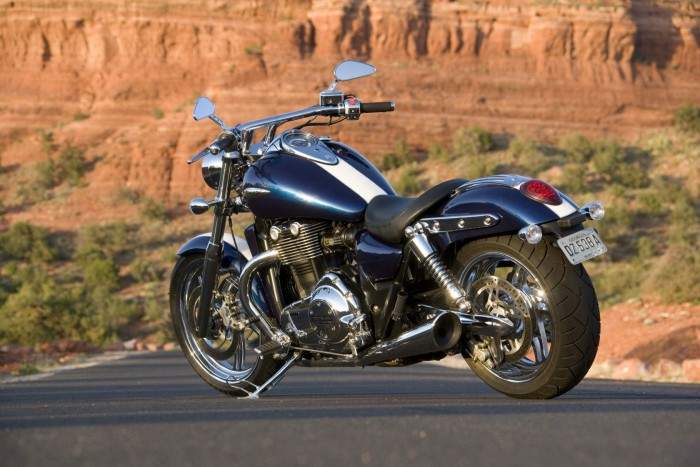
Triumph Thunderbird 1600
The Thunderbird model has been very important to the history of Triumph. We have to go back to 1950 to find the original Thunderbird 6T, a motorcycle specifically designed for the American market. In fact, its name is derived from a native American mythical bird of enormous size with supernatural powers and a taste for human flesh. Just two years later in 1952, the Thunderbird became famous around the world largely due to it being Marlon Brando's motorcycle in the movie "The Wild One."
In 1981, the Thunderbird name was placed on a 650cc roadster and reappeared in 1994 on a bike with a 900cc three-cylinder engine. And now that the English brand is going through one of the best times in its history thanks to its growth in the global marketplace, a mythical name from the past is reappearing; the bird of thunder is back and rumbling from two cylinders.
Triumph is fortunate that its rich history allows it to design bikes without looking to outside influences, a strategy that has allowed the brand to enjoy great successes. So when the company announced that it would make a large displacement, custom-style bike to fill the gap that existed in its line between the 865cc America and Speedmaster, and the huge 2.3-liter Rocket III, we knew that its engine wouldn't be a Harley-style, V-twin engine.
So we're not surprised that the new Thunderbird is powered by a new water-cooled, parallel-twin engine that displaces 1597cc, with a DOHC 8-valve head. The engine makes 85 horsepower and 14,90 Kgm (108 ft/lbs) at 2750 rpm. For those who want more power, Triumph offers a kit that adds 12 horsepower and more torque.
Another sensation we notice at the moment we turn the ignition key, located on the right side of the bike, is one of refinement. And one should not confuse refinement or smoothness with a lack of character, as any engine that has pistons that displace roughly 800cc each is brimming with character. The smoothness of the engine is achieved by placing two balance shafts in front and behind the cylinders, and by the use of an advanced fuel injection system by Keihin that has an oxygen sensor for each cylinder (which allows for constant optimization of the fuel mixture).
Aside from the all-new, T-16 engine, the Thunderbird also gets a new six-speed
gearbox . . . a gearbox that has a tall "overdrive" sixth gear for long,
high-speed cruising.
Passengers on the Thunderbird will find a very small seat with only a strap to hold onto. But if long journeys are your thing, you should know that Triumph has a large catalog of accessories to increase the cruising appeal of its bikes. What hasn't been so successful is the low placement of the speedometer on the fuel tank. What bothers us most is the confusing array of km/h and mph markings that demands us to lower our eyesight for a closer look, something we now have to do often thanks to the increasing threat of radar traps (overseas). In contrast, important and practical information is pleasingly displayed on the small LCD screen; odometer, trip meter, a clock, fuel level, and miles to empty. Accessing this information is as easy as pushing a button next to the screen. One design principle we respect in the Thunderbird is functionality. The
Thunderbird eschews things like wire wheels, a single front disc, and a long,
exaggerated front fork found on many "cruisers". The braking system is a real
standout in the cruiser segment. In front, two large floating rotors measure
310mm each and are clamped by Nissin brand four-piston calipers. In back,
another 310mm rotor is mated to a two-piston Brembo caliper. The brakes are more
than up to hauling down the 308-kilogram (claimed dry weight equivalent to 678
lbs.) bike without any trouble. For those who need more, a version is available
with ABS. Having tested the Thunderbird in the city, on secondary roads, and on the highway our general impression is very positive in all of these environments; our only gripe is that we didn't have more time with the bike. To make sure that doesn't happen to you, you should know that putting a Thunderbird in your garage will require purchasing the base machine at a U.S. MSRP of $12,499 and the ABS model at $13,799. Highlights The sound emitted by the two-cylinder engine and
its long exhaust pipes is successful in bringing together the rider and the
ride.
|
|
|
Any corrections or more information on these motorcycles will be kindly appreciated. |