|
|

|
|
|
|
Classic Bikes
Custom Bikes
Individual
Racing Bikes AJP
AJS
Aprilia
Ariel
Avinton / Wakan
Bajaj
Benelli
Beta
Bimota
BMW
Brough Superior
BRP Cam-Am
BSA
Buell / EBR
Bultaco
Cagiva
Campagna
CCM
CF Moto
Combat Motors
Derbi
Deus
Ducati
Excelsior
GASGAS
Ghezzi Brian
Gilera
GIMA
Harley Davidson
Hero
Highland
Honda
Horex
Husaberg
Husqvarna
Hyosung
Indian
Jawa
Kawasaki
KTM
KYMCO
Laverda
Lazareth
Magni
Maico
Mash
Matchless
Mondial
Moto Guzzi
Moto Morini
MV Agusta
MZ / MuZ
NCR
Norton
NSU
Paton
Peugeot
Piaggio
Revival Cycles
Roland Sands
Royal Enfield
Sachs
Sherco
Sunbeam
Suzuki
SWM
SYM
Triumph
TVS
Ural
Velocette
Vespa
Victory
Vincent
VOR
Voxan
Vyrus
Walt Siegl
Walz
Wrenchmonkees
Wunderlich
XTR / Radical
Yamaha
Zero
Video
Technical
Complete Manufacturer List
|
Triumph Sprint ST
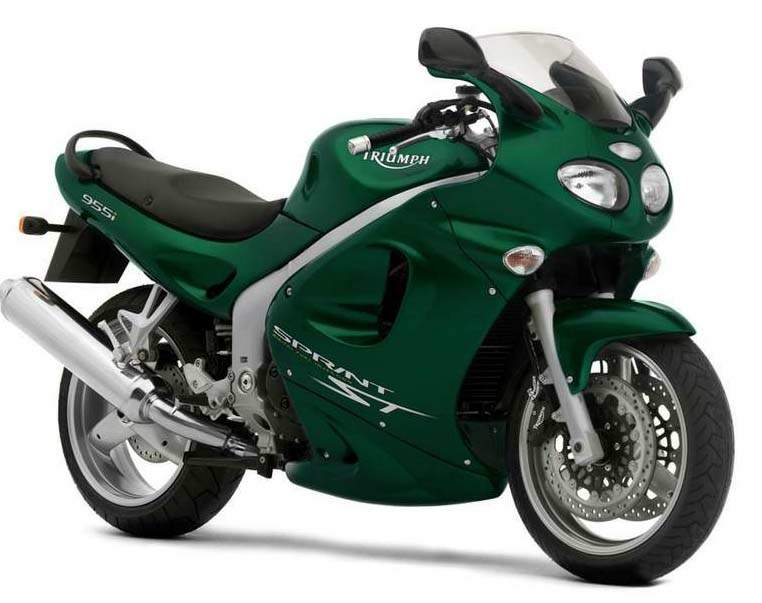
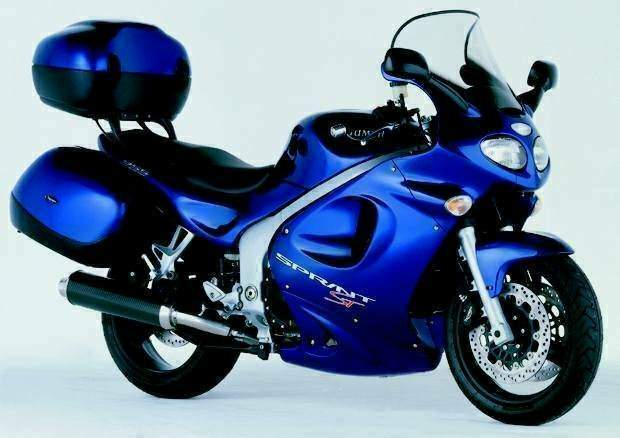
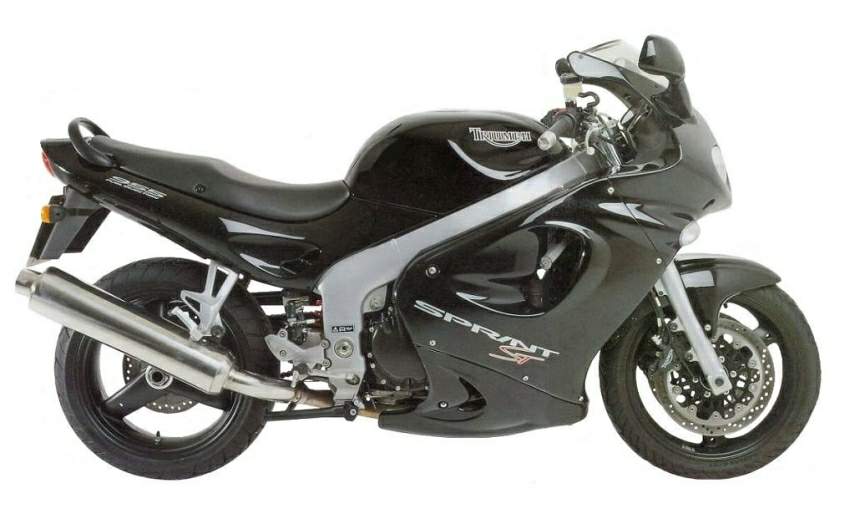
First unveiled at the end of 1998, Triumph's Sprint ST is the Hinckley firm's interpretation of the modern sports-tourer bike. Long dominated by Honda's VFR800, this competitive sector of the market requires a machine with the comfort for easy 1200km (750-mile) days, as well as track-friendly performance on arrival. On paper, the Sprint ST fits the bill. Powered by Triumph's latest 955cc three-cylinder engine, the ST can hit 256km/h (160mph), while weighing less than the VFR, at just 207kg (4561b). Adjustable suspension and sporty tyres add chassis sporting potential, and the sleek bodywork and single-sided swingarm supply classic good looks. Strong, sportsbike brakes give class-leading performance. The Sprint ST's combination of sporting performance and all-round ability has firmly established it as one of motorcycling's very best sports-tourers. Its pace and agility are matched by long-distance comfort and versatility, resulting in a bike that shines in every roadgoing situation. Performance is provided by a 955cc three-cylinder motor that is tuned to give a maximum of 110PS (108bhp) with a broad spread of torque. The fuel-injected, liquid-cooled 12-valve motor produces peak torque at just over 6000rpm, making for effortless low-rev acceleration as well as a sharp turn of speed when revved harder. Handling is exemplary, thanks partly to a twin-spar aluminum frame that is both light and supremely rigid. In conjunction with top-quality suspension and well-chosen geometry, this gives the ST light, easy steering yet also maintains exceptional high-speed stability even when the bike is heavily loaded. As well as giving a stylish look, the Sprint's light and rigid single-sided swing-arm allows the pannier system to be tucked in tight to the rear wheel, minimizing width. Triumph's purpose-built luggage system was designed to fit the ST from the outset, and thus could be made capacious while also blending in with the bike's styling. Ergonomic layout is sporty yet practical, providing a large degree of comfort and protection for rider and pillion while also facilitating high-speed control. The sports-tourer's braking ability is also of the highest order, thanks to twin 320mm front discs plus four-piston calipers that deliver huge power with excellent feel at the lever. It all adds up to a bike that provides a remarkable blend of abilities, reinforcing Triumph's status as a manufacturer of high-class sports-touring machinery.
Review Amsterdam, November 16, 1999 -- "Know what that is?" said the Triumph guy as we circled the stationary Sprint. "None of the journos notice it when they take the Sprint," he said shaking his head in amazement as he leaned forward to pull open a small plastic cap low on the right-hand side of the bike. "It's even got a plug for your heated touring gear." Then he stepped back to give me room to admire this example of the commitment with which Triumph has set out to build their new generation sport touring bike. Courtesy forced me to pause for a few seconds in silent admiration, but an access plug wasn't what I was looking for from the bike. There would have to be more than that -- a LOT more -- if it was going to come even close to deposing the Honda VFR800, the long-reigning King of the Sport Tourers. There's been a Sprint in Triumph's line-up since 1993, but the arrival of the new generation T595 Daytona in 1997 created a sales slump as the Sprint struggled to find a place between the new Daytona and the full-dressed Trophy. A large dose of new technology was needed to solidify Triumph's place in a market segment that is small but relatively uncrowded. The most obvious strategy would have been to do some minor work on the Daytona to take the edge off the sporty character of the bike. "The Sprint pulls strongly from just off idle to the 9500 redline with the rev limiter kicking in almost immediately after." But the problem was that nagging doubts about the Daytona chassis led to its recall in 1997 after a couple of bikes had the headstock fracture under severe crash conditions. After that experience, Triumph had decided to bow to fashion and use a conventional twin-spar frame for the upcoming TT600. Possibly its application on the Sprint would give Triumph a little time to sort out any problems before they launched the bike on which their future in the new millennium firmly rests. So twin-spar aluminum perimeter frame it is, with a wheelbase slightly longer than the Daytona and some tweaks to the steering geometry. The back end, including the single-sided swingarm, has been lifted from the Daytona and lower-spec suspension grace the front and rear. The engine is close to the 955i unit, but with the inevitable changes such as new cam profiles to soften power delivery as well as suitable fuel injection re-mapping. Triumph claims to have cut power to 112 bhp from the Daytona's 130 bhp, but they kept the torque high and flat around 65 ft lbs. from 3500 rpm through redline at 9500 rpm. We were unable to get the Sprint to the dyno to check the figures, but the seat-of-the-pants dyno says these numbers are in the ballpark. What Triumph has definitely managed to cure is the hole in the power delivery that the first T595 had at 4000 rpm. It's strange that Triumph hasn't given the Sprint any over-rev capability since the bike is still pulling hard and a few more revs would be appreciated by sport riders on a charge. The Sprint can be ridden on the edge but it's hard work. With a dry weight of 456 pounds and the new standards for sportbikes set by the R1 and copied by the new CBR929RR and GSXR-750, a few people might consider the Sprint positively obese. Still, it carries its weight well and once turned into the corner tracks like a rhino on a scent trail, although the worn Bridgestone BT57s got quite loose mid-corner. Turning in needs a determined push on the bars and flip-flops have you wishing you did more with your physical condition than check out Men's Health every month. Identical brakes to the units found on the 955i do as good a job despite the extra weight. If your friends ride anything but the latest generation of hypersports bikes, you should be able to use the ample brakes and motor to keep them within sight. But the Sprint's not really about scratching on Sunday mornings. It's about riding 400 miles on Saturday to do some scratching on Sunday morning, then riding 400 miles home again on Sunday afternoon. "It has many of the qualities that you need from a bike to even consider such a proposition." The riding position is excellent, with the wide, flat bars exactly right. The mirrors are mounted well out into the slipstream and do more than let you admire your elbows. But you have to watch them when lane splitting on gridlocked highways or else they'll snag on car mirrors, hands holding cigarettes, dogs, kids heads or anything else sticking out of cars full of stressed-out occupants. The bike's well-balanced and good at slicing through traffic since the clutch is light, the gearbox is smooth and the engine is full of grunt with perfect fuel delivery. When the traffic clears, nail the throttle at 5000 rpm and cruise at 100 mph all day -- at least you could if the seat were better padded. Our test bike had 10,000 miles under its belt and the foam had started to settle. Sitting on a lightly-padded sub-frame is not comfortable. Also, in true Triumph tradition, the vibration through the bars will leave you with a numb right pinkie after an hour, so a stop every hour would be welcome.The Sprint is incredibly fuel efficient turning in 45 miles per gallon on the highway and not dipping much under 40 mpg on the backroads. Good for the pocket if not for the butt. So there's some niggly stuff on the comfort level, but the rest of the vital ingredients for an excellent sports tourer seem to be present and correct. Despite this bike's generally high-level of all-around goodness, it's difficult to feel passionate about the bike. It's competent at everything but seems bland and dull all the same. There is nothing to give the bike any sort of character.Even the potential excitement from the snarling 3-cylinder engine is smothered in the technical efficiency of the exhaust system. The styling itself, especially on the black model, is very restrained, reinforcing the perceived dullness of the bike. It's not a bike to turn heads; it has them nodding instead. Small wonder that in Europe the red color option outsells the black two to one. For the 2000 model year blue will be offered as well. So has the Sprint snuck up on the VFR and stolen the honors in the sport touring class? It comes close, but lacks the quantum leap of distinction that will seriously dent the momentum of VFR sales driven by 15 years of Honda's market domination. Yet Honda has left themselves vulnerable. The lack of a factory hard bag option is, at least to a few Stateside journos, a serious flaw. The BMW R1100S is an excellent machine, yet with all the touring options the retail price begins to approach Harley-Davidson territory. "They could well be King of the Sport Tourers." Ducati did a good job when building the ST4 around the 916 engine with the engine and chassis and integrated hard bags matching the sporty good looks. But Ducatis are sportbikes and expensive and 916 engines have been known to go pop as well. Functionally, the Triumph can scarcely be faulted. If only the styling had been a little more creative and some magical ingredient added to reinforce the sportier side of the bike's character, they could well be King of the Sport Tourers. For the time being the Sprint is just heir apparent. Source Motorcycle.com
|
|
|
Any corrections or more information on these motorcycles will be kindly appreciated. |