|
|
|
|
Classic Bikes
Custom Bikes
Individual
Racing Bikes AJP
AJS
Aprilia
Ariel
Avinton / Wakan
Bajaj
Benelli
Beta
Bimota
BMW
Brough Superior
BRP Cam-Am
BSA
Buell / EBR
Bultaco
Cagiva
Campagna
CCM
CF Moto
Combat Motors
Derbi
Deus
Ducati
Excelsior
GASGAS
Ghezzi Brian
Gilera
GIMA
Harley Davidson
Hero
Highland
Honda
Horex
Husaberg
Husqvarna
Hyosung
Indian
Jawa
Kawasaki
KTM
KYMCO
Laverda
Lazareth
Magni
Maico
Mash
Matchless
Mondial
Moto Guzzi
Moto Morini
MV Agusta
MZ / MuZ
NCR
Norton
NSU
Paton
Peugeot
Piaggio
Revival Cycles
Roland Sands
Royal Enfield
Sachs
Sherco
Sunbeam
Suzuki
SWM
SYM
Triumph
TVS
Ural
Velocette
Vespa
Victory
Vincent
VOR
Voxan
Vyrus
Walt Siegl
Walz
Wrenchmonkees
Wunderlich
XTR / Radical
Yamaha
Zero
Video
Technical
Complete Manufacturer List
|
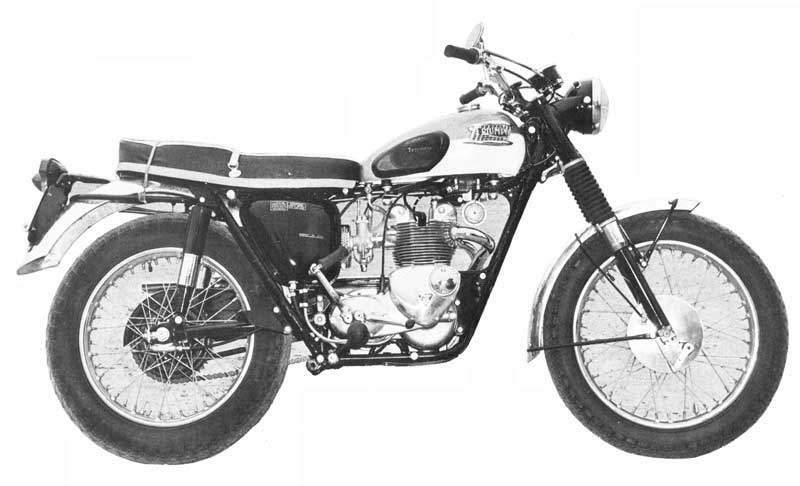
Triumph Sport Tiger T100SC
|
|
Make Model |
Triumph Sport Tiger T100SC |
|
Year |
1965 -- 73 |
|
Engine |
Four stroke, parallel twin, OHV |
|
Capacity |
490 cc / 29.9 cub in. |
| Bore x Stroke | 69 x 65.5mm |
| Compression Ratio | 9.1:1 |
| Cooling System | Air cooled |
|
Induction |
Single Amal 25 mm carburetor |
|
Ignition |
AC Magneto |
|
Starting |
Kick |
|
Max Power |
28.3 kW / 38 hp @7000 rpm |
|
Clutch |
Wet, 6 plate |
|
Transmission |
4 Speed |
|
Final Drive |
Chain |
| Gear Ratio | 1st 14.14 / 2nd 9.18 / 3rd 6.95 / 4th 5.70 |
| Frame | Steal twin downtubes |
|
Front Suspension |
Telescopic forks |
|
Rear Suspension |
Swing arm, adjustable shocks |
|
Front Brakes |
7 in Drum |
|
Rear Brakes |
7 in Drum |
|
Front Tyre |
3.25 -19 |
|
Rear Tyre |
4.00 -18 |
| Wheelbase | 1359 mm / 53.5 in |
| Ground Clearance | 229 mm / 9.0 in |
| Seat Height | 838 mm / 33 in |
|
Dry Weight |
152 kg / 335 lbs |
|
Wet Weight |
168 kg / 371 lbs |
|
Oil Capacity |
3.4 L / 7.2 US pt / 6.0 Imp pt |
|
Fuel Capacity |
13 7L / 3.6 US gal. gal. 2.9 Imp gal |
|
Top Speed |
169 km/h / 105 mph |
|
Road Test |
Cycle Magazine 1966 |
Road Test
The actual weight difference is not great; 335 lbs. for the Tiger as compared to 363 for the top-of-the-line Bonneville. But the compactness of the smaller bike gives it a feeling of agility usually associated with 250 or 350cc machines.
The Tiger's wheelbase is two important inches shorter than that of the larger Triumph. The short handlebars are another factor favoring the bike's maneuverability. They are raked back about 3" for maximum rider control.
Another factor of great importance is the excellent rider position afforded by the Tiger; Even a short man can reach the ground with both feet and on the dirt the rider has great freedom of movement to lean forward or to the side, still maintaining good balance, even at speed. Exhaust pipes are swept around the engine to the left side where they are smoothly joined into a single pipe which is tucked neatly alongside the engine. A safety precaution which might have been added is a heat shield, although it is unlikely that a rider could get burned from the pipe in this position. Footpegs are high. They are of the non-folding type.
An impressive feature of this machine is the more than ample Ground Clearance, achieved via several methods; for one thing, there is no centerstand, only a sidestand (which is lengthened by necessity to compensate for the added Ground Clearance). The front tire (by Dunlop) is a large 3.25" x 19" and the rear sports 4.00" x 18" rubber. The result is nearly 9 inches of space beneath the center of the machine; plenty of leeway for big rocks and deep ruts, the kind of terrain for which the Tiger is intended.
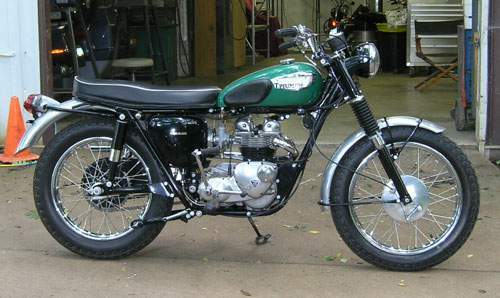
The other type of riding that suits this bike is ordinary street cruising. We found either type pleasurable on the T100SC. There is a noticeable difference between this bike and the more powerful 650 models in the Triumph line, not only in acceleration, but in smoothness of ride. The Bonneville, for example, gives less vibration and generally a more solid feeling in high speed freeway type cruising. One contributing factor might be the fact that the 500cc model does not feature the rubber-mounted handlebars found on its big brother. And, of course, the 500 requires more rpm's to develop its power. Triumph claims 38 horses at 7,000 rpm compared to 50 horses at 6500 for the street Bonneville, a substantial difference. But the Tiger is capable of feats that the larger Bonneville could not safely attempt. We felt right at home with the T100SC off the road on trails that are usually exclusive to all but lightweights. The torque is there for the steepest inclines and the suspension will iron out the choppiest terrain as well as any off-the-road bike we have tested. The horsepower creates a tendency for the bike to rear back on its hind wheel but this is easily controllable by the rider shifting his weight and, working the throttle.
As is always the case with combination street-dirt machines, there are some areas of compromise; the same tires that perform well on the road lack proper traction for trail or desert. And road gearing is a compromise off the road, the rear sprocket having 46 teeth. Triumph has eliminated one normally troublesome area of compromise with a readily detachable headlight. Five minutes is all the time it takes to yank the unit from the bike in preparation for a back country jaunt. On the whole, there are few, if any, improvements that could be practically applied to this bike to make it more ideally suited to its dual purposes. Prospective owners of the Tiger should be aware that this machine requires a long break-in period. The engine is set up unusually tight and even at 1,000 miles performance will not be at its best. The first 300-400 miles will, in fact, be somewhat disappointing to the rider graduating from a well broken-in 250. It will be well to heed the advice of Triumph dealers who will tell you to be patient with the 500 until ample mileage is accumulated. Then speeds of 100-plus may be expected.
Some features worthy of comment are as follows:
STARTING. 9:1 compression is quite a lot and the Tiger requires a healthy kick but usually starts on the first kick. The lever, located on the right-hand side is slightly on the short side, meaning more muscle needed. The single Amal carb is equipped with a tickler to assist in starting.
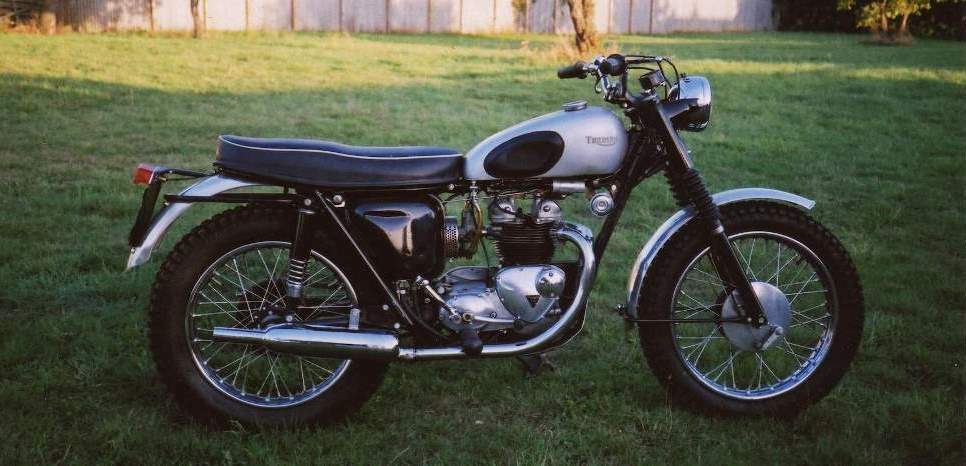
STOPPING. No ignition switch is provided on the battery-less magneto-equipped machine. A kill button is located on the left of the bars. In fact, no locking device of any kind is to be found on this machine; a definite drawback in our opinion.
LIGHTING. The quickly detachable headlight is unique also in that it contains its own dimmer switch, mounted to the right of the on-off switch. Taillight is large, contributes to bike's safety on the street.
FINISH. Typically British, the Tiger is immaculately painted (Burnished Gold tank, black trim). Chrome and polished alloy parts are strictly top quality.
BRAKES. Front braking is via full-width alloy hub; rear brake is not full width. Both have 7" diameter braking surface. Stopping power rates excellent.
SHIFTING. Gearbox operates extremely smooth. Ratios enable good flexibility on or off the road.
The Tiger T100SC is an ideal motorcycle in many respects, especially for the enthusiast who uses his bike for various types of riding, and who has the experience necessary to handle a really powerful off-the-road machine.
Source Cycle 1965
|
Any corrections or more information on these motorcycles will be kindly appreciated. |