|
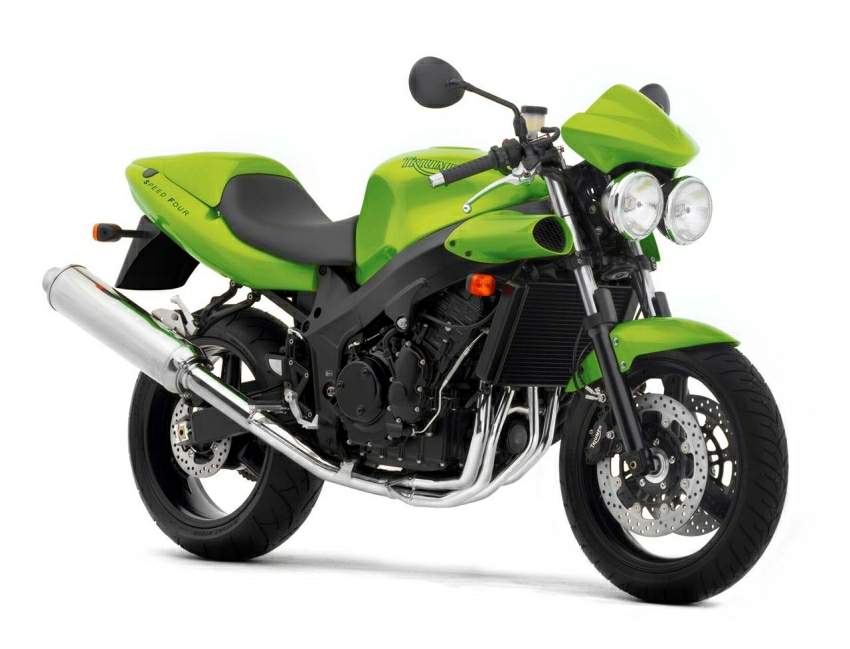
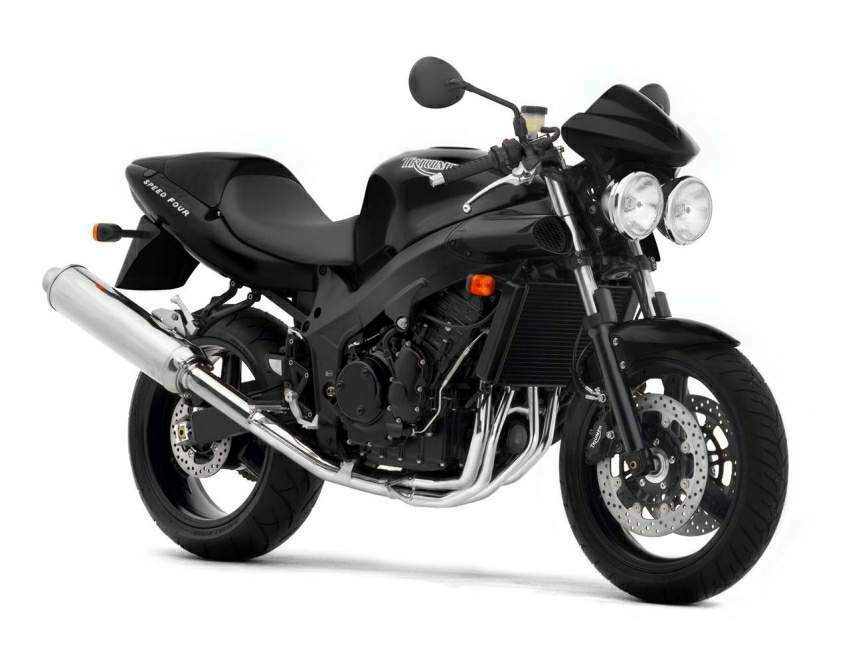
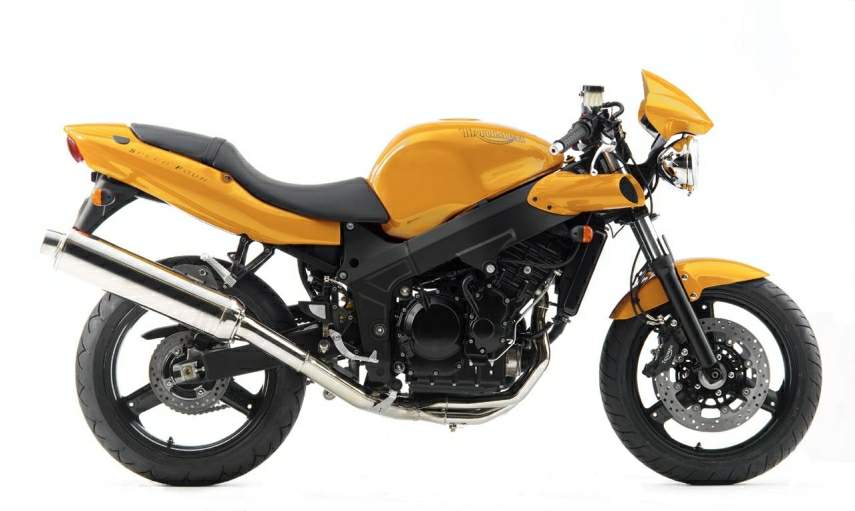
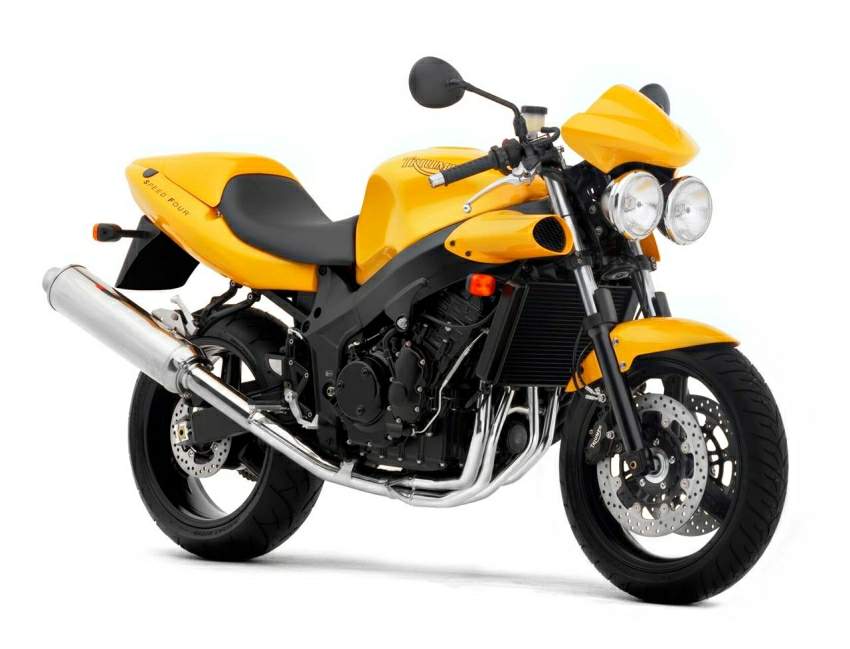
Triumph Speed Four

|
Make Model |
Triumph Speed Four |
|
Year |
2002-03 |
|
Engine |
Liquid cooled, four stroke, transverse four cylinder, DOHC, 4 valves per
cylinder. |
|
Capacity |
599 |
|
Bore x Stroke |
68 x 41.3 mm |
|
Compression Ratio |
12.5:1 |
|
Induction |
Multipoint sequential electronic fuel injection with forced air induction |
|
Ignition /
Starting |
Digital inductive type, via electronic engine
management / electric |
|
Max Power |
98 hp 71.4 kW @ 11750 rpm |
|
Max Torque |
68 Nm @ 10500 rpm |
|
Transmission /
Drive |
6 Speed / chain |
|
Front Suspension |
43mm forks with dual rate springs and adjustable preload, compression
and rebound damping |
|
Rear Suspension |
Monoshock with adjustable preload, compression and rebound damping |
|
Front Brakes |
2x 320mm discs 4 piston calipers |
|
Rear Brakes |
Single 220mm disc 1 piston caliper |
|
Front Tyre |
120/70 ZR 17 |
|
Rear Tyre |
180/55 ZR 17 |
|
Dry-Weight |
170 kg |
|
Fuel Capacity |
18 Litres |
|
Consumption average |
20.8 km/lit |
|
Standing
¼ Mile |
11.4 sec |
|
Top Speed |
231.4 km/h |

Triumph's Speed Four is, in part, an attempt to recoup
some of the massive investment in developing the TT600 engine and chassis.
Essentially a TT600 without the full race fairing, the Speed Four is aimed
at the popular middleweight naked bike market. Its aluminium twin-spar frame
and liquid-cooled engine are clearly on display, and its high-quality
suspension is also retained, giving the highest-spec chassis in the class.
The impressive brakes of the TT are also retained. Re-tuning of the TT600
engine has produced a lower peak power output, but improved low-down pull.
The Speed Four's styling is borrowed from the firm's Speed Triple. The twin
headlamps and small flyscreen echo the bigger bike's 'streetfighter'
styling.
A sporty, middleweight motorcycle has to perform in many environments -
from racetrack to city street and winding back road, perhaps in one day. And
the Speed Four has been built not just to perform.
But to amaze.Its lineage is pure supersports but with a twist - an X-factor - all of
its own. The Speed Four's howling 599cc, four-cylinder, fuel-injected engine
gives instant, thrilling power all the way to the redline and its taut,
race-spec chassis and high quality, fully adjustable suspension connects the
rider intuitively to the road flashing beneath.
The naked, bare-boned style of the Speed Four marks its individuality,
unique character and eagerness to stand well clear of the workaday,
homogenous masses. It's a statement of attitude mixed with a shot of pure
adrenaline. And fittingly the Speed Four is not merely ridden; it's worn as
an extension of the soul.
Triumph Urban Sports
The word on the street is Triumph. And the sound that beats their arrival
is a special and throaty roar. Sexy, head-turning looks are matched by
exhilarating performance and precise handling.

Triumph's John Bloor is known as a fiscal hard-ass.
He flies economy class and expects underlings to do the same. The Hinckley
factory is a fine example of efficient manufacturing, while the product line
takes full advantage of economies of scale and parts commonality. And still we
don't know how Triumph sells the Speed Four for a measly $6500. Honestly, we
just can't see it.
Obviously someone inside Triumph knows how to rub a couple of shillings
together, hence the ridiculously low price&151nearly two grand off the original
TT600's price and a thou down on the 2003's sticker. In fact, this bike was
originally intended to go into "The $7000 Solution" because, well, it's about
the same amount of money as the others. One problem surfaced about, oh, 500
yards into the test ride: In just about every performance category, the Speed
Four obliterates the three budget blasters from Japan. Inadvertently, we'd
dropped a Hollywood stunt double into a classroom of science nerds swooshing
mock light sabers; it took all of five minutes to get their polyester-clad butts
kicked.
We should have known. The Speed Four is basically the discontinued TT600 sans
fairing and a nice ski vacation sliced off the sticker price. (It's very close
to the Daytona 600 spec-wise, too.) A pair of goggle-eyed headlights and a
mini-prow fairing from the Speed Triple were tacked on up front. Mechanically,
the Speed Four gets a mild tweaking to improve midrange at the expense of
top-end compared with the TT600. On our SuperFlow dyno, however, that boosted
midrange failed to appear. Compared with an '02 TT600, the '04 Speed Four's
torque trace showed a very minor advantage between 3500 and 4750 rpm and a
brief, 4.1-foot-pound bump at 7500 rpm, but otherwise followed the TT's curve
faithfully. Except at the top, of course, where the neutered Speed Four lies
down; its peak of 88.5 horsepower is well down from the TT's 96.7.

Unstrapped from the dyno, the Speed Four bounds back
with more enthusiasm. The engine is fairly smooth at lower and higher
revs—though it buzzes irritatingly between 5500 and about 8000, right where you
ride most of the time&151and feels plenty potent in the company of the low-buck
bikes, with a pleasing willingness to rev and a hot soundtrack to boot. Triumph
has finally licked 90 percent of the TT's fuel-injection demons; the Four feels
fine when cold yet is slightly soggy off the bottom once hot. There's still some
abruptness right off idle—magnified by quite a bit of driveline lash (much like
the Yamaha FZ6). All in all, the Speed Four feels like what it is: A
once-frontline sportbike recast as a semi-standard, weird-Harold naked bike.
Triumph wisely left the TT's chassis unaltered in the translation to the Speed
Four, so it has by far the best—and most adjustable—suspension, an
aluminum-cartridge KYB fork up front and a fully adjustable shock mated to the
powdercoated alloy swingarm out back. The S4 also boasts the strongest brakes
and sharpest handling of the similarly priced beaters. As on the TT, the
Triumph's steering is light and accurate, giving you an honest read on what the
excellent Bridgestone BT010 tires are doing. Although it's not a lightweight—at
446 pounds wet, it's the equal of the 599 and 17 pounds heavier than the SV650
—the bike never feels ponderous. Perhaps in the same way that the 599 carries
its weight in the right place, the Speed Four hides the heft with an ideal
center of gravity and aggressive chassis geometry. And yet the Triumph never
threatens to shake the narrow, angled-back clip-on bars from your grasp, even if
you must traverse choppy pavement in the middle of a corner. Confidence oozes
from the Speed Four.
The naked Brit thrills experienced pilots, but it isn't exactly a
newbie-coddler. (We admit it; this is a difficult chore.) Compared with the
others, the Triumph's suspension is firmly damped&151it responds well to small
imperfections, but the chassis does the usual sportbike hobbyhorse over larger
whomps, such as you'd find on a concrete-block highway. As a result, the Four
takes a bit of aggression to make the chassis work best; it's not as happy
pottering around at a five-tenths pace as, say, the Honda 599. Those powerful
brakes are a bit too sharp for genuine beginners—and we wish the adjustable
lever had more range closer to the bar, as we don't all wear size-XXL gloves.
Primary ergonomics come from the previous school of sportbike standards—meaning
they're amazingly comfortable compared with the smaller, lighter, tighter 600s
of today—but are considerably more cramped and aggressive than the sit-up
postures of the other three. In particular, the Speed Four is very tight betwixt
seat and peg, challenging long-legged riders to find a comfortable perch. In
truth, had the S4 more standardlike ergonomics—lower pegs, a Speed Triple-style
tubular bar—we probably would have put it back into the main comparison, where
we're absolutely certain it would have been the victor.
Even a hard-case like John Bloor would have smiled at that.
Source
Cycle World
|