Once upon a time in America cruisers
were wallowy domestic pigs, bitten hard by the slow bug. There wasn't a foreign
make or a real runner in sight. Then some Japanese bean counter discovered that
big bikes meant big profits, and soon the whole friggin' category erupted faster
than a runaway African virus. We've got all sorts of different cruisers these
days. Some perform better than others, but they are all too lumbering and pokey
for my effete sportbike sensibilities. Until the Triumph Rocket III, that is.
When MMM Publisher Wanchena demanded
that I test the monster, I balked. This British bike is so oversized it's really
an ultra-cruiser and I considered jumping journalistic ship for Easy Riders
magazine. Thankfully appearances deceive and the Rocket works much better than
it should. It's balanced, fast, has excellent brakes, fast, handles well, and
did I mention that it's fast? But at 750 pounds wet and 98.4 inches end to end
my work was cut out for me.
All media hype aside, the Rocket is
not the largest motorcycle ever made. That dubious honor likely belongs to
Roadog, a Mad Max-styled creation fitted with a Chevrolet engine and a 1-ton
truck differential. Cobbled together in the late 1960's by a wacko Detroit
engineer named Wild Bill Gelbke, Roadog weighed 2-1/2 tons. Corvette brakes
stopped the 17-foot long monster and it used motorcycling's first automatic
transmission. At the time, Roadog was proof that bigger was not better.
The Rocket is a great example of
Darwinian motorcycle evolution; a plus-size beauty who could tango with verve.
Everywhere I rode people went all goo-goo over the huge 3-cylinder inline
engine. It's an odd choice for Triumph's 21st Century flagship, earlier Tridents
and Rocket triples notwithstanding. Inlines have powered a 1950's Moto Guzzi
road racer, Sunbeam's pillowy S-8, the Danish Nimbus and some oldster Indians
and FN's. There's also a startling new American semi-inline racer from architect
Michael Cyzsc, but it's a prototype.
The hairy three-banger roars like a
fierce British lion, setting the bike miles apart from all those me-too V-twins
chugging around. Displacing a class-busting 2300cc's, Triumph claims some 140
bhp and 147 ft/lbs of torque, strong enough to shove even a tobacco barn down
the road. Impressive? Yes, but scary too. In any gear, I could whack the
throttle open and the bike slammed forward like an angry F-18 on full
afterburner. Astride the Rocket, I never forgot that motorcycling's biggest
baddest dog was pounding away between my legs.
Inside the silvery cases lives a
fuel injected liquid-cooled oversquare DOHC powerplant with 4 valves per
cylinder activated via shim and bucket. 2 sparkplugs for each cylinder light the
mixture and the 120-degree crank spins clockwise while balance, input and
final-drive shafts all rotate the other way. The twin demons of vibration and
torque reaction are thusly tamed but Triumph engineers have cannily left in
ample rorty triple character. Trickling around town, the fat individual pipes
emit a muted purr. Dial in 3000 rpm and the beast within awakens. The exhaust
growl rises menacingly and vibes dance lightly from the footpegs to the
handlebars. Those monster throttle bodies suck loud air, the horizon goes
blurry, and around fifty-five hundred the mill really howls. By then you'll back
off anyway, palms sweaty and eyeballs itchy from windburn. This thing flat-out
cooks.
The Rocket uses an advanced digital
engine management system. Various sensors (throttle body, engine revs,
coolant/ambient temperature and exhaust gas) all feed information back to the
ECU. A master chip processes the data and balances throttle valves, timing and
fuel delivery for optimum performance. Basically the engine maps itself,
cylinder by cylinder, for the best possible running. Power is electronically
retarded by 7% in all of 1st and 2nd and part of 3rd gears. Supposedly this
controls wheel spin, insuring that corseted ladies don't faint when the bike
zooms by, but there's another more mundane reason. The unfettered Rocket gulped
so much gas under full power Triumph opted to trade a bit of acceleration for
fuel economy. I got 34-39 mpg for a combination of town and open-road riding.
From a tank holding 6.6 gallons it's possible to log 200 miles before fueling.
Triumph says it runs nicely on regular so that's an added bonus.
Chassis-wise things are
conventional, but really, really big. The engine is a stressed frame member with
two thick tubes snaking back over the cylinders, forming a spine from the
steering head down to the gearbox rear and swingarm pivot. Triumph uses 43mm
inverted telescopic forks clamped between oversize alloy triple trees to take
care of the front end, while out back a box-section steel swing arm and two
shock absorbers tame the bounce. On paper it sounds normal enough, but in Rocket
III land even garden-variety bits are impressively chunky as befits their
context.
The huge 5-spoke alloy rear wheel
measures 16 x 7.5 inches and carries a mammoth 240/50 x 16 tire specially
developed just for the Rocket. It's about as large as most import car donuts.
The front wheel, a 17 x 3.5 incher, carries 150/80 17-inch rubber. The rear
wheel/tire combo is also notable in that it's too heavy for the production build
team to handle manually. The Hinckley factory had to install a crane to lift and
position the wheel unit on the assembly line.
A first for any Triumph, final drive
is shaft and bevel gear inside super-thick alloy cases. What else could be
counted on to reliably control the bike's enormous power and torque? Blip the
throttle in neutral and the Rocket gently rolls to the right, but otherwise
you'd never know it was a shaftie. The 5-speed transmission, provided by the
same supplier as Lamborghini 'boxes, was generally cooperative with a
Harleyesque klunk engineered into each shift. Clutch pull is feathery light with
progressive engagement easily controlled even though this is, yes, you guessed
it, the largest clutch ever fitted to a production bike. Seeing a design trend
here, are we?
It took a while for Triumph to get
from there to here. Starting with the 1999 concept bike the engine grew
from1500cc to 1800cc, then to 2 liters, and finally the current 2300cc. Unlike
the classic Brit oil-leakers we loved to hate, Triumph gave the Rocket III a
proper long-term thrashing to make sure the important bits all held up. Huzzah
to them; the big fella looks and feels solid as the rock of Gibraltar. According
to Triumph, test Rockets in the UK have collectively burned over 150,000 liters
of fuel and worn through some 6000 tires. That's the equivalent of 3 continuous
loops around the earth, sometimes testing 24 hours per day, 7 days a week.
One of the bike's idiosyncrasies is
a lack of engine braking. Maybe it's due to the 39-pound flywheel, but I could
kick it down two full gears with minimal slowing. At this point I was ever so
glad to grab a handful of powerful, progressive brake. Purloined directly from
Triumph's 955i, 320mm disks spinning at the front are clamped by 4-pot calipers.
Out back, a single 2-puck caliper services one 316mm disk. The back brake is
oversize by current standards and Triumph claims the rear is all that's needed
for hard stopping. But even with the monster 240-size contact patch I could
still force a skid easily. There's so much bulk and attendant weight transfer I
don't see how it could be otherwise. Used together as God and Queen intended,
the brakes were stellar.
In spite of its intimidating size
and weight, I was able to toss the machine into corners almost like a sportbike.
Factory testers clearly spent lots of time scratching on twisty rural English
roads getting the handling dialed in and the whole package works amazingly well.
The chassis is stable and stiff, with suspension bits all doing their job. Hero
blobs at the footpeg ends defined sane lean angles and you'd have to be in a
huge hurry to lay the Rocket down much further. Personally, I wouldn't want to
get so much weight crossed up for any reason. Other Rocket III reviewers slag
the back tire, but it didn't hamper my own cornering style which is more kareful
kat than kamakazi. I found it more fun to flog the Rocket on moderately curvy
roads than drone on the superslab where expansion joints set up an irritating
rocking horse motion.
This bike loves smooth medium
sweepers; a fat surge of torque between 3-5,000 rpm hurled me to warp speed in a
heartbeat. Conversely, rough pavement made the back end dance a bit during
really hard transitions. Such a heavy shaft drive chassis demands stiff rear
shocks with limited travel to keep the back end under control. The Triumph's
rear suspension is simple compared to BMW and Moto Guzzi. Both these makes use
more sophisticated suspension designs and control linkage to isolate the various
competing forces. In all fairness, their components are much lighter than the
III's and must cope with far less power. If you don't do anything too stupid on
this biggest Triumph it's all good fun and remarkably easy to ride forcefully.
Puttering around town it's nicely
balanced too. I had a couple of nervous moments during tight u-turns and one
off-camber uphill maneuver. The Rocket feels like a much smaller machine until
you need to push-start it for a dead-battery jump. With a full tank of gas and
yours truly aboard, the whole shebang crowds the half-ton mark and it can be a
real handful in stop-and-go traffic. With a handlebar width of 38.2 inches, I
got stuck between cars sporadically during rush hour lane splitting. But I doubt
many owners will want or need to do their daily commute on this bike.
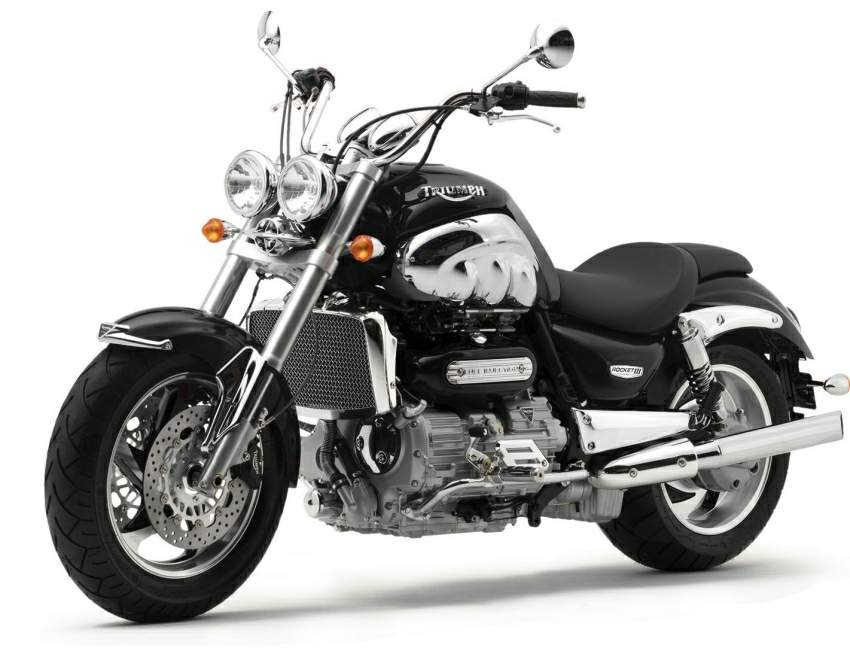
Styling is best described as
"completely bonkers meets incredible excess". Twin bug-eyed headlights match the
chromed tach and speedo pods stylistically. Acres of metallic candy-apple red
paint and lashings of chrome insure you won't ride anywhere unnoticed. There's
hardly a 90-degree angle anywhere on the machine, and the massive chromed
radiator recalls Suzuki's mid- '70's GT750 "water buffalo" two-stroker. I
especially loved the retro-nouveau lozenge taillight and 50's Buick-style horn
cover. Either you like the derivative design the Rocket represents or not, and
public reaction fell into two distinct camps of "love-it/hate-it" as well. It's
easy to posture a king-of-the-road attitude on the III especially when you've
got the size and raw power to back it all up.
Savvy Rocketeers will make 3
immediate upgrades. Dump the Massey-Ferguson exhaust and bolt on sexy
aftermarket pipes, surely being developed by specialists as we speak. Re-coding
the ECU would rebate that "missing"7% power loss in the lower gears as long as
fuel mileage isn't an issue. Dustbin the stock rear shocks for adjustable units
with better damping and rebound and your Rocket will have improved road manners
on rough pavement and at high speed. To make the Rocket a killer touring mount,
just add windshield, bags, radio and a plush aftermarket seat with better lumbar
support. Don't forget the leather-clad S&M teddy bear strapped to your sissy
bar, either. He'll be waving goodbye to almost everything else on the road as
you disappear into the distance at triple-digit speeds.
I had few complaints. Whoever
designed the speedo and tach markings should be forced to polish the chrome with
a linen napkin stapled to his tongue. Dump the artsy triangles and enlarge the
tiny numbers, which are almost illegible at speed. The curved shift lever rubbed
my left foot sore, but your feet are likely smaller. Besides, with 147 ft/lbs of
torque on tap, shifting is entirely optional. Be prepared for constant
attention- even the jaded "outlaws" at my local biker watering hole crowded
around eagerly to ask questions when I pulled up on the monster Triumph.
I put 750 miles on my test bike with
just one incident. The stock battery suffered a freak internal failure,
stranding me for an hour until a replacement was fitted. It took 4 of my beefy
riding buddies to push-start the huge bike in a burger joint parking lot while
local onlookers got enough free chuckles to last a lifetime. Other than this,
the machine was reliable and exhilarating to ride. The throttle delivers
euphoria just like those hand-held morphine drips in the hospital emergency
room. Squeeze gently for a dose of fun; repeat as needed until a huge permanent
grin sets in. Thankfully Triumph's Rocket III is legal, non-addictive and a lot
faster than any hospital gurney I've ever been strapped to.
M.M.M.
NOTE: Some of the photos on
Motorcycle Specs are owned by somebody. If you see any of your
photos, you can let me know so that I can acknowledge it, or if
you object to it, I can remove it altogether. If any copyright
holder objects to their articles being placed on Motorcycle
Specs, it will be removed upon request. Any correction or more
info on these bikes will kindly beappreciated
Contact MePrivacy
Policy
Website Stats