|
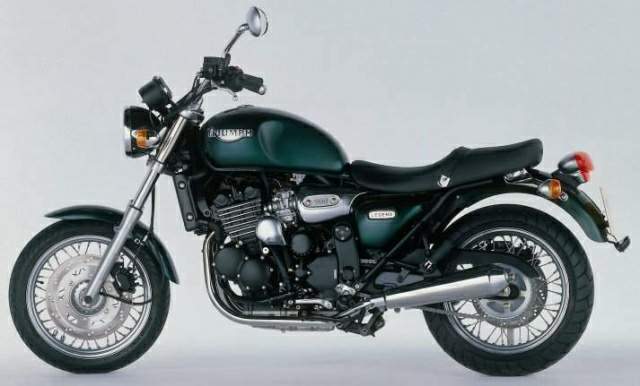
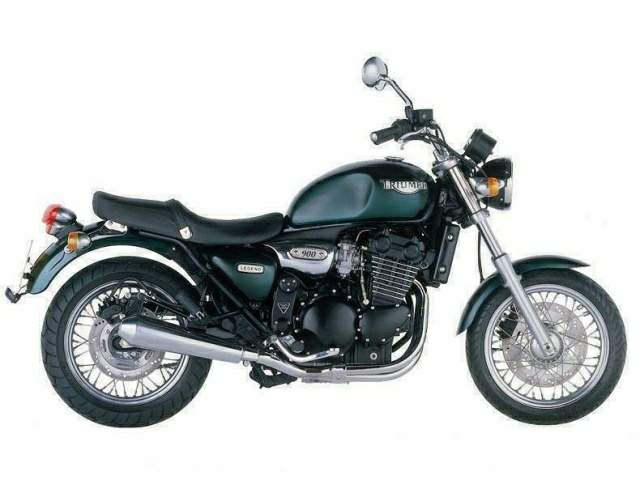
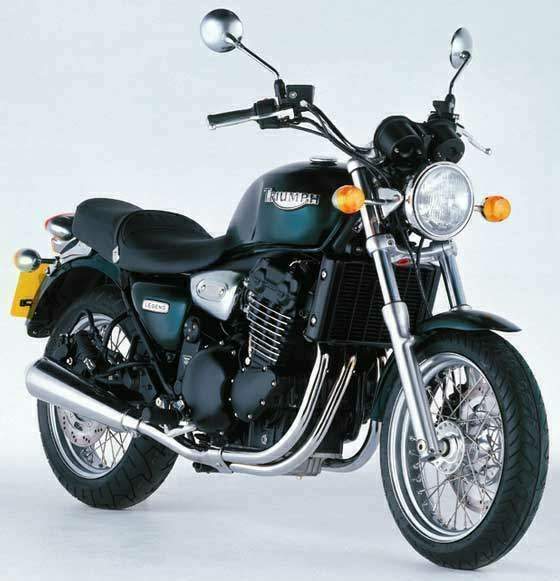
Triumph Legend TT

|
Make Model |
Triumph Legend TT |
|
Year |
1999 |
|
Engine |
Liquid cooled four stroke, transverse three cylinder,
DOHC, 4 valve per cylinder. |
|
Capacity |
885 |
|
Bore x Stroke |
76 x 65mm |
|
Compression Ratio |
10.0:1 |
|
Induction |
3 x 36mm flat slide
CV carbs |
|
Ignition /
Starting |
Digital / electric |
|
Max Power |
69 hp 50.3 kW @ 8000 rpm |
|
Max Torque |
72 Nm @ 4800 rpm |
|
Transmission /
Drive |
5 Speed / chain |
|
Clutch |
Wet,
multi-plate |
|
Frame |
Micro alloyed high tensile
steel spine |
|
Front Suspension |
43mm forks with triple
rate springs |
|
Rear Suspension |
Monoshock with adjustable
preload |
|
Front Brakes |
Single 320mm disc 2 piston caliper |
|
Rear Brakes |
Single 285mm disc 2 piston caliper |
|
Front Tyre |
120/70 R17 |
|
Rear Tyre |
160/60 R17 |
|
Seat Height |
725 mm |
|
Dry-Weight / Wet-weight |
215 kg |
|
Fuel Capacity |
15 Litres |

Essentially a budget version of the Thunderbird, the
Legend was introduced in 1998 in two versions. The basic Legend TT had 43cm
(17in) wire-spoked wheels and an extra-low seat height. The Legend Deluxe
had an even lower seat, and came with two-tone paintwork. Both bikes shared
the 885cc liquid-cooled triple engine of the Thunderbird, its 51kW (69bhp)
and torquey power delivery giving relatively sprightly performance. Cost
cutting (the Legend was almost S2.000 [$3,200] cheaper than the Thunderbird)
is hard to spot on the Legend, and it offers good value for an entry-level
machine. Triumph's strong build quality and finish are continued on these
models, and both engine and chassis are almost identical to the Thunderbird.
The Legend TT is designed for riders looking for a
classically styled roadster with lively performance plus everyday
versatility.
Like Triumph's other classically styled bikes, the
Legend features an appealing blend of period styling plus modern engine and
chassis engineering, with a look that is clean and classically elegant.
A teardrop fuel tank, reverse-cone silencers and
traditional laced wheels with chromed rims combine with the distinctive
three-cylinder engine to give an attractive period feel.
The 885cc, liquid-cooled motor comes with a durable
powder-coated finish, and follows the successful format set by Triumph's
other classic triples. It is tuned for crisp throttle response and generous
torque output at low and medium engine speeds.
The Legend is notably easy to ride, thanks to its low
seat and a chassis designed for easy handling. The engine is available with
a restriction kit*, which makes it an ideal entry to the world of
three-cylinder classic motorcycling.
For owners who enjoy personalizing their machines, the
Legend's distinctive look can be further enhanced with a selection from
Triumph's extensive range of accessories.
Engine:
-
Proven 885cc liquid-cooled 3-cylinder engine with
DOHC, 12 valves.
-
Satin black powder coated engine for long term
durability, with classic styling.
-
Low maintenance hydraulic clutch operation.
-
Digital electronic ignition for precise combustion
control.
-
Smooth shifting 5-speed transmission.
-
Raised overall gearing for relaxed cruising and
improved economy.
-
Stainless steel exhaust headers with bright chrome
finish for durability and good looks.
-
Chrome reverse cone megaphone silencers for authentic
traditional style.
Chassis:
-
Lightweight, powder
coated steel spine frame, using engine as a structural member.
-
Anodized oval section
aluminum alloy swing-arm.
-
Rising rate monoshock
rear suspension with preload adjustment.
-
43mm telescopic forks
with triple rate springs.
-
Traditional spoke wheels.
-
Stainless steel braided
front brake line.
-
Low seat height for easy
maneuverability and rider confidence.
-
Classically-styled
instrumentation including: speedometer with odometer, trip meter, tachometer,
with warning lights for turn signals, main beam, oil pressure, low fuel,
engine temperature and neutral.
-
Hazard warning lights.
-
Color matched front and
rear mudguards.
COLOR
OPTIONS: Obsidian Black, Cardinal Red, Imperial Green
TRIUMPH ACCESSORIES
-
Integrated alarm
-
Summer Screen
-
Roadster Screen
-
Tank Bag
-
Leather
Pannier Kit
-
Soft
Panniers
-
Performance Silencer
-
King &
Queen Seat
-
Color
Coordinated Flyscreen
-
Grab rail
-
Sissy Bar
& Luggage Rack
-
Chrome
Master Cylinder Guard
-
Chrome
Clutch Cover
-
Chrome
Radiator Guard
-
Outrigger
Finishers
-
Chrome
Chainguard
-
Chrome
Instrument Kit
-
Knee Pads
-
Front
Mudguard Extension Kit
-
Fork
Protector Kit
-
Center
Stand Kit
-
Low
Handlebar Kit
-
Chrome
Water Pipe
-
Chrome
Lever Kit
-
Adjustable Levers
-
Side
stand

Kawasaki W650 And Triumph Legend TT -
There Are Two constants in motorcycling that we take for granted. One, the
British motorcycle industry lived and died on charismatic twins and singles
(and, OK, the occasional triple) that stuck to mature technologies to the bitter
end. Brit bikes are either attractively iconoclastic or rotting and unreliable
old sleds, depending on your point of view and tolerance for warm beer. Two, the
Japanese motorcycle industry lives and dies on the incessant march of
technology-even if it's sometimes liberated from other places-and would rather
turn to making beaded moccasins than appear to be behind the times.
These are fine generalizations, facile and easy to digest, but they run
increasingly against the grain. How's that again? Well, consider these two
motorcycles as the levers that pry such preconceived notions right off the
pavement.
Kawasaki is hot on retro bikes-modern motorcycles designed to look and,
sometimes, feel like old ones. Its Eddie Lawson Replica replica, the ZRX1100, is
selling like saddlestitch jeans to adolescent girls. And there's no
misunderstanding the inspiration for the deep-fendered Drifter cruiser; it, too,
is rolling out of showrooms at good speed. Retros are well into fever pitch in
Japan, so Kawasaki figured to try them here and is cautiously dribbling some
into the States in limited numbers.
Triumph has grasped its own history delicately between finger and thumb,
selecting bits that are evocative but not precisely retrospective. Under John
Bloor, the company has chosen to look ahead and make much more contemporary
pieces. These converging paths lead to the Kawasaki W650 and the Triumph Legend
TT: A Japanese bike that's convincingly British in character and performance,
and a power cruiser from Hinckley that, for its polish and somewhat-anonymous
styling, could well have Far Eastern roots. They share modest prices-$6499 for
the W650 and $7699 for the Legend-and an acknowledgement that they won't be
volume leaders. Think entry-retro.
Kawasaki W650
First things first. This is a Kawasaki, it says so right on the tank and seat,
but it's trying hard, really hard, to be a 1960s Triumph Bonneville. Yes,
Kawasaki can honestly say that the W650 traces its roots to the firm's own W1
and W1SA parallel-twins of the late 1960s and early '70s; but those bikes were
pretty shameless knockoffs of Brit models of the time. And that's the point.
Kawasaki wants everyone from motorcycle know-nothings to seasoned riders who
were there the first time to see the W650 and think Bonneville. The shape of the
W650's tank, fenders, seat and engine all evoke-and in some cases closely
replicate-the original's. From 20 feet, most nonenthusiasts would mistake the
W650 for the real thing. And even those not easily fooled by Kawasaki's clever
design (redesign?) staff, the overall impression is one of homage more than a
calculated theft of someone else's history. (Could also be that Brit-bike fans
are more sanguine about copies than harley nut jobs.)
One ride on the W650 will drag you back, perhaps writhing and groaning, into the
netherworld of 1960s moto tech. The bars are wide and graceful, and the bike
feels quite small and light for a 650-even though, at 453 pounds wet, it's not
exactly in need of eating-disorder counseling. (Do you remember your daddy
telling you that a 650 was a big bike?) The hard, strangely shaped saddle
(replete with white piping) places you high above the bike, perched as though on
a barstool. It's an odd impression for riders used to stumpy, dense sportbikes
to teeter atop a thin, tall motorcycle. And it works fine in the city, but at
speeds on the far side of 70 mph the W650 quickly becomes tiring to ride thanks
to a losing proposition of upper-body strength against aerodynamics.
From this tippy columbarium, you stare down on instruments that, should you have
no memory of the actual pieces, may remind you of wiggly needled Smiths clocks.
(We eagerly await some hacker successfully programming faux waggle into the
electronic gauges.) At the handgrips are switches you've probably not seen since
Mach III days-all totally appropriate for the W650. (Can you imagine how awful
modern switchgear would appear?)
Look behind your right leg and, yes, it's a kickstarter! We seldom used the
electric assist and got the 676cc parallel-twin chuffing on the first or second
prod every time. At idle, the massively undersquare (72.0 x 83.0mm) air-cooled
twin thrums almost silently and barely raises its voice when being thrashed.
Despite having four valves per cylinder actuated by a single overhead,
bevel-driven cam, the W650's powerplant produces only modest power-44.8 hp at
6750 rpm. At least the 360-degree-crank engine-both pistons rise and fall
together-carries its torque well, staying above 35 foot-pounds from 2000 to 6500
rpm. Thanks to 34mm CV carbs fitted with a throttle-position sensor and an
accelerator pump, the engine is reasonably responsive, seeming only to work
against a lot of flywheel effect.
Source Motorcycllist
|