Liquid cooled four stroke, transverse three cylinder,
DOHC, 4 valves per cylinder.
Capacity
955
Bore x Stroke
79 x 65 mm
Compression Ratio
11.2:1
Induction
Electronic Fuel Injection
Ignition /
Starting
Digital inductive type / electric
Max Power
130 hp @ 10200 rpm (rear
tyre 117.3 hp @
10000 rpm )
Max Torque
9.1 kg-m @ 8300 rpm
Transmission /
Drive
6 Speed / chain
Front Suspension
45mm rwu forks with dual rat spring adjustable
compression, rebound and preload.
Rear Suspension
Monoshock adjustable compression rebound and preload.
Front Brakes
2x 320mm discs 4 piston calipers
Rear Brakes
Single 220mm disc 2 piston caliper
Front Tyre
120/70 ZR17
Rear Tyre
190/50 ZR17
Dry-Weight / Wet-Weight
192.6 kg / 214 kg
Fuel Capacity
18 Litres
Consumption average
15.3 km/lit
Braking 60 - 0 / 100 - 0
12.9 m / 36.9 m
Standing
¼ Mile
11.0 sec / 206.1 km/h
Top Speed
254.0 km/h
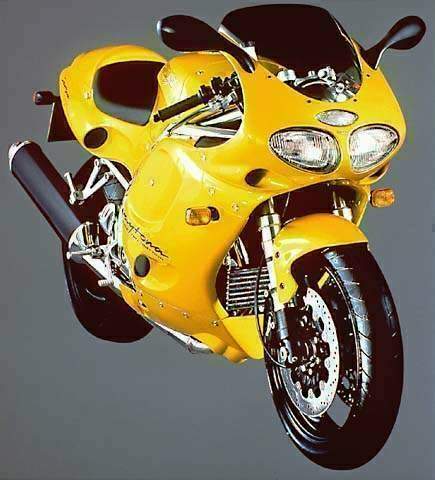
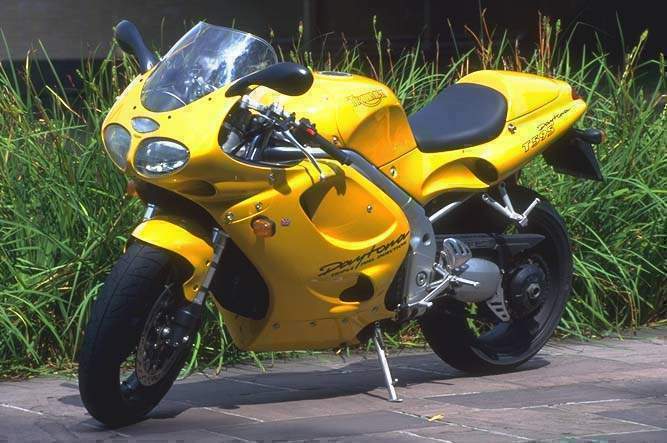
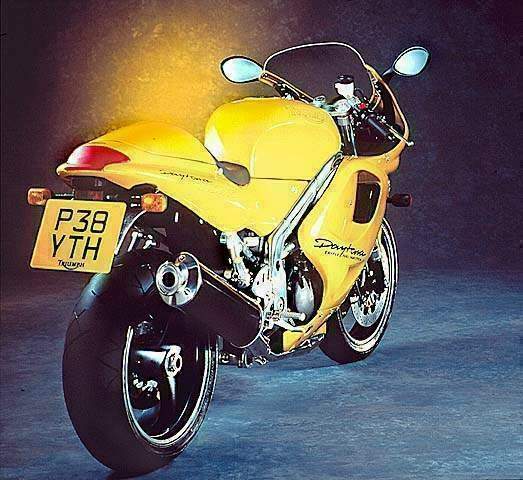
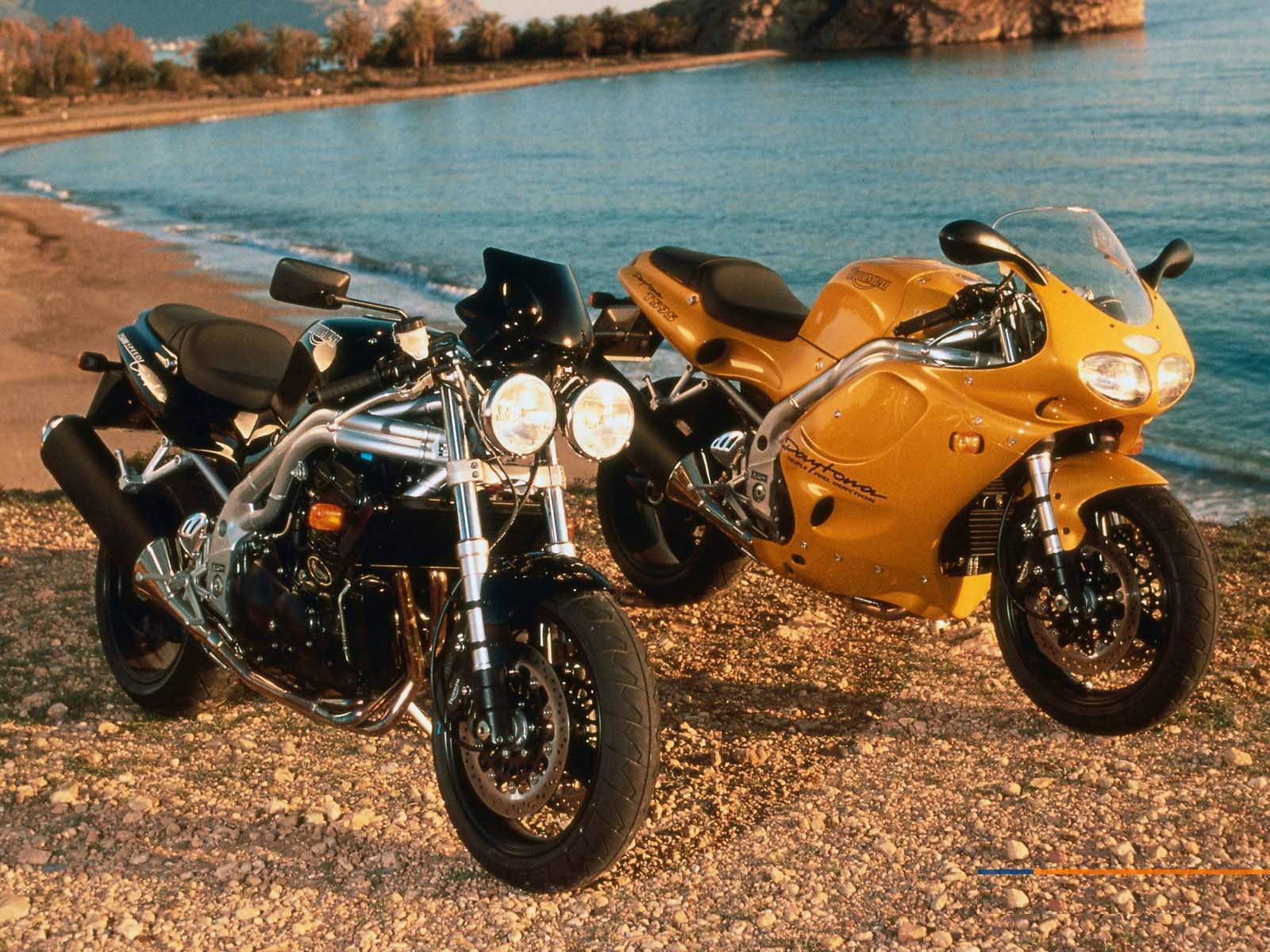
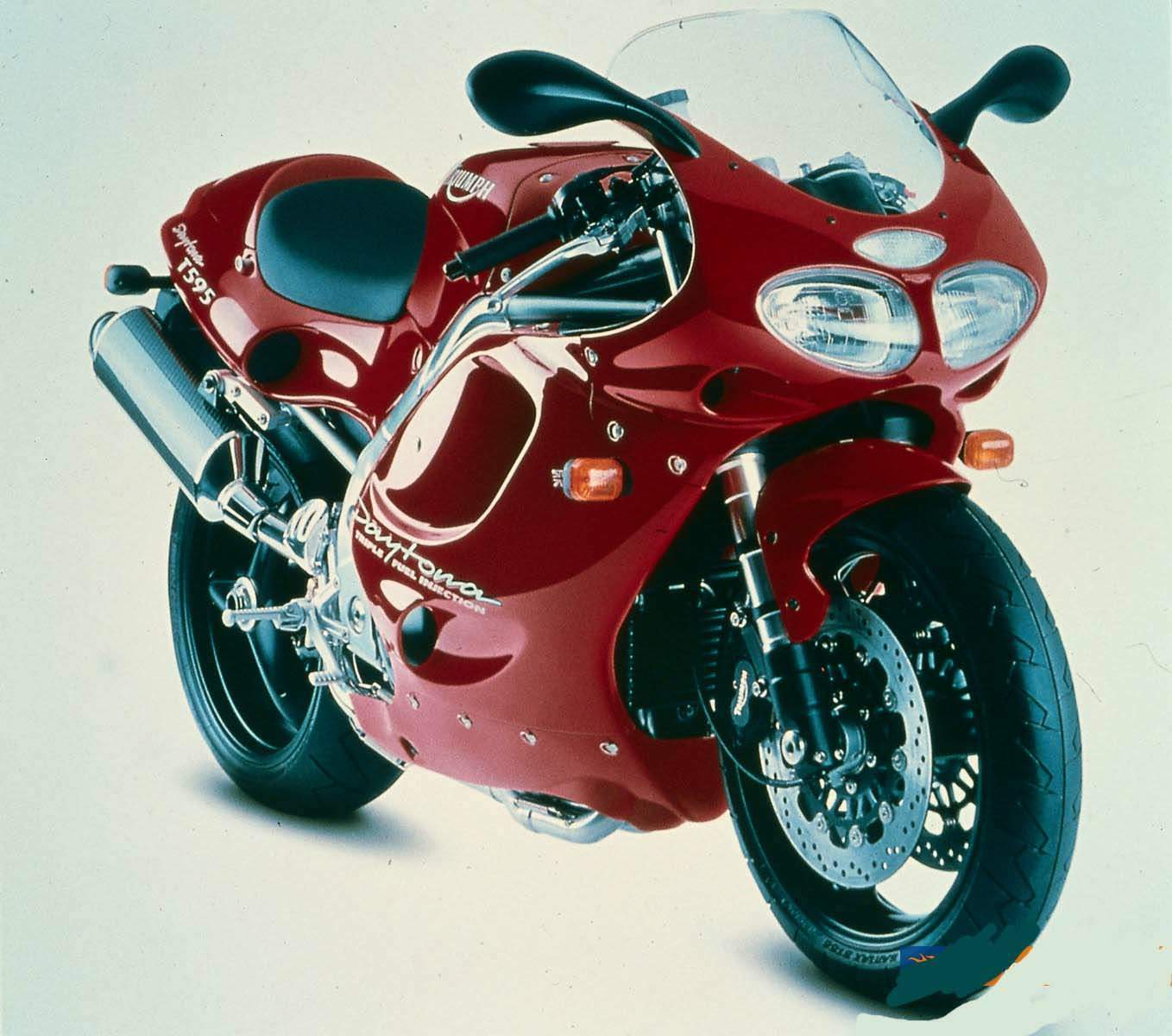
The T595 Daytona was the bike
with which Triumph came of age as a superbike manufacturer. Fast and
fine-handling, the Daytona was the first sports bike from the reborn British
firm that was designed to compete head-on with the best from Italy and
Japan. And although the Triumph was slightly less racy than some
super-sports rivals, its unique blend of style, performance and
three-cylinder character made it a big success.
A crucial factor in the Daytona's
development was Triumph boss John Bloor's decision to abandon the modular
format with which his firm had entered the market in 1991. Modular design
involved several different models sharing many components, and had proved a
cost-effective way of developing a range of bikes rapidly. But it involved
too many compromises for a competitive super-sports machine.
The Daytona changed all that.
This time, Triumph's designers had no such handicap in developing a
purpose-built triple. The T595 title came from Triumph's factory codename, a
factory tradition dating back to the T120 Bonneville and beyond, but the
bike was later renamed the Daytona 955 i because many people thought the 595
referred to capacity. This was in fact 955cc, as the motor was a bored-out
version of the previous Daytona's 885cc liquid-cooled, dohc 12-valve unit.
Inside the motor, new semi-forged
pistons held thinner, low-friction rings and moved in new aluminium liners.
Lotus Engineering helped tune the motor by improving its breathing with
larger valves, new cams and lightened crankshaft. Magnesium engine covers,
modified crankcases and a redesigned gearbox and clutch further reduced
weight. Other engine-related changes included a new airbox, three-into-one
exhaust system and Sagem fuel-injection system.
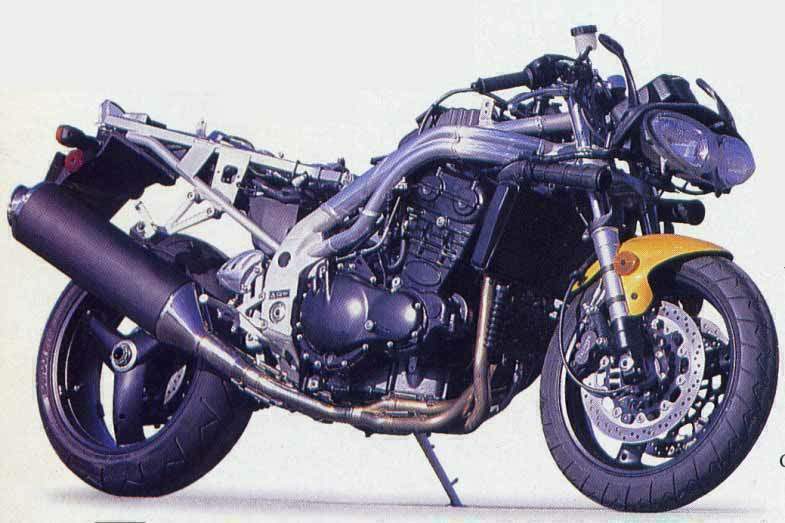
If the motor was a development of
its predecessor, then the chassis of which it formed a stressed member was
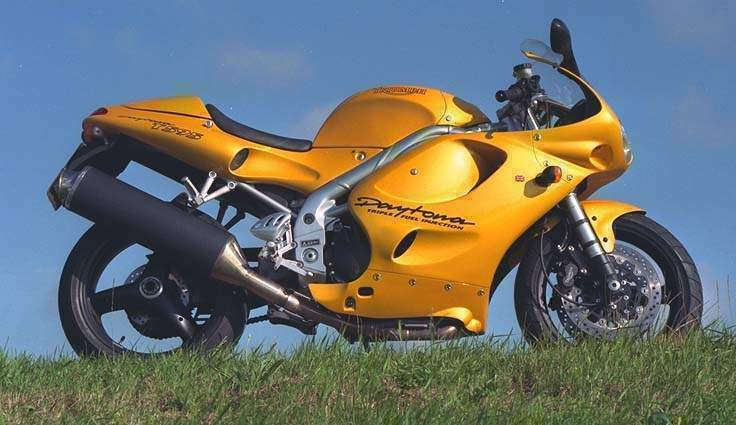
totally new. In place of the old steel spine was a perimeter frame of twin
oval-section aluminium tubes. Styling was a key factor in the chassis
design, hence the frame's polished tubes and the single-sided swingarm that
enhanced the Daytona's sleek and distinctive look. Suspension was by Showa
of Japan, with 45mm forks and a similarly multi-adjustable shock.
Compact and eager to rev
From the rider's seat the Daytona
felt notably more compact than previous Triumphs, and it was certainly much
faster too. The new motor was smooth and eager to rev. It kicked hard
anywhere above 6000rpm to send the triple surging forward and its
rev-counter needle flicking towards the 10,500rpm redline. Peak output was
128bhp at 10,200rpm, giving a 15bhp advantage over the previous Daytona
Super III. With its rider tucked down behind the fairly low screen the
triple was good for over 160mph (257km/h). Only the slightly notchy
six-speed gearbox and a noticeable power dip at about 5500rpm marred the
impression of a superbly fast and sophisticated sportster.
There were no such complaints
about the handling, particularly on the Triumph's combination of light,
neutral steering and confidence-inspiring stability was very impressive. The
top-heaviness of previous Triumphs was gone, replaced by a pleasantly
manageable feel, and backed-up by excellent control from the firm yet
compliant suspension. Although the Daytona could not quite match the agility
of its raciest rivals, it was not far behind, and its Nissin brake system
gave outstanding stopping power.
The T595 Daytona was more than an
excellent sports bike, it was proof that Triumph was truly back in the big
time. Almost 30 years after Honda's CB750 had arrived to outclass the
previous Meriden-based factory's T150 Trident triple and
hasten the demise of the once
dominant British motorcycle industry, Triumph once again had a sporting
superbike that stood comparison with the very best in the world.
T595 vs R1 vs CBR vs ZX-9R
LOS ANGELES, January, 1998 -- Screw the real world.
Forget about gas mileage, weather protection, operating expenses, "real world
power delivery," and comfortable ergonomics. Screw the bureaucratic nannies who
harp about public safety and demand horsepower limits, and cuff the next twit
who whines 'we don't get the really cool bikes in America' in the back of the
head. This is the US of A, and on our long, wide, civilized and
government-subsidized roads, brute power rules the day. So, we recently prompted
the major manufacturers of three- and four-cylinder motorcycles: "give us the
quickest, lightest asphalt-annihilator around." Give us Yamaha's YZF-R1, Honda's
CBR900RR, Kawasaki's ZX-9R, Suzuki's GSX-R750 and Triumph's T595.
Assembled before you are five of the gnarliest multis ever made, each of them a
marriage of horsepower, handling, and weight. Our goal: To separate the men from
the boys; to take the fastest and best-handling bike from each of these
manufacturers, regardless of displacement, put them on the same track together
and let them tear each other apart. You might notice that there are no twins in
this shootout, but don't despair, they will be covered in Part II. Best of the
Best, Part III, will follow with the two victors dukin' it out for the title of
Supreme Sportbike.
In the past we've received complaints from many readers who don't care about
price, ergonomics, or streetability: Well, our squidly friends, this shootout is
for you. No freeway testing, no touring, and no damned urban cruising. Just the
track, some canyons, and the dragstrip. Nothin' but good old-fashioned
scratching.
While it was really no big surprise that Yamaha's tour-de-force YZF-R1 was the
winner in all objective categories -- it was the fastest at the drag strip,
turned the quickest racetrack lap time, and kicked ass on the dyno -- and
gathered first-place votes from four of our five testers, there were some
surprises a little further down the food chain.
Honda's CBR900RR (Fireblade in some markets) returned for 1998 with what seemed
like redesigns too minor to hang with this buffed out crowd. Ah, but all is not
as it seems, and this year the 'RR matches up to the marketing hype that sold so
many of the (ex-) wobbly machines in years past. Notably, a stiffer chassis, 5mm
more trail (trail, not steering head angle, is what provides front-end
"stability"), 10mm more fork span to enhance handling and torsional rigidity,
improved suspension valving and selected weight savings added up to a quantum
leap forward from the previous model. In fact, it was argued that with more
power the RR might have won this test: That is, despite its 114 horsepower motor
being a little under par in this group, the RR proved to be a such a flickable,
stable mount with predictable power delivery, it afforded all riders instant
confidence to go fast in the twisties. Bottom line: the 'RR is the easiest bike
to jump on and go fast.
One of the surprises of this test is that most of these mongo dong-swingin'
hyper-bikes are also great street bikes with tractable power and livable
ergonomics. Not so with the GSX-R750. As resident Willow Springs Motorcycle Club
king-pin big-fish Chuck Graves -- who won seven out of seven classes this past
season at Willow -- pointed out, "the GSX-R750 sure likes to be ridden hard, but
it's a miserable street bike." Point the GSX-R750 at a track or a set of curves
that you've scouted for dirt and cop officers and hang on for one awesome ride:
The Gixxer captured the only other first place vote in the test, from AMA Dirt
Tracker Brett Landes: "The harder I rode, the better it handled. I was very
impressed with its racetrack prowess."
LOS ANGELES, January, 1998 -- Screw the real world. Forget about gas mileage,
weather protection, operating expenses, "real world power delivery," and
comfortable ergonomics. Screw the bureaucratic nannies who harp about public
safety and demand horsepower limits, and cuff the next twit who whines 'we don't
get the really cool bikes in America' in the back of the head. This is the US of
A, and on our long, wide, civilized and government-subsidized roads, brute power
rules the day. So, we recently prompted the major manufacturers of three- and
four-cylinder motorcycles: "give us the quickest, lightest asphalt-annihilator
around." Give us Yamaha's YZF-R1, Honda's CBR900RR, Kawasaki's ZX-9R, Suzuki's
GSX-R750 and Triumph's T595.
Assembled before you are five of the gnarliest multis ever made, each of them a
marriage of horsepower, handling, and weight. Our goal: To separate the men from
the boys; to take the fastest and best-handling bike from each of these
manufacturers, regardless of displacement, put them on the same track together
and let them tear each other apart. You might notice that there are no twins in
this shootout, but don't despair, they will be covered in Part II. Best of the
Best, Part III, will follow with the two victors dukin' it out for the title of
Supreme Sportbike.
In the past we've received complaints from many readers who don't care about
price, ergonomics, or streetability: Well, our squidly friends, this shootout is
for you. No freeway testing, no touring, and no damned urban cruising. Just the
track, some canyons, and the dragstrip. Nothin' but good old-fashioned
scratching.
While it was really no big surprise that Yamaha's
tour-de-force YZF-R1 was the winner in all objective categories -- it was the
fastest at the drag strip, turned the quickest racetrack lap time, and kicked
ass on the dyno -- and gathered first-place votes from four of our five testers,
there were some surprises a little further down the food chain.
Honda's CBR900RR (Fireblade in some markets) returned for 1998 with what seemed
like redesigns too minor to hang with this buffed out crowd. Ah, but all is not
as it seems, and this year the 'RR matches up to the marketing hype that sold so
many of the (ex-) wobbly machines in years past. Notably, a stiffer chassis, 5mm
more trail (trail, not steering head angle, is what provides front-end
"stability"), 10mm more fork span to enhance handling and torsional rigidity,
improved suspension valving and selected weight savings added up to a quantum
leap forward from the previous model. In fact, it was argued that with more
power the RR might have won this test: That is, despite its 114 horsepower motor
being a little under par in this group, the RR proved to be a such a flickable,
stable mount with predictable power delivery, it afforded all riders instant
confidence to go fast in the twisties. Bottom line: the 'RR is the easiest bike
to jump on and go fast.
One of the surprises of this test is that most of these mongo dong-swingin'
hyper-bikes are also great street bikes with tractable power and livable
ergonomics. Not so with the GSX-R750. As resident Willow Springs Motorcycle Club
king-pin big-fish Chuck Graves -- who won seven out of seven classes this past
season at Willow -- pointed out, "the GSX-R750 sure likes to be ridden hard, but
it's a miserable street bike." Point the GSX-R750 at a track or a set of curves
that you've scouted for dirt and cop officers and hang on for one awesome ride:
The Gixxer captured the only other first place vote in the test, from AMA Dirt
Tracker Brett Landes: "The harder I rode, the better it handled. I was very
impressed with its racetrack prowess."
Impressions:
1. Brent Plummer, Editor-in-Chief
If you want the best sportbike made today, go get an R1. But you'll have to get
in line behind me, 'cause I'm pulling industry strings to get one ASAP. Ha ha!
2.Chuck Graves, Contributing Editor Racer
The R1 is incredible, state-of-the-art through and through. The neatest thing
about it was that while it still had suspension plush enough to give a smooth
ride on the highway, the chassis still gave the razor-sharp feeling of a
racebike when ridden at its limits. It's as stable as a rock. The other thing
that made it leaps and bounds beyond everyone else's motorcycle is the
smoothness of the throttle control -- the exact same thing that I was raving
about on the old YZF1000. Rolling on the throttle was always smooth, always
predictable, and that goes a long way towards instilling confidence when driving
off a turn.
The Honda moved around a lot, but never gave you the feeling of getting out of
control, even though it didn't have great control and wasn't smooth over the
bumps, there was always confidence that the bike was going to stick when you
turned it in. Suzuki's GSXR750 -- which got my vote for third place -- is better
than last year's 750, which was an awesome bike. It's a great machine.
I was alone in liking the Triumph at the racetrack. While we agreed it looks
great and that its tractable motor made for excellent streetability, I felt that
its superior throttle response made it easy to achieve smoothness when ridden
hard.
I thought the ZX-9R felt too vague. You couldn't tell what it was going to do
when you tried to change direction quickly, and you couldn't turn it in really
fast because you weren't sure what the front end was going to do because it was
too soft and moved around so much. It had good brakes and a really comfortable
riding position, but the off-to-on throttle transition was so abrupt that you
really couldn't control the bike coming off the corners.
3. Billy Bartels, Associate Editor
I really wanted to pick the CBR900RR to win: Sure, it wasn't fastest, but it was
so much fun to ride. I suppose it all depends on how much testosterone is in
your riding diet. If you want to live to a ripe old age and have plenty of fun
sweeping through the countryside at speeds double the legal limit get the CBR,
if not then there's the R1.
In fact, if you belong to the Anthony Gobert win-or-wad school of racing, you
will probably want to get the R1, but I hear you'll be waiting until next year,
as they are already selling out in most locales.
The ZX-9R was a distant third, yet still an excellent bike, after all this is
the Best of the Best. That motor is awesome. Give the Triumph the benefit of the
doubt, it's a killer street bike, but in this company its only fourth. I don't
get the GSX-R, its racing credentials are second to none, but on the street it's
almost impossible to ride that bike the way it is designed.
4. Brett Landes
AMA Grand National #41 The Honda was the first bike I rode. I was very impressed
with everything about the bike. The bike felt real stable through the middle of
the corner. The power was good and it stopped real well. The CBR really lets you
build confidence in yourself. Going from the CBR to the Triumph is a let-down
... it's a fun bike to ride but does not compare to the other bikes in the test.
I was impressed with the way the bike handled, but the transmission does not
have a close enough gear ratio to be a race bike ... Also, I have a hard time
riding a bike that leaks oil.
I was not very impressed with the Kawasaki. It felt like the bike moved around a
lot in the corners and did not stop as well as the other bikes. I think the
tires had a lot to do with that. The bike wanted to break loose exiting the
corners. I spent a lot more time riding the GSX-R. At first I had to fight it in
the middle of the corner in order to be where I wanted to be on the race track,
but the harder I rode, the better the GSX-R handled. This bike has great brakes,
accelerates well, steers well. And the Yamaha is an absolute ball to ride. It's
very smooth doesn't do anything radical at all. I had a little trouble steering
it in the middle of the corner, but I don't think it would take much to fix than
perhaps a little stiffer spring in the back. In my opinion, I think it is the
best looking bike at the test. The R1 is one great street bike!
I don't feel that there are any losers in this test. The bottom line is simple.
If you want to go racing, the GSX-R is definitely the best bike to buy. If you
want a great street bike that is extremely fast and comfortable, I would go with
the R1 followed by the CBR.
5. Roland Sands
AMA 250 GP #10 I love motorcycles more than most things and riding the Yamaha R1
made me realize that. Fast as all git out, the kind of fast that leaves you
thinking about what would happen if it got away from you, but it never did. It
greeted full-throttle slides with a smile. The only problem was a slight lag
when getting back on the throttle, but most people wouldn't notice it. Good gear
box, and good suspension, though a bit soft for me, but that's fixed easily
enough.
The RR was the friendliest bike, I was immediately comfortable on it and ran
like stink. (In Roland-speak, "like stink" translates into "very good" or
"great.") The CBR is the best complete package if I were going to get a street
bike, but I'm a little biased by the sheer, undeniable power of the R1. The very
racy Suzuki was the closest thing of the bunch to my TZ, I ran it the hardest in
the corners and it always felt like it wanted more. You have to rev the snot out
of it to get it to do anything, but if you get it where it wants to be, it'll
scream like a chick in a Hitchcock flick. Not so great if you want to run to the
pub for some suds, but great if you want to win races.
I loved the ZX-9R, more so than anyone else here. It's lighter and faster than
the old one. Smokey rear tire fast. Good brakes and sharp steering made it easy
to pitch in, but there was a noticeable lack of mid-corner grip once there. The
lack of traction might just have been the year-old lay-away rubber on the thing,
and as we all know if you ain't got rubber, you ain't gonna get none. The
Triumph is beautiful, I was in love. But on the track, I was always looking for
more revs past the 10k red-line. It missed gears and leaked oil. Well, the
chassis felt strong and the steering was good, and it sounded cool as hell, but
its just a little out of league with this group.
Riding all these bikes is fun and anybody could ride one fast.
Source Motorcyle.com
NOTE:
Some of the photos on Motorcycle Specs are owned by somebody. If you see any of
your photos, you can let me know so that I can acknowledge it, or if you
object to it, I can remove it altogether. If any copyright holder objects
to their articles being placed on Motorcycle Specs, it will be removed upon
request. Any correction or more info on these bikes will kindly be
appreciated.
Contact MePrivacy
Policy Website
Stats