Liquid cooled four stroke, transverse three cylinder,
DOHC, 4 valves per cylinder.
Capacity
955
Bore x Stroke
79 x 65 mm
Compression Ratio
12.0:1
Induction
Multipoint sequential
electronic fuel injection
Ignition /
Starting
Digital / electric
Max Power
149 hp 108.6 kW @ 10700 rpm
Max Torque
100Nm 74ft.lbf @
8200 rpm
Transmission /
Drive
6 Speed / chain
Front Suspension
45mm forks with dual rate
springs and adjustable preload, compression and rebound damping
Rear Suspension
Monoshock with adjustable
preload, compression and rebound damping
Front Brakes
2x 320mm discs 4 piston calipers
Rear Brakes
Single 220mm disc 2 piston caliper
Front Tyre
120/70 ZR17
Rear Tyre
190/50 ZR17
Seat Height
815 mm / 32.1in
Dry-Weight
188 kg / 414 lb
Fuel Capacity
21 Litres / 5.5 gal
Top Speed
155 mp/h
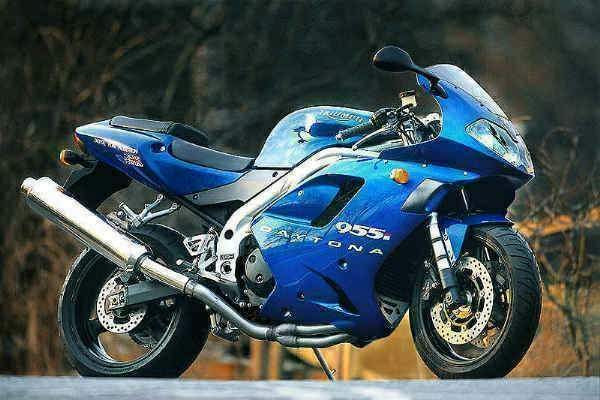
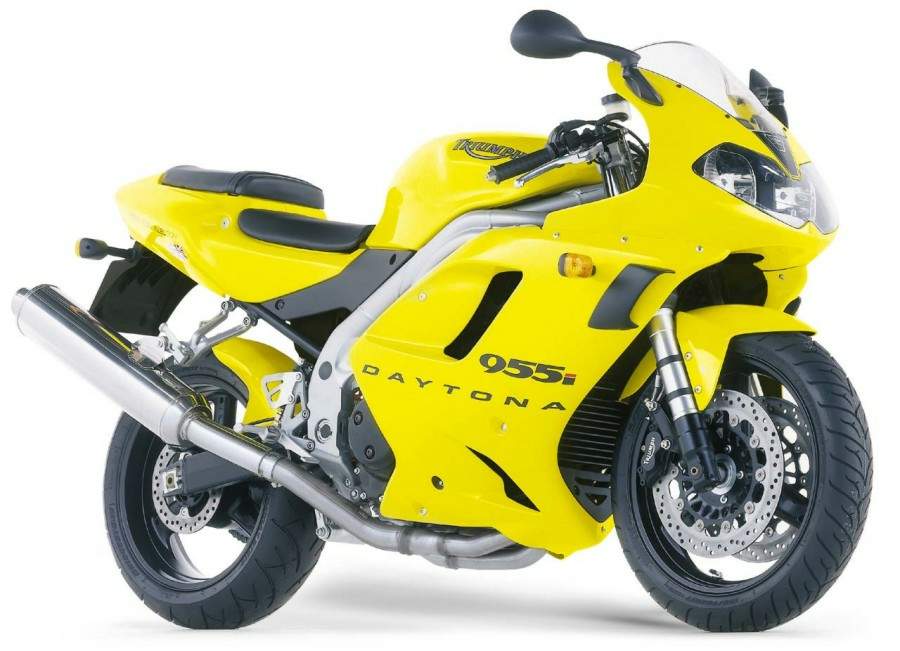
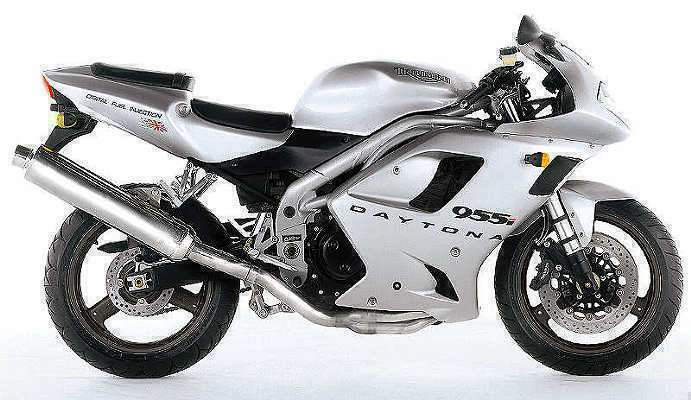
The Daytona has always been
Triumph's flagship sportsbike, so when the firm launched a new-generation
sportsbike in 1997 it simply had to take that name. First unveiled as the
T595 Daytona, the new bike had a very impressive spec, and was aimed at
taking on the might of the Japanese top-class sportsbikes, such as Honda's
FireBlade and Kawasaki's ZX-9R.
The heart of the original T595
was an uprated 955cc triple engine, based on the earlier three-cylinder
designs. Fitted with an advanced fuel-injection system designed by the
French firm Sagem, the engine produced a remarkable peak power figure of
97kW (130bhp), together with the trademark torquey mid-range and soulful
sound of the inline three-cylinder design.
The chassis was also rather
remarkable. An aluminium tubed perimeter frame design was chosen to combine
stiffness and low weight, while looking different from the usual Japanese
twin-spar aluminium frames. Mated to an elegant single-sided rear swingarm
and stiff, 45mm (1.8in) fully adjustable front forks, the T595 chassis was
every bit as accomplished as its engine.
Although the T595 couldn't get
the better of the Japanese - Yamaha's Rl appeared nine months later,
redefining sporting motorcycles - it was still a successful model, combining
Triumph character and heritage with genuinely sporting performance.
The 1998 model year saw a
renaming of the T595 as the Daytona 955i. Cosmetic changes were made, as
well as a redesigned exhaust to improve ground clearance.
But it wasn't until the 2001
update that significant changes were made to the Daytona. This latest
version reverted to a double-sided swingarm to reduce weight and improve
stiffness, and new bodywork sharpened the styling of the Daytona. Extensive
engine upgrades produced another power increase, this time to a very
impressive 1 lOkW (147bhp). And while the opposition has moved on in terms
of track performance, the latest Daytona makes an impressive sporting
machine for road use.
The awesome Daytona 955i – heavily revised earlier this
year and now sharper, lighter and faster than ever - remains the flagship of
the Triumph range.
Launched in 1997, gradual development and continual
improvements had always kept the Daytona competitive, but the latest engine,
chassis and bodywork redesign elevated the machine to new levels of
performance.
Powered by Triumph’s second-generation fuel-injected
engine – more refined, quieter and with lighter internals – the Daytona
breathes easier, runs cooler and revs higher. Packing a mighty 147bhp punch
it’s capable of blistering acceleration on the track while the generous
spread of torque ensures its road going performance is as useable as ever.
The new lightweight chassis has won much praise for
its first-rate, confidence-inspiring handling thanks to the combination of
shorter wheelbase, steeper steering geometry, lighter twin-sided swingarm,
lightweight 17’ front wheel and multi-adjustable suspension.
Review
Italy, July 24, 2001 -- If you've ever been to
London you might recall those nasty little "near misses." You look left before
crossing a quiet road, proceed on and then come but a cat's ass away from being
flattened by a car coming from your right - the wrong direction.
A long line of obscenities in a charming Cockney accent usually follows the
sound of screeching rubber. No doubt about it, Brits do it differently and it's
not just driving on the wrong side of the road. Case in point: the all-new 955i
Daytona. From its inception under the 595 moniker (changed later to 955 to avoid
confusion), the Triumph flagship tried to mix it up with the likes of Yamaha's
YZF1000, Honda Fireblade and Suzuki GSXR750 with peculiar technical solutions.
In this world of monkey see, monkey do, any self-respecting manager would have
analyzed the opposition, copy the good bits and try to do some better. But not
so in England.
Back in '97, the Daytona caused quite a stir if only because of Triumph's
courage to face the current Japanese hypersport bikes with such an original
piece. "The opposition has four cylinders? Let's go for three. They have a twin
spar frame? Ours will do with funky oval tubes.
And just to make sure we're different indeed, let's throw into the equation fuel
injection and
a single-sided swing arm." But they had a point. In England, Fireblades had
become so mundane by then, they rightfully sensed a need for a hypersport tool
with tons of British character and, above all, different styling. The result was
rather well received, but the final verdict was usually one that suggested the
Daytona was in need of more power and a diet. Oh, but "it's a nice first try."
With the 2002 Daytona 955i, Triumph's engineering staff seemingly took the
complaints seriously and endowed the new model with 19 more horsepower while
sucking away some 22 pounds of the old model's fat like so many Beverly Hills
surgeons. The claimed 149 HP put the 955 shoulder to shoulder with the CBR
while, in the weight department, it still lags behind the competition by some 15
to 30 pounds.
The welcome improvements in engine performance were achieved by implementing
current racing four-stroke technology. The totally new cylinder head has had the
included valve angle reduced from 39 to 24 degrees while the compression has
been bumped from 11.2:1 to 12:1. These changes, combined with with enlarged
throttle bodies (43 to 46 mm), make the new engine one hell of a screamer. The
claimed 149 horses stampede at 10,700 rpm, relatively high engine speed even for
a four cylinder engine, let alone a triple bore.
"Chassis wise, the main change is the conventional swingarm. As cool as the
single-sided item looked, it weighed some 6.5 pounds more than the new one."
The very sensual oval tubes frame got their steering angle pulled in from 24
degrees to 22.8 to alleviate the somewhat ponderous steering of the previous
model. A host of other refinements such as new instruments, lighter front wheel,
brakes and thinner fairing panels contribute to the loss of 22 pounds.
The previous model's fairing received its fair share of criticism for mimicking
too closely that classic Ducati 916 twin headlight look. Never mind that the
same could be said about the R1. In many eyes, the old Daytona had a feline look
that was quite unique. In this year's remake, it got binned and a new, sharper
shaped fairing covers the 955's most intimate parts. In fact, this new haircut
is quite becoming. But then, the designers also replaced the twin headlights
with a huge unit that somehow reminds us of a '93 750 GSX-R. Well, the huge
reflectors sure look like they could forever blind an oncoming car driver, so
it's probably a change for the better.
By courtesy of Italy's Triumph importer, Numero Tre, we get to test the 955 at
the cute Varano track midway between Milano and Bologna. After warming up on
other Triumph models on hand, we climbed onto the new Daytona. The riding
position has definitely changed, especially in the handlebar department. The
higher bars are kinder to your wrists than those of old and you can definitely
see that the Honda Fireblade was between the designer's crosshairs in the
comfort department. The seat height is quite high though, with an arse-up-in-the-air
style.
Upon starting the engine, the deep, stimulating three cylinder bark is all
there, but now revs pick up a lot faster when playing with the throttle. Once
off, even before we get to check for truth behind Triumph's claims for peak
power, there's all that amazing mid-range power to sample. The hot rodding of
the 955's engine has not harmed that beautiful pull. Down low, the 955 feels
R1-strong and kicks onto the main straight in a hurry. Further up the range it
just goes on and on with the engine getting into its stride by 6,000 with peak
torque coming along for the ride at about 8,000 rpm.
For the first tentative laps, all that torque sure helps as it's easy to
short-shift around the track, paying close attention to lines. I finally kick
the 955 into the upper rev range and it responds with a superbly linear pull all
the way to some wailing 11,000 rpm.
It feels a tad tamer and saner than a CBR, but then again, the linearity of the
power delivery somewhat masks the true one liter rush that's present in this new
Daytona. Thankfully, we have not even one bad word to say about the fuel
injection.
In the slow and technical esses of this track, there are quite a few on/off
throttle situations but the response is seamless. It might not be as surgically
precise as on a GSX-R750, but then this relative looseness in response works
just fine for a non-racer.
Those little changes on the frame seem to work, too. The weight loss and reduced
steering angle make the 955 a quick steering bike, although it's still not
Fireblade quick. The new swingarm held the plot well up to the point where the
rear Bridgestone 010 cried enough under the punishment of a heavy throttle hand.
No big dramas, it all remained under control. As good as the Bridgestones were,
they'd be useless without proper suspension and plenty of ground clearance. In
the fast right-left esses that had other bikes in the Triumph range wallowing
around, the new 955 was steady. Not dragging anything on the track was
beneficial, too. Good marks go to the fine brakes that had nice feel and power.
"Our only points of criticism on this track test were a slight heaviness while
initiating turns with the brakes still on."
Not that much of a problem, just do your braking while upright and trail off
quickly as you get the bike turned in. The only other complaint had to do with
the fact that the Varano track is not really a fast one. It's a bit slow and
technical, the sort that best suits the lighter, more nimble 600s. This created
a problem in that the 955's gearing wasn't quite suited to the conditions.
Considering the fact that Triumph does not refer to the 955 as a "race replica,"
its surprising how good a track tool it is. And for the same reason it looks
like it should be an even better road bike. That doesn't mean that Triumph
created the perfect Fireblade or R1 carbon copy - quite the opposite. The 955i
Daytona still has its very own, big Brit character. Its actually so good and
unique as to make the little odds and ends that have an unfinished look
forgivable. In fact, in Europe, the new Triumph even undercuts the competition
price wise.
The fact that there is such an option for the Japanese offerings at a
competitive price, is truly remarkable. And this new Triumph makes few
concessions for the sake of owning something with "character" than anything
preceding it. Long live the British eccentricity!
Source Motorcycle.com
NOTE: Some of the photos on
Motorcycle Specs are owned by somebody. If you see any of your
photos, you can let me know so that I can acknowledge it, or if
you object to it, I can remove it altogether. If any copyright
holder objects to their articles being placed on Motorcycle
Specs, it will be removed upon request. Any correction or more
info on these bikes will kindly beappreciated
Contact MePrivacy
Policy
Website Stats