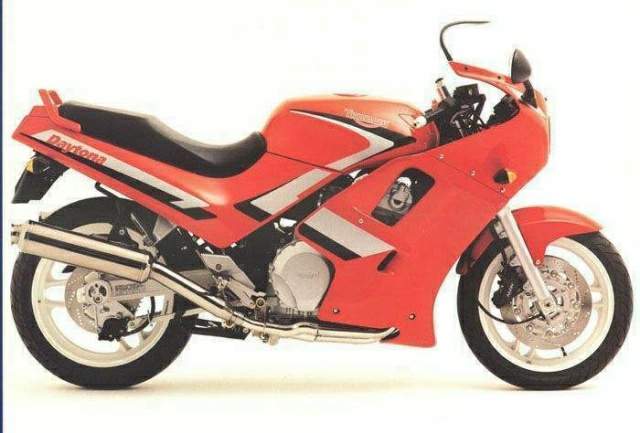
THERE WAS NO way these would be crap. Triumph's mix-and-match production
system means every 750 component has already made its debut in cither the
Daytona 1000 or Trident 900. And they were ace. So the chances of their little
brothers turning out to be a couple of no-hopers were slim.
But of all the Triumph range the two little 'uns could easily be the most
average. Both have identical short-stroke triple engines which carry frames,
forks, and numerous other bits hefty enough to take care of900 and l000cc
motors. Which may mean viccless handling, but what good's that if they're so
heavy it takes all day to get up to interesting cornering speed? The Trident
750, for example, weighs no less than the Trident1900, and the Daytona 750
weighs 131bs more than that.
Thankfully, the smallest of Triumph's engines strikes a happy medium between
the rev-the-nuts-off-me style of a GSX-R motor and the not-a-lot-happening style
of a Zephyr. And the medium really is happy.
The motor has enough mid-range power to make binibling along a pleasant and
relaxing experience, yet enough urge at the top-end to make you stop binibling
and get your arse in gear.
For a 750 the mid-range is arm-stretchingly impressive. There was a brief
hesitancy at all revs when the throttle was opened ("inexplicable, hardly worth
mentioning," said Triumph), but onceover this, it pulls cleanly from four thou,
strongly from six, and it's grins all the way from eight to the 11,000 red line.
After ten minutes on the Trident I actually stopped to check if some prankster
at Triumph hadn't peeled off a 900 sticker (the only obvious visual difference
between the two Tridents). The mid-range makes every other 750 seem gutless
between five and eight thou.
Of course the pay-off for such a useful middle bit is that the top bit is not
of GSX-R proportions. Which is not a problem on the Trident. Pulling away
sitting bolt upright, you may not actually be accelerating as fast as a wailing racer-replica, but it bloody feels like it. Your neck strains,
your arms stretch and you can wear a smug grin, because the engine isn't
anywhere near the red-line.
Similarly, when speeds start to get silly and top-end propelled GSX-R pilots
disappear over the horizon in search of fairing-encased adrenalin, I defy any
Trident rider to want to go faster. And anyway, the Trident is a "roadster", has
no sporty pretentions and doesn't have to compete with racer-reps on their own
territory. But the Daytona does; no matter what Triumph says about it being
designed unashamedly for road, not race track, use.
Its acrodynamically sculpted fairing, four piston Nissin calipers and low
slung bars immediately throw it in the ring with some awesome competition.
There's no way the engine can compete, because it isn't designed to. So if
you're sitting at the lights with a long straight ahead, and matey-boy pulls
alongside astride his arse-kicking ZXR750, don't expect to blow him away. If he
knows what he's up to, he'll keep his engine screaming and you'll go backwards.
But if he's not in the mood, or doesn't time his gear-changes with care you'll
be right up his chuff even if you're a gear higher than you should be. There
really is no excuse for not using the 'box on cither bike, because it is superb
— more of a foot operated switch than a lever connected to a mass of quietly
whirring gears. But the mid-range makes the Daytona an easy bike to be lax with
gear changing yet ride deceptively quickly.
The deception is appreciated by those in car-shot. As Johnny Knceslider
blasts his GSX-R along country B-roads, farmhouse curtains twitch in irritation
and Granny Perkins starts banging on about how motorcyclists were quieter in her
day. When a Daytona or Trident 750 powers past no-one complains and Granny P
shuts up while she works out what it was. The noise is so different from fours.
The triples emit a refined throb which is pleasing enough to have you acting
your shoesize not your age at traffic lights and sit there pumping the throttle.
The "sports" exhaust and silencer fitted to the Daytona did not make any
appreciable difference. Not with earplugs in anyway. As the revs build, the
noise becomes less refined, but no less pleasing, and at the top is not an
oriental scream, but a hoarse British shout. Makes you proud.
The handling and feel of both Triumphs are dominated by their similarities.
With a tall, upright engine, and a scat height of31.5 inches both feel top heavy
at first, and if you're short in the leg department, climbing aboard cither can
be an eye-waterer, never mind an eye-opener. They feel big; compared to Japanese
racer-rep 750s the height and weight of the Triumphs makes the rider instantly
aware that he is perched on top of a lot of metal.
The Trident is easier to adjust to, because being so high up seemed to fit in
with the riding position; with the raised bars and pegs set directly below your
bum, it's like sitting on a posh dining chair, whereas the very low 550 Zephyr I
normally run around on feels more like sitting on a toilet.
Guiding the dining chair through bends was fun — at least as much of a laugh
as the toilet. The Trident's weight and mid-range power gave it a secure feel, yet
the steering was light enough to let you drop into bends, confident that the
bike could be flicked upright round the other side. Perhaps because of the
sturdy frame and 43mm forks, which are capable of keeping the 900 in order, the
Trident did not suffer from the irritating/terrifying side-effect often
afflicting light front-ends — high speed wibbly-wobbliness. My only "moment"
came after hitting a large mysterious lump on a fast bend when the Trident lost
its assurance, the exhaust grounded and I was a tad worried. Character building
stuff.
But large mysterious lumps aside, the suspension copes superbly. On the
standard settings it's soft enough not to make you grip the slim tank in terror
when you see a sign saying "RAMP" and the car in front hop in the air, and it's
firm enough to keep the exhaust clear on corners unless you're really going for
it. Married with a comfy seat for both rider and pillion, a 5.5 litre tank and
the same superb bungee hooks as the 900, it makes the Trident a realistic
cruising tourer. Unless it rains. The easy-to-read clocks (speedo on the right for some reason) are big enough to cower behind
for a while, but it's not long before you wish you had a decent fairing.
Like the Daytona's. Its fairing works well, directing the worst of the blast
over your head, yet still leaving a goodly breeze to take weight off your
wrists. But unless it's tipping down and you've still got 400 miles to do, this
is outweighed by the fact that the handsome motor is cloaked behind high-tech bendy fibreglass. Slippery fairing aerodynamics give the Daytona a lOmph
top speed advantage over the Trident, but who cares? This is more than
out-weighed by the visible engine factor. Unless it rains.
The Daytona's bars are four inches lower than the Trident's which
automatically has the rider leaning from his dining chair and stretching for the
gravy on the other side of the table. But it's not a severe racing crouch, and
needs half an hour of crawling through traffic before wrist-ache sets in. Above
bimbling pace the Daytona is extremely comfortable because the riding position
is not extreme. The footpegs, for example, are in exactly the same position as
the Trident's — underneath the rider's bot. Which is not a problem unless you
fancy dangling your knee toward Tarmac. If you do, and you're around six foot
tall, remember to unhook your knee from behind the fairing to prevent a worrying
micro-second or two as you try to work out why your leg is apparently glued to the bike.
The way the Daytona scampers safely and rapidly through a succession of bends
is different from racer-rep 750s. It's softer, and there is never the worry that
should the road surface suddenly change from being race-track smooth to what the
council regards as smooth, you'll be in deep trouble. With their slowish (27°
rake/105mm trail) steering, both Triumphs reward smooth, confident riding with
enough feedback to let you safely correct cornering bungles on the spot. But
thanks to the Daytona's riding position throwing more weight over the front
wheel it is the more poised of the two. As it should be.
Just as the frame and forks make light work of a mere 750ccs worth of power,
the brakes too are well up to the job — the Trident's two pistons coping just as
well as the Daytona's four. Both bikes can be two-fingered to a stop rapidly in
the dry, and warily in the wet; the Dunlop Sport Radials were superb until it
rained. Then they moved disturbingly not a lot, but enough to make wet
roundabouts a delicate tippy-toe affair.
The Trident 750 will sell. Its engine, riding position and handling conspire
to make it fun and invigorating to ride. Its lustrous British racing green paint
job (the new cherry red one looks good too) and dashing good looks attract many
an admiring glance. And the competition is nowhere. Who wants a GT750, a 750
Zephyr, or even an FZ750 when there's a Brit that goes and looks so much better?
Nutters, that's who.
The Daytona is a different proposition. It is a comfortable, sporty, 750
tourer. In this little niche, it's the best. But in the sporty niche next door
sit yobs like the new GSX-R750, and in the tourer niche on the other side lurk
FJ12s. The Daytona lacks the racing glamour and pedigree of a ZXR, yet is too
small and buzzy (comparitively) for continent hoppers.
At ,£6149 the Daytona seems pricey unless it's compared to the Trident. For
just £850 more, the Daytona gets extra little goodies like span-adjustable
levers and extra big goodies like a fairing. It seems like a bargain until you
realise the FJ12 costs under £6000.
From an engineering point of view Mr Bloor and Co certainly haven't failed;
the Daytona's chassis and engine are as good as they get. Triumph has hit the
bullseye with both Tridents, but with the Daytona 750 you have to ask whether
they're aiming at the same dartboard as everyone else. □
Source Bike Magazine1991