|
|
|
|
Classic Bikes
Custom Bikes
Individual
Racing Bikes AJP
AJS
Aprilia
Ariel
Avinton / Wakan
Bajaj
Benelli
Beta
Bimota
BMW
Brough Superior
BRP Cam-Am
BSA
Buell / EBR
Bultaco
Cagiva
Campagna
CCM
CF Moto
Combat Motors
Derbi
Deus
Ducati
Excelsior
GASGAS
Ghezzi Brian
Gilera
GIMA
Harley Davidson
Hero
Highland
Honda
Horex
Husaberg
Husqvarna
Hyosung
Indian
Jawa
Kawasaki
KTM
KYMCO
Laverda
Lazareth
Magni
Maico
Mash
Matchless
Mondial
Moto Guzzi
Moto Morini
MV Agusta
MZ / MuZ
NCR
Norton
NSU
Paton
Peugeot
Piaggio
Revival Cycles
Roland Sands
Royal Enfield
Sachs
Sherco
Sunbeam
Suzuki
SWM
SYM
Triumph
TVS
Ural
Velocette
Vespa
Victory
Vincent
VOR
Voxan
Vyrus
Walt Siegl
Walz
Wrenchmonkees
Wunderlich
XTR / Radical
Yamaha
Zero
Video
Technical
Complete Manufacturer List
|
Triumph Bonneville 750 T140V
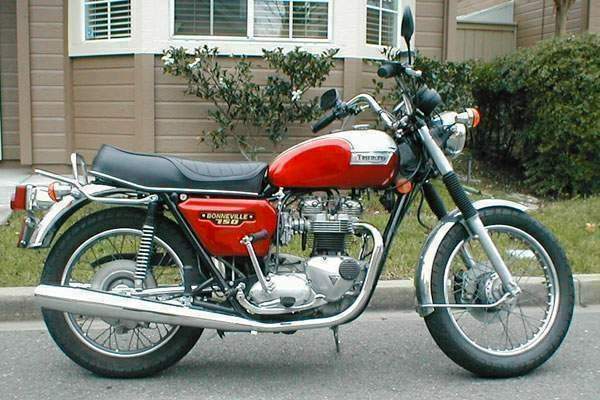
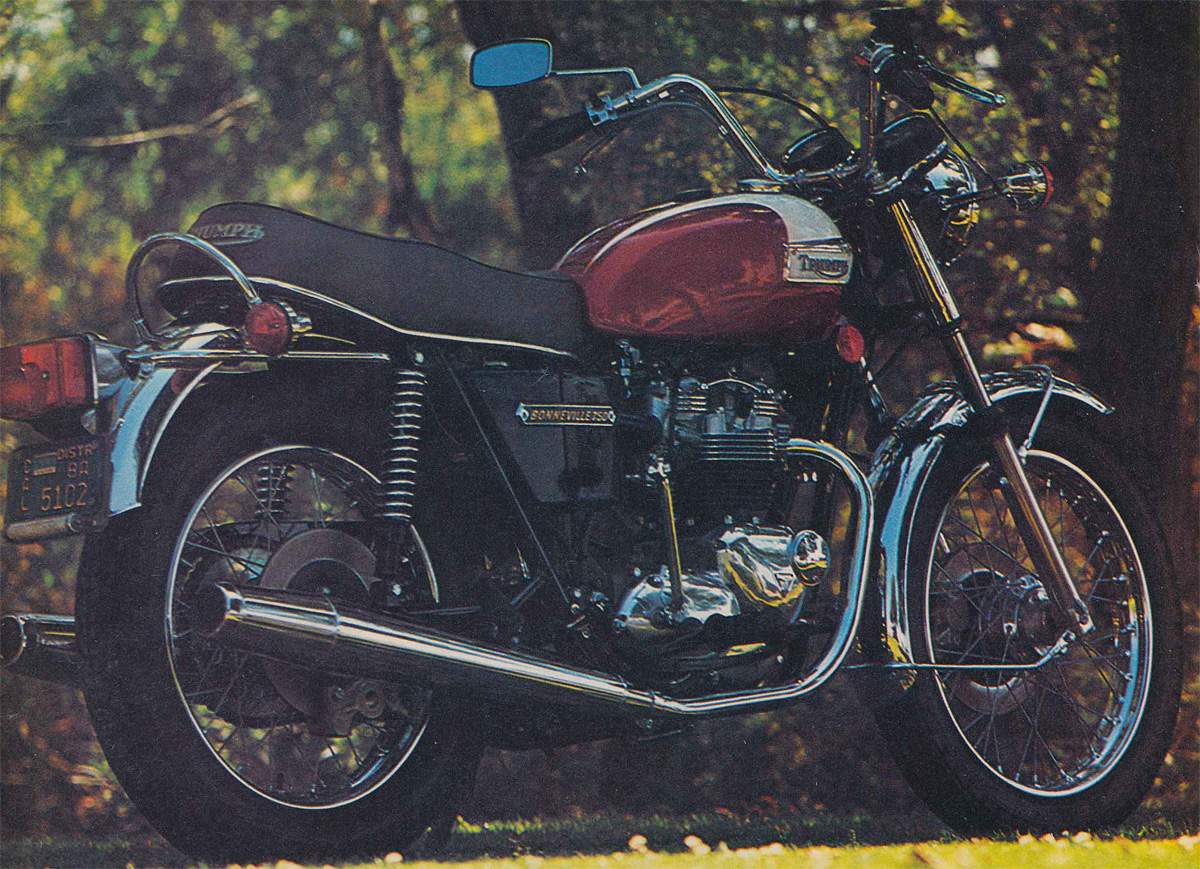
Cycle Guide Review How quickly they forget. It's been just seven or eight short years since Triumph was on top of the motorcycling world, yet to many of today's blonde-haired, tank-topped, sandal-clad young riders, the name Triumph means very little—if anything at all. Triumph's successes weren't the result of its motorcycles being particularly better than or especially different from all the other British bikes of the fifties and sixties, because they weren't. But somehow that marque, with its lean, classic styling, legendary performance, nimble handling, and total commitment to racing, became a symbol of everything motorcycling stood for—the embodiment of the sport itself. A Triumph looked, ran and sounded the way a motorcycle was supposed to look, run and sound. And no matter how many other motorcycles a rider owned, he ultimately longed for a Triumph. If he couldn't afford one, he tried to make his bike look like a Triumph. The decision to buy a Triumph was not based on practicality or financial considerations; it was emotional. But motorcycling went through some dramatic evolutionary phases in the late sixties, and astonishing breakthroughs made by the Japanese companies put an irreparable dent in the Triumph mystique. Mechanically, the Oriental designers outdid the British, building motorcycles that didn't break, didn't leak, didn't vibrate, didn't cost as much, and were impressive straight-line performers. The rest of the motorcycle industry reeled from the impact of the technologically-superior machines from Japan. The Japanese domination of the American motorcycle market crippled the Triumph organization, yet it easily might have survived were it not for an incredible succession of management blunders. The rest is history, and probably quite confusing to outsiders, who have heard only brief snatches of the on-again/off-again follies of the Triumph/BSA company, or who have wondered about the status of the beloved Bonneville. The important point, however, is that the Bonneville is still being produced and its future looks brighter than it has in years. The reason for the optimistic outlook is more than just the mere fact that the factory's doors are open once again. For one thing, the company's management has a better handle on its financial situation, and the whole operation is geared toward the market that is, not the one that was ten years ago. For another, a segment of the motorcycle-riding public is having second thoughts about the multi-cylinder miracle bikes proliferating today.
Those machines are incredibly heavy and intimidatingly complex. Their engines are so wide that they must be mounted much higher than normal, giving an unusually high center of gravity and the feeling of even more weight. They therefore handle more awkwardly and reluctantly than narrower, lighter bikes. And inflation in the Japanese economy has caused the prices of the bikes to rise higher and higher, so they don't really hold much of an edge in that area. The message is clear: To some people, a narrow, 400-pound, competitively-priced 750 twin that handles and steers lightly makes sense. If it happens to vibrate more than a multi, leak a bit of oil, or require more frequent routine maintenance, it's still a fair trade to obtain the kind of responsive handling and lean styling that currently isn't available anywhere else. But is the Bonneville actually relevant to today's rider, or are the people out there who welcome its presence merely misty-eyed sentimentalists who can't bear the truth? Is the trade-off between basic function and space-age sophistication really a worthwhile one, or has the Bonneville truly outlived its usefulness? The answers to those questions depend heavily upon what riding a motorcycle means to you. THE BIKE: The motorcycle's official model designation is the T140V, but only dealers, parts men, and others who work within the bike's distribution network view it clinically enough to call it by that name. To everyone else, it's a 750 Bonneville. The Bonneville is, for all intents and purposes, the same basic motorcycle it has been for years. Originally a 650 that utilized a separately-housed four-speed gearbox, the engine design dates back to 1950. The "two-piece" idea gave way to "unit construction" in 1963, which simply means the gearbox casing was cast as part of the engine cases instead of being an independent piece. The original 650 engine traded its chain-driven DC generator and self-contained magneto for a crank-driven alternator and cam-driven battery/coil ignition when the unit construction change was made. The displacement grew to 750 in 1970 with the addition of five millimeters to the cylinder bore, and the five-speed gearbox showed up in 1971. Swinging arm rear suspension came along in 1955, and an oil-in-the-frame chassis was introduced in 1971. Aside from those major changes, the Triumph 650/750 twins have remained essentially the same all those years. The unmistakable Triumph engine is severely undersquare, with a bore of 76mm and a stroke of 82mm. The 744cc four-stroke powerplant has a tame 8.6:1 compression ratio, but the owner's manual recommends the use of premium gas.
The overhead valves are pushrod-oper-ated by two separate camshafts. The intake cam is located just below the rear of the cylinder base, and the exhaust cam is just below the front. The pushrods live inside chromed metal tubes - one in front and one in the rear - that lurk in recesses between the cylinders. Access to the valve lash adjusting screws is through the oval inspection covers on the individual rocker boxes atop the engine. The two (one intake, one exhaust) bolt-on inspection covers replace the four screw-on caps that were fitted to (and often fell off of) previous Triumphs. A massive one-piece forged crankshaft spins in two main ball bearings, with two-piece plain bearings on the big ends of the aluminum connecting rods. The small ends of the rods use removable bronze bushings. A large cast-iron flywheel ring bolts around the middle of the crank and supplies a considerable amount of crankshaft inertia, which is typical of British motorcycle engines. The left end of the crank drives a triple-row primary chain and a large-diameter wet clutch. An adjustable primary chain tensioner—which is just a rubber-covered metal "slipper" beneath the lower run-prevents excessive fluttering of the chain as it stretches. All sorts of things happen on the right side of the engine beneath the triangular timing cover that immediately identifies the motorcycle as a Triumph. The right end of the crankshaft is fitted with a small gear that turns a larger idler gear, which then meshes with both the intake cam gear and the exhaust cam gear. A plunger-type oil pump sits just to the outside of the intake cam gear, and an eccentric on the gear securing nut moves the plungers up and down. The exhaust cam, meanwhile, also serves double-duty, as the point cam and spark advance mechanism bolt directly into a taper in the center of its drive gear. A breaker plate with two sets of Lucas contact points fits into the outer timing cover. The T140V's five-speed gearbox shifts on the left, a first for any Triumph twin. A cross-shaft traversing the engine between the gearbox and the crankcase area operates the same gear selector mechanism that Triumphs have used for years, and the internal structure of the transmission is the same as on right-foot-shift models. The large black housing beneath the seat conceals the Bonneville's dual washable gauze-type air filter elements. Two 30mm Amal concentric carbs handle the gas mixture chores, with cable-operated chokes and push-button ticklers provided for cold starting. The swivel-type choke lever formerly found on the left handlebar end is now attached to the bottom of the left carb. The Bonneville's exhaust system is a mix of old and new. The bend of the heavily-chromed pipes is traditional Triumph, with slightly upswept new-style tapered silencers designed to cope with ever-increasing noise regulations. The crossover tube between the two head pipes was introduced on 1969 Triumphs. The Bonnie's double-downtube frame uses the backbone and front downtubes as an engine oil reservoir, with a dipstick/ filler cap just beneath the front edge of the seat. The steering head rests at a 28-degree angle, and the wheelbase averages about 57 inches. An internally-sprung fork provides just over six inches of suspension at the front, and chromed springs on Girling shocks allow 3.25 inches of rear wheel travel. Dunlop rubber—of British origin and in the old-standby K70 tread pattern—is delivered at both ends; a 3.25 x 19 at the front, and 4.00 x 18 in back. Single hydraulic disc brakes provide the Bonnie's stopping power at both wheels with double-acting hydraulic calipers built by Lockheed. The fuel tank is the same classic 3 5-gallon unit that has graced the Bonneville since 1966. The deep burgundy paint, with white scalloped trim and hand-painted Triumph and Tribulations: Roger Stange is a man who inspires confidence. In an age when the Captains of Industry are more like temporarily-promoted orderly-room clerks, Stange projects his personality with Force Nine strength. American in the Gary Cooper tradition, with close-cropped blonde hair and eyes that seem to pick out some point in your brain and bore holes through your corneas to get there, Roger Stange is clearly a man who knows the ways of command. And he needs to, because Stange is president of Norton Villiers Triumph America, Incorporated, and could well have the toughest and least-envied job in the motorcycle industry. But not to hear him tell it. In his David Brinkleyesque baritone, Stange tackles the problems and obstacles facing NVT with seeming relish. He does not avoid the disasters of the past, but like most aggressive men, is more interested in the future. "The most important thing," he says, "is that there is a future for us." Can this be true? Can the company that suffered a near-total work stoppage for 18 months during its most critical time be alive? Will Triumph's 600 American dealers actually have something to sell? Until a few weeks ago, it seemed unlikely. But a corporate reshuffle (which changed the name of the U.S. subsidiary of Norton Villiers Triumph Limited from Norton Triumph Corporation to NVT America, Inc.) has lifted the cloud of dread which has hung over NVT since the withdrawal of the British government's money in September of 1975. The reorganization has resulted in a virtual emancipation of NVT, which now has more freedom of operations than at almost any previous time, with no lame-duck factories or political pressure to bear. It owns all the tooling, designs and research of the old group with none of the constraints, which means that NVT is free to manufacture motorcycles anywhere it is economically feasible to do so. while retaining in full force the remarkable engineering design which has in the past and will in the future characterize British motorcycles. In addition, with the shackles off, NVT America can now source its parts much more freely, assuring a better supply to dealers and customers. This action alone has breathed new life into the American operation, which has been slashed from over 100 employees to less than 30 as part of Stange's save-Triumph effort. Even the computer in the Duarte, California headquarters has been laid off, saving the company, according to Sales Vice President Tom Cates. a small fortune. In fact, as you walk through the huge Duarte building, noting the empty offices and silent, darkened computer, you begin to get an inkling of how serious Stange is about making it all work. Instead of trying to salvage his operation with a gigantic media blitz costing millions. Stange has taken the hard, bitter way of cutting back, making do with less and just plain working harder. In the same building where the empty corridors echo hauntingly, there are frantically busy, cheerful people who move as though they really care about what they are doing .. . which, clearly, they do. It is not a typical modern office atmosphere, and it reflects the new atypical approach to survival and success fostered by Stange. "The days of glory, of hundred-thousand dollar dealer conventions, of three-hundred thousand dollar carpets for this place, are gone. We can't change that. But we can meet the demands of the significant number of people in North America who want what a Triumph or Norton—and only a Triumph or Norton—can give." But is there really a market? After seven years of Honda CB750s, does anyone really want a Triumph? Half an hour from Duarte is Robert M. Law's Triumph-Yamaha dealership. Tucked away in downtown Anaheim, his store is more like a piece of Kansas City or Des Moines than of modern California, with its shiny, chrome-faced, all-glass Kawasaki and Yamaha and Suzuki and Honda dealerships. If anyone can tell about demand, Bob Law can. "Oh, yes, times have sure changed," he muses, staring across the street to where his old hole-in-the-wall shop used to be. "But 1 don't think there is any doubt about demand for Nortons or Triumphs. You don't sell them like you do a Japanese bike, you just write up the sales ticket when someone wants one." He points to a gleaming brown XS500C Yamaha and asks somewhat ruefully, "How could you sell a Norton against one of those?" Right now, with the limited product line in NVT's book, there is no way. But NVT has definite production ideas for the motorcycles being developed at the Shenstone. England facility: The 900cc T180V Trident, the dohc 750cc Norton Cosworth and the air-cooled rotary, which. Strange says with a gleam in his eye, is a "real motorcycle, not a refrigerator." Plans, confidence, "development." In the light of recent turmoil, in the light of the appalling disappearance of first BSA, then BSA/Triumph and finally Norton-Triumph, is any of it credible? The answer to that is a little clearer when you understand something about the history of the companies involved. Take, for example. Triumph. Most Americans have an image of Triumph as a solid, tradition-bound company rooted firmly in the English subsoil of Queen Victoria, but in fact. Triumph has been through more changes in its 74-year history of motorcycle production than many younger companies. Originally founded by a German. Siegfried Bettmann, as an import/export firm in London, Triumph was successively a bicycle exporter, then bicycle manufacturer, motorcycle maker, car manufacturer, and finally motorcycle manufacturer once again. The corporate juggling that went on before the BSA merger or the highly-publicized work stoppage in Meriden in 1973 was in many ways just as important, though less visible. That stoppage itself (which was a lock-out of NVT by the workers at the Bonneville- and Trident-producing Meriden plant) is the beginning of most people's image of the Triumph calamity, and as such deserves a closer look. It came about because, as part of a British government plan which would combine BSA, Triumph and Norton output, only two of the three main factories producing BSAs, Triumphs and Nortons (at Small Heath, Meriden. and Wolverhampton respectively) could remain in operation . . . and Meriden was the loser. Small Heath was to build Tridents and Bonnevilles, while Wolverhampton continued Nortons. But the workers at Meriden objected, and the result was the 18-month work-in that crippled the whole NVT timetable. According to company reports, it was impossible to get the vital Trident tooling out of the Meriden factory, and the result was—predictably—chaos. Even that chaos might have been untangled sooner had not the issue become political, which both sides now agree was the case. Shifting government policies finally resulted in the infamous withdrawal in September of 1975 of government assistance (originally made necessary by the aborted NVT new-product and parts production timetable) and resultant shortfall of profits. To many, it looked like Norton, Triumph and British motorcycles were dead forever. But not to Dennis Poore. Roger Stange. and the other directors of NVT, who worked steadily to achieve the resurrection of the company, nor to the workers at Meriden who bought their factory (with government money, ironically), formed a worker's cooperative and began contract production of Bonnevilles and Tigers for NVT. Victory has hardly been snatched from the jaws of defeat for NVT, but a viable group of companies, pared to the bare essentials of dedicated professionals, with working capital, tooling and freedom to work, has been extracted from the debacle. Reflectively, Roger Stange gazes at the Norton Triumph logo on his wall. "We hit absolute bottom a few months ago," he says, and then his eyes light up as he continues, "but that means we have nowhere to go but up!" Those are the words of a fighting general who knows the whole score, and there is no better combination for gold pinstriping. is flawlessly applied. The tank alone accounts for about half of the timeless charm that has made the Bonneville a "classic." Thickly-chromed steel fenders attractively shroud both wheels, and a large chromed headlight housing adds to the brightwork. The dual seat is stylish and looks quite thick, but is hollowed out considerably to fit down over the frame side rails. The rubber-mounted handlebars have quite a high rise, which some riders dislike. However, most Triumph dealers will testify that when the Bonnevilles were delivered with lower, wider bars, many buyers requested high risers. So the factory made them standard equipment several years ago. The most inescapable feature of this motorcycle is still its enduring, classic lines. Lithe, lean, and unencumbered, the styling has been—and remains—a standard of excellence for all others to study and imitate. ENGINE AND GEARBOX: The new T140V starts the way Bonnevilles have always started—with a healthy romp on the right-side kickstart lever. We tickled the carbs for cold starts and the Bonneville always started with one kick. Unless the temperature drops to around 40 degrees or less, the choke is not needed. The T140V is willing to pull away as soon as it comes to life. However, a minute or two of warm-up is recommended, and the machine won't idle happily until it is warmed up. Once warm, the Bonneville can be left idling for minutes at a time without stalling. Compared to other 750s, the peak horsepower and torque figures of the Triumph twin aren't very impressive. Instead, the engine has a wide, tractable power spread. It will accelerate almost as strongly from 1500 rpm as it will from 5000 rpm, and you can cruise smoothly anywhere from 25 to 105 mph in fifth. At 55 mph, the engine is turning just below 3500 rpm in fifth gear, and makes its maximum horsepower at 6000 rpm. If the throttle is snapped all the way open below 2000 rpm, the engine will sputter a moment before it catches its breath and begins accelerating. Below 1500 rpm, whacking the throttle wide open will kill the engine until you close the throttle slightly. This problem is negated somewhat by very stiff throttle return springs and a throttle opening span of well over a quarter turn. Together they make it difficult to snap the throttle wide open from low throttle openings. None of the above presents much of a problem, however, because the engine responds so briskly and cleanly to small throttle openings. The biggest improvement in the new Bonneville is its five-speed gearbox. The old Triumph four-speed was a crunchbox in the most literal sense of the word. If you smoked away from a stop and tried to hang a quick power shift into second above 6000 rpm, you got a loud crunch, a false neutral, and floating valves. High-rpm downshifts sometimes produced the same results and could suddenly put you in a neutral when you were diving into a corner. The left-side-shifting five-speed is among the smoothest, most positive-shifting gearboxes we've ever used. A fairly high pressure is required to shift, but the throw is short and each gear engages quietly. Since there is no indicator lamp, finding neutral sometimes takes several pokes at the lever and a very cautious release of the clutch. The gearbox ratios are staged with perfect progression. First gear is tall enough to be useful for more than just starting out, but there is an unusual amount of flywheel effect and enough low-speed power to make it easy to get under way with a minimum of clutch slippage. Fifth gear is also slightly tall, making it suitable for cruising, but third or fourth is required for quick high-speed passes, especially on uphill grades. The clutch engages progessively and doesn't grab, drag or slip. A moderately stiff pull is required to disengage it. Performance was once the keynote of the Bonnie's personality, but that has changed. Although the Bonneville accelerates as hard as it always did—or even a little harder—it can't match the 750 multis for raw horsepower. However, with considerably less weight to lug around, it laid down a best standing-start quarter-mile run of 14.20 seconds at 92.4 mph. That's a respectable time, but not in the superbike category anymore. However, the TI40V has become somewhat of a big-bore economy champion. Ours averaged 44.8 miles per gallon during the test, with a best figure of about 50 mpg during a long cruise at a steady 55 mph. The reasons for its good gas mileage are its low overall weight, good mid-range torque, and fairly tall gearing. HANDLING: At 414 pounds (with the gas tank empty), the Bonneville weighs about 100 pounds less than most other 750s (the 430-pound BMW being a notable exception). And the T140V feels lighter than it really is, even standing still. When you're putting it on the centerstand, for example, it feels like a tall 125. The light weight of the machine is an important factor contributing to the Bonneville's wonderfully light and quick—yet steady—handling. The machine has a low center of gravity, and the front end geometry (28 degrees of rake and 4.3 inches of trail) is designed for easy steering. A rider used to a bigger, heavier, slower-steering multi may be surprised on his first ride on the Triumph twin. A little bit of pressure on the handlebars or a small amount of body lean produces a lot of change in direction—right now. The same sort of force exerted on a big four-cylinder 750 results in a much smaller change of course. The Triumph's quickness makes it possible to flick the bike from peg to peg in an ess-bend with no more than a mild pressure on the handlebars. It sometimes feels like the Bonneville turns if you just think about turning. The steering quickness is combined with enough stability to make the bike steady and dead accurate in turns of any speed. Rush up to a corner, point the front wheel where you want to go, and you'll get there without having to adjust the steering two or three times in the process. Given a line, the Bonneville sticks to it like it was on rails. However, if you do want to change your line in a corner—as you might in a blind, decreasing radius turn—the T140V does it willingly. Despite its light steering response, the Bonneville is stable in the rough. For example, one tester ran over a fist-sized rock while cornering hard at 50 mph, and much to his surprise, the bike never even twitched. Bumps and sidewinds don't divert the machine either, and though it wiggles somewhat in rain grooves, the wiggling never causes discomfort or a change of direction. The damping of both front and rear suspensions is much better than with most original-equipment suspension components, but the springing is stiffer than average. This stiffness is a slight advantage in smoothly-paved corners, and a distinct disadvantage in bumpy corners, where the bike gets bounced around more than other machines. The bike's lightness and low center of gravity, however, keep the bouncing from affecting control very much. So even in very cobby corners, the Bonneville steers more accurately and steadily than most machines. The Bonneville's cornering Ground Clearance is only slightly greater than average, but the confidence imparted by the machine during cornering is much greater than average. As a result, we could easily drag the centerstand in left-handers and the muffler clamp in right-handers. One of the most surprising things we encountered was what happened when we grounded something hard enough to lift the rear wheel off the road: Nothing. The rear of the bike moved over an inch or two and the tire regained traction, all without a twitch or a wiggle. The Dunlop K70 tires are adequate within the limits imposed by the machine's cornering clearance. Although the K70 tread pattern isn't as good as the K81, it works well on wet pavement. The original equipment tires on the Triumph are British Dunlops, which seem to have a better rubber compound than Dunlops made elsewhere and partially explains why the K70s work as well as they do. Most Bonnevilles will see a lot of city driving, and the machine's light, easy steering is a real asset in town. The quick handling makes the bike outstanding in the low- and medium-speed types of cornering done in the city. And the lightness and nimble handling at ultra-slow speeds make the T140V easy to manage in stalled and crowded traffic. COMFORT AND RIDE: This is where the Bonneville comes up shortest. There is no way the machine can be considered a comfortable long-distance tourer. Vibration, although significant, wasn't as bad as we had anticipated. The T140V's throbbing sort of vibes were only annoying above 3000 rpm. Around town we rode at fairly low rpm most of the time (because there is so much usable power down there), so the vibration didn't bother us too much. However, while wringing the bike out on our favorite back roads, the vibration sometimes intruded into our enjoyment. And at highway speeds—over 50 mph in fifth—the vibration constituted a significant source of discomfort. It reached us primarily through the seat and non-folding footpegs. Other major annoyances in touring-type riding were the seat—which began to produce sore butts after 45 minutes of riding, even in town—and the kickstart pedal, which poked into the rider's right calf all the time. The lever isn't splined onto the shaft; it's located with a tapered key, so you can't rotate it to another position. The seating position itself was quite comfortable for all of us, although some testers felt the handlebar shape was slightly annoying during low speed maneuvering. Most of us agreed that we prefer the handlebars that came on Bonnevilles in the late sixties. However, one thing that hasn't changed is the narrowness of the bike, and that's something just not available on other 750s. The narrow Triumph tank allowed us to sit comfortably without spreading our knees any more than if we were sitting in an armchair, and the forward location of the footrests didn't require us to bend our knees sharply. Everyone who rode the bike complained about the heavy throttle return pressure which quickly tired the rider's right hand and forearm. The problem is overly-stiff throttle slide return springs, and is aggravated by a sticky throttle cable which adds resistance to throttle movement. The Bonneville's stiff suspension gives a harsh ride over both large and small bumps. The ride was especially unpleasant over road surfaces made of concrete slabs laid end to end with each slab at a slightly different height. Sharp bumps were the worst; the suspension could cope with gradual road irregularities like long dips, but for big, sharp bumps, the most comfortable approach was to stand on the pegs and let our legs absorb the jolt. Over the years there have been a lot of Triumph twins fitted with loud accessory exhaust systems, and recent sound level restrictions probably reflect, in part, the irritation those loud pipes have caused non-motorcyclists. The new mufflers still allow the Bonneville to tell everyone it's a Triumph, but that growl has been subdued to 92.6decibels. BRAKING: Disc brakes front and rear have given the Bonneville stronger, more-fade-resistant, more-predictable braking than was ever available with older drum-braked Triumphs. The new front brake requires a strong squeeze, but works pro-gressively, and—if enough pressure is applied to the lever—will lock the front wheel. The front brake lever is a long way from the grip, and operates over a fairly short span, so our small-handed staffer had trouble using it comfortably because there is no adjustment. The rear brake also requires strong pressure to lock and operates progressively and predictably. Neither brake faded, even after many hard applications in rapid succession. RELIABILITY DURING TEST: Yes (before you ask), the Bonneville did leak oil. Each time the bike was parked, a few drops of 50-weight appeared under the bike. This made it a little harder to keep the motorcycle (and the driveway) clean, but we never had to add oil. The carbs also leaked a little, particularly if the gas was left on when the machine was parked. On one particularly hot day, the glue holding the right grip to the handlebar throttle assembly began to melt. Consequently, the grip loosened slightly and slipped down towards the end of the handlebar. A better glue would solve the problem. The bulb intended to illuminate the tachometer at night kept slipping out of the tachometer back, apparently because of a poor fit between the bulb holder and the hole in the tach back. However, this ceased to be a problem when the tach stopped working altogether. A plug in the tachometer gearbox (on the left end of the exhaust camshaft) had fallen out. allowing the gear that drives the tach cable to slip out of place. Replacement parts cost a dollar and took a few minutes to install. CONCLUSION: The Triumph Bonneville 750 is definitely not everyman's motorcycle. The breed of rider cultivated within the last decade has come to demand mind-boggling power, electric-motor smoothness, a plush ride, 100-percent reliability, and a sizable dose of the technical wizardry one would expect in the space age. The Triumph cannot fulfill those expectations, and the vast majority of today's riders will shun it for that very reason. What the Bonneville has to offer is light weight, dead-accurate steering, telepathic handling, low-rpm torque, and stone-ax simplicity. It has styling strong enough to get a certain kind of rider interested, and a personality vivid enough to keep him that way. Which means that the things that made a Bonneville appealing in the first place are still going for it: It does what a motorcycle is supposed to do, and it looks the way a motorcycle is supposed to look. The type of person drawn to a Bonneville today is as staunch in his interpretation of motorcycling as the Bonneville itself is in its design. His relationship with a motorcycle is not one of possession, but one of involvement and affection. He looks upon engine vibration not as an annoyance, but as the throbbing pulse of the motorcycle's heartbeat. Wiping a bit of oil off the cases is not a hassle, but a chance to touch his motorcycle's very soul. Frequent routine maintenance and repairs aren't an inconvenience, but an opportunity to strengthen the emotional bond between man and machine—a bond that seldom exists if the partnership is with one of the computer-perfect, appliancelike motorcycles of the present. The Bonneville owner is a person with an explicit point of view about motorcycling, and the Bonneville is a motorcycle that exemplifies that point of view. Those who don't share that viewpoint - those who have never thought of a multi-cylindered, water-cooled, vibration-free, dead-reliable, solid-state motorcycle as a lifeless refrigerator - will never understand.
|
|
|
Any corrections or more information on these motorcycles will be kindly appreciated. |