|
|
|
|
Classic Bikes
Custom Bikes
Individual
Racing Bikes AJP
AJS
Aprilia
Ariel
Avinton / Wakan
Bajaj
Benelli
Beta
Bimota
BMW
Brough Superior
BRP Cam-Am
BSA
Buell / EBR
Bullit
Bultaco
Cagiva
Campagna
CCM
CF Moto
Combat Motors
Derbi
Deus
Ducati
Excelsior
Fantic
GASGAS
Ghezzi Brian
Gilera
GIMA
Harley Davidson
Hero
Highland
Honda
Horex
Husaberg
Husqvarna
Hyosung
Indian
Jawa
Kawasaki
KTM
KYMCO
Laverda
Lazareth
Magni
Maico
Mash
Matchless
Mondial
Moto Guzzi
Moto Morini
MV Agusta
MZ / MuZ
NCR
Norton
NSU
Paton
Peugeot
Piaggio
Revival Cycles
Roland Sands
Royal Enfield
Sachs
Sherco
Sunbeam
Suzuki
SWM
SYM
Triumph
TVS
Ural
Velocette
Vespa
Victory
Vincent
VOR
Voxan
Vyrus
Walt Siegl
Walz
Wrenchmonkees
Wunderlich
XTR / Radical
Yamaha
Zero
Video
Technical
Manufacturer List Contact
|
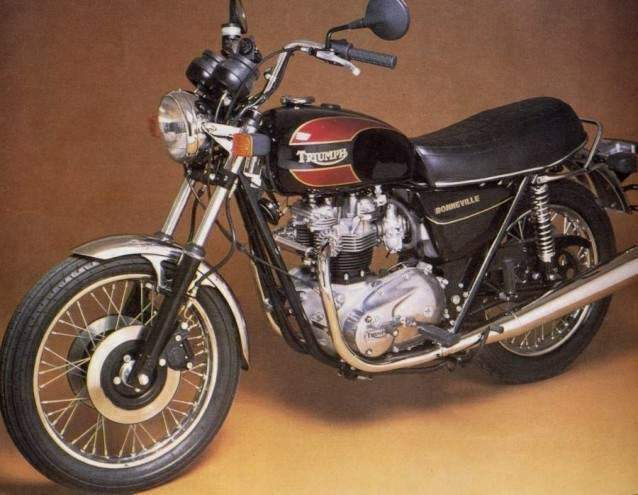
Triumph Bonneville 750 T140E Final Edition
Development History The original Triumph Bonneville was named after the Bonneville Salt Flats in the state of Utah, USA, where Triumph and other motorcycle companies made attempts on the world motorcycle speed records. It was popular (particularly in its early years) for its performance, compared to other bikes available. Although later enlarged to 750 cc, in the late 1970s and early 1980s it suffered when compared to more modern and reliable Japanese motorbikes from Honda and other manufacturers. The T120 engine, both in standard configuration and especially when tuned for increased performance, was popular for installing in café racers such as Tribsas, and particularly Tritons. T120 Bonneville The original Triumph Bonneville was a 650 cc parallel-twin (two-cylinder) motorcycle manufactured by Triumph Engineering Co Ltd and later by Norton-Villiers-Triumph between 1959 and 1974. It was based on the company's Tiger 110, and was fitted with the Tiger's optional twin 1 3/16 in Amal monobloc carburettors as standard, along with that model's high-performance inlet camshaft. Initially it was produced with a pre-unit construction engine which enabled the bike to comfortably achieve 115 mph without further modification, but later (1963), a unit construction model was made which was more compact and added slightly to the stiffness of the set-up, together with additional bracing for the steering head and swinging arm. The steering angle was altered and improved forks were fitted a couple of years later, which, together with the increased stiffness enabled the overall performance of the Bonneville to match that of its rivals. T140 Bonneville Developed from the later 'oil in frame' (based on that of the BSA A65) version of the T120, the first few T140s, designated T140V, featured a larger capacity engine of 724 cc, a five-speed gearbox option and indicators, but still retained drum brakes and kick-start. Shortly after, the engine was further bored-out to 744 cc and front disc brakes were fitted (single discs before 1982). In 1975, along with engine modifications, the gearchange lever was moved from right to left to comply with regulations introduced for the American market. Several T140 models followed featuring various modifications and refinements until production ceased with the closure of the Meriden works in 1983.
Meriden Bonneville Time-line 1958 Debut of Bonneville T120 at Earls Court Bike Show 1959 First Bonneville 650cc T120 released. Headlamp is enclosed in a nacelle and frame is single downtube 1960 New model appears with twin downtube duplex frame and headlamp nacelle is absent 1961 Amal monoblocs replace remote float bowl set-up 1962 Land speed record achieved @ 224.57mph 1963 Unit construction of engine and gearbox. Frame is revised with single downtube and duplex cradle 1964 Approximately 70 Thruxton Bonnies built over next 2 years 1967 Amal Concentric carburettors are introduced 1971 Oil in frame Bonnevilles appear and indicators are standard 1972 Optional five speed gear box is introduced 1973 Five speed 750cc T140 released. Front disc brake is added and frame revised. NVT announces closure of Meriden. 1975 Meriden Co-operative agreed to and trading begins under new name of Meriden Motor Cycle Co-operative. First of the new Meriden Co-op Bonnevilles appear 1976 Left side gear change is now standard as is rear disc 1977 Purchase of Triumph name and sales rights from NVT. Limited edition Silver Jubilee released 1979 New model sees electronic ignition, MkII Amals, revised instrumentation and parallel inlet ports 1980 Electric start available 1983 Last of Meriden built Bonnevilles. Increasing debts force Meridens closure 1985 Bonnevilles now built under licence by parts manufacturer LF Harris in Devon 1988 Production of Bonnevilles cease
|
|
|
Any corrections or more information on these motorcycles will be kindly appreciated. |