|
|

|
|
|
|
Classic Bikes
Custom Bikes
Individual
Racing Bikes AJP
AJS
Aprilia
Ariel
Avinton / Wakan
Bajaj
Benelli
Beta
Bimota
BMW
Brough Superior
BRP Cam-Am
BSA
Buell / EBR
Bultaco
Cagiva
Campagna
CCM
CF Moto
Combat Motors
Derbi
Deus
Ducati
Excelsior
GASGAS
Ghezzi Brian
Gilera
GIMA
Harley Davidson
Hero
Highland
Honda
Horex
Husaberg
Husqvarna
Hyosung
Indian
Jawa
Kawasaki
KTM
KYMCO
Laverda
Lazareth
Magni
Maico
Mash
Matchless
Mondial
Moto Guzzi
Moto Morini
MV Agusta
MZ / MuZ
NCR
Norton
NSU
Paton
Peugeot
Piaggio
Revival Cycles
Roland Sands
Royal Enfield
Sachs
Sherco
Sunbeam
Suzuki
SWM
SYM
Triumph
TVS
Ural
Velocette
Vespa
Victory
Vincent
VOR
Voxan
Vyrus
Walt Siegl
Walz
Wrenchmonkees
Wunderlich
XTR / Radical
Yamaha
Zero
Video
Technical
Complete Manufacturer List
|
Triumph Bonneville 750 T140E
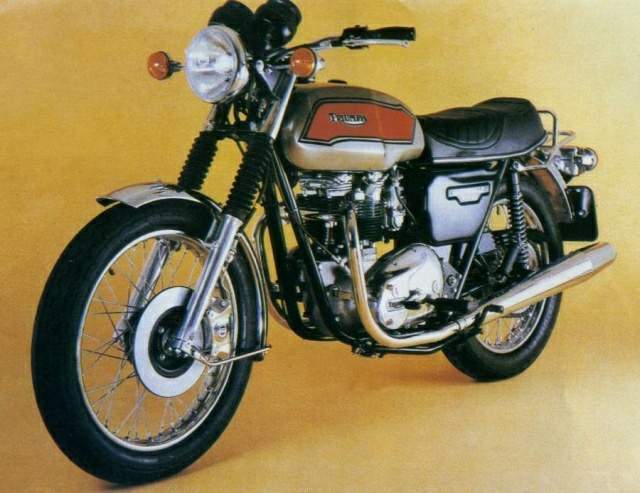
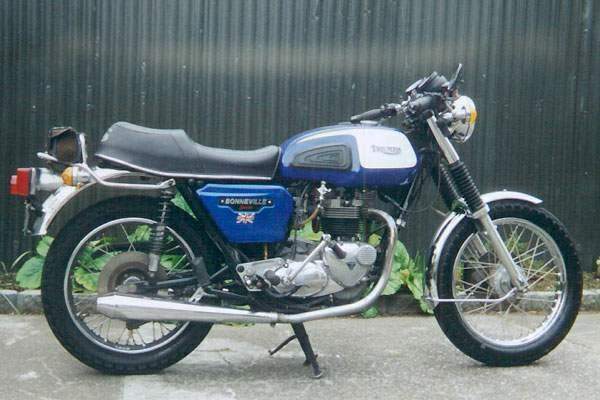
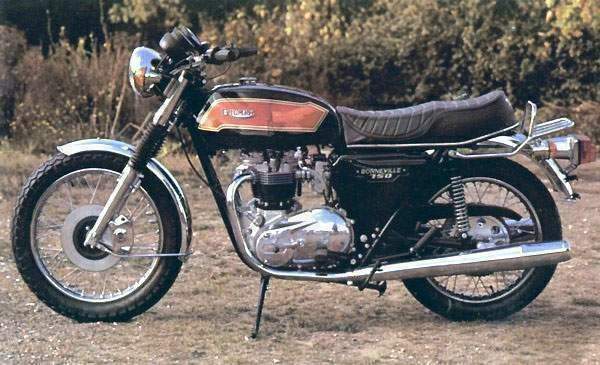
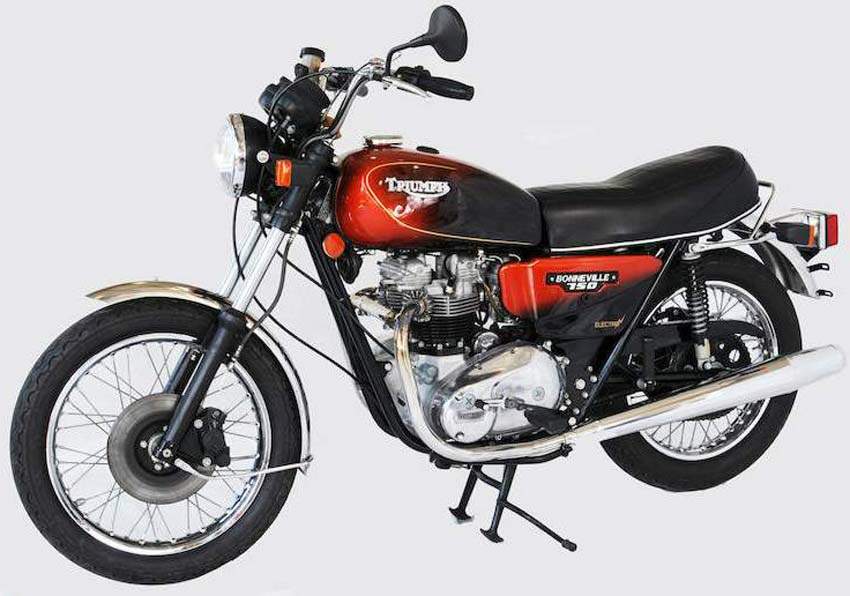
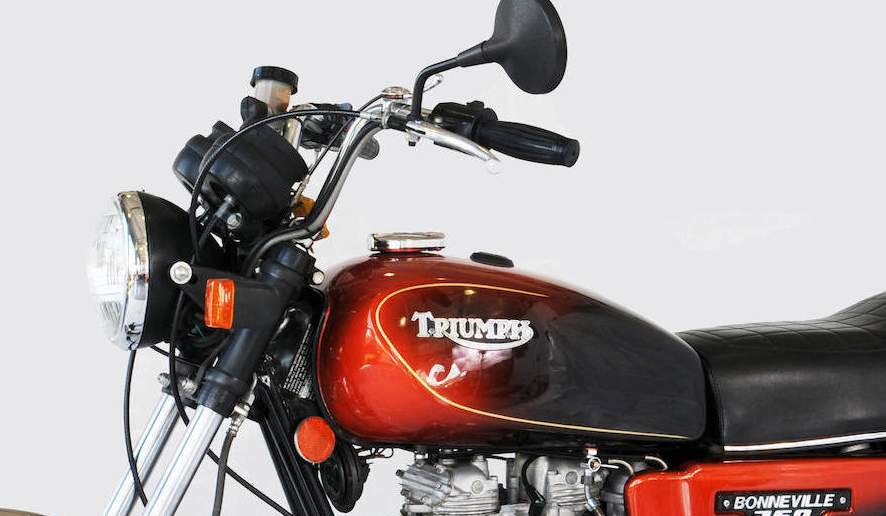
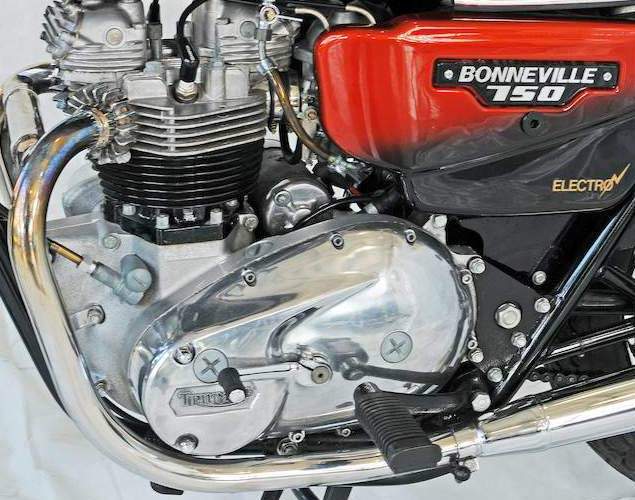
Road Test 1978 The Triumph Bonneville has traditionally been held responsible for everything from keeping Harleys out of winner's circles to keeping small-town daughters locked up. But nowadays a new kind of fantasy surrounds the well-known curves of the Bonnie the fantasy of a machine from an earlier, simpler age. And even if those over 25 can hardly consider the Fabulous Fifties an age of simplicity, whenever the conversation turns to Triumphs the talk inevitably turns nostalgic. It's too bad. The Bonneville is more than a cartoon of a Fonz-bike, more than simply an oil-leaking hunk of prehistoric British iron. It is as legitimate a motorcycle as can be found anywhere, one whose character is instantly apparent in the bluff honesty of its upright cylinders, and one which deserves the attention of all serious riders, allegations of outrageous anachronism notwithstanding. But so overwhelming is the flood of techno marvels from Japan that most enthusiasts probably think that even this latest Bonnie is simply the old one dolled up in new powder and paint. No so: In the biggest single change since the bike got its 747cc engine in 1970, the Amal concentric carburetors have been chucked out, to be replaced with a pair of far more modern Amal Mk IIs. Mikuni-like, they eliminate much of the hassle of the old Bonnies, since they have a single lever-type choke and excellent flow characteristics enhanced by parallel intake tracts. Other changes include the use of "inverted" Girling gas shocks, Dunlop K81/ TT100 tires front and rear (in place of the old squarish K70s) and redesigned side covers. The list price is one of the few things that hasn't changed much. The improvements and inflation in the two years since we last tested a Bonneville have only raised the price $300, to $2299. Given that price, the potential buyer might well ask (since it's remarkably low for a 750) what he gets, besides a conversation piece. As our test Bonneville showed me all over again, quite a lot. First there's the phenomenal Triumph handling, a thing so unique it's been a cornering yardstick used by motojournalists for over a decade. Indeed, it's that very familiarity with the Bonneville's handling that's bred a certain contempt for it, especially among Triumph marque freaks, who maintain that the post-'71 bike was never as good as the "old" Bonnie. So it's probably worthwhile to examine the roots of the whole thing.
What makes Bonneville handling so special today—in the era of monsterbikes—is its effortless precision. This is a motorcycle whose pegs your grandmother could drag, not because they're too low (and they are, a bit) but because the bike combines magic qualities of suspension geometry, frame stiffness and mass placement in such a way that no steering input seems to require much effort. This is something we tested further than normal, since we replaced the standard handlebar—an egregious cryptochopper affair totally incongruous among the clean lines of the bike—with an optional ($16) European handlebar with which all domestic Triumphs are equipped. And riding efforts with either bar were precisely the same: so low you only need think the bike through a corner. This spectacular ability of the Bonneville to dazzle its rider with instant response is matched by the road-holding of its suspension and tires. Dunlop's H-rated (130-mph) K81s have a justly-won reputation for stickiness that finds a perfect match in the compliant front fork and firmly sprung rear shocks. Although the Girling folks claim about a half inch less travel with the new gas emulsion shocks than with the old air/oil types, the damping is superb, and we simply left the shocks on the softest of their three spring-preload positions—even for two-up riding. There are only two limiting factors in how far and how hard you can ride the Bonneville: the dragging point of the undercarriage and the fatigue imposed by the mild but ever-present vibration of the big twin. The first factor is something all Triumphs within recent memory have shared, and the culprits are easily identifiable: the huge, rubber-booted footpegs, the left-side stands and right-side exhaust pipe. Mind you, it's not like you ground these items when turning into the supermarket parking lot; you have to be trying for the limit with some energy before the pavement rushes up to the unyielding bits. And even when the bike thunks gently onto the ground with one of its appendages, the fantastic stability of the Bonneville allows the rider either to simply ignore the peeling rubber and trailing sparks or back off—all without necessitating a change in line. Or, for that matter, a rise in the adrenaline level.
Similarly, the loping thunder of the vertical twin (muffled but still satisfyingly present even with the too-long exhaust pipes) finds its way into the handlebar and footpegs in the form of a gentle throb. This is not the feared and often invoked Eyeball Death Rattle used to scare young riders away from British bikes, but an insistent reminder that the motorcycle you're astride is a product of the technology of three decades ago, when engine counterbalancers were quite simply not to be thought of—especially in motorcycle engines. But it doesn't require a hopeless Anglophile to recognize that the vibration is low-frequency and only intense enough to rate about a three on the Vibro-Scale (on which the Yamaha XS Eleven is a zero and the BSA Victor is as close to ten as anyone can bear). Nonetheless, despite the excellent ergonomics of the bike—footpegs, grips and controls occasioned no gripes even from this gripe-prone staff—the vibration will eventually tire even the sturdiest Belstaff-suited Bonneville rider. And long before that will have occurred, the blurred mirror will have irritated the rider enough to vary his pace. The convex Stadium bar-end mirror fitted to the low bar is a vast improvement over the standard flat Harley-style mirror, but even it couldn't clear up the fuzzies. And that lack of effective rear-view vision could be of some concern to the Bonneville rider, because the handling of the bike is matched perfectly to the power of the engine—a certain recipe for full-throttle back-road riding. Capable of 100 mph inside a half mile and of thrashing through a quarter-mile in 13.41 seconds at 96.2 mph, the Triumph is clearly no slug. Indeed, this year's MK-II carbureted bike, with no other performance changes (including gearing) was .79 seconds and 3.5 mph faster than our '76 test bike. No threat to the Honda Six, to be sure, but respectable enough to keep the men in the black-and-whites alert. After all, they're used to thinking of Porsches as about the quickest things around.
None of this, of course, adds up to a bike that could be thought "modern" in the same way a Suzuki GS1000 could. We expect our motorcycles to be indestructible today, demanding even zero-maintenance from our chains, and in those terms the Bonneville is a hopeless antique. It requires its owner to understand everything about it, from the way the people at Meriden gave its slick-shifting five-speed gearbox a left-hand shifter to the secret cure for a leaking countershaft seal (ours didn't have the cure). It is a high-maintenance machine, in both the mechanical and emotional senses. You cannot buy a Bonneville simply to ride and park in your garage; you must, if you are to expect any enjoyment from it, become its psychologist, doctor, riding master and slave. Anything less will find you advertising it within the first month of your purchase. If this all seems a bit much to pay for a motorcycle, consider this: Lack of techno-marvels and all, Triumph has slid virtually unnoticed back into sixth place in American sales (behind Honda, Yamaha, Suzuki, Kawasaki and Harley-Davidson), relegating BMW to seventh. This is the first time since Triumph's glory days of 1973-74 (when 25,000 Trumpets a year went out onto our streets) that such a thing has happened. That means that more than 7000 riders will walk into Triumph showrooms this year, point at blue-and-silver, black and-red or brown-and-gold Bonnevilles and ride out on them, having been sold not by Fonzie, fads or flashy ads, but by the special qualities of the bike: its simplicity, stability, styling and unexcelled performance of the fundamental kinesthetics of motorcycling. Rumors persist that next year's Bonneville will see even more substantial changes than this year's: electronic ignition, radical styling alterations and triple-disc brakes with Morris mag wheels. Whether or not that will change the elemental character of the Bonneville remains to be seen; after all, since its introduction in 1959 it has prevailed through a history that would have killed most devices. But it has remained the beguiling Bonnie, a ride unique in the two-wheeled world. It's a ride that every motorcyclist should enjoy at least once. Source Cycle 1978
|
|
|
Any corrections or more information on these motorcycles will be kindly appreciated. |