|
|

|
|
|
|
Classic Bikes
Custom Bikes
Individual
Racing Bikes AJP
AJS
Aprilia
Ariel
Avinton / Wakan
Bajaj
Benelli
Beta
Bimota
BMW
Brough Superior
BRP Cam-Am
BSA
Buell / EBR
Bultaco
Cagiva
Campagna
CCM
CF Moto
Combat Motors
Derbi
Deus
Ducati
Excelsior
GASGAS
Ghezzi Brian
Gilera
GIMA
Harley Davidson
Hero
Highland
Honda
Horex
Husaberg
Husqvarna
Hyosung
Indian
Jawa
Kawasaki
KTM
KYMCO
Laverda
Lazareth
Magni
Maico
Mash
Matchless
Mondial
Moto Guzzi
Moto Morini
MV Agusta
MZ / MuZ
NCR
Norton
NSU
Paton
Peugeot
Piaggio
Revival Cycles
Roland Sands
Royal Enfield
Sachs
Sherco
Sunbeam
Suzuki
SWM
SYM
Triumph
TVS
Ural
Velocette
Vespa
Victory
Vincent
VOR
Voxan
Vyrus
Walt Siegl
Walz
Wrenchmonkees
Wunderlich
XTR / Radical
Yamaha
Zero
Video
Technical
Complete Manufacturer List
|
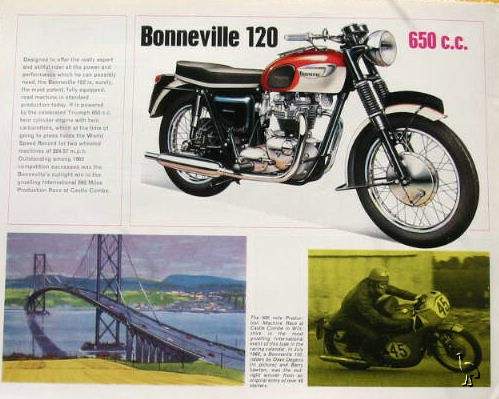
Triumph Bonneville 650 T120R
One of the most famous Triumph models, the Bonneville vertical twin was a high performance bike with tremendous bottom end torque. In 1937 Triumph announced a new bike
that took the world by storm. Designed by the famed Edward Turner, the 500cc
vertical-twinTriumph Speed Twin was so successful that it set a fashion that was
quickly followed by all the other major British manufacturers.
Cycle World Review 1980 by Peter Egan The rain came down in solid sheets, like one of those B-movie monsoons where you suspect they're dumping a watering can in front of the lens. It was the kind of downpour a friend of mine from Texas calls a toadstrangler. Barb and I were waiting it out in an abandoned barn along the road, standing one foot back from the door, perfectly dry. We'd seen the storm coming. Our motorcycle was parked behind us, still making hard plinking sounds as it cooled. The barn smelled like pigeons and burlap dust. The sky didn't promise any sudden change, so we sat down in a corner of the barn and leaned back against the wall and settled back for a long gaze at the motorcycle. I didn't care if it rained all day; I never got tired of looking at the bike. It was a 1967 Triumph Bonneville, burgundy in color, on its maiden post-restoration voyage. We were traveling to a Country-Blues festival in a little Wisconsin town called Arena. Muddy Waters, Luther Allison, and the Ozark Mountain Daredevils were supposed to be there. The radio had been plugging the concert for weeks. Mass quantities of beer and brat-wurst were promised. It all sounded good, but for me the trip was more than just a chance to sit on a grassy hillside, snacking and listening to music. It was the fulfillment of a half-forgotten, leftover dream. And, in some twisted sense, a small private revenge on the likes of Melvin Laird, and a couple of ex-Presidents to boot. Just 10 years late, a mere decade out of synch with the mainstream of American culture, I was finally going to a music festival on a Triumph motorcycle. It had been, in the immortal words of David Crosby, a long time coming. It started in the late Sixties, when I was languishing in college. Back in those days I thought that the three finest things in the world were a Nikon camera, a Martin guitar, and a Triumph motorcycle. (I was trying hard to shun materialism, but hadn't quite got the hang of it.) I was certain that if you could latch on to those three items your earthly needs would be forever complete. Sure, you might need some clothes, a place to sleep, an occasional meal and a few Jack Kerouac novels, but those were all minor, secondary considerations. In this simple material hierarchy the Triumph was important above everything. It allowed you to go to all the right places where you could take pictures with the Nikon and play your Martin guitar, and to properly punctuate those arrivals and exits with a certain romantic flair. It was also important just because it was a Triumph, the best-handling good-looking all-around motorcycle an enthusiast could buy. The machine was a cultural legend. Everyone who knew anything seemed to have a Triumph. Dylan appeared on the cover of Highway 61 wearing a Triumph T-shirt and was reputed in whispers of the Rock grapevine to have been riding a Bonneville at the time of his reportedly terrible, possibly disfiguring accident near Woodstock (?) that may or may not have nearly killed him and ended his career. Arlo Guthrie sat astride a Triumph on the cover of Running Down the Road, and everyone knew that when Arlo said he didn't want a pickle but just wanted to ride his motorsickle, he was talking about his big Twin. Steve McQueen made the national magazines desert-sledding his 650, and even on the screen he chose a thinly disguised Wehrmacht-grey Triumph for his Great Escape (you could hardly expect him to jump a 10 ft. fence into Switzerland riding a BMW and sidecar with armor plate). In the real world of competition and road riding, Triumphs were the universal motorcycles of the Sixties. They were expected to go everywhere and do everything well, just as today's roadburners are not. They won at desert races, flat tracks, en-duros, TTs, Bonneville and Daytona. The great names—Nixon, Elmore, Romero, Castro and dozens of others—all wore leathers emblazoned with that swooping Triumph emblem. With minor changes in pipes, handlebars, carbs and gearing the 500s and 650s could be set up for any purpose. An ordinary, everyday owner expected to be able to use his bike for touring, cowtrail-ing, stoplight drags, or suddenly peeling off a country road to tear across some farmer's field of new-mown hay. Triumphs were not generally transported in pickup trucks; riding started from your garage. If you had a garage. Or a Triumph. Which I did not. I had a Honda CB160. I didn't have a Nikon or a Martin, either. Just a secondhand twin lens reflex camera and a $50 Harmony guitar. I was attending the University and sharing a student-dive apartment with three roommates who did their dishes once a week with a can of Raid. Those were wonderful times. We all lived in a world of grey underwear because we didn't sort colors from whites at the laundromat, and we thought chivalry was hiding old pizza cartons under the sofa when someone's girlfriend came for the weekend. Every night about nine the police cruised by and shot a teargas canister onto the front porch, just as a warning. Next to the typewriter on my desk was a coffee can with a slot in the top, marked Triumph Fund. I was working nights unloading trucks at the Coca-Cola bottling plant and setting aside a share of those earnings for a new cycle. Any Triumph would have been acceptable, but I had settled on a Competition Tiger 500, not only because it was the cheapest of the line, but because it looked like the most versatile. It had a single carb and E.T. ignition, which I imagined would make it easier to tune, and a 500 seemed like a sensible step between my 160 and the ultimate purchase, a Bonneville. But even a 500 cost over a thousand dollars, which represented a lot of truck-loads of Coke bottles in those pioneer days of inflation, and somehow the Triumph fund never grew large enough for even a respectable down payment. It was always being robbed for tuition or going to see Blow-Up for the fifth time. One of my roommates was also working at the Coke plant and saving for a Triumph, with about the same success. The idea was we would buy a pair of them, at some tremendous volume discount, and then take the Ideal Trip to some Rock festival or other celebration against doom. We worked and saved, unloaded bottles and calculated profits, but never seemed to gain much financial ground. Then one day my roommate got lucky. He showed up in the driveway on a nice blue and white T100R; a Daytona. He'd got an absolutely incredible deal on the bike. He bought it from a fraternity boy who had flunked out and was selling off all his luxuries—cowboy boots, Head skis, Four Tops albums, stolen beer steins, etc.—in that timeless ritual of prodigal sons everywhere who return home dishonored and humble. My roommate paid the poor guy just enough for some sack cloth and ashes and a bus ticket East. The Daytona was put to hard use. In the months that followed it made dozens of flat-out runs between Madison and Chicago. My roommate, after a heated phone call with his sometime-girlfriend, would slam down the receiver, hop on his bike, and dash off to Chicago in the middle of the night. When he got there he'd pound on her apartment door and have a terrible fight in the hallway, then ride back home at high speed, arriving at our apartment in the early hours of the morning, completely worn out and looking like frozen Death. Then he'd crash into bed, still wearing his boots and leather jacket, and sleep for about two days. Nothing quite so dramatic was possible on my Honda 160. You could get to Chicago and back with no problem, but the 160 was missing an element of passion and fire-breathing style that only a raucous British Twin could deliver. The Triumph was good theater; it was made for the dashing arrival and the bellowing, angry departure. When you left on one people were supposed to watch you shift off into the distance and think, "That guy's out there somewhere on a Triumph now. I hope he's all right ..." If you rode a 160 they just assumed you were fine, which was no fun at all. The money never fell together for a Triumph. School ended and a slightly desicated lady at the draftboard branded me U.S. Choice. Most of the next two years were spent perspiring, carrying a radio around on my back, and driving a Jeep down tropical roads clogged with Honda 50s and 90s. We all went on a lot of neat hikes and cookouts. It was fascinating, but we missed things that were happening at home and had to enjoy them vicariously through letters and movies. Woodstock and Alice's Restaurant came to camp and were projected on the side of a reinforced concrete latrine with a sandbag roof. (Odd concept, the rocket-proof latrine; even odder when you're in one and Hendrix is playing his unearthly version of the Star Spangled Banner on the other side of the wall.) My ex-roommate kept in touch with letters and told exotic tales of dry socks, air conditioning, and riding his Triumph on country roads—and going to Chicago. He also sent along a color brochure of the new Trophy 500 for 1970, a nice green bike with high double pipes. The brochure was carried around until it finally broke in half from being folded and re-folded. Whenever I got the chance I'd sit down to look at the Triumph picture and reflect on the merits of being out of the Army. It was during those idle moments that the vision gradually formed; a single enduring image which seemed to embrace everything good about civilian life. It came as a recurring dream. It was a scenario in which I was on a motorcycle trip, going it-didn't-matter-where, dressed in clean civilian clothes of my own choosing and seated at a roadside restaurant, drinking coffee and looking out the window at a Triumph motorcycle. That was it; nothing more than a simple daydream. An American still life waiting to happen. But it was winter when I got home, so I bought a car with a heater and snow tires and went back to school. By the time there was money for another cycle the Triumph plant was closed with labour and managementmproblems, British bikes had been eclipsed by new Japanese offerings, and I was lured away by a fast, reliable machine with a lot of cylinders and exhaust pipes. There was no more Triumph fund, and the notion of owning one was allowed to simmer on a back burner. I'd bought a Nikon camera by then, but still didn't own a Martin guitar because you have to play well to deserve one. The Harmless Seventies slipped by, various bikes were bought and sold, and Triumphs became something admired from afar and regarded wistfully when seen on the street. Then last summer I took a weekend motorcycle trip. While passing through a little unmapped bar-and-gas-pump village I spotted an old and very ratty Bonneville leaning on the wall of a defunct garage. I inquired after the bike at some nearby houses, but no one was home. The bar and gas station were closed. I left reluctantly and continued the trip, but all through the next winter visions of that neglected, weatherbeaten Bonneville caused me to toss in my sleep, eat poorly, and lose weight. There were troubled dreams of an old garage with a giant snow drift blown up against the wall and nothing sticking out of it but a chromed clutch lever. In spring I returned to the village. The bike was still there, though it appeared to have been used—the carbs dripped gas and the chaincase was streaked with fresh oil. An old woman was in her yard nearby, watering some flowers clumped around a little windmill. The windmill had a crank and rod arrangement that caused a small wooden lumberjack to drag a saw back and forth over a log. She directed me to the farm of the Bonneville owner, some two miles away, and said the man ran a sawmill. Sawing wood was a big industry in the village. I found the man ripping through some logs at his mill. He shut down the saw to talk to me. Yes, he was interested in selling the bike. Property taxes were coming up. He wanted a lot of money for the Triumph and was not interested in taking less; the bike was worth it, he said. He was right, of course. You don't find country folks any more who have old vehicles and don't know their value—if you ever did. On the contrary, there are farmers who think a Studebaker Lark is worth money. But the myth of the $50 Henderson covered with hay bales is right up there with Babe the Blue Ox. We went back to the village and I took the Triumph for a test ride. Everything was loose, but the bike ran fine. So after a moment of silence for my life's savings I swallowed hard and wrote out a check. We were only 25 miles from the city, so I decided to live dangerously and ride the Bonneville home. Barb drove our Volkswagen. "Follow me, but keep your distance," I advised. "Watch for falling parts and blink your lights if you run over anything." The trip home was my first ride on a Bonneville. As I motored along those country roads the bike struck me as a great bundle of conflict and paradox. It vibrated and surged annoyingly through town in lower gears, but you could drop it into fourth and rumble along on the idle circuit with no commotion at all. And at full chat (a foreign term peculiar to the sound and feel of British bikes) it smoothed out into a rushing, headlong reasonance no more disturbing than the clicking of rails on a fast passenger train. The brakes were terrible, but every time I dived into a corner at unchecked, suicidal speed I discovered there was no cause for alarm; the Triumph heeled over into an easy arc and came out of the corner without flinching. The hand and foot controls felt crude and antique after the velvet-and-Teflon smoothness of those on my Japanese Four, yet the performance of the bike was anything but antique. The speedometer needle touched a surprisingly easy 105 mph as I moved out to put some distance on a gravel-tossing milk tanker. The Bonneville tracked down the road with an uncanny, almost gyroscopic stability at that speed, encouraging you to go faster than 12-year-old maladjusted engines full of dirty old oil ought to go. I got a firm grip on my enthusiasm, slowed down, and made it home without blowing the thing up. Most modern Triumph dealers now handle another line of bikes and sell new models and parts on an order-only basis. But in our small city I found no fewer than four repair shops who welcomed Triumph work and stocked bins of new and used parts. In a few trips I dug up the appropriate tank emblems (missing on mine), primary and drive chains, gaskets, fork seals, gaitors, cables, tune-up parts, and miscellaneous Whitworth nuts and bolts whose standard of measure is the instep of some dead king or the distance between two alehouses; I can't remember which. The rear tire was replaced with a K-81 Dunlop I had lying around, but it didn't look right. Only the original K-70 had the necessary bulk to fill that roomy fender well, so I bought a new one. The front got a new 19-inch ribbed Continental because it looked nearly authentic and someone gave it to me. Original tank knee-pads were unavailable and long-gone everywhere I checked. ("If you find any, let me know where you got 'em.") No one had a paint code for a '67 Bonneville or knew where I might find one. A magazine out of my '67 archives showed a dark burgundy tank, and I finally found a very close match with (Gott in Himmel) a Mercedes Medium Red. The tank looked good in a solid color, so I decided not to spoil it by trying my hand at white accent lines and gold pinstripe to match the old photos. Stripping the tank and sidecovers for painting rivaled the labors of Schliemann unearthing the layered ruins of Troy. The paint revealed a varied past. Beneath the outer coat of flat black primer was a thick layer of metalflake blue, and under that white metalflake with the understated elegance of a sequined bowling shirt. Then came a {California Kandy-apple red overlaid with green pinstripe patterns of trapezoids and triangles with the artist's initials, "J.R.", at the bottom. ("That's Joe Rembrandt," my friend Wargula pronounced without hesitation, "Sam Picasso's cousin."). And on the bottom coat, painted into the original lacquer at the corner of each sidecover, was a small white peace emblem. In three weeks of weekend and late-night fanaticism the Triumph was ready to'roll. With the mechanicals refurbished and the paint nearly dry, we rolled down the.driveway and turned west, in the general direction of the Country-Blues festival. The trip was to be a 300-mile meandering back-country ride that would allow us to visit some friends on a farm, hit the festival, and then circle home. The tank was too wet for a tank bag and a luggage rack was aesthetically out of the question, so we left with our pockets bulging and clanking. Just to be safe, we took enough tools and spares to do a major roadside overhaul; everything but a frame jig and crankshaft lathe. We made it to the end of the block before the Triumph stopped running. The tach cable had pushed the hot wire off the ignition switch. No problem. I rerouted the wire, plugged it in, and we were on our way. Just out of town I smelled gasoline and pulled off the road. We were suffering from that dreaded British ailment, Pet-cock Failure. The brass flare nut was cracked and fuel was hissing onto the hot exhaust. I pulled a tube of silicone sealer and a 7/16 Whitworth from my coat pocket, made an instant O-ring, and everything was fine. There were no other problems on the rest of the trip. The big Twin thundered serenely along twisting valleys, up and down hills, and across bridges without missing a beat. And at one point it absolutely blew the doors off a rallye-equipped Scirocco when the driver foolishly tried to race with us, apparently believing that a pathetic 90 mph would keep us in his dust. "So long, pal," I said, tossing off a Lafayette Escadrille wave as the car became a dancing speck in our mirrors. "This bike had your name on it." The Triumph was made for fast, winding country roads. At right around 70 mph it came into its own and maintained the pace easily, backing down from only the worst curves. I didn't know if it was any faster than my Multi, but it certainly had more grace under pressure. We reached our friends' farm in two euphoric hours; record time. We had a nice evening on the farm, eating, drinking, playing guitars, patting dogs on the head and examining horses. The sky was threatening rain when we left early in the morning and headed south for the music festival. Around 10 o'clock the air became suddenly cool and the wind dropped off to a deathly stillness that could be sensed even on a motorcycle. We got to the old barn just before the storm landed. The old Bonneville was a pleasant object to contemplate on a rainy day—or any other time. It provoked a bad case of XKE Syndrome; impossible to park and walk away from without looking back over your shoulder. It was a simple, clean design with all its elements in harmony. I never looked at it and thought, "Nice bike, except for the gas tank," or, "I'd buy one if I could throw the seat and mufflers away." I couldn't find an offensive piece or a jarring transition of line anywhere on the motorcycle. It seemed, like the DC-3 or the Winchester saddle gun, to be the final product and distillation of everything learned about balance and proportion in the era that preceeded it. Its lines were, as Saint Exuperay once said of a favorite aircraft, not invented but simply discovered. Owners of more modern bikes often commented that you could "see through" the Triumph, or "see what all the parts are for." The starkness and simplicity fostering that impression translate into a unique road feel. At 363 lb. the Bonneville is light for a 650 and carries its weight low in the frame, so that the roll axis of the bike feels to be between your ankles rather than sloshing and lost somewhere in the gas tank. It gives you the odd, anachronistic sensation you are riding a motorbike - a genuine motorized bicycle; a Schwinn paper-boy special with a big hairy engine bolted into the frame - rather than a two wheeled transportation module. Perhaps the heart of the Triumph's appeal lies in the subconscious feeling of eternal wonderment that you are hurtling down the road without having to pedal. The '67 Bonneville's big advantage, of course, is that it was built just before un-elected public servants got into vehicle design. So the Triumph has a front fork unburdened by turn signals, beepers, reflectors, timers, dashboards and idiot lights, which makes the steering light and precise. The tail light, though visible at night, is smaller than a breadbox, and the shift lever is on the right because, bygod, that's where the transmission is. The muffler muffles without strangling (silencer, the British term, is an exaggeration) and the engine has no emission controls to help motorcyclists atone for the past sins of Eldorado owners. But like all machines of character, the Triumph had a few spanners designed into its venerable works. By modern standards, it is not a perfect motorcycle. It suffers from medieval wiring (though at least repairable by anyone with a basic waterpipe concept of electrical flow), an engine with all the well-documented vibratory failings of the vertical Twin, and brakes that make reversing the props on the Queen Mary or recalling the Three Hundred from the Valley of Death seem quick and positive. The clutch plates like to stick together on cool (below 80° F.) mornings, though they can be freed by bumping the bike or jabbing the kick starter with the clutch out. The carbs are sensitive to lean angle and engine heat, and they wear out from their own jittering. (To compensate for carb problems, however, the factory always listed thousands of needle and jet options to help in your personal search for the rhythmic tickover and the light-chocolate electrode.) The rear wheel is installed so that suicide seems a rational alternative to changing a road-side flat (improved, like most of these problems, on later models). And then, of course, the carbs, petcocks, and gaskets tend to seep, further reinforcing a popular belief that the British should never have been allowed to handle any fluid less viscous than chilled window putty. But I knew all these things when I bought the bike. I didn't expect mechanical perfection. If I wanted that, there were plenty of other motorcycles to choose from; machines like Interstate highways - much better than the old roads, but not always as interesting. The Triumph was no four-lane Interstate. It was a twisting country lane with potholes, loose gravel, one-lane bridges and switchbacks. And old barns. The rain ended just before noon. The clouds parted and a shaft of sunlight streamed through the open barn door onto the motorcycle, like some heavenly message from a Charlton Heston epic. The Triumph started, as always, halfway through the first kick, and we were on the road again. The first band had just begun to play when we arrived at the festival. I parked the Triumph under a tree, between a KZ1300 and a GS1000, and we found a comfortable spot to sit on the hillside not far from the stage. We got something to eat and drink, and sat back in the sun. Festivals haven't changed so much in 10 or 12 years, I decided. True, Ken Kesey and the Hog Farm didn't show; Canned Heat was gone forever, and the Airplane was off somewhere being a Starship. But there was a dog who wore a red bandana and caught frisbies in mid-air; a band of jugglers who juggled non-stop all afternoon and evening; a pioneer couple whose blond children ran naked around a VW bus, a smattering of outlaws, a girl who wore a rose in her hat and blew soap bubbles that floated away in the wind, a lone flute player oblivious to the music coming from the stage, a tanned, aging man with a pony tail who did yoga beneath a tree, and a girl in a long dress who danced near the stage by spinning around and around with her arms floating outward until she fell down. We sat next to a man with a wispy satyr beard who smoked a small brass pipe and offered it to everyone who passed, or sat next to him. With the last rays of the sun slanting through the low cloud of blue smoke and dust that only a crowd of several thousand can raise, Luther Allison offered his last song to the memory of Jimi Hendrix and played a half-hour low-down version of Little Red Rooster. We headed home at dusk and rode into
darkness. A fog settled on the river valley, and droplets of water formed on my
face shield and gloves and blew to the side. The headlights of cars were yellow
and vague in the mist, a nice touch at the end of a day in bright sunlight. Half
way home we stopped at a roadside restaurant for a late dinner. We sat at a
window booth where I could look out at the Triumph and sip coffee. "I was just thinking," I said, "That riding well is the best revenge." A lady in the next booth overheard me and snickered, then began to cough and choke on her Bacon-Burger Deluxe. When that was over, she turned in her seat for a look at the person who had uttered this wonderful truth. I stared back and she returned to her dinner. She'd get no apologies from me. I was dead serious. When we got home I picked up my guitar and started to plunk around on it, running through my cheating, half-the-hard-stuff-missing version of Little Red Rooster. In the end I sat up half the night practicing. I figured maybe if I got good enough I'd finally deserve a Martin guitar. Then I'd have everything I needed.
|
|
|
Any corrections or more information on these motorcycles will be kindly appreciated. |