|
|
|
|
Classic Bikes
Custom Bikes
Individual
Racing Bikes AJP
AJS
Aprilia
Ariel
Avinton / Wakan
Bajaj
Benelli
Beta
Bimota
BMW
Brough Superior
BRP Cam-Am
BSA
Buell / EBR
Bullit
Bultaco
Cagiva
Campagna
CCM
CF Moto
Combat Motors
Derbi
Deus
Ducati
Excelsior
Fantic
GASGAS
Ghezzi Brian
Gilera
GIMA
Harley Davidson
Hero
Highland
Honda
Horex
Husaberg
Husqvarna
Hyosung
Indian
Jawa
Kawasaki
KTM
KYMCO
Laverda
Lazareth
Magni
Maico
Mash
Matchless
Mondial
Moto Guzzi
Moto Morini
MV Agusta
MZ / MuZ
NCR
Norton
NSU
Paton
Peugeot
Piaggio
Revival Cycles
Roland Sands
Royal Enfield
Sachs
Sherco
Sunbeam
Suzuki
SWM
SYM
Triumph
TVS
Ural
Velocette
Vespa
Victory
Vincent
VOR
Voxan
Vyrus
Walt Siegl
Walz
Wrenchmonkees
Wunderlich
XTR / Radical
Yamaha
Zero
Video
Technical
Manufacturer List Contact
|
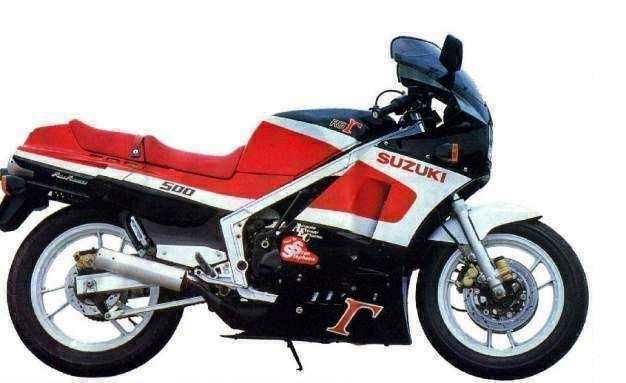
Suzuki RG 500 Gamma
|
| Make Model | Suzuki RG 500 Gamma |
| Year | 1987 |
| Engine | Two stroke, square four cylinder, rotary valve with exhaust port valves |
| Capacity | 498 cc / 30.4 cu in |
| Bore x Stroke | 56 x 50.6 mm |
| Cooling System | Liquid cooled |
| Compression Ratio | 7.0:1 |
| Lubrication | Wet sump |
| Induction | 4 x 28mm Mikuni VM28SH Flatslide carburetors |
| Ignition | Suzuki PEI |
| Spark Plug | NGK, BR9ES |
| Starting | Kick |
| Max Power | 70 kW / 95 hp @ 9000 rpm |
| Max Power Rear Tyre | 61.9 kW / 83 hp @ 10000 rpm |
| Max Torque | 72 Nm / 7.3 kgf-m 53.1 lb-ft @ 9000 rpm |
| Clutch | Wet, cable operated |
| Transmission | 6 Speed |
| Final Drive | Chain, 2.500 (40/16) |
| Primary Drive Ratio | 2.230 (58/26) |
| Gear Ratio | 1st 2.636 (29/11) / 2nd 1.750 (28/16) / 3th 1.380 (29/21) / 4th 1.173 (27/23) / 5th 1.045 (23/22) / 6th 0.956 (22/23) |
| Frame | Steel, double cradle frame |
| Front Suspension | Air adjustable fork with 38mm tubes, adjustable spring preload and anti dive valuing. |
| Front Wheel Travel | 130 mm / 5.2 in |
| Rear Suspension | Shock absorber, adjustable for spring preload |
| Rear Wheel Travel | 126 mm / 4.9 in |
| Front Brakes | 2 x 260 mm Discs, 4 piston calipers |
| Rear Brakes | Single 210 mm disc, 2 piston caliper |
| Front Tyre | 110/90 V16 |
| Rear Tyre | 120/90 V17 |
| Dimensions |
Length 2100 mm / 82.7 in Width 695 mm / 27.4 in Height 1185 mm / 46.7 in |
| Wheelbase | 1425 mm / 56.1 in |
| Seat Height | 770 mm / 30.3 in |
| Ground Clearance | 120 mm / 4.7 in |
| Dry Weight | 156 kg / 339.5 lbs |
| Wet weight | 175 kg / 386 lbs |
| Fuel Capacity | 22 Litres / 5.8 US gal / 4.8 Imp gal |
| Consumption Average | 8.7 L/100 km / 11.5 km/l / 27 US mpg / 32.5 Imp mpg |
| Braking 60 km/h - 0 | 16 m / 52.5 ft |
| Braking 100 km/h - 0 | 39.2 m / 18.6 ft |
| Standing ¼ Mile | 11.2 sec / 193.9 km/h / 120.5 mph |
| Top Speed | 236.4 km/h / 146.9 mph |
| Road Test | Motociclismo |
Knee-draggers the world over have been holding their breath for Suzuki's RG500 Gamma. And when the bike was unveiled at germany's Hochenheim circuit last month, it seemed Suzuki had given them what they want: a synthesis of road bike and grand prix racer. John Nutting was at Hockenheim and he found the RG500 takes it ... CLOSER TO THE LIMIT!
This is the fantasy: convert a competitive 500 cm3 grand prix racer into a road bike. A great fantasy, but turning it into reality is far from easy, as anyone who has ridden the results will testify.
The difference between a hot road bike and a road-racer is so profound that only those who regularly hop between the two camps can really understand the gulf.
Racing machines live in a pampered world in which components are regularly and microscopically scrutinised. Their life is brief at best and only the most foolhardy of mechanics will force extra life out of parts that are due for replacement.
A racer can therefore be delicate and crude compared to its road-going counterpart, which may have to endure months of neglect without failing.
Having ridden road-legal TZ350 Yamahas and RG500 Suzukis I know that they're both evocative and quirky. A machine used to being ridden at speeds rarely below the legal limits is more than a handful when the realities of traffic stops force themselves on the rider, who has to as sume either a leather-like veneer to the difficulties or have an imagination as large as that necessary to conceive such a project in the first place.
But Etsuo Yokouchi, General Manager of Motorcycle Design at Suzuki in Japan, doesn't display any of the usual signs of an individual disposed to placing such fantisies in the hands of the general public.
Slick in gold-rimmed glasses a healthy tan, pastel casuals of the sort normally seen on the golf course, and a willing smile, Yokouchi is the man behind the development of Suzuki's RG500 Gamma road bike, as close a machine as you'll find to Suzuki's grand prix bikes.
Five years ago, just the idea of a major manufacturer offering such a machine would have been laughed at. Too fast, too highly strung, too expensive, not enough buyers.
Yamaha's RZ500 V4 two-stroke changed the climate overnight when it was introduced last year. Suddenly grand prix technology didn't seem so preposterous. But Suzuki was fully aware of what Yamaha was up to. Early during 1983 the plans for the RG500 Gamma had been laid.
If that appears to be a short lead time, it's worth remembering that the first pictures of the smaller 400 cm3 version aimed at the Japanese market appeared early in 1984! But Suzuki was tied up with the development of the GSX-R750 four-stroke and with so much untried technology to iron the wrinkles out of, the RG500 had to be delayed until this year.
But it's been worthwhile. Yokouchi, along with engine designer Haruo lerda and frame specialist Mitsuru Tachikawa, has built a machine that has all the sensations you'd expect of a fully-distilled grand prix bike, but a surprising lack of quirkness.
Sporting motorcycling has recently polarised into two camps. There are those who subscribe to the image of megamuscle as defined by the hot Kawasaki and Suzuki fours with four-into-ones. Italian multies appeal for the same reason. The rapidly growing two-stroke camp hasn't been able to show its hand until recently with the advent of the more overt GP-orientated machines. The Suzuki RG500 is the pinnacle of their desires.
Just reading the RG's specificstions will be enough to get them foaming at the mouth. The RG500 Gamma develops healthy 70 kW (95 bhp) at 9500 rpm from its square four two-stroke engine. Now that's not particularly exciting, particularly as Suzuki's own 1100 cm3 bikes develop 93 kW and the 750 four pumps out 74 kW, until it's learnt that Suzuki claims the bike weighs just 154 kg (340 Ibs) dry!
That's nearly 22 kg lighter than the GSX-R750 and nine kilograms lighter than Honda's contender in grand prix replica stakes, the three cylinder N5400R.
The RG500 doesn't look that light or for that matter, feel it. In the current vogue of the Japanese factories, the bike features a full race-styled fairing with rear bodywork that encloses the upper pair of exhaust pipes and reaches down to the footrests. The RG500 displays a chunky continuity of line that gives only a glimpse of the goingson inside the fairing.
Sitting astride the bike, the rider drops into a semi-racing crouch due in part to the low clip-on handlebars. These, for the first time on a volume production road bike, are clamped to the fork legs beneath the top yoke. The seat is spare and low behind the wedge-shaped fuel tank and the rider's section unlocks to reveal a tiny battery hovering between the rear pair of exhaust pipes, protected by heat reflectors. The footrests are exotic-looking alloy forgings with the minimum of clutter around them.

Three white dials are inside the cockpit, a 250 km/h speedo on the left, a 3000 to 13,000 rev counter dead centre, a temperature gauge on the right and the usual warning lights beneath the tacho. They're mounted in dummy foam. You'll see hardly any chrome on the bike, black or blue being the dominant hue.
Like the RZ500, the kick-start lever is on the right. But it is much longer and tucks easily into the fairing. The choke lever is mounted into the left switch console but unlike the race bikes which have four throttle cables, one for each carburettor, the road bike has a single cable with a junction box.
Starting is easy enough, but the Japanese mechanics at the launch at Hockenheim in Germany were checking that all four cylinders were firing before letting the bike go. It runs on hottish B9HCS NGK plugs which could oil up before the watertemperature rises.
At tickover the RG500 has less of the rattly sound of the RZ500 and there's a good reason for that. The Gamma's engine layout is identical to those being used in the racers currently being campaigned by Rob McElnea, Sito Pons and Franco Uncini. In effect it has two parallel twin twostroke engines geared between the cylinders to a countershaft which then drives the clutch. Whereas the racers have straight-cut gears for the clutch the roadster has quieter helical gears. Also the engine, by having opposing pairs of pistons firing together, has a smoother delivery than the 50-degree vee-four layout of the Yamaha that requires a balance shaff to smooth the offset pulses.
Clutch lever action is slightly heavy and initially the RG500's steering feels heavy too, despite the 16-inch front wheel and 'quick' geometry. The engine makes a muted drone and response to the throttle is neither startling nor impressive, having the muted moped note we've come to expect from all the latest high performance twostrokes at low revs.
The six-speed gearbox's action is positive, as you'd expect from the first cousin of a racer, and those first few tentative yards of the Hockenheimring will be remembered as the time when I didn't know a completely new experience in motorcycling was in store for me.
First lap on a new bike is always exploratory, but the way in which the Suzuki beguiled me into letting it loose was a shock. Above 5000 rpm the motor becomes almost totally smooth and the deep drone from the four pipes turns into an unholy howl that still sends shivers up my back when I recall it.
The motor uses the same type of disc inlet valves with slim sidefacing Mikuni carbs as on the racers, a design that appears to have been upstaged by the reedvalve motors favoured by Honda and Yamaha in their GP racers. But it does help tractability in a two-stroke along with torque and fuel consumption.
The RG500 is reckoned to develop around 140 kW per litre. That level of power comes from adopting the same seven-port cylinders as the racer but with steel liners which allow rebores. Bore and stroke are 56 x 50.6 mm and the cranks run on four bearings apiece, giving a durability that has allowed the race motors to go 2000 kilometres between crank rebuilds.
Big power in a two-stroke is the result of the various resonances in the exhaust pipes, inlet system and porting chiming together. In a racer a 2000 rpm power band is acceptable, but it would be unmanageable on the road. So Suzuki, along with most other two-stroke manufacturers, has adopted methods of making the delivery less frantic.
Suzuki's is called Automatic Exhaust Control (SAEC) and like Honda's ATAC system it adds a small volume to the exhaust pipes below certain revs. The additional volume, in the shape of a chamber cast into the cylinder and head, fattens the power curve at low revs at the expense of top end power. By means of a rotating valve controlled by a servo, the engine can give peaky power at top revs without losing torque lower down.
It works a treat on the RG500, the engine chiming in from 7000 rpm usefully but still coming on strong from there on.
Then comes the shock. Instead of switching off at the 10,000 rpm red line as you'd expect, the RG500 just keeps on reving to 12,000 rpm. You'd expect that in the gears but it still went to 11,500 rpm in top. And that's when it crossed my mind that the bike seemed to be going incredibly quickly. The speedo said 255 km/h (about 145 mph) but the rev needle told another story. Either Suzuki's engineers were pulling the collective plonkers of the bureaucratic minds who thought up the 73 kW limits in Europe or this really was a new type of machine.
The way the RG500 hugged the track suggested a new dimension too. The GSX-R750's 225 km/h on the Ryoyo test track in Japan was quite undramatic but then there were all the usual cues such as noise and vibration.
The RG500 is uncanny at speed. There's barely any vibration and wind is enough to draught the exhaust noise away from the rider tucked inside the fairing.
Yokouchi was asked why the engine reved so hard. He said that the power was flat from 9500 upwards. If that's the case then he's found a new secret for broadening two-stroke power that noone's ever though of.
The Suzuki's chassis is better at speed than the 750's but still needs skilful rider control to maintain equilibrium, just as you find on racers. It has the same aluminium duplex layout as on the 750 but with a larger casting for the steering head. It incorporates the air filter and the older style of Full Floater rear suspension with a rocker arm above the single shock which can be adjusted for spring preload by means of a remote adjuster.
Slight instability in a bike like the RG500 is usually allied to brilliant cornering ability and on the smooth curves of the track's arena section there wasn't much wrong with the machine's roadholding. Suzuki had fitted fat Michelin A48/M48 tyres, a choice that had surprised the riders who'd remembered the original queasiness of the rubber at the edge of the tread. We needn't have worried because these are a new design in 110/90V16 and 120/90V17 sizes that suited the Suzuki well.
Brakes are similar to those used on the GSX-R750 with four-piston opposed calipers, but the smaller front discs (260 mm instead of 300 mm) that float on the wheel mountings needed more lever pressure. The small rear disc has a torque arm connected to the frame to minimise hopping at the rear, but the front stoppers have enough bite to allow the rear disc to be used simply to keep the back end in line.
Gauging the potential of a machine like the RG500 on the basis of a track test as brief as mine is risky at best. But a few things are obvious. The bike is miles quicker than the RZ500 or the NS400R though its handling may give away a mite to the Honda triple for all its lighter weight.
It's more refined than the Yamaha and feels less like the gnarly two-stroke of the past. At least it doesn't overheat the rider.
It may even be better overall than the GSX-R750, though that would disappoint the Suzuki top-brass who want to place all their racing cards in the four-stroke camp.

Some opinions suggest that Suzuki still doesn't see a future for its bikes in GP racing. It looks more at endurance and Formula One events. That's reinforced by the lack of any race kit to bring the RG500 up to the full spec for open racing.
In the meantime, the RG500 is bound to give everything else the runaround in 500 cm3 production racing - even without tuning.
The RG500 Gamma engine is an almost exact copy of the units that were first raced in RGB form by Barry Sheene in the late 1970s. It is a stepped square-four two-stroke with disc inlet valves and sidefacing carburettors, a layout that oftered the most compact engine for the power.
In road form it develops just six kilowatts less than the model which carried Barry Sheene to his two 500 world championships in 1977 and 1978.
The four water-cooled cylinders are arranged in a square above two crankshafts with the pistons set at 180 degrees to each other so that they fire in opposite pairs, giving perfect mechanical balance.
Drive is taken from between the crank throws by large spur gears to a countershaft. The shaft takes the drive across the cases to the right side where helical gears connect to the wet, multi-plate clutch.
The crankcase is split across the crankshaft centre lines but the gearbox can be removed without disturbing the cranks by means of removing a cover. With the cover comes the main and layshafts along with the shifter drum, kick starter and gear change mechanism.
The generator, in its separate casing, is mounted on the left hand end of the countershaft. Ignition pickups are set into the cases and are triggered by notches in the crank. At either outer end of each of the crankshafts a disc valve controls the inlet timing from the narrow flat-slide 28 mm Mikuni carburettors. These are slim (36 mm from face to throat) both for compactness and better power.
Disc valve intake control has been favoured by Suzuki, and in the sixties and seventies by Yamaha and MZ, as a means of obtaining better peak power and spread by exploiting assymetric timing, so preventing blow back through the carbs as the pistons fall.
Recent developments in reed valve technology has closed the gap and the best reed GP engines can better the Suzukis at the top end. Sito Pons' Suzuki was still the second fastest to Spencer's veefour Honda in Yogoslavia, so it can't be far down on power.
To allow high peak power without sacrificing mid-range the RG500 uses power chambers (SAEC) on each cylinder above the exhaust port.
With the power chamber connected to the exhaust port the resonant characteristics of the exhaust pipes give good mid range but poor top end. With the power chamber disconnected by the barrel valve, the peak power is good but there's only poor mid range.
So the power chamber is only connected below 7500 rpm to give the best of both worlds. A control unit that monitors engine revs rotates the barrel valves by Bowden cables.
The RG500's frame is similar to the GSX-R750's in that it uses square section light alloy tubing with reinforced corners. Main difference in the frame layouts is that the 500 has a massive steering head casting at the front that doubles as the six-litre air box and air filter container. Main advantage of the frame is its simplicity, resuiting in a lighter structure.
Rear suspension is by rocker arm system to the vertical shock, a method that has been superceded by the GSX-R750's and 250 Gamma's cam rocker arrangement. Up front the forks have air valves and spring preload ajusters and a progressive anti-dive system.
Brakes are the four-piston caliper Deca type seen on the 750 front end but this time enhanced by floating discs on the wheel. The smaller rear disc piston caliper with a torque arm connected to the frame to give a floating action.
Equipment includes a maintenance-free battery and white-faced instruments, the centrally mounted tacho red lined from 10,000 to 13,000 rpm.
Claimed peak power of the RG500 is 70.8 kW at 9500 rpm. But the unit would rev cleanly to 12,000 in the gears and even over 11,000 in top gear. Engine designer Harur, Terada said that though the power peaked at 9500 it was essentially the same through to 12,000 rpm. So the effective delivery is far more stunning than usual.
Ally that to a machine weighing just 154 kg dry and you've got all the elements of a giant killer.
Gallina: It's A Close Copy ROBERTO Gallina, the Italian boss of the HB-Suzuki Grand Prix team, was surprised at how closely the RG500's engine mimicked the units raced by Sito Pons and Franco Uncini.
"This is the first time I've seen the engine since its prototype stage " he said at the Hockenheim launch, "but it's almost identical.
"Of course the crankcases on the racer are magnesium and we use crankshafts with larger bearings and supports, but otherwise the RG500 looks just like the XR7O.
"The cylinders have the same seven ports (but with steel liners) and the exhaust power chambers look the same. The racer has the facility to change the volume of the ???? ed,the timing so that we can tune the engine to each circuit - the control system is the same though.
"The narrow carburettors are the key to good power on a disc valve engine," said Gallina, "and the connection between the intakes boosts the throttle response at low revs."
Otherwise the only other changes for road use on the RG500 are the addition of a ramp-type shock absorber on the countershaft connecting the two crankshafts and the use of a kick-start mechanism. The six-speed cassette-type gearbox offers the same opportunity as on the racers to change ratios easily after the clutch has been removed and the inner cover is unbolted. Also, the road RG500 has an oil pump to lubricate the crankshaft and cylinders.
There isn't an engine for road use that comes closer to a Grand Prix motor.
Source 1985
|
Any corrections or more information on these motorcycles will be kindly appreciated. |